
Correction of Skeletal Class II Malocclusion with Powerscope
A B Shetty Memorial Institute of Dental Science, Mangalore
ABSTRACT
A 16 year old growing female patient reported with the chief complaint of forwardly placed upper front teeth. The case was diagnosed to be skeletal class II due to a retrognathic mandible. Since the patient was in the growing phase, two phase treatment was planned .The 1st phase comprised of mandibular advancement using ‘Powerscope’- a fixed functional appliance. The final finishing and detailing was achieved in the 2nd phase of treatment using .022 MBT prescription.
INTRODUCTION
Class II division 1 malocclusions with mandibular deficiency have been treated for more than a century with different types of functional appliances. It has been suggested that maxillary, mandibular and dental morphologies have an indirect effect on the the perception of facial beauty. Therefore, one of the goals of functional treatment is to attain a straighter profile from a retrognathic one. It has been shown that fixed functional appliances enhance mandibular growth and that they tend to produce a more horizontal condylar growth compared with removable functional appliances.1 They have the advantage of not requiring patient compliance and can also be used concurrently with brackets.1
CASE REPORT
A 16 year old growing female patient reported to our department of Orthodontics and Dentofacial Orthopedics with the chief complaint of forwardly placed upper front teeth.
On extraoral examination patient had a brachycephalic head type and a leptoprosopic facial type. She had a straight profile with a slight anterior divergence and retrusive mandible. She had competent lips with a slightly negative lip step and a deep mentolabial sulcus.
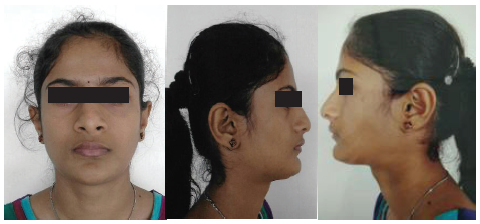
PRETREATMENT EXTRAORAL PHOTOGTRAPHS
On intraoral examination molar and canine relation was angle’s class II, incisor relationship was also class II div 1 with an overjet of 7.5 mm and overbite of 3.5 mm, mesiobuccal rotation w.r.t. 12, 16, 26 and distobuccal rotation w.r.t. 35. Mild crowding was present. Lower incisors were moderately flared. Midlines are coinciding.
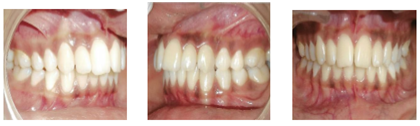
PRETREATMENT INTRAORAL PHOTOGRAPHS
On cephalometric analysis, ANB was 50 (SNA= 810 SNB= 760) and Wits appraisal was 3.5mm indicating skeletal class II relation.
DIAGNOSIS
Growing female patient with skeletal Class II relationship, horizontal growth pattern with retrognathic mandible
TREATMENT OBJECTIVE
- To obtain skeletal class I relationship
- To achieve class I molar and canine relation with optimum overjet and overbite
- Derotation of 12, 16, 26, 35.
- To achieve optimal facial balance and aesthetics
TREATMENT PLAN
Two phase therapy was finalized for the patient 1stphase: growth modulation using powerscope.
Initial alignment with mild expansion of upper arch. It was planned to use a growth modulation (powerscope) appliance to advance the retruded mandible.
2ndphase: PEA- .022 MBT bracket Levelling of curve of spee by supraeruption of lower posterior teeth. Root paralleling and settling.
1ST PHASE
Noncompliance has been a concern in orthodontics for more than 40 years. A number of fixed appliances have gained popularity in recent years to help achieve better results in noncompliant patients. One of such innovations is powerscope, which is a hybrid appliance for the correction of mild skeletal class II in noncompliance patients. This appliance addresses critical needs of the orthodontists, including patient comfort and acceptance, extensive range of motion and simple installation. Powerscope also has the advantage of permitting lateral movements due to exclusive ball and socket joints and typical telescopic mechanism is also advanced feature, unlike other class II correctors, there is no need for assembly measuring or appliance manipulation. This wire-to-wire device delivers unmatched patient comfort and eliminates the need for headgear tubes or special band assembles2.
Powerscope is a hybrid and rigid appliance designed to correct class II malocclusion in growing patients. Powerscope has the ability to treat the following types of cases: class II correction with dentoalveolar compensation of occlusion, class II division 1 malocclusion, class II division 2 malocclusion, unilateral correction of class II, asymmetric cases- midline correction4.

POWERSCOPE PICTURE (COURTESY4)
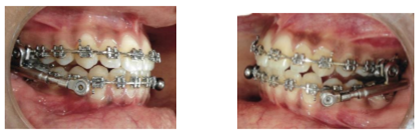
INTRAORAL PHOTOGRAPHS OF POWERSCOPE
END OF GROWTH MODULATION

INRAORAL PHOTOGRAPH
2NDPHASE(PEA APPLIANCE)
Non extraction treatment with fixed mechanotherapy using .022 slot MBT bracket system

ANTERIOR BITE PLATE FOR MOLAR EXTRUSION MOLAR PROTRACTION

POST TREATMENT EXTRA-ORAL PHOTOGRAPHS

POST TREATMENT INTRAORAL PHOTOGRAPHS
POST TREATMENT OUTCOME
The post treatment intraoral photographs show the proper alignment of upper and lower arch with proper intercuspation and the extraoral photograph reveals harmonious profile of the patient. The treatment results shows significant improvement in patient’s stomatognathic system with best possible aesthetics and function.
REFERENCES
- Carlos Flores-Mir, Michael P. Major, Paul W. Major. Soft tissue changes with fixed functional appliances in class II division 1. Angle orthod 2006;76:712-720.
- Nishanth B, Gopinath A, Ahmed S, Patil N, Srinivas K, Chaintanya A. Cephalometric and computed tomography evaluation of dentoalveolar/ soft tissue change and alteration in condyleglenoid fossa relationship using the PowerScope: A new fixed functional appliance for class II correction – A clinical study. Int J Orthod Rehabil 2017;8:41-50.
- Alexander Moro. Simplified correction of class II using powerscope. Clinical Orthodontics 2016.
- Orthodontic treatment of the class II noncompliant patient. Moschos A. Papadopoulos. 1st edition.
Disclaimer from Guident
The views and opinions expressed in articles published in Guident are solely those of the authors and do not necessarily reflect the views of the editors, the editorial board or the publisher, Ivory India. Guident does not endorse any product, technique or treatment described. Clinical content is intended for qualified dental and medical professionals and is not a substitute for individual clinical judgement. Guident, its editors and the publisher accept no liability for any consequence arising from the use of information published in the journal.
How to cite this article
Dr. Sakshi Dr. M.N Kutappa Dr. Krishna Nayak US Department of Orthodontics and Dentofacial Orthopedics. Correction of Skeletal Class II Malocclusion with Powerscope. Guident. 2018 Feb;11(3). Available from: https://ivoryindia.in/articles/orthodontics/correction-of-skeletal-class-ii-malocclusion-with-powerscope.html


