Esthetic Correction of Dental Malalignment Using Invisalign: A Clinical Case Report
Wisdom Dental Clinics ®, Jaipur, India
ABSTRACT
Invisalign is a clear aligner system that provides an esthetic, comfortable, and effective alternative to conventional fixed orthodontic appliances for the correction of dental malalignment. Customized removable aligners, fabricated using advanced three-dimensional digital treatment planning and software, enable controlled, precise, and predictable tooth movement while improving patient comfort, oral hygiene, and treatment acceptance. This case report describes the successful correction of dental malalignment using Invisalign clear aligners in a growing patient.
KEYWORDS: Invisalign, Digital Orthodontics, Esthetic Dentistry
INTRODUCTION
Orthodontic treatment aims to achieve ideal tooth alignment, functional occlusion, improved facial esthetics, and long-term stability. Conventional fixed orthodontic appliances have long been considered the gold standard for correcting dental malalignment and malocclusion; however, many adolescent and adult patients hesitate to undergo treatment because of the unaesthetic appearance, difficulty in maintaining oral hygiene, dietary restrictions, and discomfort associated with metal braces. The increasing demand for esthetic and patient-friendly orthodontic treatment has led to the widespread adoption of clear aligner therapy.1,2
Invisalign is one of the most widely used clear aligner systems. It employs a sequence of customized, removable thermoplastic aligners fabricated using three-dimensional digital technology. Each aligner is designed to deliver controlled and predetermined orthodontic forces, producing gradual tooth movement while maintaining patient comfort. The digital workflow allows clinicians to visualize treatment outcomes before initiating therapy, improving treatment predictability and patient acceptance.2,3
Recent advancements in digital intraoral scanning, virtual treatment planning, optimized attachments, and aligner materials have expanded the scope of Invisalign treatment. Dental malalignment, rotations, spacing, deep bite, crossbite, and selected Class II and Class III malocclusions can now be managed effectively with clear aligners. Success depends on accurate diagnosis, appropriate case selection, meticulous treatment planning, and excellent patient compliance.3,4
CASE REPORT
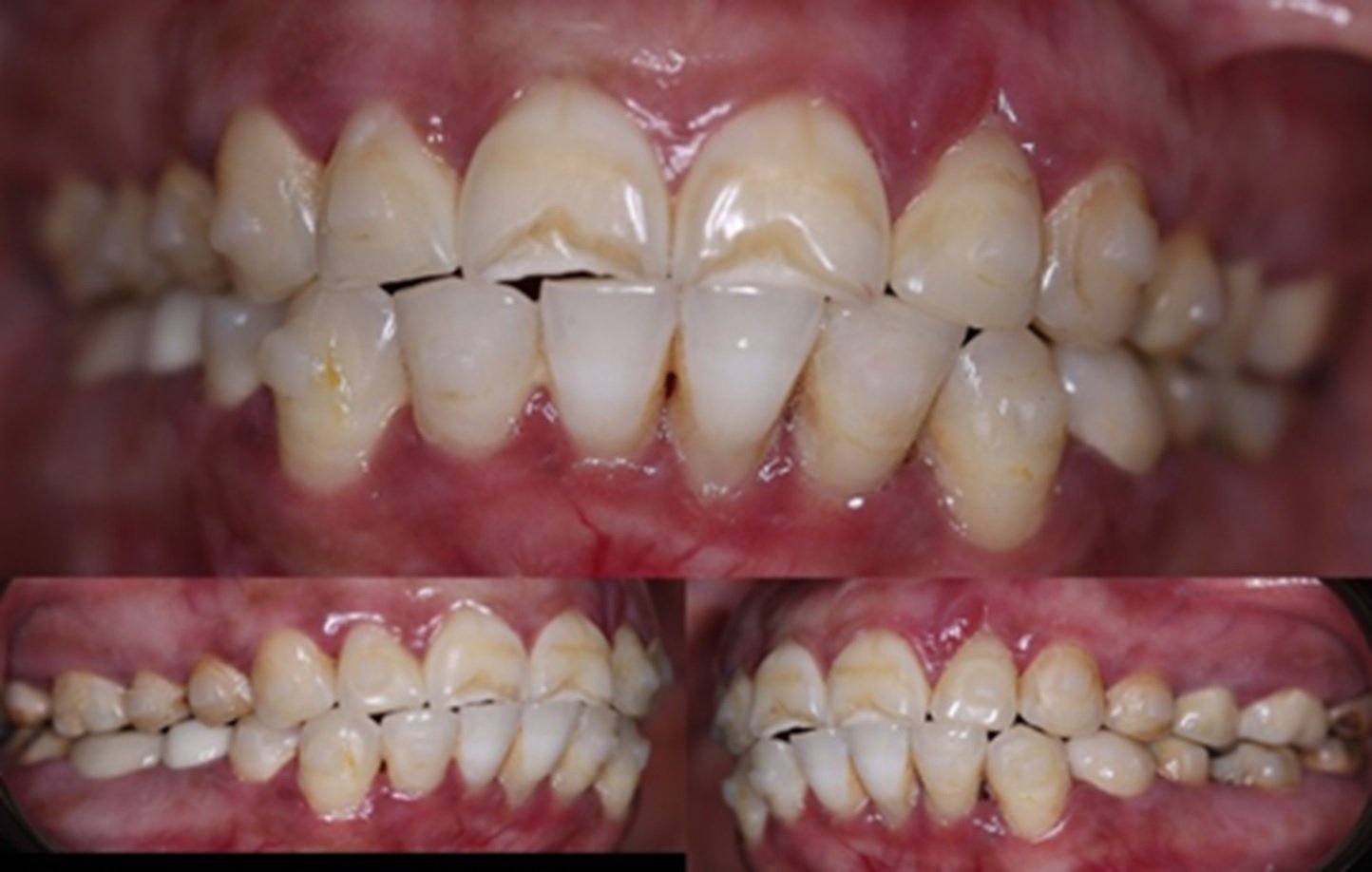
A 13-year-old male patient presented to the clinic with the chief complaint of irregularly aligned teeth and dissatisfaction with his smile aesthetics. Clinical examination revealed moderate-to-severe crowding in both the maxillary and mandibular arches with malalignment of the anterior teeth and compromised occlusal relationships. [Figure 1]

Figure 1:Pre-Operative photos
The patient was informed in detail about the available treatment options, including conventional fixed orthodontic appliances (braces) and clear aligner therapy (Invisalign), along with their advantages, limitations, treatment duration, and expected outcomes. After discussion of both treatment modalities, the patient elected to proceed with Invisalign treatment primarily due to esthetic considerations and the desire for a less visible orthodontic appliance.
Prior to initiation of orthodontic therapy, a comprehensive oral examination was performed, followed by full-mouth scaling and professional cleaning to establish optimal periodontal health. Digital impressions of both arches were obtained using an intraoral scanner and electronically transmitted to the laboratory for fabrication of a customized series of Invisalign aligners. The patient was informed in detail about both conventional fixed orthodontic treatment and clear aligner therapy, including their respective advantages, limitations, and expected outcomes.
After discussing the available options, the patient elected to undergo Invisalign treatment because of its superior esthetic appearance and greater comfort during daily activities. A virtual treatment plan was developed to achieve correction of crowding, alignment of both arches, improvement of overjet and overbite, and establishment of functional occlusion. Based on the approved digital setup, a total of 55 sequential aligner sets were fabricated. The patient was instructed to wear the aligners for approximately 20–22 hours per day.
Progress was monitored remotely through the Invisalign portal, where the patient uploaded intraoral photographs on a weekly basis. These photographs were reviewed by Dr. Gaurav Gupta and only after clinical assessment and approval through the portal was the patient instructed to proceed to the next aligner in the series. This protocol allowed close monitoring of tooth movement, ensured treatment progression according to the digital plan, and enhanced patient compliance throughout therapy.
Throughout treatment, progressive alignment of the dentition was achieved through controlled orthodontic tooth movement. The clear aligners effectively corrected the crowding, improved arch coordination, and established a more favorable occlusal relationship. Patient compliance was excellent, and no significant periodontal or treatment-related complications were observed. Post-treatment records demonstrated marked improvement in dental alignment, smile symmetry, and overall facial aesthetics. The severe crowding present before treatment was successfully resolved, resulting in well-aligned maxillary and mandibular arches with satisfactory overjet, overbite, and intercuspation. [Figure 2]

Figure 2: Post treatment photos
DISCUSSION
Invisalign has become an increasingly popular alternative to conventional fixed orthodontic appliances because of its superior esthetics, comfort, and convenience. Unlike traditional braces, clear aligners can be removed during eating and oral hygiene procedures, allowing patients to maintain better periodontal health while minimizing plaque accumulation and gingival inflammation.2,3,7
Advances in digital treatment planning, optimized attachment design, SmartTrack material, and computerized force delivery have significantly improved the predictability of Invisalign® therapy. These developments have expanded its ability to manage dental malalignment, rotations, spacing, and selected malocclusions with favorable clinical outcomes.3,4
Patient compliance remains one of the most important determinants of successful clear aligner therapy. Since aligners are removable, treatment success depends on wearing them for approximately 20–22 hours daily. Weekly monitoring through the Invisalign portal further enhances treatment predictability and ensures proper aligner tracking.5,6
In the present case, accurate diagnosis, digital treatment planning, weekly remote monitoring, and excellent patient cooperation resulted in successful correction of dental malalignment, improved functional occlusion, and excellent smile esthetics. The patient expressed high satisfaction with both the treatment process and the final outcome, emphasizing the effectiveness of Invisalign for appropriately selected cases.1,4,7
CONCLUSION
Invisalign clear aligner therapy provides an effective, predictable, and esthetic approach for the correction of dental malalignment. Digital treatment planning, customized aligners, optimized biomechanics, and regular monitoring contribute to successful clinical outcomes. Careful diagnosis, appropriate case selection, meticulous treatment planning, and patient compliance remain the key factors for successful Invisalign treatment. This case demonstrates that Invisalign can effectively correct dental malalignment while providing excellent esthetic and functional results with high patient satisfaction.
REFERENCES
- Boyd RL. Complex orthodontic treatment using a new protocol for the Invisalign appliance. J Clin Orthod. 2007;41(9):525-547.
- Rossini G, Parrini S, Castroflorio T, Deregibus A, Debernardi CL. Efficacy of clear aligners in controlling orthodontic tooth movement: A systematic review. Angle Orthod. 2015;85(5):881-889.
- Papadimitriou A, Mousoulea S, Gkantidis N, Kloukos D. Clinical effectiveness of Invisalign orthodontic treatment: A systematic review. Prog Orthod. 2018;19:37.
- Kravitz ND, Kusnoto B, Begole E, Obrez A, Agran B. How well does Invisalign work? A prospective clinical study evaluating treatment effectiveness. Am J Orthod Dentofacial Orthop. 2009;135(1):27-35.
- Weir T. Clear aligners in orthodontic treatment. Aust Dent J. 2017;62(Suppl 1):58-62.
- Phan X, Ling PH. Clinical limitations of Invisalign. J Can Dent Assoc. 2007;73(3):263-266.
- Ke Y, Zhu Y, Zhu M. A comparison of treatment effectiveness between clear aligner and fixed appliance therapies. BMC Oral Health. 2019;19:24.
Disclaimer from Guident
The views and opinions expressed in articles published in Guident are solely those of the authors and do not necessarily reflect the views of the editors, the editorial board or the publisher, Ivory India. Guident does not endorse any product, technique or treatment described. Clinical content is intended for qualified dental and medical professionals and is not a substitute for individual clinical judgement. Guident, its editors and the publisher accept no liability for any consequence arising from the use of information published in the journal.
How to cite this article
Dr. Gaurav Gupta, Dr. D.K. Gupta, Dr. Anirudh Agarwal. Esthetic Correction of Dental Malalignment Using Invisalign: A Clinical Case Report. Guident. 2026 Aug;19(9). Available from: https://ivoryindia.in/articles/orthodontics/esthetic-correction-of-dental-malalignment-using-invisalign-a-clinical-case-report.html