Orthodontic Correction of Class III Malocclusion Using Invisalign Therapy in an Adolescent Patient: A Case Report
Wisdom Dental Clinics ®, Jaipur, India
ABSTRACT
Class III malocclusion is one of the most challenging orthodontic conditions because of the involvement of skeletal, dental, and functional components. The present case report describes the successful correction of mild skeletal and dental Class III malocclusion in an adolescent patient using Invisalign clear aligner therapy. Treatment was carried out using sequential aligners combined with Class III elastics and digital treatment planning. Favorable correction of anterior crossbite, improvement in overjet and overbite, proper alignment of both arches, and enhanced smile esthetics were achieved. This case highlights the effectiveness and predictability of clear aligner therapy in carefully selected Class III malocclusion patients with good compliance.
KEYWORDS: Class III malocclusion, Invisalign therapy, orthodontic camouflage
INTRODUCTION
Class III malocclusion is a complex dentofacial anomaly characterized by a mesial relationship of the mandibular dentition relative to the maxillary dentition. It may occur due to maxillary deficiency, mandibular prognathism, or a combination of skeletal and dental discrepancies. Clinically, patients often present with anterior crossbite, negative overjet, functional mandibular shift, and compromised facial esthetics. The etiology of Class III malocclusion is multifactorial and includes genetic, environmental, and functional factors. Genetic predisposition is considered a major contributing factor, especially in skeletal Class III cases associated with mandibular prognathism. Functional abnormalities such as tongue posture, airway problems, and occlusal interferences may also influence the development and progression of the malocclusion.1
Early diagnosis and intervention are important because untreated Class III malocclusion may worsen during the pubertal growth period. Orthodontic treatment in growing patients can improve dentoalveolar relationships, reduce functional disturbances, and enhance facial esthetics. Conventional treatment options include reverse pull facemask therapy, chin cup appliances, fixed orthodontic treatment, extraction therapy, and orthognathic surgery in severe skeletal discrepancies.2
Fixed orthodontic appliances have traditionally been considered the gold standard for correction of complex malocclusions because they provide excellent control over tooth movement. However, many adolescent patients are reluctant to undergo treatment with fixed braces due to poor esthetics, discomfort, soft tissue irritation, and difficulty in maintaining oral hygiene. Invisalign clear aligner therapy has revolutionized modern orthodontics by providing a removable and nearly invisible alternative to fixed appliances. Advances in aligner biomechanics, attachment design, and digital treatment planning have expanded the scope of Invisalign therapy to include more complex malocclusions.3
Recent studies have demonstrated that Invisalign therapy can effectively treat mild to moderate Class III malocclusion cases using dentoalveolar compensation and sagittal correction mechanics. The use of optimized attachments, intermaxillary elastics, precision cuts, and sequential tooth movement allows clinicians to achieve improved occlusal relationships and satisfactory esthetic outcomes. Clear aligners offer several advantages including improved esthetics, enhanced patient comfort, better periodontal health, reduced plaque accumulation, and easier oral hygiene maintenance compared with fixed orthodontic appliances.4
The present case report describes the successful management of mild skeletal and dental Class III malocclusion in an adolescent patient using Invisalign therapy combined with Class III elastics.
CASE REPORT
A 19-year-old female patient reported to the clinic with the chief complaint of irregularly arranged teeth and dissatisfaction with smile appearance. The patient was particularly concerned about the visibility of conventional braces and requested an esthetic orthodontic treatment option that would not interfere with daily activities, social interactions, and school life.
Extraoral examination revealed a mildly concave facial profile with competent lips and acceptable facial symmetry. The patient demonstrated normal mandibular movements without any signs or symptoms of temporomandibular joint dysfunction. Smile analysis revealed reduced smile esthetics due to anterior crossbite and irregular alignment of anterior teeth. [Figure 1]

Figure 1: Extraoral examination
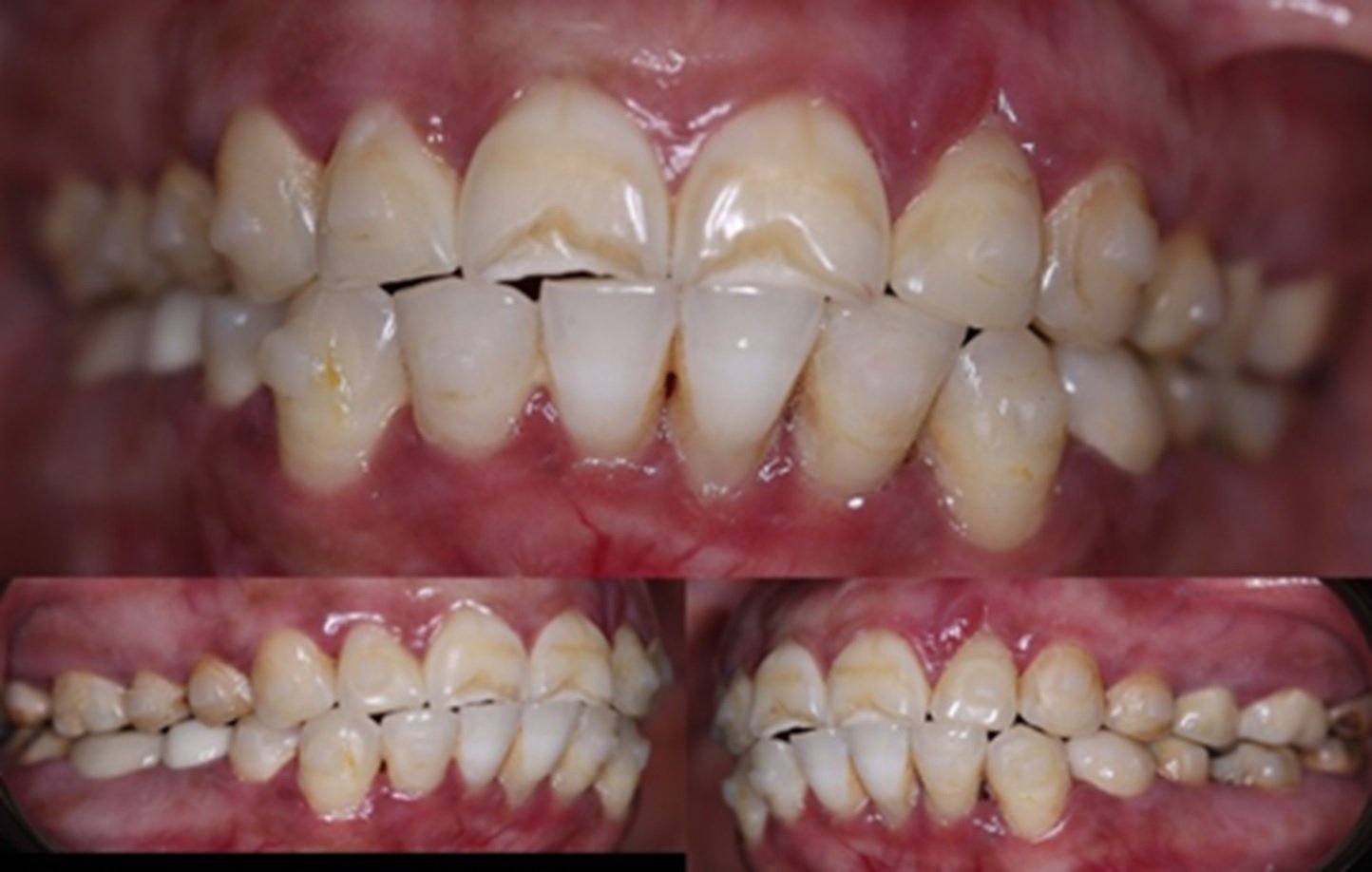
Intraoral examination demonstrated bilateral Class III canine relationship, anterior crossbite involving the maxillary incisors, negative overjet of approximately 2 mm, and mild mandibular anterior crowding. The overbite was approximately 20%. Maxillary arch constriction and mild lower anterior rotations were also noted. Oral hygiene status was satisfactory with healthy periodontal tissues.


Figure 2: Intraoral examination
Pretreatment cephalometric analysis showed a mild skeletal Class III relationship with acceptable vertical proportions. The ANB angle was slightly negative, indicating a mild sagittal discrepancy between the maxilla and mandible. Maxillary incisors were retroclined while mandibular incisors showed mild proclination. Panoramic radiographic examination revealed complete permanent dentition with no evidence of pathology, root resorption, or impacted teeth. [Figure 3]

Figure 3: OPG and cephalogram
Based on clinical and radiographic findings, the case was diagnosed as mild skeletal and dental Class III malocclusion with anterior crossbite and mild mandibular crowding. The primary treatment objectives included correction of anterior crossbite, achievement of positive overjet and ideal overbite, alignment and leveling of both arches, establishment of functional occlusion, improvement in smile esthetics, and maintenance of periodontal health throughout treatment.
Considering the patient’s esthetic demands, favorable growth pattern, and mild skeletal discrepancy, Invisalign clear aligner therapy was selected as the treatment modality. Digital impressions were obtained using an intraoral scanner, and treatment planning was performed using ClinCheck software.
The treatment plan involved sequential alignment, mild maxillary arch expansion, mandibular anterior interproximal reduction, controlled proclination of maxillary incisors, and use of Class III elastics to improve sagittal correction. Optimized attachments were placed on premolars and canines to improve aligner retention and facilitate controlled tooth movement.
The patient was instructed to wear aligners for 20–22 hours daily and replace them every 7 days. Class III elastics were prescribed to be worn consistently throughout treatment. Regular follow-up visits were scheduled every 6 weeks to evaluate treatment progress, monitor oral hygiene, and reinforce patient compliance.
Progressive correction of anterior crossbite and improvement in overjet were observed during treatment. Significant improvement in alignment and occlusal relationships was noted after approximately 5 months of therapy. Positive overjet was achieved by the eighth month of treatment. Refinement aligners were subsequently prescribed to improve intercuspation, final detailing, and occlusal settling. The total treatment duration was approximately 14 months. [Figure 4]

Figure 4: During treatment
Final records demonstrated satisfactory occlusal relationships, improved smile esthetics, proper alignment of both arches, and positive overjet and overbite. Bilateral Class I canine relationship and functional occlusion were achieved. The patient expressed high satisfaction regarding esthetics, comfort, and convenience of Invisalign therapy.
Post-treatment cephalometric analysis demonstrated improvement in dentoalveolar relationships and incisor inclination. Vacuum-formed retainers were delivered, and the patient was instructed regarding long-term retention and follow-up care. [Figure 5]

Figure 5: Post-treatment photographs
DISCUSSION
Management of Class III malocclusion remains one of the most challenging areas in orthodontics because of the variability in skeletal and dental components associated with the condition. Successful treatment requires accurate diagnosis, growth assessment, and appropriate treatment planning. Conventional treatment approaches for Class III malocclusion include orthopedic appliances, fixed orthodontic therapy, and orthognathic surgery. Although fixed appliances provide excellent control of tooth movement, they may negatively affect esthetics and oral hygiene during treatment.5
The increasing demand for esthetic orthodontic treatment has significantly contributed to the popularity of clear aligner therapy. Invisalign aligners are removable, transparent, and more comfortable than conventional braces, making them highly acceptable among adolescents and young adults. Advancements in digital treatment planning, aligner material properties, and attachment systems have improved the predictability of complex orthodontic movements including sagittal correction, root control, distalization, and arch expansion.6
In the present case, the patient exhibited a mild skeletal Class III pattern with predominantly dental involvement, making the case suitable for Invisalign therapy. The use of Class III elastics played a significant role in correction of the sagittal discrepancy and improvement of anterior crossbite. Digital treatment planning using ClinCheck software enabled visualization and staging of tooth movement throughout treatment. Sequential aligner therapy provided controlled orthodontic forces and predictable movement patterns.7
Patient compliance is considered one of the most important factors influencing the success of clear aligner therapy. In the present case, excellent patient cooperation contributed significantly to successful treatment outcomes. Several studies have reported favorable outcomes of Invisalign therapy in mild to moderate Class III malocclusion cases. Clear aligners are effective in controlling orthodontic tooth movement when supported by auxiliaries and optimized attachments. Another major advantage of Invisalign therapy is improved periodontal health. Because aligners are removable, patients can maintain better oral hygiene practices compared with fixed appliance therapy.8
The present case demonstrates that Invisalign therapy can effectively correct mild skeletal and dental Class III malocclusion in adolescent patients while providing superior esthetics and patient comfort.
CONCLUSION
Invisalign therapy can serve as an effective and esthetic treatment option for selected adolescent patients with mild to moderate Class III malocclusion. Careful diagnosis, proper case selection, biomechanical control, and patient compliance remain essential for achieving predictable and stable treatment outcomes.
REFERENCES
- Boyd RL. Complex orthodontic treatment using Invisalign appliance. J Clin Orthod. 2007;41(9):525–547.
- Rossini G, Parrini S, Castroflorio T, et al. Efficacy of clear aligners in controlling orthodontic tooth movement: A systematic review. Angle Orthod. 2015;85(5):881–889.
- Ngan P, Moon W. Evolution of Class III treatment in orthodontics. Am J Orthod Dentofacial Orthop. 2015;148(1):22–36.
- Papadimitriou A, Mousoulea S, Gkantidis N, Kloukos D. Clinical effectiveness of Invisalign orthodontic treatment: A systematic review. Prog Orthod. 2018;19:37.
- Proffit WR, Fields HW, Sarver DM. Contemporary Orthodontics. 6th ed. Elsevier; 2019.
- Graber LW, Vanarsdall RL, Vig KWL. Orthodontics: Current Principles and Techniques. 6th ed. Elsevier; 2017.
- Ke Y, Zhu Y, Zhu M. Comparison of treatment effectiveness between clear aligners and fixed appliances. BMC Oral Health. 2019;19:24.
- Lombardo L, Arreghini A, Maccarrone R, et al. Predictability of orthodontic movement with aligners. Prog Orthod. 2017;18:35.
Disclaimer from Guident
The views and opinions expressed in articles published in Guident are solely those of the authors and do not necessarily reflect the views of the editors, the editorial board or the publisher, Ivory India. Guident does not endorse any product, technique or treatment described. Clinical content is intended for qualified dental and medical professionals and is not a substitute for individual clinical judgement. Guident, its editors and the publisher accept no liability for any consequence arising from the use of information published in the journal.
How to cite this article
Dr. Gaurav Gupta, Dr. D.K. Gupta, Dr. Anirudh Agarwal. Orthodontic Correction of Class III Malocclusion Using Invisalign Therapy in an Adolescent Patient: A Case Report. Guident. 2026 Jun;19(7). Available from: https://ivoryindia.in/articles/orthodontics/orthodontic-correction-of-class-iii-malocclusion-using-invisalign-therapy-in-an-adolescent-patient-a-case.html