Immediate Functional Rehabilitation of the Mandibular Anterior Region Using Corticobasal Implants Following Failure of Fixed Prosthesis: A Case Report
Smile Dental and Implant Clinic, Namner, Agra, UP, India
INTRODUCTION
Failure of mandibular fixed prostheses is frequently associated with pain, mobility, recurrent infection, compromised mastication, and deterioration of oral function. Management of such cases becomes increasingly complex when multiple teeth exhibit structural compromise and inadequate periodontal support.
Traditional implant protocols generally advocate delayed loading and extended osseointegration periods, which may not fulfill the patient’s desire for immediate rehabilitation. Corticobasal implantology has emerged as a predictable treatment modality that utilizes the highly mineralized cortical bone for implant anchorage, thereby permitting immediate functional loading even in compromised bone conditions.
Furthermore, intraoral welding enhances rigidity and minimizes implant micromovement, contributing to improved biomechanical stabilization during the healing phase. This clinical report presents the successful rehabilitation of a compromised mandibular anterior segment using immediately loaded corticobasal implants with intraoral welding and hybrid prosthetic rehabilitation.
CASE REPORT
Patient History
A 60-year-old female patient reported to the clinic with the chief complaint of persistent pain in the lower arch accompanied by mobility of the lower anterior bridge. The patient also complained of difficulty during mastication and discomfort while chewing.
The patient expressed a strong desire for immediate replacement of the compromised teeth to restore oral function and improve quality of life.
Clinical Examination
Comprehensive intraoral examination revealed:
- Mobility associated with the lower anterior fixed prosthesis
- Tenderness in relation to teeth 33, 34, 35, 43, 44, and 46
- Failing mandibular anterior bridge with compromised abutment support
- Functional discomfort during occlusion and mastication
The clinical condition suggested poor long-term prognosis for the existing prosthesis and associated teeth.
Radiographic Findings
Radiographic evaluation demonstrated:
- Structural compromise and inadequate support around teeth 43 and 44
- Endodontically compromised teeth in relation to 33, 34, and 35
- Defective lower anterior bridge with compromised periodontal support
- Reduced bone support in the mandibular anterior region
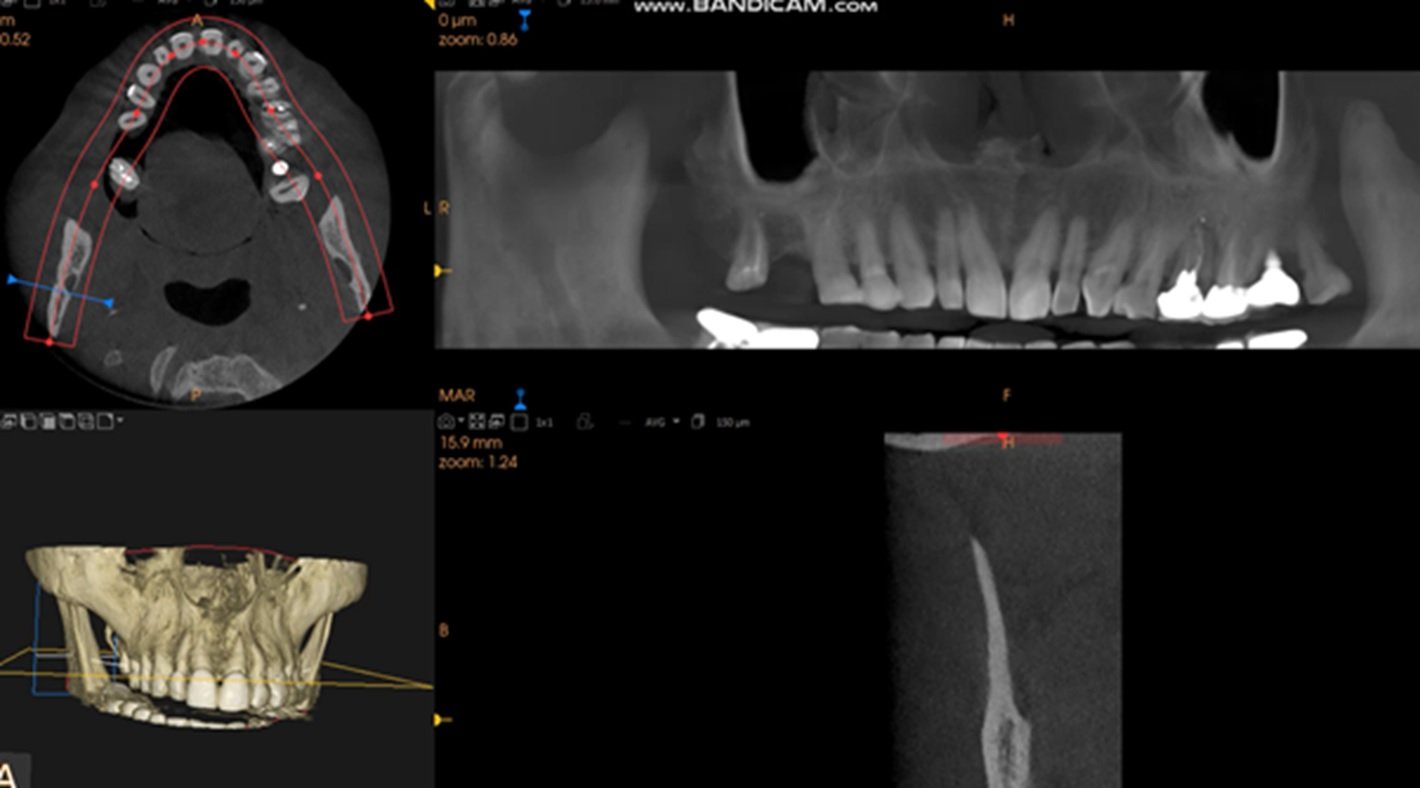
A Cone Beam Computed Tomography (CBCT) scan was later performed to evaluate cortical bone engagement and implant planning.
DIAGNOSIS
Based on clinical and radiographic findings, the case was diagnosed as:
- Failure of mandibular anterior fixed prosthesis
- Compromised abutment teeth with poor restorative prognosis
- Partial edentulism requiring immediate functional rehabilitation
TREATMENT PLANNING
Considering the patient’s functional demands and compromised oral condition, the following treatment plan was formulated:
- Removal of the faulty mandibular bridge
- Endodontic therapy for teeth 33, 34, and 35
- Extraction of non-restorable teeth 32 ,43 and 44
- Post and core rehabilitation of 34 and 35
- Restoration of tooth 46 using composite
- Immediate placement of corticobasal implants
- Intraoral welding for rigid stabilization
- Immediate prosthetic rehabilitation with hybrid prosthesis
The patient was informed regarding the treatment protocol, advantages, limitations, and postoperative care, following which informed consent was obtained.


SURGICAL PROCEDURE
All procedures were performed under local anesthesia under strict aseptic conditions.
Pre-Implant Phase
- The existing faulty bridge was carefully removed.
- Endodontic treatment was completed in relation to teeth 33, 34, and 35.
- Atraumatic extraction of teeth 32, 43 and 44 was carried out.
- Post and core procedures were performed on 34 and 35
- Tooth 46 was restored using composite to establish functional support.
Implant Placement
As the patient requested immediate rehabilitation, immediate implant placement was planned following extraction.
- Six corticobasal implants were strategically placed in the mandibular anterior region.
- Bicortical anchorage was achieved to obtain excellent primary stability.
- Implant positioning was confirmed clinically and radiographically.
Primary stability achieved through cortical engagement enabled immediate loading of the implants.
INTRAORAL WELDING AND PROSTHETIC REHABILITATION
Following implant placement:
- Intraoral welding of all six implants was performed using a 2 mm titanium wire to establish rigid splinting and reduce micromovement.
- Immediate alginate impressions were made.
- Bite registration was completed on the same day.
- Diagnostic casts were prepared and transferred to the laboratory for prosthesis fabrication.
Prosthetic Phase
- A metal framework trial was performed during the subsequent appointment to verify passive fit and occlusal harmony.
- The final prosthesis was delivered on the third postoperative day.
The prosthetic rehabilitation included:
- PFM crowns in relation to teeth 33, 34, 35, and 46
- Hybrid prosthesis replacing teeth in the 45, 43, 42, 41, 31, and 32 regions
CBCT evaluation confirmed satisfactory cortical engagement and implant positioning.
POSTOPERATIVE CARE AND FOLLOW-UP
Postoperative instructions regarding oral hygiene, diet, and maintenance were provided. The patient was placed under periodic follow-up evaluation to assess:
- Soft tissue healing
- Implant stability
- Occlusal function
- Prosthetic adaptation
At the 6-month follow-up examination:
- No peri-implant inflammation was observed
- Implant stability remained clinically satisfactory
- Functional efficiency and mastication improved significantly
The patient reported high satisfaction with both esthetics and function
No postoperative complications or implant failures were noted during the follow-up period.
DISCUSSION
Immediate loading protocols have transformed modern implant dentistry by reducing treatment duration and improving patient comfort. Corticobasal implants, in particular, offer significant advantages in compromised mandibular conditions due to their ability to engage highly mineralized cortical bone.
In the present case, immediate loading was successfully achieved because of:
- Excellent bicortical anchorage
- High primary implant stability
- Rigid fixation through intraoral welding
- Immediate prosthetic splinting
Intraoral welding plays a critical role in minimizing implant micromovement, thereby enhancing biomechanical stability during the healing phase. Additionally, immediate functional loading contributes positively to patient psychology, comfort, and masticatory rehabilitation.
The successful outcome observed in this case further supports the predictability of corticobasal implantology in managing complex restorative situations with immediate functional demands.
CONCLUSION
Immediate functional rehabilitation using corticobasal implants represents a predictable and efficient treatment modality for patients presenting with failed mandibular fixed prostheses and compromised dentition.
The combination of bicortical engagement, intraoral welding, and immediate loading enables rapid restoration of oral function while maintaining excellent implant stability and patient satisfaction.
This case demonstrated favorable clinical, radiographic, and functional outcomes, highlighting the effectiveness of corticobasal implantology in complex mandibular rehabilitative procedures.
REFERENCES
- Ihde S. Principles of BOI: Clinical, Scientific, and Practical Guidelines. Springer Publications.
- Misch CE. Contemporary Implant Dentistry. 3rd Edition. Mosby Elsevier.
- Malo P, Rangert B, Nobre M. Immediate function of implants in edentulous arches. Clinical Implant Dentistry and Related Research.
- Kopp S, Ihde S. Corticobasal implantology in compromised alveolar ridges. Implant Dentistry Journal.
- Esposito M et al. Interventions for replacing missing teeth: different times for loading dental implants. Cochrane Database of Systematic Reviews.
Disclaimer from Guident
The views and opinions expressed in articles published in Guident are solely those of the authors and do not necessarily reflect the views of the editors, the editorial board or the publisher, Ivory India. Guident does not endorse any product, technique or treatment described. Clinical content is intended for qualified dental and medical professionals and is not a substitute for individual clinical judgement. Guident, its editors and the publisher accept no liability for any consequence arising from the use of information published in the journal.
How to cite this article
Dr. Ashraf Husain Naqvi, Dr. Monika Verma. Immediate Functional Rehabilitation of the Mandibular Anterior Region Using Corticobasal Implants Following Failure of Fixed Prosthesis: A Case Report. Guident. 2026 Jun;19(7). Available from: https://ivoryindia.in/articles/implantology/immediate-functional-rehabilitation-of-the-mandibular-anterior-region-using-corticobasal-implants-following.html