Restoration in Posterior Maxilla Using Zimvie TSVT Implant with Zirconia Ti Base Restoration: A Case Report
Wisdom Dental Clinics ®, Jaipur, India
ABSTRACT
Immediate implant placement is an effective treatment approach for reducing treatment time while preserving alveolar bone and soft tissue architecture. This case report describes rehabilitation of a 60-year-old male patient with hopeless posterior maxillary teeth using immediate placement of ZimVie TSVT implants followed by restoration with zirconia crowns on Ti-base abutments. Implants were placed immediately after atraumatic extraction with adequate primary stability. After successful osseointegration, definitive prosthetic rehabilitation was completed using zirconia restorations. Clinical and radiographic evaluation demonstrated favorable functional and esthetic outcomes with healthy peri-implant tissues.
Keywords :Immediate implant placement ,ZimVie TSVT implant, Ti-base abutment
INTRODUCTION
Dental implants have become a highly predictable and widely accepted treatment modality for the replacement of missing teeth because of their excellent functional and esthetic outcomes. Traditionally, implant placement was performed several months after tooth extraction to allow complete healing of the extraction socket. However, delayed implant placement often leads to alveolar bone resorption, soft tissue collapse, prolonged treatment duration, and increased patient discomfort. To overcome these limitations, immediate implant placement into fresh extraction sockets has gained significant popularity in modern implant dentistry.1,2
Immediate implant placement refers to insertion of a dental implant at the same surgical appointment as tooth extraction. This protocol offers several advantages including preservation of alveolar ridge dimensions, reduction in surgical procedures, shorter overall treatment time, improved patient acceptance, and maintenance of gingival architecture. In addition, immediate implant placement may help minimize post-extraction bone remodeling and provide better prosthetically driven implant positioning.3,4
Despite these advantages, immediate implant placement in the posterior maxilla remains clinically challenging because of poor bone quality, decreased bone density, wide extraction sockets, and proximity to the maxillary sinus. Achieving sufficient primary stability is considered one of the most critical factors for successful osseointegration in such cases. Implant macrodesign, thread pattern, and taper configuration play an important role in enhancing stability in soft maxillary bone.5
The ZimVie TSVT implant system is a tapered screw-vent implant specifically designed to achieve improved primary stability and bone engagement, especially in compromised bone conditions. Its tapered body and aggressive thread design facilitate higher insertion torque and enhanced mechanical retention in extraction sockets. These characteristics make it suitable for immediate implant placement procedures in posterior maxillary regions.6
In recent years, prosthetic rehabilitation using zirconia crowns on titanium base (Ti-base) abutments has become increasingly popular because of improved esthetics, strength, and precision. Zirconia restorations exhibit excellent biocompatibility, plaque resistance, and favorable soft tissue response, while titanium bases provide durable implant-abutment connections and reduce the risk of mechanical complications. Extraoral cementation of zirconia crowns onto Ti-base abutments further minimizes peri-implant cement-related complications.7,8
Successful immediate implant therapy depends on careful case selection, atraumatic extraction techniques, preservation of socket walls, achievement of adequate primary stability, and proper prosthetic planning. Long-term maintenance and regular follow-up are equally important for preserving peri-implant tissue health and ensuring implant success.9
CASE REPORT
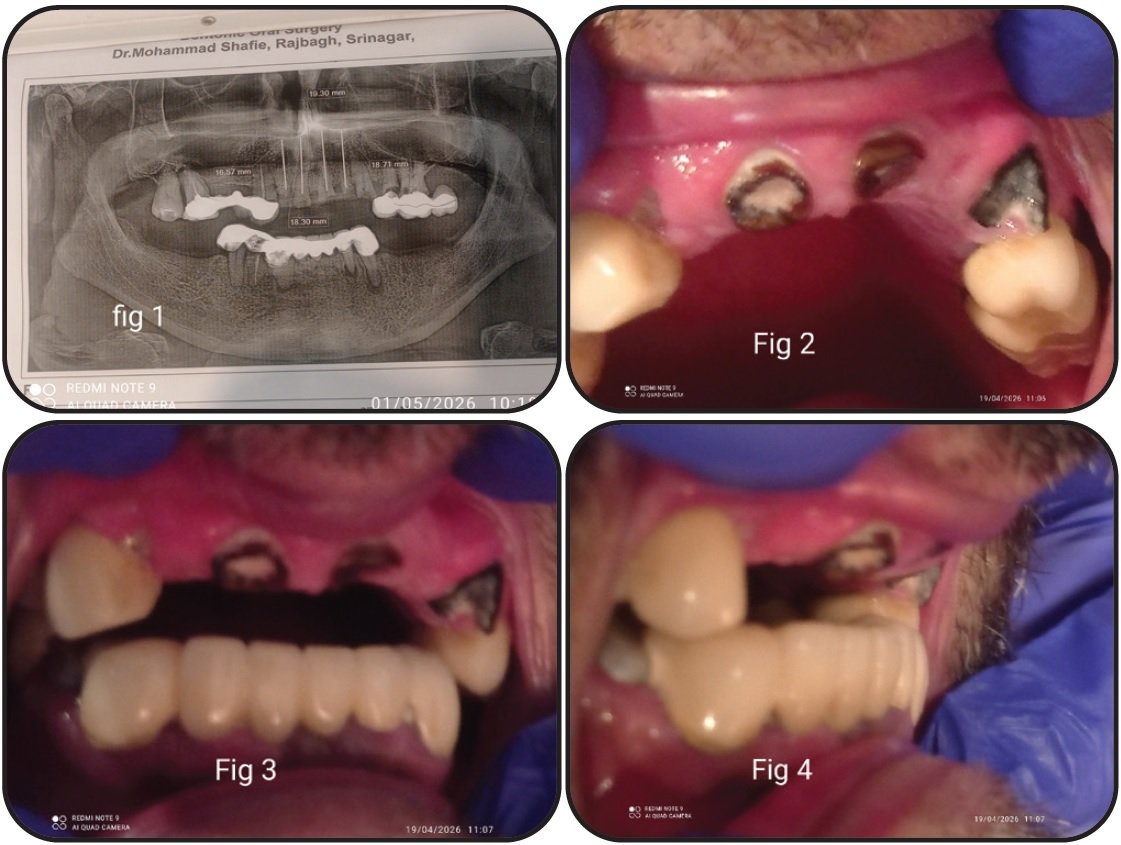
A 60-year-old male patient reported to clinic with the chief complaint of missing teeth in the maxillary posterior region associated with compromised mastication and reduced oral function. The patient expressed a desire for fixed prosthetic rehabilitation. Clinical examination revealed partial edentulism in the maxillary arch with multiple previously restored and endodontically treated teeth. Existing fixed prostheses were noted, and the oral hygiene status was fair. No signs of acute infection, swelling, or sinus tract formation were observed at the proposed surgical sites.
Preoperative radiographic assessment included panoramic radiography and cone beam computed tomography (CBCT). Radiographic examination demonstrated partial edentulism in the maxillary posterior region with adequate residual alveolar bone height and width for implant placement. Adjacent teeth exhibited previous restorative and endodontic treatment, while no significant pathology involving the maxillary sinus or surrounding anatomical structures was identified. CBCT evaluation facilitated precise assessment of bone morphology, implant angulation, and restorative space for prosthetically driven implant placement.[figure 1]
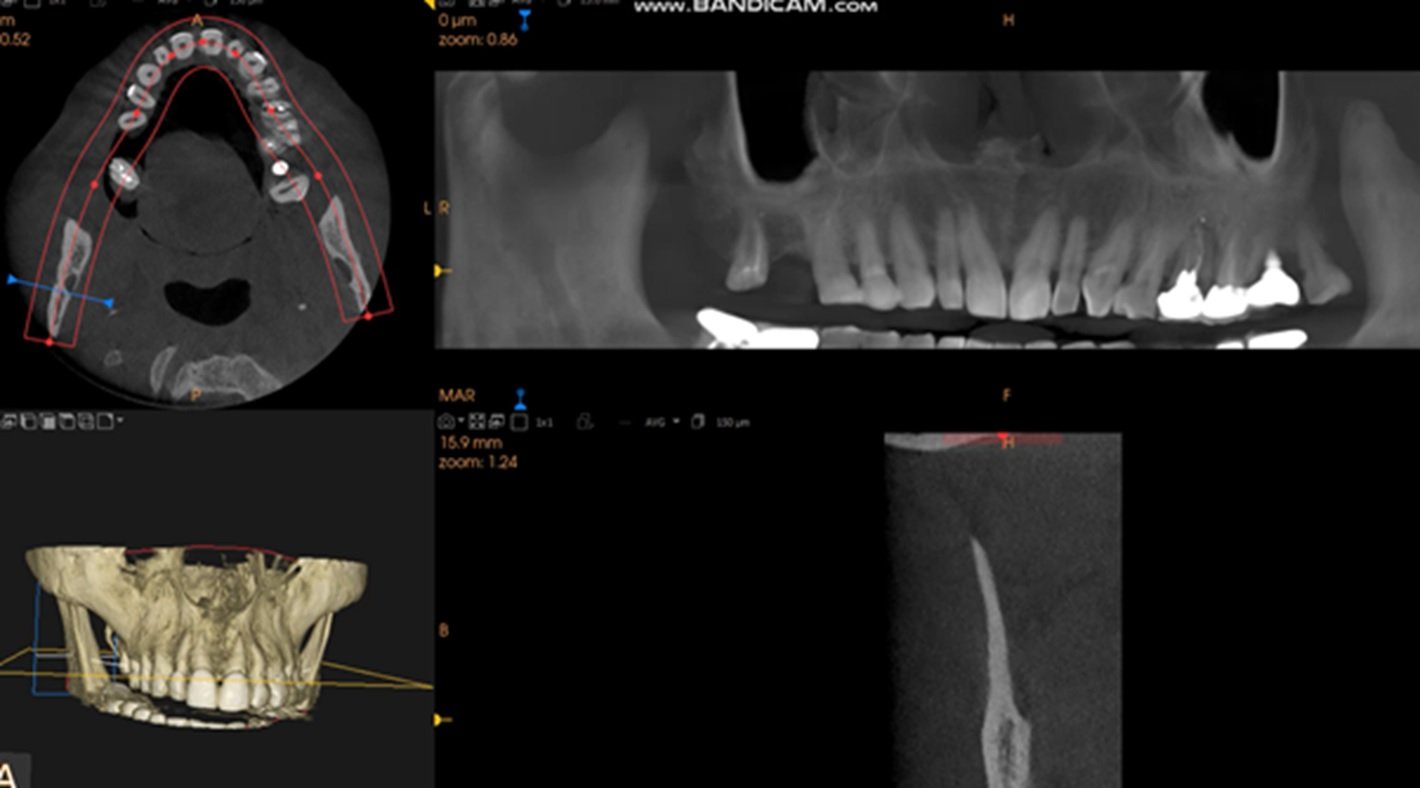
Figure 1:Pre-Operative CBCT
Based on the clinical and radiographic findings, immediate implant rehabilitation was planned using ZimVie TSVT Implant implants in the maxillary posterior region . Implant placement was performed under local anesthesia.Sequential osteotomy preparation was performed according to the manufacturer’s protocol, and ZimVie TSVT implants were immediately placed into the extraction sockets engaging the apical and palatal bone to achieve primary stability. Implant placement torque of more than 35 Ncm was achieved, indicating satisfactory primary stability.
After the final osteotomy preparation, implants were placed with an insertion torque of 30Ncm by a torque measuring wrench posing good primary stability, parallel to the roots of the adjacent teeth. ISQ measurements were in the range of 75-78, cover screw was then placed on the implant to facilitate the development of a gingival emergence profile for the anticipated restoration. Post-operative OPG was taken to check for the placement of the implant. [Figure 2 a,b]

Figue 2a,b: Immediate post op
Postsurgical instructions were explained to control postoperative pain. Antibiotics and analgesics were prescribed to the patient for 5 days. The patient was recalled after 1 week for a routine check-up; there was no extra oral swelling or discomfort.
The second stage surgery was done after healing period of 3 months. The implant was exposed without damaging the surrounding bone and gingival healing cap was placed. Digital impression technique was used for taking the impression of the abutment using scan body .The patient was recalled after 3 months for carrying out the prosthetic procedures .OPG was suggested, ISQ test was done again, which showed excellent biological stability with reading measuring 84, showing excellent secondary stability. [Figure 3a,b]

Figure 3a: 3 months pot-op & Figure 3b: scan body
Healing abutment/gingiva former was replaced with the final abutment and zirconia crowns fabricated over titanium bases (Ti-bases) crown on stock abutment was given. The crown was fabricated and checked for its passive fitting to abutment and occlusal interference checked. Crown was then cemented. After final placement of prosthesis on its desired site, intraorally post-operative radiograph was taken. Patient was asked to come for timely follow-ups. [Figures 4a,b,c]

Figure 4 a,Figures 4a,b,c :Post –operative
DISCUSSION
Immediate implant placement has gained widespread acceptance because of advancements in implant surface technology, surgical protocols, and prosthetic materials. Preservation of the extraction socket architecture and reduction in overall treatment time are among the major advantages of this approach.10
Primary stability is considered the most important factor influencing implant success in immediate placement protocols, especially in the posterior maxilla where bone quality is often poor. Tapered implant systems such as ZimVie TSVT implants improve mechanical engagement with surrounding bone and enhance insertion torque values.11
The use of Ti-base abutments with zirconia crowns has become increasingly popular because of their mechanical reliability and esthetic benefits. Titanium bases provide a durable implant-abutment connection, while zirconia restorations demonstrate excellent biocompatibility, strength, and esthetic properties. Extraoral cementation of zirconia crowns onto Ti-bases reduces the risk of excess cement around peri-implant tissues.12,13
Several studies have reported high survival rates for immediately placed implants in posterior maxillary regions when proper surgical and prosthetic protocols are followed. Patient selection, adequate bone volume, primary stability, and maintenance of oral hygiene remain critical determinants for long-term success.14,15
CONCLUSION
Immediate implant placement in the posterior maxilla using ZimVie TSVT implants can be a predictable and successful treatment option in carefully selected cases. The tapered implant design contributed to achieving adequate primary stability despite the compromised bone quality of the posterior maxilla. Restoration with zirconia crowns on Ti-base abutments provided excellent functional and esthetic outcomes. Proper surgical technique, prosthetic planning, and maintenance protocols are essential for achieving long-term implant success.
REFERENCES
- Chen ST, Buser D. Clinical and esthetic outcomes of implants placed in postextraction sites. Int J Oral Maxillofac Implants. 2009;24 Suppl:186-217.
- Esposito M, Grusovin MG, Polyzos IP, et al. Timing of implant placement after tooth extraction. Eur J Oral Implantol. 2010;3(3):189-205.
- Schropp L, Isidor F. Timing of implant placement relative to tooth extraction. J Oral Rehabil. 2008;35 Suppl 1:33-43.
- Javed F, Ahmed HB, Crespi R, Romanos GE. Role of primary stability for successful osseointegration. J Dent. 2013;41(7):612-620.
- O’Sullivan D, Sennerby L, Meredith N. Influence of implant taper on stability. Clin Oral Implants Res. 2004;15(4):474-480.
- Sailer I, Mühlemann S, Zwahlen M, et al. Cemented and screw-retained implant reconstructions. Clin Oral Implants Res. 2012;23 Suppl 6:163-201.
- Misch CE. Contemporary Implant Dentistry. 3rd ed. Mosby; 2008.
- Covani U, Cornelini R, Barone A. Buccal bone augmentation around immediate implants. Clin Oral Implants Res. 2007;18(3):357-366.
- Fugazzotto PA. Implant placement at the time of extraction. J Periodontol. 2008;79(3):443-450.
- Lang NP, Pun L, Lau KY, et al. Immediate implant placement after extraction. Clin Oral Implants Res. 2012;23 Suppl 5:39-66.
- Meredith N. Assessment of implant stability as a prognostic determinant. Int J Prosthodont. 1998;11(5):491-501.
- Araújo MG, Lindhe J. Dimensional ridge alterations following extraction. Clin Oral Implants Res. 2005;16(2):212-218.
- Gehrke P, Johannson D, Fischer C, et al. Zirconia implant abutments and restorations. Clin Implant Dent Relat Res. 2006;8(2):61-69.
- Crespi R, Capparé P, Gherlone E. Immediate versus delayed loading of dental implants. Int J Oral Maxillofac Implants. 2008;23(2):267-273.
Disclaimer from Guident
The views and opinions expressed in articles published in Guident are solely those of the authors and do not necessarily reflect the views of the editors, the editorial board or the publisher, Ivory India. Guident does not endorse any product, technique or treatment described. Clinical content is intended for qualified dental and medical professionals and is not a substitute for individual clinical judgement. Guident, its editors and the publisher accept no liability for any consequence arising from the use of information published in the journal.
How to cite this article
Dr. Gaurav Gupta, Dr. D.K. Gupta, Dr. Neelja Gupta. Restoration in Posterior Maxilla Using Zimvie TSVT Implant with Zirconia Ti Base Restoration: A Case Report. Guident. 2026 May;19(6). Available from: https://ivoryindia.in/articles/implantology/restoration-in-posterior-maxilla-using-zimvie-tsvt-implant-with-zirconia-ti-base-restoration-a-case-report.html