Immediate Loading of Basal Implants in the Anterior Maxilla Following Failed Endodontic Treatment: A Case Report
Smile Dental and Implant Clinic, Namner, Agra, UP, India
ABSTRACT
Rehabilitation of the anterior maxilla following failed endodontic therapy presents both functional and aesthetic challenges. Immediate loading of basal implants offers a viable solution, especially in cases with compromised bone conditions. This case report describes the successful management of a 28-year-old female patient presenting with recurrent infection, mobility, and chronic periapical abscess associated with previously endodontically treated maxillary anterior teeth. Extraction followed by placement of basal cortical screw (BCS) implants with immediate loading and intraoral welding resulted in favorable clinical and radiographic outcomes. The case highlights the advantages of bicortical engagement and rigid fixation in achieving early functional restoration with predictable results.
Keywords: Basal implants, Immediate loading, Bicortical engagement, Intraoral welding, Anterior maxilla, Failed root canal treatment
INTRODUCTION
Failure of root canal-treated teeth in the anterior maxilla often leads to infection, bone loss, and compromised aesthetics. Conventional implant protocols typically require delayed loading and sufficient bone volume, which may not always be feasible.
Basal implantology, particularly Basal Cortical Screw (BCS) implants, provides an alternative approach by utilizing the cortical bone for anchorage. Immediate loading protocols further enhance patient comfort by reducing treatment time and restoring function quickly.
This report presents a clinical case where immediate loading basal implants were used successfully following extraction of infected anterior maxillary teeth.
CASE REPORT
Patient History
A 28-year-old female patient reported to Smile Dental and Implant Clinic, Namner, Agra, referred by a colleague with complaints of:
- Recurrent infection
- Progressive tooth mobility
- Pain in upper anterior region
- Discoloration of teeth
The patient had a history of root canal treatment in teeth 11, 21, and 22 approximately 5 years prior.
Clinical Examination
Clinical findings included:
- Grade II mobility in involved teeth
- Presence of sinus tract and pus discharge
- Discoloration of anterior teeth
- Tenderness on percussion
Radiographic Findings
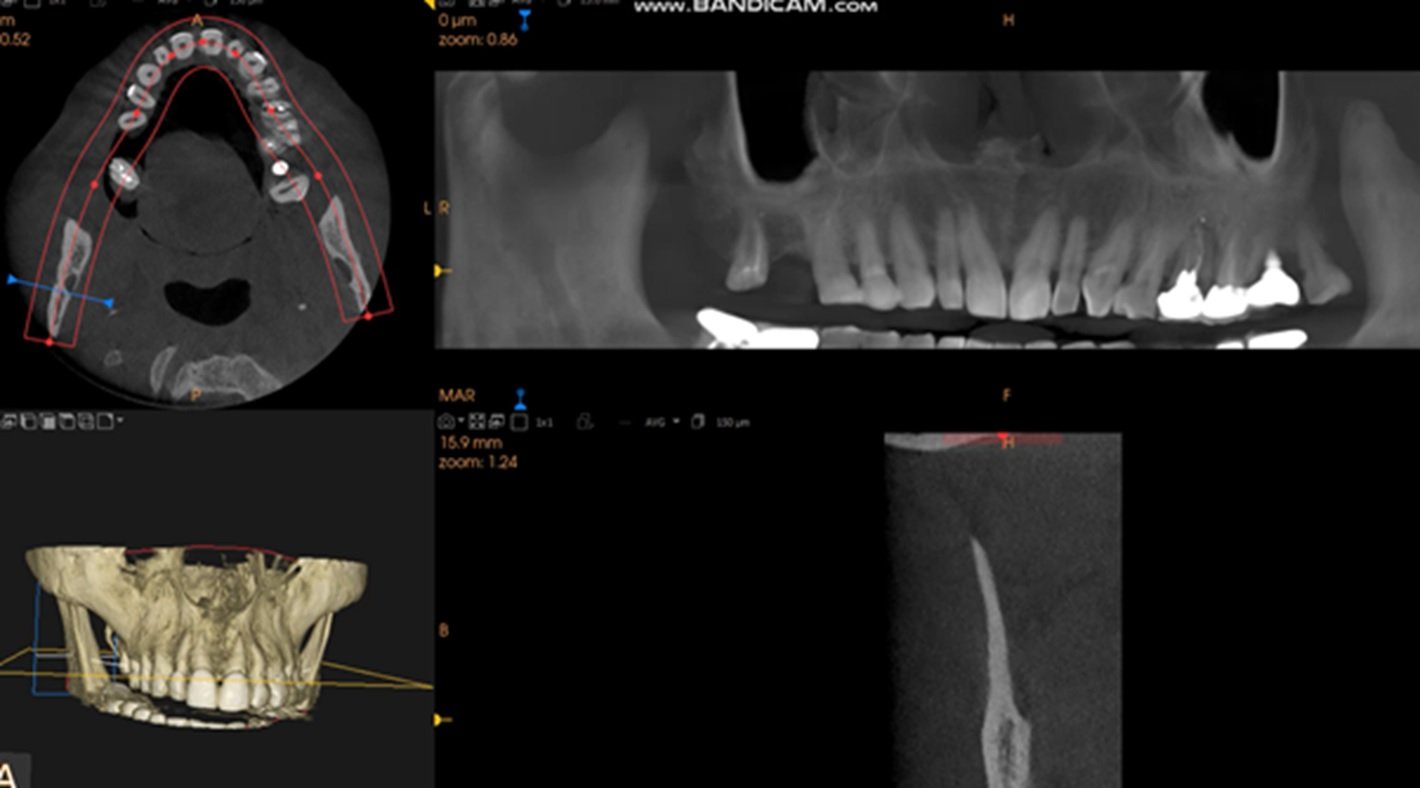
Radiographic evaluation revealed:
- Periapical radiolucency associated with teeth 11, 21, and 22
- Evidence of chronic periapical abscess
- Compromised bone support
Treatment Planning
Considering the extent of infection and poor prognosis of the treated teeth, the following treatment plan was formulated:
- Extraction of teeth 11, 21, and 22
- Immediate placement of basal implants
- Immediate loading with provisional prosthesis
Surgical Procedure
- The procedure was performed under local anesthesia.
- Atraumatic extraction of the involved teeth was carried out.
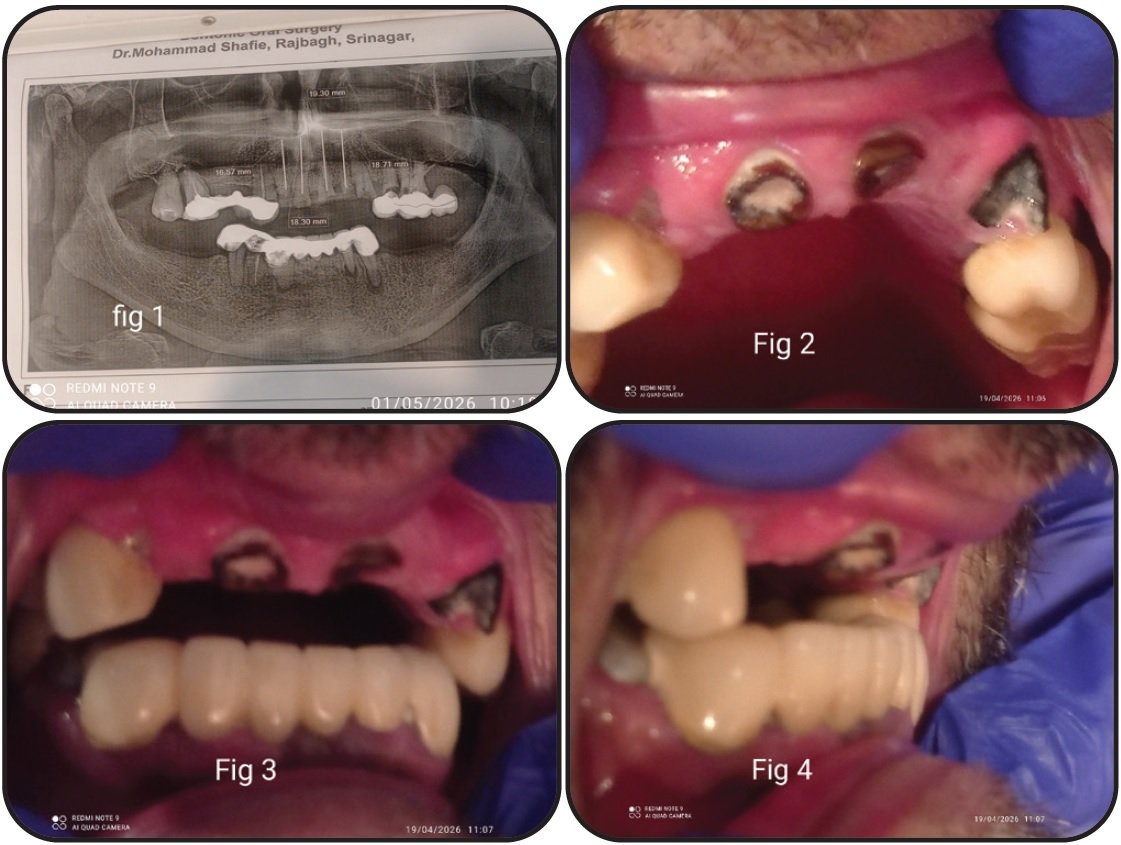
- Three BCS implants (3.6 mm diameter × 23 mm length) were placed in the anterior maxilla.
- Bicortical engagement was achieved to ensure primary stability.


Intraoral Welding & Prosthetic Phase
- A 2 mm titanium wire was used for intraoral welding to rigidly splint the implants.
- Immediate alginate impression was made.
- A provisional prosthesis was fabricated and delivered on the same day for immediate loading.


Postoperative Care and Follow-Up
The patient was monitored regularly for:
- Soft tissue healing
- Signs of infection
- Implant stability
At follow-up visits:
- No inflammation was observed
- No signs of bone resorption
- Stable implant integration noted
- Patient reported satisfactory function and aesthetics

DISCUSSION
Basal implants are particularly advantageous in cases with compromised alveolar bone, as they engage the cortical bone, which is less prone to resorption. Immediate loading further enhances patient satisfaction by eliminating the need for prolonged edentulous phases.
In this case:
- Bicortical anchorage ensured excellent primary stability
- Intraoral welding provided rigid fixation, reducing micromovement
- Immediate loading promoted functional stimulation and faster recovery
These factors contributed to the successful outcome despite the presence of infection and bone loss.
CONCLUSION
Immediate loading of basal implants in the anterior maxilla is a predictable and efficient treatment modality in cases of failed endodontic therapy. The combination of bicortical engagement and intraoral welding provides excellent primary stability and allows early functional rehabilitation.
Long-term prognosis in this case appears favorable, with stable implant integration and absence of complications.
REFERENCES
- Ihde S. Principles of BOI: Clinical, Scientific, and Practical Guidelines.
- Kopp S, Ihde S. Basal implants in compromised bone. Implant Dentistry Journal.
- Malo P et al. Immediate loading protocols in implant dentistry.
- Esposito M et al. Interventions for replacing missing teeth. Cochrane Database.
- Misch CE. Contemporary Implant Dentistry.
Disclaimer from Guident
The views and opinions expressed in articles published in Guident are solely those of the authors and do not necessarily reflect the views of the editors, the editorial board or the publisher, Ivory India. Guident does not endorse any product, technique or treatment described. Clinical content is intended for qualified dental and medical professionals and is not a substitute for individual clinical judgement. Guident, its editors and the publisher accept no liability for any consequence arising from the use of information published in the journal.
How to cite this article
Dr. Ashraf Husain Naqvi, Dr. Raghvendra Dubey. Immediate Loading of Basal Implants in the Anterior Maxilla Following Failed Endodontic Treatment: A Case Report. Guident. 2026 May;19(6). Available from: https://ivoryindia.in/articles/implantology/immediate-loading-of-basal-implants-in-the-anterior-maxilla-following-failed-endodontic-treatment-a-case.html