Digital Pathways to Smokeless Tobacco Cessation: Addressing Addiction Among Indian Youth: A Narrative Review
Department of Prosthodontics and Crown & Bridge, Seema Dental College and Hospital, Rishikesh, Uttarakhand, India, 2Balajee Sewa Sansthan, Member Secretary, Uttarakhand Tobacco Free Coalition, Department of Public Health Dentistry, Sai Institute of Pramedical and Allied Science, Dehradun, Uttarkhand
ABSTRACT
Background: Smokeless tobacco (SLT) consumption remains a major public health challenge in India, particularly among adolescents and young adults. Despite increasing awareness regarding the harmful effects of SLT, cessation rates among Indian youth remain low due to addiction, social acceptance, inadequate counseling services, and limited accessibility to cessation programs. The rapid expansion of digital health technologies offers innovative opportunities for behavior modification and tobacco cessation interventions.
Objective: This narrative review aims to explore the role of digital behavioral interventions in smokeless tobacco cessation among Indian youth and to examine their effectiveness, challenges, and future potential in public health practice.
Methods: A narrative review of published literature was conducted using electronic databases including PubMed, Scopus, Google Scholar, and Web of Science. Relevant articles published in English focusing on digital health interventions, behavioral modification strategies, mobile health applications, social media–based campaigns, telehealth, and smokeless tobacco cessation among adolescents and young adults were reviewed and synthesized.
Results: Digital interventions such as mobile applications, text messaging services, social media campaigns, tele-counseling, and artificial intelligence–based support systems demonstrated promising outcomes in enhancing awareness, motivation, and quit attempts among youth. Behavioral approaches including cognitive behavioral strategies, motivational interviewing, and personalized digital counseling were found to improve user engagement and cessation outcomes. However, barriers including digital illiteracy, lack of culturally tailored content, privacy concerns, and unequal access to technology continue to limit widespread implementation.
Conclusion: Digital behavioral interventions have significant potential to strengthen smokeless tobacco cessation efforts among Indian youth. Integrating technology-driven cessation models into public health programs may improve accessibility, engagement, and long-term behavioral change. Further evidence-based research and culturally adaptive interventions are required to optimize their effectiveness in the Indian context.
Keywords: Smokeless tobacco, digital health, tobacco cessation, behavioral interventions, Indian youth, mobile health, public health, telehealth, addiction prevention.
INTRODUCTION
India is the world's biggest consumer of smokeless tobacco (SLT), with a wide range of demographics using products including paan masala, gutka, zarda, and khaini.1 Although smoking is frequently the focus of worldwide tobacco control, SLT accounts for the bulk of tobacco use in India.2 Adolescence and early adulthood are often when this behaviour first emerges.3 Indian adolescents are subject to particular sociocultural pressures that normalise the use of SLT, which are exacerbated by a lack of knowledge about its particular health concerns, including oral malignancies and oral submucous fibrosis (OSMF).2,4 Due to structural constraints, expense, and fear of judgment, children frequently underutilise traditional cessation frameworks, such as in-person counselling and Nicotine Replacement Therapy (NRT).4,5
Digital channels offer a vital chance to close this disparity. Digital health interventions can provide young users with individualised, real-time support due to India's rapidly increasing smartphone usage and reasonably priced mobile data.6 This analysis assesses the structural design, effectiveness, and implementation challenges of digital initiatives used to fight SLT addiction among young Indians.
The Landscape of Smokeless Tobacco Use Among Indian Youth
Millions of Indian adolescents routinely use SLT, according to statistics from the National Family Health Survey (NFHS) and the Global Youth Tobacco Survey (GYTS).3,7 Several different factors enhance the initiation:
- Affordability: SLT products are easily affordable with pocket money because they are offered in inexpensive, single-use sachets (pouches).
- Social Acceptance: Some kinds of SLT are culturally incorporated into daily routines and social rituals, in contrast to smoking, which is often stigmatized in Indian households.1,4
- Deceptive Marketing: In order to get around regulatory constraints, manufacturers frequently use surrogate advertising to market these products as mouth fresheners or digestion aides.8
These socio-environmental triggers, along with nicotine's extremely addictive nature, result in long-term dependence.1 As a result, in order to effectively break these deeply rooted behavioural patterns, cessation techniques must be extremely engaging and ongoing.
Digital Interventions for Cessation
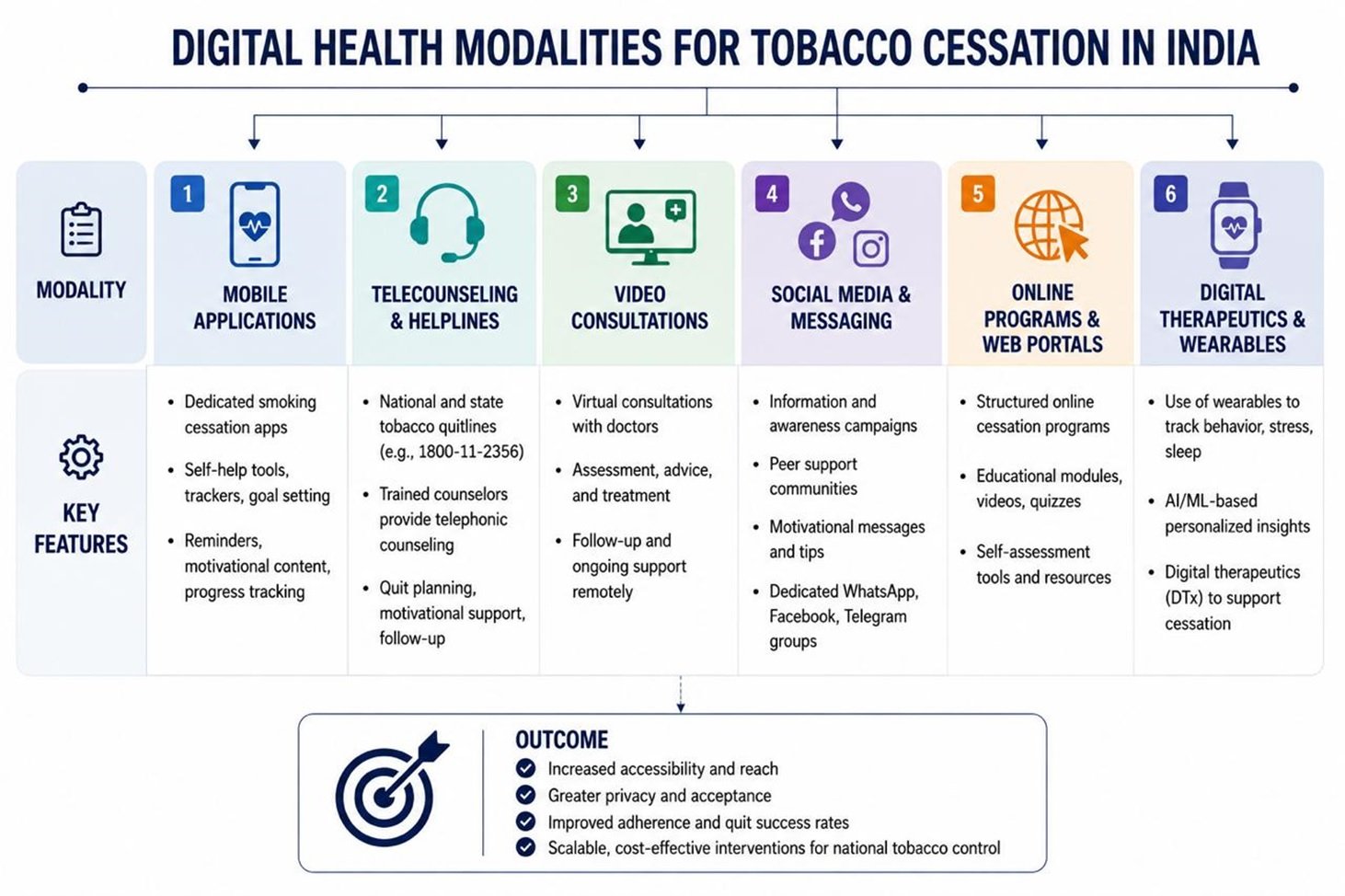
Geographical and logistical obstacles are eliminated by digital health technologies, which offer private and affordable assistance. In India, the following methods are now in use (Fig 1):
SMS-Based Frameworks and mHealth
A significant text-based public health campaign is the Government of India's mCessation effort.6,9 SMS-based pathways use automated, timed messaging to provide health education, motivating quotes, and advice on how to control cravings.9 SMS offers a low-barrier touchpoint that doesn't require internet connectivity for young people utilising feature phones or basic smartphones.6
Smartphone Applications
Interactive, multimedia settings are provided by app-based interventions. Contemporary apps for quitting incorporate:
- Gamification: Users can track smoke-free days, receive badges, and see their savings.10
- Behavioural Logging: The ability to record emotional states, craving strength, and triggers.10
- Push Notifications: JITAIs, or just-in-time adaptive interventions, provide helpful alerts at high-risk periods of the day.11
Artificial Intelligence and Conversational Chatbots
Automated behavioural counselling is provided by AI-powered chatbots on well-known messaging services like WhatsApp.11–12 When a user has strong cravings, these tools mimic human communication and respond promptly. These bots are very relatable to urban and semi-urban youth because they use Natural Language Processing (NLP) to understand native slang and code-switching, such as Hinglish.12
Social Media and Peer Support Networks
Both community-led recovery organizations and public health campaigns use Facebook, YouTube, and Instagram as platforms.13 Young people are greatly impacted by peer support; witnessing digital producers discuss their quitting experiences lessens feelings of loneliness and combats the pressure to use tobacco.13
Challenges in Digital Implementation
In the Indian context, digital cessation channels encounter substantial systemic obstacles notwithstanding their potential:
- The Digital Divide: There are still significant differences in smartphone ownership and dependable internet access, particularly for young women and rural adolescents.14
- Linguistic Diversity: In addition to basic English or Hindi, tools must be provided in a variety of regional dialects due to India's extensive multilingual landscape.
- Product-Specific Tailoring: A lot of digital platforms were initially created with Western cigarette smokers in mind, and they lack modules that specifically address the particular behavioural triggers and physical rituals connected to chewing tobacco.1,15
- Data Privacy and Trust: Young people are very conscious of their privacy, and they quickly stop using the digital tool if they believe that family members may learn about their tobacco use.14
Future Directions
Future interventions must give priority to three key practices to optimise the impact of digital pathways:
- Hyper-Localization: Content must be created in regional languages, addressing particular local SLT varieties and making use of cultural idioms.6,15
- Hybrid Care Models: A continuous continuum of care is ensured by integrating digital technologies with the current National Tobacco Quitline Services (NTQLS) and community health professionals (ASHA workers).5,9
- Youth-Centric Design: Including young people in the co-design of chatbots and apps ensures that the user interfaces stay extremely relevant, interesting, and nonjudgmental.10,13
CONCLUSION
For young Indians who are addicted to smokeless tobacco, digital routes provide an effective, scalable solution. Public health programs can provide discrete, individualised, and affordable behavioural support by utilising mobile technologies. Overcoming obstacles about data privacy, product customisation, and linguistic diversity will be crucial. The burden of SLT addiction can be significantly decreased, and the health of the younger generation can be safeguarded by fostering user-centric, localised digital ecosystems.
REFERENCES
- World Health Organization. Smokeless tobacco and public health in India. New Delhi: WHO Regional Office for South-East Asia; 2021.
- Sinha DN, Gupta PC, Ray C, Singh PK. Prevalence of smokeless tobacco use among adults in WHO South-East Asia Region. Indian J Med Res. 2018;148(1):13-23.
- Ministry of Health and Family Welfare (MoHFW), Government of India. Global Youth Tobacco Survey (GYTS-4) India Report. New Delhi: MoHFW; 2021.
- Quadri JA, Sarwar S, Jafri AH, AlQahtani SM. Socio-cultural determinants of smokeless tobacco use among youth in India: a review. J Oral Health Community Dent. 2020;14(2):45-51.
- Thankappan KR. Tobacco cessation in India: Challenges and opportunities. Indian J Med Res. 2020;151(5):387-389.
- Ghorpade AG, Kumar AMV. Digital health interventions for tobacco cessation in low- and middle-income countries: A scoping review. mHealth. 2022;8:14.
- International Institute for Population Sciences (IIPS). National Family Health Survey (NFHS-5), 2019–21: India. Mumbai: IIPS; 2021.
- Kapoor S, Anand S, Sahu S. Surrogate advertising of smokeless tobacco products in India: A persistent challenge to tobacco control policies. Tob Induc Dis. 2023;21(February):28.
- Tripathy JP, Sharma S. Evaluation of the government of India's national mCessation programme: A text-messaging initiative for tobacco cessation. Lancet Digit Health. 2021;3(8):e488-e496.
- Bricker JB, Watson NL, Mull KE, Sullivan BM, Heffner JL. Efficacy of smartphone applications for smoking cessation: A randomized clinical trial. JAMA Intern Med. 2020;180(11):1472-1480.
- Heffner JL, Watson NL, Mull KE, Bricker JB. Just-in-time adaptive interventions for tobacco cessation using mobile platforms: A systematic review. Nicotine Tob Res. 2022;24(6):801-811.
- Sharma R, Kumar V, Singh J. Artificial intelligence and conversational agents in healthcare: Tailoring multilingual chatbots for tobacco cessation in India. J Med Syst. 2024;48(1):12.
- Cole-Lewis H, Janse VR, Campbell H. Social media as a tool for youth tobacco cessation: A systematic review of peer-led digital communities. J Med Internet Res. 2021;23(4):e21345.
- Government of India. Digital India Report: Analyzing the urban-rural digital divide and privacy paradigms among youth. New Delhi: Ministry of Electronics and Information Technology; 2023.
- Kumar S, Jain S. Tailoring digital health platforms for smokeless tobacco vs. smoking cessation: The Indian perspective. Indian J Public Health. 2022;66(3):310-314.
Disclaimer from Guident
The views and opinions expressed in articles published in Guident are solely those of the authors and do not necessarily reflect the views of the editors, the editorial board or the publisher, Ivory India. Guident does not endorse any product, technique or treatment described. Clinical content is intended for qualified dental and medical professionals and is not a substitute for individual clinical judgement. Guident, its editors and the publisher accept no liability for any consequence arising from the use of information published in the journal.
How to cite this article
Dr. Jyotsna Seth, Mr. Awadesh Kumar, Dr. Arti Rauthan. Digital Pathways to Smokeless Tobacco Cessation: Addressing Addiction Among Indian Youth: A Narrative Review. Guident. 2026 Jun;19(7). Available from: https://ivoryindia.in/articles/general/digital-pathways-to-smokeless-tobacco-cessation-addressing-addiction-among-indian-youth-a-narrative-review.html