Recycling Clear Aligner Materials in Orthodontics: Current Technologies, Challenges, and Prospects for a Circular Economy: A Comprehensive Narrative Review
Department of Orthodontics and Dentofacial Orthopaedics, Rural Dental College, Pravara Institute of Medical Sciences (DU), Loni, Maharashtra, India
ABSTRACT
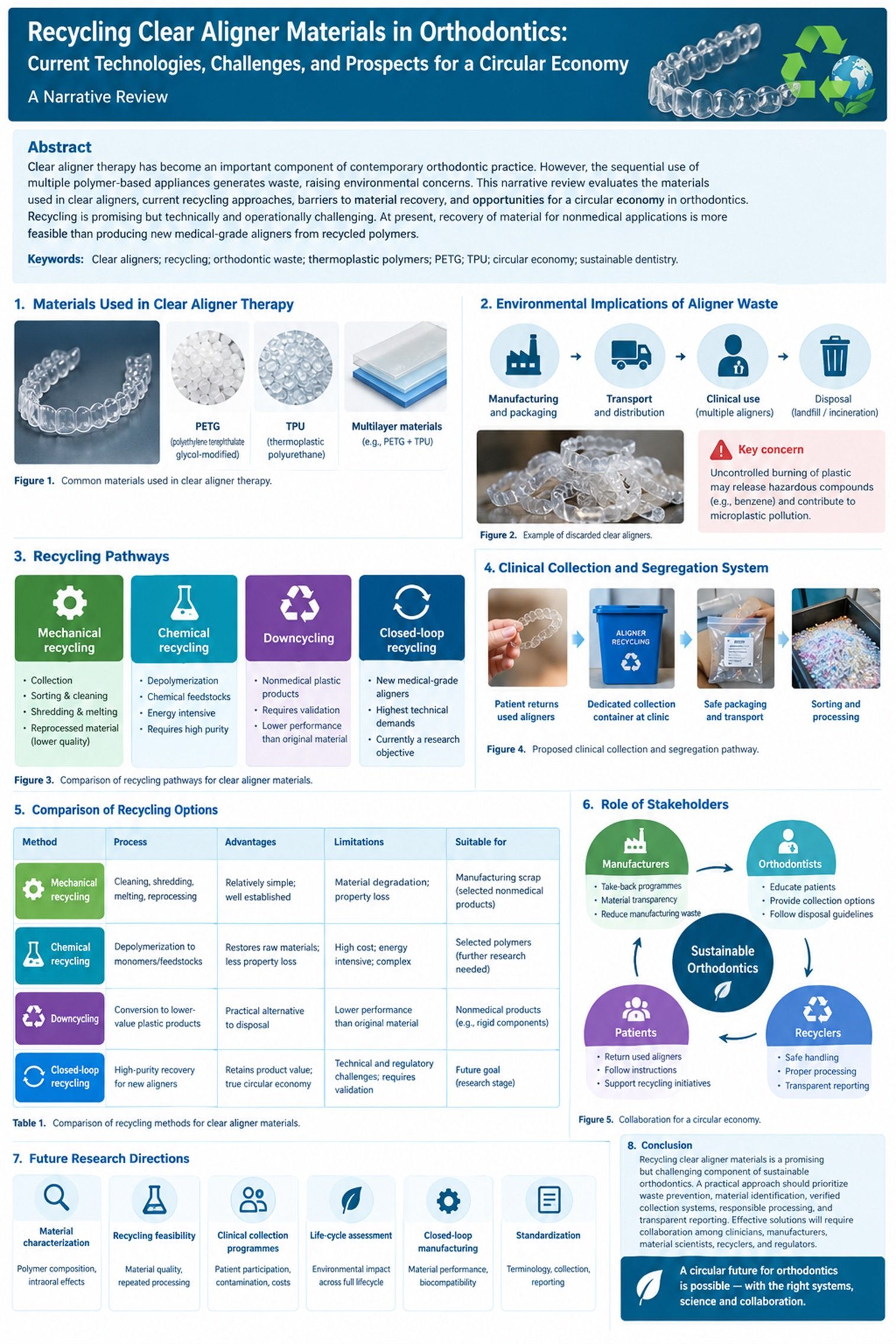
Clear aligner therapy has become an important component of contemporary orthodontic practice. The treatment involves the sequential use of multiple polymer-based appliances, generating waste during both manufacturing and clinical use. The limited recyclability of certain aligner materials and the absence of standardized collection and recovery systems present environmental challenges.
Aim: This narrative review evaluates the materials used in clear aligner therapy, current recycling approaches, barriers to material recovery, and opportunities for developing sustainable waste-management systems in orthodontics.
Review: Clear aligners are manufactured from polymers such as polyethylene terephthalate glycol-modified (PETG), thermoplastic polyurethane (TPU), and other polyurethane-based or multilayer materials. Their mechanical properties, transparency, and flexibility make them suitable for orthodontic treatment, but differences in polymer composition complicate sorting and recycling. Potential recycling pathways include mechanical recycling, chemical recycling, downcycling into nonmedical products, and material recovery from manufacturing waste. However, used intraoral appliances require appropriate collection, handling, and risk assessment before processing. Thermal degradation, mixed-polymer composition, contamination, and the loss of mechanical properties may limit the reuse of recovered material in new aligners. Digital manufacturing, reduction of unnecessary material consumption, manufacturer-led take-back programmes, and standardized waste segregation may help improve sustainability.
Conclusion: Recycling clear aligner materials represents a promising but technically and operationally challenging component of sustainable orthodontics. At present, the recovery of material for nonmedical applications is more readily distinguishable from the substantially more demanding process of producing new medical-grade aligners from recycled polymers. Further research should evaluate material quality, environmental performance, economic feasibility, and the effectiveness of clinical collection systems.
Keywords: Clear aligners; recycling; orthodontic waste; thermoplastic polymers; PETG; polyurethane; circular economy; sustainable dentistry.
1. INTRODUCTION
Clear aligner therapy has transformed adult orthodontic treatment through advances in digital treatment planning, computer-aided design, and polymer processing. The technique involves a sequence of removable appliances designed to produce progressive tooth movement. Although clear aligners provide aesthetic and practical advantages, their growing use raises questions about the environmental consequences of manufacturing, packaging, transportation, clinical use, and disposal.
Conventional aligner treatment commonly involves the production of multiple trays for each patient. Used appliances are generally discarded after their prescribed period of use, while additional plastic waste may arise from packaging, manufacturing models, trimming, and rejected components. The cumulative environmental implications depend on the number of appliances produced, the materials used, the manufacturing method, and the disposal pathway.
Veseli et al. highlighted concerns about the disposal and recyclability of clear aligners, drawing attention to their dependence on petroleum-derived polymers and the environmental implications of inappropriate disposal.1 Contemporary reviews have further discussed the need to incorporate waste reduction, responsible material selection, and recycling into orthodontic practice.2,3
Recycling is an important component of sustainable waste management, but it is not a universal solution for every polymer. Clear aligners may contain different polymers, multilayer structures, and additives that influence their suitability for recovery. In addition, appliances used intraorally require appropriate handling and assessment before entering a recycling stream.
An important distinction must be made between recycling used aligners into nonmedical plastic products and recovering material for manufacturing new orthodontic appliances. The latter requires substantially more stringent evaluation of polymer properties, purity, processing consistency, and product safety.
This narrative review examines the available recycling pathways for clear aligner materials, the technical and clinical barriers to implementation, and the potential development of a circular economy model for orthodontics.
2. MATERIALS USED IN CLEAR ALIGNER THERAPY
2.1 Polyethylene terephthalate glycol-modified
PETG is a thermoplastic polyester used in certain clear aligner systems because of its transparency, formability, and favourable handling characteristics. It can be thermoformed over a dental model to produce an appliance with the required geometry.
PETG is a thermoplastic material and may be amenable to mechanical reprocessing under suitable conditions. However, the recyclability of an unused PETG sheet cannot automatically be extrapolated to a used aligner. Intraoral exposure, material aging, contamination, additives, and the presence of other polymers may affect the feasibility of recovery.
The material should therefore be identified before a recycling pathway is selected. Mixing PETG with incompatible polymers can reduce the quality of the recovered material and make processing less predictable.
2.2 Thermoplastic polyurethane
Thermoplastic polyurethane is used in some orthodontic appliances because of its flexibility, elasticity, and resistance to mechanical deformation. Depending on its formulation, TPU may behave differently from polyester-based materials during heating and reprocessing.
Polyurethane-based materials are not a single uniform category. Their composition and molecular structure influence their processing behaviour and recycling potential. Consequently, the presence of polyurethane should not be interpreted as proof that an aligner can be recycled using the same process as PETG.
Appropriate material identification and manufacturer-provided specifications are important for determining whether a particular recycling pathway is feasible.
2.3 Multilayer aligner materials
Some aligners incorporate multiple polymer layers or proprietary material formulations designed to combine flexibility, strength, and force-delivery characteristics.
Multilayer construction can complicate recycling because different polymers may require different processing conditions. Separating the constituent layers may be technically difficult or economically impractical, particularly when the precise composition is not disclosed.
This creates an important challenge for circular manufacturing: materials developed primarily for clinical performance may not have been designed for straightforward end-of-life recovery.
2.4 Manufacturing waste and post-consumer waste
Waste generated during aligner production should be distinguished from used appliances returned after clinical use.
Manufacturing scrap may be relatively clean and easier to identify, especially when material specifications and processing conditions are known. Used aligners, in contrast, may contain saliva-derived residues, biofilm, and other contaminants. They may also have undergone repeated mechanical loading, temperature fluctuations, and chemical exposure during use.
These differences affect collection, handling, sorting, and processing requirements. A recycling programme should therefore consider manufacturing waste and post-consumer aligner waste as separate streams rather than treating all orthodontic plastic as equivalent.
3. ENVIRONMENTAL IMPLICATIONS OF ALIGNER WASTE
3.1 Accumulation of plastic waste
The sequential replacement of aligners produces a recurring source of plastic waste. Although the mass of an individual appliance is relatively small, the aggregate quantity may become significant when large numbers of patients are treated.
The environmental burden extends beyond the discarded tray itself. It includes the production of polymer feedstocks, manufacturing energy, packaging, transport, and disposal. Accordingly, the environmental performance of clear aligner therapy should be assessed across its life cycle rather than solely by considering the material used in a single appliance.
A reduction in plastic waste does not necessarily translate into an equivalent reduction in total environmental impact. Energy consumption, transport distances, water use, and the processing requirements of recycled materials must also be considered.
3.2 Disposal and incineration
Used aligners may enter general household waste streams when patients discard them at home. Depending on local waste-management systems, the material may be landfilled, incinerated, or mixed with other plastics.
A laboratory investigation published in 2024 examined the combustion products of PETG and polyurethane aligner materials. The authors identified potentially hazardous compounds in the smoke generated under the experimental conditions, including benzene in the PETG sample4 These findings support concern about uncontrolled burning and should not be interpreted as a quantitative estimate of emissions from regulated waste-treatment facilities.
Open burning of plastic waste should be avoided. Where recycling is not feasible, disposal should follow applicable local requirements for the classification and management of used dental appliances.
3.3 Potential release of microplastics
Plastic fragmentation and degradation are concerns associated with polymer waste. Mechanical abrasion, weathering, and inappropriate disposal may contribute to the release of small plastic particles into the environment.
However, the amount of microplastic released specifically by used clear aligners, and its relative contribution compared with other plastic waste sources, require further investigation. Environmental claims should therefore be supported by direct measurements rather than inferred solely from the presence of synthetic polymers.
4. RECYCLING PATHWAYS FOR CLEAR ALIGNER MATERIALS
4.1 Mechanical recycling
Mechanical recycling involves collection, sorting, cleaning, size reduction, melting or other appropriate reprocessing, and the conversion of recovered plastic into a new material or product.
For clear aligners, this process may be considered when the polymer is identifiable, the waste stream is sufficiently consistent, and contamination can be managed. Manufacturing scrap may be a particularly suitable starting point because its composition and exposure history are more predictable than those of used appliances.
The major limitation is that polymer reprocessing can change material properties. Heat and repeated processing may cause degradation, changes in molecular weight, altered mechanical behaviour, or discoloration. These changes may be acceptable for certain nonmedical products but may be unsuitable for a precision orthodontic appliance.
Mechanical recycling should therefore not be equated with direct reuse of recovered material in new aligners.
4.2 Chemical recycling
Chemical recycling refers to processes that convert polymers into chemical feedstocks, monomers, or other lower-molecular-weight products through chemical or thermal treatment.
For suitable polymers, chemical recycling may offer an alternative when mechanical recycling cannot produce material of adequate quality. However, the suitability of a process depends on the specific polymer, its additives, the degree of contamination, the energy required, and the efficiency of recovery.
Chemical recycling is not automatically more sustainable than mechanical recycling. A meaningful comparison requires life-cycle assessment, including energy consumption, emissions, chemical inputs, process yields, and the environmental effects of residual waste.
The feasibility of applying these technologies to used aligners requires further material-specific investigation.
4.3 Downcycling into nonmedical products
Downcycling refers to converting a material into a product with different or less demanding performance requirements than the original product.
Recovered aligner plastics may potentially be considered for suitable nonmedical applications, subject to polymer compatibility, contamination control, processing validation, and applicable regulations. Examples of possible product categories might include selected rigid plastic components or other products that do not require medical-grade performance.
The actual suitability of any product must be demonstrated rather than assumed. Material identity, physical properties, chemical safety, and the requirements of the intended application should be evaluated before a recycling route is adopted.
Downcycling may provide a practical alternative to disposal when closed-loop recycling is not feasible. However, it should not be described as the manufacture of new aligners from recycled material unless that specific process has been validated.
4.4 Closed-loop recycling
Closed-loop recycling aims to recover material for use in the same or a comparable product category. In clear aligner therapy, this would involve recovering used aligner material and incorporating it into new aligners.
This approach presents demanding technical requirements. Recovered polymers must have suitable purity, consistent composition, predictable mechanical properties, and appropriate chemical and biological safety. Intraoral exposure and the use of proprietary or multilayer materials introduce additional uncertainty.
Even if a polymer can be melted and remoulded, the resulting material may not retain the properties required for accurate orthodontic force delivery. New aligners would therefore require comprehensive validation of their material characteristics, manufacturing consistency, biocompatibility, and clinical performance.
Closed-loop recycling should be regarded as a research and development objective rather than an established pathway for all used aligners.
5. COLLECTION AND SEGREGATION IN ORTHODONTIC PRACTICE
5.1 Establishing a collection system
An effective recycling programme begins with a collection system that patients and dental professionals can use consistently.
Orthodontic practices could consider dedicated collection containers for used aligners, provided the programme has a defined destination, appropriate handling procedures, and an authorized processing partner. Patients should receive clear instructions about where to return appliances and what materials are accepted.
Collection without a verified recovery pathway is insufficient. The receiving organization should be able to explain how the material is sorted, processed, and ultimately used.
5.2 Sorting by material type
Different aligner polymers should not automatically be mixed in the same recycling stream. Where possible, manufacturers should provide clear material identification and guidance regarding compatible recycling pathways.
A standardized labelling system could help clinics and recycling partners distinguish PETG, TPU, multilayer materials, and other polymers. Such a system would require collaboration between manufacturers, dental professionals, recyclers, and relevant regulatory bodies.
5.3 Hygiene and contamination management
Used aligners have been exposed to the oral environment. Collection and transportation procedures should therefore include appropriate precautions to prevent leakage, unnecessary handling, and contamination of other materials.
Cleaning, disinfection, or sterilization requirements must be established by the receiving facility according to its validated processing procedure and the applicable regulatory framework. Clinics should not assume that rinsing an aligner makes it suitable for ordinary plastic recycling.
Where a recycling partner cannot accept used intraoral appliances, the clinic should follow the relevant waste-management requirements rather than divert the material into an unapproved stream.
6. THE ROLE OF MANUFACTURERS AND ORTHODONTIC CLINICS
6.1 Manufacturer-led take-back programmes
Manufacturers are well positioned to support recycling because they may have access to material specifications, production information, and established distribution networks.
Take-back programmes can provide a defined route for returning used appliances. Their environmental value depends on the proportion of material actually recovered, transport requirements, processing efficiency, and the fate of the recovered product.
A credible programme should disclose what materials are accepted, the processing method, the final destination of recovered material, and the limitations of the programme. Collection figures alone do not demonstrate that waste has been recycled into useful products.
6.2 Reducing waste at the manufacturing stage
Waste prevention should accompany recycling. In thermoformed aligner production, material may be discarded during sheet trimming, while printed models and rejected components may generate additional waste.
Manufacturing efficiency can be improved through optimized nesting, reduced trimming losses, careful quality control, and better management of production scrap. Where technically appropriate, digital manufacturing methods may offer alternative workflows, but their overall environmental advantages must be evaluated across the complete manufacturing process.
Direct three-dimensional printing of aligners should not automatically be considered environmentally superior. Resin composition, printing energy, post-processing, cleaning, support material, and end-of-life disposal all influence the result.
6.3 The role of the orthodontist
Orthodontists can contribute to sustainable practice by:
- Educating patients about appropriate aligner disposal.
- Providing collection options where a verified programme exists.
- Separating clean manufacturing waste from used intraoral appliances.
- Following manufacturer-specific material identification and disposal instructions.
- Avoiding unsupported claims that an aligner is recyclable or biodegradable.
- Recording the quantity of material collected and confirming its final destination where possible.
These measures can improve waste management without compromising infection prevention or clinical standards.
7. A CIRCULAR ECONOMY FRAMEWORK FOR CLEAR ALIGNER THERAPY
A circular economy seeks to reduce resource consumption and retain the value of materials for as long as practical. In orthodontics, this principle can be applied through a hierarchy of strategies.
7.1 Reduce
Waste reduction begins with efficient treatment planning, manufacturing quality control, appropriate inventory management, and reduction of unnecessary packaging. Clinical decisions should remain governed by treatment requirements rather than environmental considerations alone.
7.2 Reuse
Direct reuse of a used aligner in another patient is not an appropriate routine recycling strategy. Clear aligners are patient-specific medical devices that may undergo deformation, wear, and contamination during use.
Any reuse or reprocessing of medical devices would require an applicable, validated process and regulatory authorization. In ordinary clinical practice, sustainability efforts should focus on material recovery rather than redistributing used patient-specific appliances.
7.3 Recycle
Recycling should be undertaken through a verified process compatible with the material and its contamination status. Manufacturing scrap may offer opportunities for relatively straightforward recovery, while used aligners may require more complex sorting and processing.
The destination of the recovered polymer should be documented so that recycling claims accurately reflect the actual process.
7.4 Rethink
The design of aligners and their packaging should consider end-of-life management from the beginning. Manufacturers could explore clearly labelled single-polymer systems where clinically appropriate, reduced packaging, improved material traceability, and validated recovery pathways.
The broader objective is to integrate clinical performance, patient safety, material efficiency, and environmental responsibility into a single product lifecycle.
8. BARRIERS TO RECYCLING
8.1 Proprietary material formulations
Some manufacturers do not disclose complete material formulations. This can complicate identification, sorting, and the selection of appropriate processing methods.
Greater transparency regarding polymer composition and recycling compatibility could facilitate material recovery while protecting legitimate proprietary information.
8.2 Degradation during processing
Recycling may alter the polymer's physical and chemical properties. Changes in elasticity, strength, transparency, and dimensional stability could prevent recovered material from meeting the requirements of a new aligner.
The significance of these changes depends on the polymer and processing history. Laboratory testing is needed to determine whether recovered material is suitable for the intended application.
8.3 Contamination and safety
Used appliances may contain biological residues and other contaminants. Recycling systems must establish suitable handling and processing procedures before accepting such material.
Material intended for medical applications requires a more demanding assessment than material destined for nonmedical products. A recycling programme should not compromise infection control or product safety.
8.4 Economic and logistical limitations
The small size and low individual mass of used aligners may make collection and transport expensive relative to the value of recovered polymer. Additional costs may arise from sorting, cleaning, testing, and processing.
Centralized collection systems and manufacturer partnerships may improve efficiency, but their financial and environmental performance must be demonstrated.
8.5 Limited comparative environmental data
The environmental benefit of recycling depends on the entire process. Collection and reprocessing may consume energy, water, packaging, and transport resources. A recycling programme may therefore provide a smaller benefit than expected if the recovery process is inefficient or the resulting product has a short useful life.
Life-cycle assessment is needed to compare recycling with alternative disposal pathways and to determine which interventions produce the greatest environmental benefit.
9. FUTURE RESEARCH DIRECTIONS
Further research should prioritize several areas.
Material characterization: Studies should identify the polymer composition of commonly used aligners and evaluate how intraoral exposure affects their mechanical and chemical properties.
Recycling feasibility: Laboratory investigations should assess the effects of cleaning, sorting, and repeated processing on material quality. Different polymers should be studied separately wherever their processing characteristics differ.
Clinical collection programmes: Prospective evaluations should measure patient participation, collection rates, contamination, processing costs, and the proportion of collected material successfully recovered.
Life-cycle assessment: Environmental comparisons should include raw material production, manufacturing, packaging, transport, clinical use, collection, recycling, and final disposal. The functional unit should reflect the orthodontic treatment delivered, rather than simply comparing the weight of different materials.
Closed-loop manufacturing: Before recycled polymers are incorporated into new aligners, research should establish their dimensional stability, force-delivery characteristics, chemical safety, biocompatibility, and clinical performance.
Standardization: Collaborative work among orthodontists, manufacturers, materials scientists, recyclers, and regulators could support standardized terminology, collection procedures, material identification, and transparent reporting of recycling outcomes.
These research priorities would help distinguish technically feasible recovery pathways from proposals that remain conceptual.
10. CONCLUSION
Clear aligner therapy provides important clinical advantages but generates recurring plastic waste during manufacturing and treatment. Recycling offers a potential means of reducing the environmental burden, although the feasibility of recovery depends on polymer composition, contamination, processing requirements, and the intended use of the recovered material.
Mechanical recycling, chemical recycling, and downcycling may be appropriate for selected material streams, particularly when the polymer is identifiable and the processing pathway is validated. Manufacturing scrap may be easier to recover than used intraoral appliances. Closed-loop recycling into new medical-grade aligners presents additional challenges involving material consistency, biological safety, and orthodontic performance.
A sustainable approach should prioritize waste prevention, material identification, verified collection systems, responsible processing, and transparent reporting. Recycling must be evaluated alongside the full life cycle of aligner therapy rather than treated as an isolated environmental intervention.
Ultimately, progress toward sustainable orthodontics will require coordinated action by clinicians, manufacturers, material scientists, recycling organizations, and regulatory authorities. Well-designed laboratory studies, life-cycle assessments, and real-world collection programmes are needed to determine which recycling strategies provide meaningful environmental benefits without compromising patient safety or treatment quality.
REFERENCES
- Veseli E, Veseli K, Behluli E. Recyclable aligners. Br Dent J. 2024;236:360.
- Towards sustainable orthodontics: environmental implications and strategies for clear aligner therapy. Materials [Internet]. 2024 [cited 2026 Oct 19]. Available from: https://pmc.ncbi.nlm.nih.gov/articles/PMC11395928/
- Boonchanachai C, Kanpittaya P, et al. A scoping review of sustainable orthodontic supply chains: innovations and waste management in clear aligner therapy. Eur J Orthod. 2025;47(6). doi:10.1093/ejo/cjaf080.
- How environmentally friendly is the disposal of clear aligners? A gas chromatography-mass spectrometry study. PubMed [Internet]. PMID: 39352330 [cited 2026 Oct 19]. Available from: https://pubmed.ncbi.nlm.nih.gov/39352330/
- Thermoplastics for clear aligners: a review. [Internet]. 2025 [cited 2026 Oct 19]. Available from: https://pmc.ncbi.nlm.nih.gov/articles/PMC12196624/
- Tunca M. The environmental impact of clear aligners: is recycling and waste management controlled? Eur J Ther. doi:10.58600/eurjther1984.
Disclaimer from Guident
The views and opinions expressed in articles published in Guident are solely those of the authors and do not necessarily reflect the views of the editors, the editorial board or the publisher, Ivory India. Guident does not endorse any product, technique or treatment described. Clinical content is intended for qualified dental and medical professionals and is not a substitute for individual clinical judgement. Guident, its editors and the publisher accept no liability for any consequence arising from the use of information published in the journal.
How to cite this article
Dr. Swapnil Kadam, Dr. Sumeet Mishra. Recycling Clear Aligner Materials in Orthodontics: Current Technologies, Challenges, and Prospects for a Circular Economy: A Comprehensive Narrative Review. Guident. 2026 Nov;19(12). Available from: https://ivoryindia.in/articles/orthodontics/recycling-clear-aligner-materials-in-orthodontics-current-technologies-challenges-and-prospects-for-a.html