Treatment of Bimaxillary Protrusion Using Lingual Orthodontics
INTRODUCTION
With more number of adult patients desiring orthodontic treatment, special aesthetic demands of the patients pose a great challenge to the orthodontists. These patients have professional and social commitments and cannot accept ‘visible braces’ even for a short time. To serve such patients, the orthodontic community came out with the ultimate aesthetic solution – Lingual Orthodontics.
In 1726,Pierre Fauchard first introduced the concept of appliance on the lingual surface. In December 1979, Dr. Kinya Fujita of Kanagawa Dental University, Japan introduced the first lingual multi-bracket system with mushroom shaped archwires.During the last decade, the percentage of patients treated with lingual orthodontics has increased and the technique has developed to such an extent that in some cases its easier, quicker and more accurate than traditional orthodontics.The lingual system has progressed from the first generation introduced by Dr Craven Kurz and coworkers till the recently developed 7th generation Self ligating STb systems(Scuzzo- Takemoto Bracket).
A patient named Riya,18 years age,attended our Department of Orthodontics with the chief complaint of crowding in the lower arch.There was no relevant medical and dental history. This particular case had intense social commitments and demanded esthetic treatment options and thus we opted for lingual orthodontics as the first choice.
EXTRAORAL EXAMINATION
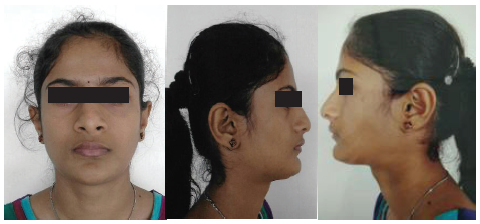
The patient presented with a convex facial profile, posterior facial divergence,Class II relation of the apical bases,a normal maxilla and a retrusive mandible.She had consciously competent lips with recessive chin and a deep mentolabial sulcus.

PRETREATMENT EXTRA ORAL
INTRAORAL EXAMINATION
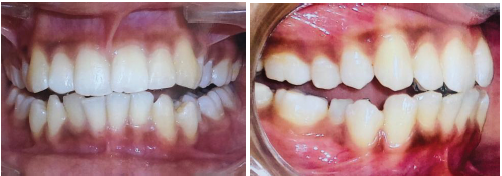
Intraoral examination revealed a Class I molar and Class II canine relation bilaterally, with overjet and overbite of 2mm each.The upper dental midline was shifted to the left by 1 mm.

PRETREATMENT INTRA ORAL
CEPHALOMETRIC VALUES:
The cephalometric values suggest a Class II relationship of the apical bases with normal maxilla (SNA=81degrees),retrognathic mandible (SNB=76degrees) and an average growth pattern.
The dental values indicate proclined lower incisors.
The soft tissue profile indicated a reduced nasolabial angle and recumbent upper and lower lips.
MODEL ANALYSIS:
Bolton’s tooth ratio revealed an overall mandibular tooth material excess of 3.2 mm and anterior mandibular tooth material excess of 0.6mm.
PROBLEM LIST
The patient had a normal maxilla and retrusive mandible with Class II relation of the apical bases.The lower incisors are proclined,with recumbent upper and lower lip.The upper dental midline is shifted to the left side by 1mm.
TREATMENT OBJECTIVES
The treatment objectives were to achieve Class I Skeletal and Dental relationships, correction of incisor proclination and midline shift and to achieve a harmonious soft tissue profile.
TREATMENT PLAN:
Owing to the high esthetic demand and social commitments, the patient was decided to be treated with Lingual Orthodontic braces as the first treatment choice. The case was initially started without extractions which needed further assessment at a later stage since there was a significant amount of tooth material excess.

SETUP SHOWING LINGUAL BONDING
TREATMENT PROGRESS:
The Lingual brackets were bonded indirectly onto the respective models using the Lingual Bracket Angulation and Positioning device (LAPD).The initial as well as the final archwires were fabricated using the arch wires templates according to the palatal surface configuration of the models.
The brackets were transferred to the patients mouth using MEMOSIL silicone impression carrier material and bonding was accomplished using conventional light curing technique.Flexible Nickel Titanium wires were used for decrowding and derotations in the initial stages.Extraction of the second premolars were finally planned to correct the tooth material discrepancy and to achieve an optimum overjet and overbite. Space Closure was done using elastomeric chains following Type B anchorage considerations.
IMMEDIATE POST BONDING
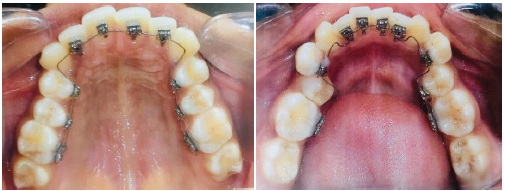
INITIAL MUSHROOM ARCHWIRES IN PLACE

INITIAL MUSHROOM ARCHWIRES IN PLACE

EXTRACTION DONE POST DECROWDING

OCCLUSAL VIEWS POST EXTRACTION
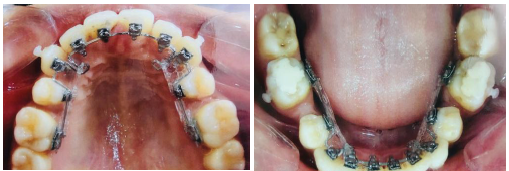
UPPER AND LOWER ARCH RETRACTION
FINISHING AND DETAILING:
The case was finished using 016 round AJ Wilcock Stainless Steel wires and settling was done with Blue elastics using composite buttons.
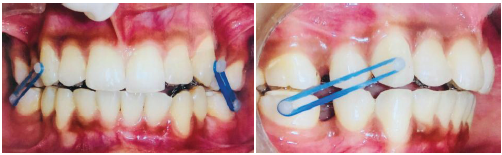
FINISHING AND DETAILING
RETENTION:
The retention for fixed lingual cases is very crucial. Essix retainers along with fixed lingual retention was given for this particular case.

POST TREATMENT INTRAORAL

POST TREATMENT RETENTION

POST TREATMENT EXTRA ORAL
CONCLUSION
Lingual Orthodontics is the most aesthetic and feasible treatment modality , and is the best treatment option for adult patients, since the brackets are invisible. It provides a high level of control for the treatment of all kinds of malocclusions.With the introduction of CAD CAM, small comfortable and reduced friction brackets, the lingual technique today is very reliable and almost as easy as the labial technique. Lingual orthodontics has come of age; its acceptance by both the profession and the patient population continues to grow internationally. The future of lingual orthodontics is dependent on the following three important issues:(1)Advances in technology related to appliance design and laboratory protocols(2)Demographic changes in population age groups—the growth in the number of adult patients seeking orthodontic treatment associated with an increase in affluence and disposable income will create a patient- driven demand for more esthetically acceptable appliances; and(3) Attitudinal changes of orthodontists.
REFERENCES:
- Creekmore T. Lingual orthodontics – Its renaissance. Am J Orthod Dentofac Orthop 1989; 95: 514-520
- Kinya Fujita. New orthodontic treatment with lingual bracket mushroom arch wire appliance. Am J Orthod. 1979
- Kyung HM. The Mushroom Braket Positioner for Lingual Orthodontics. J Clin Orthod. 2002
- Kim TW. New indirect bonding method for Lingual Orthodontics. J Clin Orthod 2000
Disclaimer from Guident
The views and opinions expressed in articles published in Guident are solely those of the authors and do not necessarily reflect the views of the editors, the editorial board or the publisher, Ivory India. Guident does not endorse any product, technique or treatment described. Clinical content is intended for qualified dental and medical professionals and is not a substitute for individual clinical judgement. Guident, its editors and the publisher accept no liability for any consequence arising from the use of information published in the journal.
How to cite this article
Dr. Upasak Mukherjee, Dr. Megha Parikh, Dr. Krishna Nayak US. Treatment of Bimaxillary Protrusion Using Lingual Orthodontics. Guident. 2018 Nov;11(12). Available from: https://ivoryindia.in/articles/orthodontics/treatment-of-bimaxillary-protrusion-using-lingual-orthodontics.html