Down Syndrome: Challenges During Dental Care
Department of Pedodontics and Preventive Dentistry K. D. Dental College, Mathura, U.P. India
INTRODUCTION
Down syndrome earlier referred to as mongolism, currently known as trisomy G or trisomy 21. It is a condition resulting from an abnormality of the human chromosome number 21. The first description of a child who apparently had Down syndrome was given by Esquirol in 1838. Down syndrome is a congenital, autosomal but easily recognized anomaly, which is well-characterized by generalized mental and growth deficiency (Figure 1). The birth prevalence of Down syndrome is generally stated to be 1 in 650 live births, but is known to vary in different populations from 1/600 to 1/2,000 live births

Figure 1: Craniofacial features of Down Syndrome
MANAGEMENT
Across the globe, majority of dental treatment for Down syndrome individuals can take place in a general dental set up with relatively minor adaptations. However, general dental practitioners may be bit hesitant to manage these patients with confidence. This could be due to very little or almost no exposure to manage patients with disabilities during undergraduate dental training.
Dental professionals should keep in mind that the basic treatment objectives for with Down syndrome subjects should be the same as that for normal patients. The overall goal should be to provide as comprehensive treatment as possible, though treatment plans may need to be adapted as necessary due to each individual’s condition.
DENTAL MANAGEMENT
- Down syndrome individuals might present with mental and physical challenges, which can have implications for their oral healthcare. It is essential to obtain and review patient’s medical history before the dental appointment.
- To assemble an accurate medical history, it is quite essential to consult the pediatrician, physician and caregivers. The person who can legally provide informed consent for treatment should also be determined.
- Nearly 40–50% of infants with Down syndrome are born with some type of cardiac abnormality. However, most of these children receive surgical correction within the first few years of life.
- However by adulthood, 50% of individuals with Down syndrome will have Mitral Valve Prolapse (MVP), requiring subacute bacterial endocarditis prophylaxis for the dental treatment.
- Nearly one-third of these Down syndrome subjects with MVP do not have auscultatory findings, which requires diagnosis by an echocardiogram. The Down syndrome patient’s physician should be consulted for medical history and the need for antibiotic prophylaxis.
- Most individuals with Down syndrome are characterized by a compromised immune system with a corresponding decrease the in number of T-cells, which can contribute to a higher rate of infections and extremely high incidence of periodontal disease.
- Even aphthous ulcers, oral candida infections and acute necrotizing ulcerative gingivitis, etc. are quite common among Down syndrome subjects. These individuals might need aggressive management of acute necrotizing ulcerative gingivitis and other oral infections.
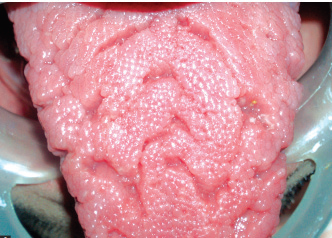
- Chronic upper respiratory infection seen among Down syndrome can contribute to mouth breathing along with xerostomia and fissuring of the tongue and lips (Figure 2). The importance of using fluoride to prevent dental caries associated with xerostomia should be stressed, along with the use of lip balm to ease the strain on patient’s lips. Either the patient or the caregiver should be educated regarding prevention of oral infections with regular check-ups and daily oral care.
- Reduction in muscle tone of the lips and cheeks along with the force of tongue can contribute to an imbalance of forces on the dentition, which can contribute to the open bite often seen in Down syndrome children.
- This reduced muscle tone can also contribute to less efficient chewing and natural cleansing of the dentition. Due to this inefficient chewing, food may remain on the teeth even after eating.
- The ligamentous laxity seen throughout the body of a Down syndrome individual can cause hyperflexibility of the joints and is theorized that the ligaments around teeth may be influenced as well. “Atlanto-axial instability” is another condition related to ligamentous laxity, whose diagnosis and significance is still controversial. This type of increase in mobility between the C1 and C2 cervical vertebrae, which is seen in 10–20% Down syndrome subjects often leads to an unsteady gait and neck pain. Careful positioning in the dental chair is required to avoid any potential harm to the spinal cord for such type of patients.
- Infants with Down syndrome do suffer from seizures, which can be controlled with anticonvulsant medications. During a seizure, Down syndrome child might bite the tongue or cheeks, or even chip teeth. However, controlled seizure disorders can easily be treated in the general dental office. Information about the frequency of seizures and the medications used to control them should be recorded before the appointment by consultation with the physician. The factors that trigger the Down syndrome patient’s seizures should be identified and avoided.
- If a seizure occurs during dental procedure, dental instruments, if at all, are to be taken out from the oral cavity and the surrounding area around the dental chair should be quickly cleared. Rubber dam clamps and mouth props should be tied with dental floss before treatment begins. This will help to remove them quickly. During a seizure, insertion of any objects between the teeth should be avoided. Dental professional should turn the patient to one side and monitor the airway to reduce the risk of aspiration.
BARRIERS IN DENTAL CARE
- Down syndrome individuals are often affected with certain visual impairments such as glaucoma, strabismus (crossed or misaligned eyes) and cataracts. Thus it is optimum to determine the level of assistance that a patient would require to move safely through the dental office.
- Down syndrome patient should be made to feel comfortable using certain tactile feedback, such as a warm handshake. Dental professionals should face their Down syndrome patient while speaking and keep them acquainted of each upcoming dental procedure, especially when water is used.
- Use of clear and evocative language to explain procedures should be relayed upon. The dental professionals should demonstrate how the dental equipment might feel and sound.
- Poor communication skills complicated by hearing impairment can be accommodated with planning. Due to their seeming lack of response to a request, Down syndrome children with a hearing impairment might turn bit stubborn. The sound of some instruments may cause auditory discomfort to the Down syndrome patient. This might lead them to adjust their hearing aids.
- If the patient uses a form of sign language, an interpreter can be asked to come to attend along with the patient during dental procedure. It would be ideal to find out prior to the appointment, if the patient can read lip movement and if that’s the case then the dental professional should speak in a normal soft tone.
- Before the dental professional speaks, all background noise such as television and the suction must be eliminated. Dental professionals should not wear their facemask during speaking or wear a clear face shield. Proper eye contact with the patient should be maintained throughout the treatment.
SLEEP APNEA
- An awareness regarding the incidence of sleep apnea in the Down syndrome subjects is very important to every dental professional. The incidence of upper airway obstruction is reported to be as high as 31% in children with Down syndrome.
- Usually obstructive sleep apnea is predisposed by the decreased airway size combined with lowered muscle tone. Obstructive sleep apnea, if not treated properly, can increase developmental delay and further leading to pulmonary hypotension and congestive heart failure.
- Snoring, restlessness and unusual sleeping positions, etc. are the typical symptoms of sleep apnea. The patient should be referred to a sleep disorders clinic, if the signs and symptoms are proved.
- The management of sleep apnea ranges from occlusal repositioning appliances, positive airway pressure and even surgical correction. It has been found that adenotonsillectomy in Down syndrome patients with sleep apnea has been quite helpful.
INTELLECTUAL SUBNORMALITY INFLUENCING DENTAL CARE AND BEHAVIOR MANAGEMENT
- Many Down syndrome subjects who seek dental treatment have mild or moderate intellectual disability that limits their ability to learn, communicate, and adapt to their environment. Since language development is often impaired in Down syndrome individuals, they usually understand more than they can verbalize.
- Since speaking communication may be difficult for children with Down syndrome, the dental professional should actively listen to them. It is always wise enough to explain each dental procedure, such that Down syndrome patients can understand better. The instruments which are used in dental procedures should be demonstrated properly. The dental professionals should follow use of simple but concrete instructions and repeating them often to compensate for any short-term memory problems.
- Usually Down syndrome tends to be warm and well behaved, thus behavior management may not be a problem. Most of them need a little more extra time and attention to feel more comfortable during clinical procedure. However, one can expect very few as stubborn and uncooperative. The things which can motivate Down syndrome patient should be identified. For example, gifting a new toothbrush at the end of each appointment can ensure cooperation.
- Scheduling early in the day will help to ensure that all are alert and attentive, with reduction in waiting period.
- The stage for a successful dental visit can be set by involving the entire dental team, from the receptionist’s friendly greeting to the caring attitude of the dental assistant in the operatory. It is important to provide oral healthcare in a calm environment with little distractions.
- Down syndrome subjects might enjoy music and may be comforted by hearing it during dental treatment. It is ideal to eliminate unnecessary sounds, sights or other stimuli that might make it difficult for Down syndrome patient to cooperate.
- The Down syndrome child should be made to sit in the dental chair, followed by an oral examination using only fingers. Dental instruments can be used only once the patient is completely comfortable.
- Dental procedure should start with oral prophylaxis, followed by dental radiographs, which might need several visits to accomplish all tasks.
- Consistency in all aspects of providing oral health care should be tried. To sustain familiarity, it is ideal to use same dental operatory, dental staff, appointment times and other details. Down syndrome patients will be more likely cooperative, if one tries to provide more consistency.
- Rewarding cooperative behavior with compliments throughout the appointment will work wonders.
- Use of immobilization techniques should be restricted only when absolutely necessary, in order to protect the patient and dental staff during treatment. If at all it is used, it should not cause physical injury or undue discomfort to the patient.
OROFACIAL FEATURES INFLUENCING DENTAL CARE
- Though true macroglossia is a rarity among Down syndrome children; a relative macroglossia is found where the tongue is of normal size but the oral cavity is decreased in size due to the underdevelopment of the midface.
- Due to a small nasal airway, the incidence of mouth breathing can be high. The palate appears to be narrow with a high vault, which appears due to abnormal thickness of the hard palate (Figure 3). This creates less space in the oral cavity for the tongue, affecting both speech and mastication.
- Efforts should be made to teach them regarding correct tongue positioning and increasing the tone of the orofacial musculature. In extreme cases, surgical reduction of the tongue may be indicated.
- Down syndrome subjects with relative macroglossia were treated with partial glossectomies with positive outcomes, like less tongue protrusion, better speech and pronunciation, less upper respiratory tract infection, increased ability to maintain a closed mouth, better mastication and drinking, better self-confidence and pleased parents.
- Adenotonsillectomies performed in Down syndrome patients brought improvement in sleep apnea, reduced mouth breathing, reduced snoring and nasal drainage.

Figure 3: High Arched palate with significant reduction in arch length.
- Open bite condition in young Down syndrome patients can be treated by CastilloMorales’ Orofacial Therapy, which consists of two parts: (1) a manual stimulation and facilitation program and (2) palatal stimulation by removable orthodontic plate, modified by Castillo-Morales.
- Down syndrome subjects usually present with fissured, where food particles get accumulated leading to halitosis. This can be avoided by regular brushing of the dorsal surface of the tongue.
- Delayed eruption of dentition is a common finding among Down syndrome children, which may occur as long as 2–3 years in an unusual order. In children with Down syndrome, the diet may need to be altered because of lack of enough teeth to chew food items.
- Selective extractions under the supervision of an orthodontist may be of beneficial to those Down syndrome patients with severe crowding in permanent dentition. Spacing caused by microdontia can be corrected either by restorations or orthodontic intervention.
- The clinical and radiographic examination of Down syndrome child, during the time of first birthday and regularly, will help to identify unusual tooth formation and patterns of eruption.
- A panoramic radiograph is recommended as patients often find this technique less threatening than individual films.
- As preventive measure, topical fluoride application should be considered.
- Maintenance of primary dentition is essential and placement of space maintainers can be considered in case of premature loss of primary dentition.
- Teeth affected with hypocalcification should be kept under proper observation for early onset of dental caries.
- Pit and fissure sealants to restorations to full-crown coverage can be considered depending on the degree of hypoplasia.
- Traumatic injuries to the oral cavity are quite common among Down syndrome children due to incidence of falls or accidents. The special school should be equipped with a tooth-saving kit.
- The teachers or the caregivers should be instructed to locate either the avulsed tooth or even missing pieces of a fractured tooth. The radiographs of the patient’s chest may be necessary to determine if any fractured fragments have been aspirated.
- It has been observed that the abuse of children with disability is more common than the general population, often presenting with trauma to the oral cavity. It is the duty of the dental professional to report, in case if he suspects a child is being abused or neglected.
- By contrast, some individuals with Down syndrome are at an increased risk of dental caries (Figure 4) due to xerostomia, consumption of cariogenic food items, hypotonia contributing to chewing problems and inefficient natural cleansing action, etc.

Figure 4: High caries incidences
- Down syndrome children, who are on medication that can cause xerostomia, or their caretakers should be advised about drinking water often. Rinsing with water after consumption of syrup or prescription of sugarfree medicines is recommended.
- Due to poor periodontal health among Down syndrome individuals, large number of permanent anterior teeth is lost in their early teens. Daily use of an antimicrobial agent such as chlorhexidine is highly recommended for Down syndrome individuals, who do not have swallowing difficulties or one can expectorate properly.
- Proper tooth-brushing methods, toothbrush adaptations and flossing procedures should be demonstrated to Down syndrome individuals. A power toothbrush or a floss holder can simplify oral care. Emphasis should be on a consistent approach to oral hygiene.
- Malocclusions are very frequent symptoms of Down syndrome and show a high degree of severity in these cases. The possibilities and success of treatment are limited by the ability and skills needed to ensure compliance in oral hygiene and in the use of removable or fixed appliances.
- According to Waldman et al. treatment approach should emphasize a series of important steps including the following: 1. making the parents/guardians fully responsible for the oral hygiene, caries prevention prophylaxis and appliance care; 2. Using of behavior modification for particularly difficult procedures; 3. Redesigning appliances that are less patient-reliant.
- Along with standard orthodontic treatment plans, services for patients with Down syndrome may require steps to improve chewing, swallowing, nasal breathing, speech and orofacial functioning. Therapeutic exercises that do not require conscious co-operation from the patient may need to be instituted in a working relationship with myofunctional therapists.
- Many different adjunctive treatment modalities are available to the profession of dentistry today, several of which have not been previously explored in the orthodontic specialty. By familiarizing themselves with these, orthodontists can plan varied combinations of modalities.
CONCLUSION
Due to the fact that population of Down syndrome is increasing dramatically, advanced and continuing education programs will need to prepare not only for general and pediatric practitioners, but also for the orthodontists. The true measure of the society lies in the way it treats its disabled, disadvantaged citizen, as it is a perceptive reflection of its cultural level.
Disclaimer from Guident
The views and opinions expressed in articles published in Guident are solely those of the authors and do not necessarily reflect the views of the editors, the editorial board or the publisher, Ivory India. Guident does not endorse any product, technique or treatment described. Clinical content is intended for qualified dental and medical professionals and is not a substitute for individual clinical judgement. Guident, its editors and the publisher accept no liability for any consequence arising from the use of information published in the journal.
How to cite this article
Dr. Priya Verma. Down Syndrome: Challenges During Dental Care. Guident. 2018 Oct;11(11). Available from: https://ivoryindia.in/articles/pedodontics/down-syndrome-challenges-during-dental-care.html