Comparative Clinical Study on Correlation of Working Length Determination Using Three Different Electronic Apex Locator
Department Of Conservative Dentistry And Endodontics Seema Dental College And Hospital, Rishikesh
A successful endodontic treatment depends on many fundamental factors, in which one of the key factors is accurate Working Length determination. Accurate determination of the root canal length from the coronal orifice to the apical foramen is critical in the endodontic management of the root canal space. At the apical foramen, the cementodentinal junction (CDJ) or minor constriction is the land-mark that anatomically and histologically determines where the pulp ends and the peri-odontal ligament begins1.
Root canal preparation techniques attempt to use this natural barrier as the endpoint for canal preparation2. However, Lee et al.3found that almost 50% of teeth evaluated had no distinguishable CDJ. Therefore, the CDJ should be thought of as a histologic and not a morphologic landmark4. Historically, radiographs have been the primary means for deter-mining the working length in endodontic therapy. However, radio-graphs have inherent limitations, the most important being they are two-dimensional images of three-dimensional objects. This is further complicated by situations in which superimposition of anatomic structures such as the zygomatic arch or adjacent roots occur over the roots of teeth requiring endodontic therapy.5
Variation in root-end morphology as studied in the works of Kuttler4 in 1955, Green6 in 1956, and Dummer et al.7 in 1984 showed that radio-graphic interpretation alone cannot be depended on alone to establish the working length and that electronic determination is necessary.
Electronic apex location began in 1942 with studies by Suzuki8. He discovered that a constant electrical resistance of approximately 6.5 kU existed between the periodontium and oral mucous membranein vivo. In 1962, Sunada9formulated his principle of ‘‘biological characteristic theory,’’ stating that electrical resistance values between the periodontal ligament and the oral mucosa can be determined by electronic means.
To decrease radiographic exposure and the rate of overestimation of root canal length, EALs are broadly used in endodontics to determine WL during root canal treatment.10,11 Nowadays, the most broadly used EAL is Root-ZX (J. Morita, Tokyo, Japan), which concurrently measures the impedance values at two frequencies (0.4 and 8.0 kHz) and then calculates their quotient.12 The other EAL that has attracted attention is the Canal Pro COMPACT Apex Locator that uses voltage difference and operates based on the principle that in addition to the difference of impedance measurement between two electrodes, it shows a great difference at an apical constriction region.
The main purpose of this in-vivo study was to evaluate the accuracy of one EAL most widely used in clinical practice, the Canal Pro COMPACT Apex Locator, JW Moritta Apex locator, IPex NSK, Pixi-Dentsply.
MATERIAL AND METHOD
The in-vivo study was conducted in the Department of Conservative dentistry & Endodontics, Seema Dental College and Hospital, Rishikesh. An informed written consent was obtained from each patient before the treatment. Forty single rooted teeth were with mature apices and straight roots, which have been randomly selected, were used in this study. After local anaesthesia, each tooth was isolated with rubber dam and pulp cavity was accessed with tungsten carbide bur in high speed handpiece under abundant water spray. Any metal restoration was completely removed. Next the coronal and middle root canal thirds were preflared with orifice shaper 1,2 (DentsplyMaillefer, Ballaigues, Switzerland) under continuous irrigation with 1% NaOCl. EAL was used for working lengt determination according to the manufacture instructions. The lip clip was attached to the patient’s lip and the electrode of the apex locator was connected to the stainless steel file inside the root canal. The file was introduced as far as the display of the EAL indicate the apial foramen. After identifying the apical limit , the rubber stop was adjusted on the file shaft so that it touched the reference point. The instrument was carefully withdrawn and distance from the tip of the instrument to the rubber stop was measured and values were recorded. The instrument with the measurement was re-introduced into the root canal again and the working length was re confirmed by recording three angulation RVG x-ray images. single operator with 5 years of experience recorded the data .
After determining the length of all canals by these methods, the statistical data was collected.
RESULT
Sample values Falling Short, Long, or within0.5 mm from the Actual Canal Lengths
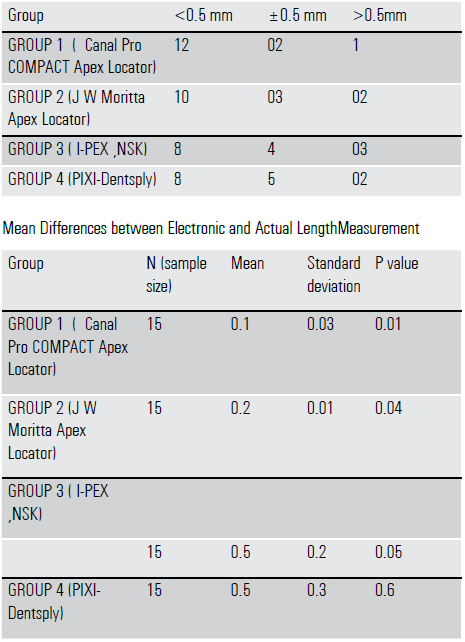

Graph 1. Sample values falling short, long or within 0.5 mm from actual root length

Graph 2. Mean difference between electronic and actual length measurement
Positive values indicate means longer than the actual canal lengths. Negative values indicate means shorter than the actual canal lengths. Statistical test used was chi square test.
DISCUSSION
The main purpose of this in vivo study was to evaluate the accuracy of one EAL most widely used in clinical practice, The JW MORITA , I PEX - NSK , PIXI DENTSPLY and the COLTENE - Canal Pro COMPACT Apex Locator . Since the introduction of EALs, numerous in vitro and in vivostudies have evaluated the accuracy of these devices in determining WL. In a study by Shabahang et al14 the reported value for jw morita was 96.2%. In another study, Pagavino et al15 showed that the I PEX - NSK was accurate 82.75% within ±0.5 mm and 100% within ±1 mm in determining WL from apical foramen. D’Assunção et al16 in an ex vivostudy showed that the accuracy of Pixi Dentsply in determining the apical foramen was 82.1% within ±0.5 mm. The apical end point used in that study was the apical foramen.
Historically, radiographs have been the primary means for deter- mining the working length in endodontic therapy. However, radio- graphs have inherent limitations, the most important being they are two-dimensional images of three-dimensional objects. This is further complicated by situations in which superimposition of anatomic structures such as the zygomatic arch or adjacent roots occur over the roots of teeth requiring endodontic therapy13. Variation in root-end morphology as studied in the works of Kuttler4 in 1955, Green14 in 1956, and Dummer et al.15 in 1984 showed that radio- graphic interpretation alone cannot be depended on alone to establish the working length and that electronic determination is necessary.
There has been controversy as to whether EALs are able to deter- mine the minor constriction or the major foramen. According to the manufacturer16, the RZX meter’s 0.5 reading indicates that the tip of the file is in the apical constriction. In what many consider to be the benchmark for testing apex locators, the in vivo/vitro method of Shabahang et al.9 used the 0.5 reading in testing the Root ZX’s accuracy. However, Mayeda et al.17 had previously concluded that EALs are only capable of detecting the major foramen. Ounsi and Naaman10 confirmed this point in 1999, concluding that ‘‘The Root ZX is not capable of detecting the ‘0.5 mm from the foramen’ position and thus, should only be used to detect the foramen (major diameter).’’ Lee et al.3 found that file tips ended in the area of the major foramen regardless of the CDJ presence and that the major foramen is a better level to test for EAL accuracy. Recently, Herrera et al.18 found that the diameter of the files used to determine working lengths with Root ZX had no significant effect until the apical widths were instrumented to a diameter of 1.02 mm. ElYuti et al.
The difference between these studies is in appointing the reference point from which measure-ment accuracy is determined. Some authors measured from the minor diameter, while others measured from the major foramen or apical foramen. The apical limit in our study was apical constriction (0.5 mm shorter than apical foramen), and the results of our study showed that the accuracy of the CanalPro COMPACT Apex Locator was 85% within ±0.5 mm and 97.5% within ±1 mm, whereas it was 85% within ±0.5 mm and 92.5% within ±1 mm for J W Moritta .
In another in vitrostudy, which had been done in retreatment cases, the electronic measurements obtained with canal pro apex locator showed an accuracy of 85% (within ±0.5 mm of the apical foramen).13 In an in vivostudy conducted by Shahi et al17, it was concluded that the accuracy of canal Propex locator was more than traditional radiographic technique (74.7 vs68%). Furthermore, one study evaluated the ability of in detecting the position of the horizontal root fracture in extracted teeth and showed the accuracy of 70% within ±0.5 mm of the fracture line. In general, we can say that similar to previous studies,18,19 our study showed no significant difference between and Coltene CanalPro COMPACT Apex Locator and JWMoritta .
REFERENCES
- Grove C. Why canals should be filled to the dentinocemental junction. J Am Dent Assoc 1930;17:293–6.
- Schilder H. Filling root canals in three dimensions. Dent Clin North Am 1967;11: 723–44.
- Lee SJ, Nam KC, Kim YJ, et al. Clinical accuracy of a new apex locator with an auto-matic compensation circuit. J Endod 2002;28:706–9.
- Kuttler Y. Microscopic investigation of root apexes. J Am Dent Assoc 1955;50:544–52.
- Tamse A, Kaffe I, Fishel D. Zygomatic arch interference with correct radiographic diagnosis in maxillary molar endodontics. Oral Surg Oral Med Oral Pathol 1980;50:563–6.
- Green D. A stereomicroscopic study of the root apices of 400 maxillary and mandib-ular anterior teeth. Oral Surg Oral Med Oral Pathol 1956;9:1224–32.
- Dummer PM, McGinn JH, Rees DG. The position and topography of the apical canal constriction and apical constriction. Int Endod J 1984;17:192–8.
- Suzuki K. Experimental study on iontophoresis. Japanese J Stomatol 1942;16:411–29.
- Sunada I. New method for measuring the length of the root canal. J Dent Res 1962;41:375–87.
- ElAyouti A, Weiger R, Löst C. The ability of root ZX apex locator to reduce the frequency of overestimated radiographic working length. J Endod 2002 Feb;28(2):116-119.
- Ravanshad S, Adl A, Anvar J. Effect of working length mea-surement by electronic apex locator or radiography on the adequacy of final working length: a randomized clinical trial. J Endod 2010 Nov;36(11):1753-1756.
- Kobayashi C, Suda H. New electronic canal measuring device based on the ratio method. J Endod 1994 Mar;20(3):111-114.
- D’Assunção FL, de Albuquerque DS, de Queiroz Ferreira LC. The ability of two apex locators to locate the apical foramen: an in vitrostudy. J Endod 2006 Jun;32(6):560-562.
- Shabahang S, Goon WW, Gluskin AH. An in vivo evaluation of Root ZX electronic apex locator. J Endod 1996 Nov;22(11):616-618.
- Pagavino G, Pace R, Baccetti T. A SEM study of in vivoaccuracy of the Root ZX electronic apex locator. J Endod 1998 Jun;24(6):438-441.
- D’Assunção FL, Albuquerque DS, Salazar-Silva JR, Dos Santos VC, Sousa JC. Ex vivoevaluation of the accuracy and coefficient of repeatability of three electronic apex loca-tors using a simple mounting model: a preliminary report. Int Endod J 2010 Apr;43(4):269-274.
- Goldberg F, Marroquín BB, Frajlich S, Dreyer C. In vitro evaluation of the ability of three apex locators to deter-mine the working length during retreatment. J Endod 2005 Sep;31(9):676-678.
- Shahi S, Rahimi S, Milani AS, Asghari Jafarabadi M, Djoorabbaf Naghsh GR. Comparison between the accuracy of novapex apex locator and radiographs in determining radiographic apex. Iran Endod J 2011 Spring;6(2):65-68.
- Goldberg F, Frajlich S, Kuttler S, Manzur E, Briseño-Marroquín B. The evaluation of four electronic apex locators in teeth with simulated horizontal oblique root fractures. J Endod 2008 Dec;34(12):1497-1499
Disclaimer from Guident
The views and opinions expressed in articles published in Guident are solely those of the authors and do not necessarily reflect the views of the editors, the editorial board or the publisher, Ivory India. Guident does not endorse any product, technique or treatment described. Clinical content is intended for qualified dental and medical professionals and is not a substitute for individual clinical judgement. Guident, its editors and the publisher accept no liability for any consequence arising from the use of information published in the journal.
How to cite this article
Dr. Annil Dhingra, Dr. Anshdeep Singh. Comparative Clinical Study on Correlation of Working Length Determination Using Three Different Electronic Apex Locator. Guident. 2018 Oct;11(11). Available from: https://ivoryindia.in/articles/research/comparative-clinical-study-on-correlation-of-working-length-determination-using-three-different-electronic.html