Direct Metal LASER Sintering
Department of Prosthodontics Ame, s Dental College & Hospital, Raichur, India
Abstract
Digital technology is growing rapidly and controls almost every aspect of life and dentistry is not exception to it .Today s time requires all manufactures to respond quickly to customers demand just shortening development time. One such imported technology is direct metal laser sintering for metal casting. The direct metal laser sintering is one of the current method. It is able to prototype any kind of material. This technology generates real 3D parts from layer by layer addition of fused metal powder. The aim of this paper is to highlight few points on direct metal laser sintering and its importance.
Key words: additive technology, SLM, rapid prototyping, DMLS technology.
INTRODUCTION
DMLS was developed jointly by RPI (raid product innovation) and EOS. It has been commercially available since 1995.1It is the first commercial rapid prototyping method to produce metal in a single process. DMLS is an additive metal fabrication technology2. This technology will help us to fabricate 3 dimensional parts directly from CAD data. The rapid prototyping uses metal powder for sintering and quick production of complex shaped 3 dimensional parts can be fabricated.
DLMS has the ability to produce fine features and thin walls with good accuracy, resolution and mechanical properties of the finished parts. With DMLS it is possible to design organic geometries, internal features and challenging passages that could not be cast or otherwise machined. The correct choice of layer thickness(0.02mm -0.04mm) is especially important with respect to accuracy and speed of production(thinner layer means higher accuracy but extended production time3.
DMLS PROCESS
After tooth preparation traditional or former digital work flow can be followed. Once the virtual models are obtained the designing of the restoration will take place and the STL file will be transferred to the central processing unit. The CAM software further slices the parts into discrete horizontal layers.
DMLS PRINCIPLE
The DMLS process is performed by two different methods powder deposition and power bed method4. The powder bed method is popular as they offer faster speed. The method differs by the way the powder is applied. The laser beam in DMLS is used to melt metal powder locally and fuse into solid parts .Parts are construction as a additive layer one layer at a time usually 20micrometer thick.
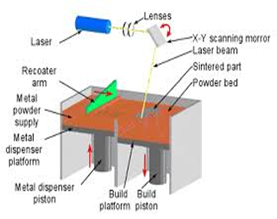
Figure-1
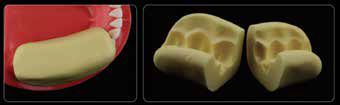
There are 2 platforms in the build chamber area.1) material dispersing platform 2)build platform(figure-1). The production of object is performed in an atmosphere of inert gas argon. The metal melts at a temperature of 15100 c to 16000 c. Material dispensing platform along with the re-coater blade is used to move new powder over the build platform. The re-coater blade can move without collision when material dispensing platform and build platform are lowered by one layer thickness. The re-coater is positioned at right the material dispenser platform will raise to supply the amount of powder5. The roller will move right to left to spread the metal powder and also from material dispensing platform to build platform. The excess metal powder will fall into collector. Next the head scan moves the laser beam and the metal powder are fused into a solid part by sintering. They are built additive layer by layer usually 20 micron meter thick. After each layer the build platform is lowered by the build piston and most layer of powder is applied. The metal parts of the most complex geometries are built layer by layer directly from 3D CAD data in DMLS process. The process is automatic and will be completed within just a few hours6. The laser job can be started only for production and bridge framework if there are sufficient number of crown (figure-2) coping.(usually 90-120 units). The created parts in DMLS is very accurate, high resolution great surface quality and excellent mechanical properties.

Figure-2
Materials
The most used metallic materials for DMLS manufacturing are Ti6AL 4V, Ti-Ni alloy, Stainless steel alloy304 or 36L and Cobalt chromium alloy7-9.
The cobalt chromium metal powder is used for crown and bridges .They are spherical (Figure-3) in morphology and 2micron m is the grain size10. The crown obtained from DMLS process present superior mechanical properties. The DMLS cobalt chromium alloy exhibits good fitting and higher adhesion strength to porcelain. The surface roughness is 4 times higher when compared to cast alloys. The higher hardness and more homogenous microstructure of cobalt chromium alloy exhibits high wear and corrosion resistance. This material exhibits higher tensile strength of1300mpa11,high yield strength of 720mpa.The titanium alloy powder is 10-45 micron m. Their chemical composition in dental implants is Ti more than 99% and other ingredients less than 1%(N,C,H,Fe O2)12.stainless steel(GPI) is characterized by good mechanical properties and highly corrosion resistance. The material is used for production of functional metal prototypes or spare parts. Composition of steel corresponds to US classification 17-4 and European 1.4542.the chemical constituents are Mn,Mo,Ni,Si,C,Cr,Cu13.

Figure-3
Applications
Prosthetic dentistry 14
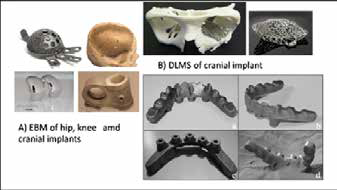
materials used are thermoplastic polymers, waxes, metal alloys, ceramic and thermoplastic composites. 2) Maxillofacial prosthesis, functional skeleton and industrial scaffolds for tissue engineering can be fabricated of composites and polymer.3) Crowns, bridges, dental implants frame work for partial denture can be constructed ( figure-4).
ii) Medical: surgical tools or implantable grade materials are manufactured for 17-4 PH ,15-5 PH,Cobalt chrome,titanium64
iii) Other applications: aerospace: laser sintered parts have been steadily embraced by the aerospace industry Inco625, Inco 718, 316SS ,cobalt chrome and materials titanium-64 and aluminium are excellent lightweight materials for space industry.
Advantages
1) Low material consumption.2) high strength.3) high toughness of manufactured parts .4) reduction of cost and production time 5 )production of part directly for 3D CAD data from the customer 6)automatic operation of the machine.15
Disadvantages
1) high strength alloys 2)broad variety of alloys3)excellent for small feature 4) need for finishing operation5) machine is energy intensive
DMLS 3D printers
:1) EOS 400-print metal parts at industrial scale 2)EOS M100 3)EOSM280 4)EOSM290 is the number one 3D printer of high quality for 3D metal parts. And 5) The Precious MO80 allows for additive manufacturing of jewellery and watch making.
CONCLUSION
the digitalized process is growing rapidly and its advancement will continue making the computerized technique cost effective. Parts built using direct metal laser sintering have excellent properties equivalent to wrought materials,high detail resolution and exceptional surface quality.
REFERENCES
- Laboratório de Otimização, Projeto e Controle Avançado (LOPCA), Faculdade de Engenharia Quimica, UniversidadeEstadual de Campinas, Av albert Einstein.DMLS technology for design and construction of microreactor. 6th Brazilian conference on manufacturing engineering-2011
- K.Vijay venkatesh, V.Vidyashree nandini.Direct metal laser sintering .J Indian Prosthodont Soc (Oct-Dec 2013) 13(4):389–392
- Duda, T., & Raghavan, L. V. (2016). 3D metal printing technology. IFAC-PapersOnLine, 49(29), 103-109
- DMLS (2011) retrieved on 13 Jun 2012 from http://custompartnet.com/wu/direc- laser-sintering. Accessed 13 June 2012 .
- Bineli, A.R.R, Peres, A.P.G, Bernardes, L.F, Jardini, A.L, Maciel Filho, R., 2010, "Design of microreactor by integration of reverse engineering and direct metal laser sintering process" Proceedings of 5th international workshop on hydrogen and fuel cells. Campinas EOS, 2009, "EOSint M 270 User Manual
- Ortorp A, Jonson D, Mouhsen A, Vult von Steyern P (2011) The fit of cobalt- chromium three unit fixed dental prostheses fabricated with 4 different techniques: comparative in vitro study. Dent Mater 27:356–363
- A. F. von Recum Handbook of Biomaterials-Evaluation, 2nd ed., 1999
- ] H. V. Buf and G. BuÅŸilă, “Technologies and installation for titanium powder manufacturing,” in Proc. Third Conference in Powder metallurgy, Cluj-Napoca, pp. 169-174, 1998 D. I. Băilă, O. C. Mocioiu, C. Zaharia, R. Trusca, A. Surdu, and M. Bunea, Rev. Roum. Chim, vol. 60, no. 9, pp. 921-930, 2015
- D. R. Buddy, S. Hoffman, F. Schoen, and J. Lemons, BiomaterialsScience, An Introduction to Materials in Medicine, 3rd ed., Academic Press, 2013
- Wu L, Zhu H, Gai X, Wang Y. Evaluation of the mechanical properties and porcelain bond strength of cobaltchromium dental alloy fabricated by selective laser melting. J Prosthet Dent. 2014 Jan;111(1):51-5.
- Diana-Irinel Bailal. Dental Restorations of Co-Cr Using Direct Metal Laser Sintering Process International Journal of Materials, Mechanics and Manufacturing, Vol. 6, No. 2, April 2018
- Chua, C. K., & Leong, K. F. (2014). 3D Printing and Additive Manufacturing: Principles and Applications (with Companion Media Pack) of Rapid Prototyping Fourth Edition. World Scientific Publishing Company.
- C. Larsson Wexell, P. Thomsen, B.-O. Aronsson et al., “Bone response to surface-modified titanium implants: studies on the early tissue response to implants with different surface characteristics,” International Journal of Biomaterials, vol. 2013, Article ID 412482, 10 pages, 2013.
- Badiru, A. B., Valencia, V. V., & Liu, D. (Eds.). (2017). Additive manufacturing handbook: product development for the defense industry. CRC Press
Disclaimer from Guident
The views and opinions expressed in articles published in Guident are solely those of the authors and do not necessarily reflect the views of the editors, the editorial board or the publisher, Ivory India. Guident does not endorse any product, technique or treatment described. Clinical content is intended for qualified dental and medical professionals and is not a substitute for individual clinical judgement. Guident, its editors and the publisher accept no liability for any consequence arising from the use of information published in the journal.
How to cite this article
Dr. Subashani, Dr. Sunil Dhaded. Direct Metal LASER Sintering. Guident. 2019 Apr;12(5). Available from: https://ivoryindia.in/articles/prosthodontics/direct-metal-laser-sintering.html