Magnet Retained Cheek Plumper in Complete Denture-a Case Report
Department of Prosthodontics & Implantology, Post Graduate Institute of Dental Sciences, Pt. B.D Sharma University of Health Sciences, Rohtak, Haryana, India
ABSTRACT
Facial esthetics plays a crucial role in establishing the psychology of patients. There is an enhanced rate of resorption of the alveolar ridges and also a reduced muscle tonicity, both of which leads to sinking of cheeks. Rehabilitating an entirely edentulous patient not only just dentally but also facially will lead to an esthetic change. This causes an increase in the patient's self-confidence and their willingness to interact socially. This clinical report discusses a method to give support for cheeks that have sunken due to reduced muscle tonicity by utilizing magnet retained detachable acrylic cheek plumpers. The new generation of magnets featuring with enhanced modern technology offers sufficient denture retention for clinical needs. Nevertheless, more follow-up may be required to establish the long-term usefulness of the magnet-retained prosthesis, due to corrosion and more loss of magnetism.
Keywords: Aging, Esthetics, Magnets, detachable cheek plumper, Sunken cheek
INTRODUCTION
Denture esthetics begins with the initial step as one of the goals of impression making. An important role is played by a prosthodontist in restoring the following losses in the individual because of aging consisting of: loss of teeth, reduced tonicity of musculature, loss of alveolar process & decreased elasticity of skin along with impairment of function.1 Gradual and consistent resorption of the alveolar bone triggers a decrease in the tonicity of the facial muscles.2 The fullness of the cheeks is mainly established by the support supplied by internal structures, i.e., teeth and also ridges. Loss of teeth and connected bone loss causes the cheeks to apparently move inwards leading to an unaesthetic facial look.3 Age additionally decreases the concavity and pout of the upper lip and straightens the philtrum. The nasolabial groove deepens which produces a sagging look in the face’s center third, while atrophy of the subcutaneous fat and also of buccal fat pads creates hollowed out cheeks.2 Plunged or hollow cheeks can lookwise add on years to a person's age and thus have a damaging psychological impact on the patient.3
Rehabilitating a patient having teeth loss with the help of dentures might result in increased self-confidence and also social interactions due to positive esthetic changes. But in some cases, the denture flanges do not provide sufficient support to the facial muscles. In order to handle with the problem of slumped tissue, additional support might be required. This is accomplished with the help of cheek plumper, also called as cheek lifting appliance which is primarily a prosthesis to give support to the cheeks thereby making them plump and providing a youthful appearance.4
A traditional cheek plumper in complete denture prosthesis is a solitary unit prosthesis with extension near premolar–molar region which support the cheek. Significant flaw in this design is the raised weight of the prosthesis. Additionally, the mesiodistal size may impede placement especially in microstomia cases. Detachable plumper prosthesis is therefore more useful. In a complete denture with detachable plumper prosthesis, plumper component can be removed.5
This clinical report highlights the use of a detachable cheek plumper prosthesis in a completely edentulous patient with hollow cheek by using magnets.
CASE REPORT
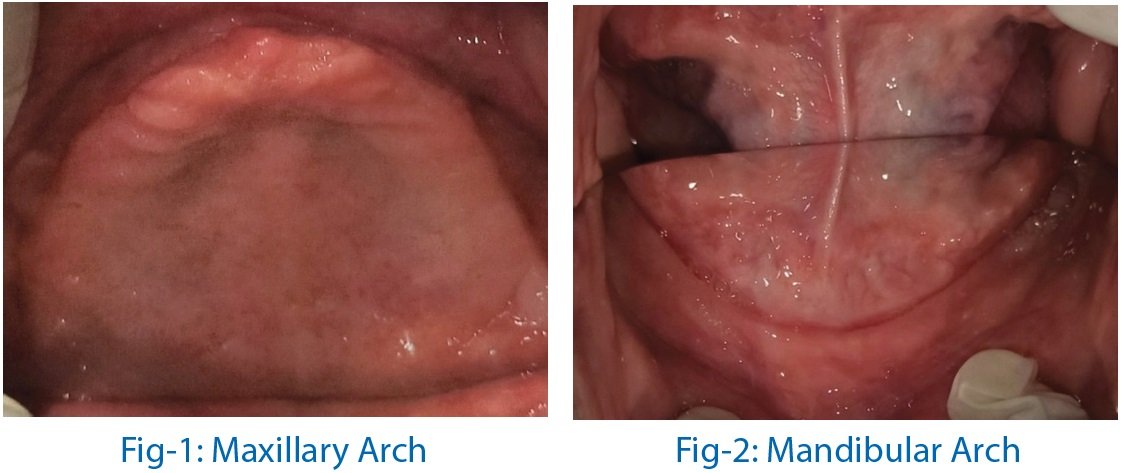
A 65 year old male patient reported to Department of Prosthodontics and Crown & Bridge, PGIDS, Rohtak, with chief complaint of replacement of existing dentures. Patient had started losing his teeth about 10 years ago due to mobility (Chronic generalized periodontitis) and was edentulous for the past 6 years. Extraoral examination revealed sagging of cheeks as one of the major finding. In Intraoral examination, the individual had an entirely edentulous maxillary and mandibular arch. The patient was conscious of his general facial appearance and wanted to have a prosthesis which would certainly make his facial appearance fuller and healthier. Treatment strategy was formulated, keeping in mind the patient’s demand. Decision was made to give patient a complete dentures set in which the maxillary denture will be having detachable cheek plumpers.
TREATMENT PLAN
The shape of the upper and lower ridges were U-shaped and lower ridge was resorbed.(Fig. 1.a & b).

Fig. 1.a: Maxillary completely edentulous arches & Fig. 1. b: Mandibular completely edentulous arches
Primary impressions of maxillary and mandibular arches were made using impression compound material (Y Dents, MDM Corporation, Delhi). Customized trays were made using autopolymerizing acrylic resin. Low fusing compound (DPI Pinnacle, The Bombay Burmah Trading Corporation Limited, Mumbai, India) was used for the border moulding of maxillary and mandibular arch border moulding was done with admixed impression technique and zinc oxide eugenol impression paste (Denzomix, Mixodent, India) as wash impression (Fig. 2).

Fig. 2: Mandibular final impression
At the jaw relation stage, (Fig. 3) imperceptible change in the sunken cheek appearance was noticed. Thus, patient was given the option of cheek plumper and explained, to which he readily agreed. Hence maxillary complete dentures with cheek plumpers retained by intraoral closed faced magnets were planned.

Fig. 3: Jaw relation recorded
At the try in stage, cheek plumpers were made as separate portions in wax and contoured (Fig. 4). The dimensions on right side were 1.5 cm in length, 0.9 cm in width, 1 cm in thickness and 3 cm in length, 1.7 cm in width, and 1 cm in thickness on left side. Acrylisation of trial denture and cheek plumper was done separately (Fig. 5). After finishing and polishing, provision for magnet was made both in denture and plumpers (Fig. 6.a & b) and magnets (5mm in diameter & 2mm in thickness) were placed in the hollow cavity. A layer of petroleum jelly applied on the magnet helped prevent monomer reacting on the surface of magnets and was sealed with autopolymerising clear acrylic resin (Fig.7). After that dentures were inserted in mouth alongwith cheek plumper (Fig. 8). Patients were instructed on the placement and removal of the plumpers. The strong magnetic pull helped in orienting the cheek plumpers. Care was taken to make sure that cheek plumpers do not hinder the opening, closing and lateral movements of the mandible. Thus, magnet retained detachable cheek plumpers were delivered to the patients and they were satisfied with the esthetics achieved (Fig. 9. a & b).

Fig. 4: Frontal view showing waxed plumpers

Fig. 5: Maxillary & mandibular finished dentures alongwith plumpers

Fig. 6a: Provision made in plumpers for the attachment of magnets & Fig. 6b: Provision made in denture for the attachment of magnets

Fig. 7:Magnets attached to the denture with self-cure acrylic resin

Fig. 8: Denture with plumpers in patient’s mouth

Fig. 9a: Preoperative frontal view & Fig. 9b: Postoperative frontal views
For this reason complete dentures with detachable cheek plumpers which could be replaced by patients were designed with the mode of attachment being intraoral closed faced magnets. They were made according to the amount of available space intraorally needed to improve the appearance of the face and also the thickness which will not hinder the functional movements.
DISCUSSION
According to GPT, denture esthetics is defined as the effect produced by a dental prosthesis that affects the beauty and attractiveness of the person.6
Because of the aging process a drastic change consisting of tissue atrophy, exaggeration of folds and also creases of face occurs in the facial esthetics. This occurs particularly due to loss of support by the alveolar bone and also teeth resulting in collapse of the lower third of the face.1
The loss of support of these muscles leads to a typical facial appearance. There is a deepening of the nasolabial fold, a drooping of the mouth corners, and also a loss of vermilion border. There is a depression of the lips, with overstated wrinkling. A loss of vertical face height makes the chin much more prominent. The regular contours of the philtrum and mentolabial sulcus are altered.7
The cheeks are less mobile than the lips and are supported on three sides: foundations that are subject to little change: the zygoma above, the mandible below, and in the posterior region the parotid gland overlying the masseter muscle. Additional built-in support is provided by subcutaneous fat and buccal fat pads, and this support is responsible for the soft, rounded contours of the cheeks in the lower third of the face. Further support is provided the cheeks by the posterior teeth and their supporting structures. Due to the loss of posterior teeth, the cheeks tend to collapse inwards to varying degrees and move medially to meet the expanding tongue’s lateral aspect. Losses of subcutaneous fat as well as elasticity of connective tissue generate the hollow cheeks seen in the aged patients.9
Complete denture prosthesis need to help in supporting the slumped tissue. Traditional methods either by enhancing the thickness of maxillary and mandibular denture’s thickness such that vestibular fornix is ï¬Âlled with proper facial contours or by organizing second row of teeth for esthetic reasons has actually been reported in the literature.1 Various other methods such as adding bulk in the premolar area to support the cheek has been adhered to till this time.4
Larsen et al. advocated making of maxillary removable partial denture framework with a retentive mesh in the bicuspid region which was strengthened with modelling plastic to get desirable contours on analysis of speech and esthetics. Wax was later on substituted with autopolymerising resin.4
Keni et al. explained a technique to support contracted cheeks with a detachable cheek plumper making use of customized attachments made of Cobalt-Cromium alloys and orthodontic separators.4
These methods may nevertheless result in the dentures being bulky and cause discomfort to the individual. Earlier case reports likewise suggest detachable cheek plumpers with the use of stereo/radio magnets and construction of hollow bulb cheek pad for cheek support.4
The main magnetic material utilized is the rare earth material (Nd-Fe-B) neodymium iron boron, which is one of the most powerful commercially and readily available magnet material. Before, the development of rare earth magnets, Alnicos (aluminium based alloys), nickel and also cobalt —were the main materials being used, although cobalt platinum (Co-Pt) magnets also existed.8
In this case report, intraoral magnets were used as the mode of attachment.
The benefits of magnet retained cheek plumper over various other known techniques are, it enables ease of placement and cleaning; automatic reseating as a result of its powerful magnetic force; magnets of smaller size can be easily placed in the denture flange.4 The 8 months follow up of the magnets did not show any signs of corrosion. Long term follow up is needed to be done so as to ensure long life of these magnet retained cheek plumpers. The results of closed magnetic field on the health of oral tissues require to be assessed.
CONCLUSION
A detachable cheek plumper is easy to fabricate, cost-effective, noninvasive and maintains patient comfort. This article has described a simple, effective and noninvasive treatment alternative to improve facial appearance in a patient with detachable cheek plumper. Suitable effort was made to enhance patient’s look by giving better support to the cheeks. Although there are numerous add-ons available for fabrication of a detachable cheek plumper such as press or push buttons, orthodontic separators and magnets, each has their own advantages and disadvantages. The magnet retained cheek plumper prosthesis effectively restored the shape of cheek boosting esthetics and also psychological wellness of the patient.
REFERENCES
- Deogade SC. Magnet Retained Cheek Plumper in Complete Denture Esthetics: A Case Report. J Dent (Tehran). 2014; 11(1): 100–5.
- Venkatachalapathy SM, Chander GN, Gnanam P. A magnetically retained cheek plumper in a maxillary single complete denture: A clinical report. J interdisciplinary dentistry. 2019; 9(1): 25-30.
- Chaudhary A , Aggarwal A , Sharma A , Bansal A. Rehabilitation of a completely edentulous patient using cheek plumper prosthesis and neutral zone technique: a case report. J Dent Specialities, 2013; 1(2): 76-9.
- Kamakshi V, Anehosur GV, Nadiger RK. Magnet retained cheek plumper to enhance denture esthetics: Case Reports. J Indian Prosthodont Soc. 2013; 13: 378–81.
- Keni NN, Aras MA, Chitrev V. Customised attachments retained cheek plumper prosthesis: a case report. J Indian Prosthodont Soc. 2012; 12(3): 198–200.
- Glossary of prosthodontic terms. J Prosthet Dent. 2005; 94(1):10–92.
- Tautin FS. Denture esthetics is more than teeth selection. J Prosthet Dent. 1978; 40(2): 127–30.
- Riley MA, Walmsley AD, Harris IR. Magnets in prosthetic dentistry. J Prosthet Dent. 2001; 86(2):137–42.
- Martone AL. Effects of complete dentures on facial esthetics. J Prosthet Dent. 1964; 14:231–55.
Disclaimer from Guident
The views and opinions expressed in articles published in Guident are solely those of the authors and do not necessarily reflect the views of the editors, the editorial board or the publisher, Ivory India. Guident does not endorse any product, technique or treatment described. Clinical content is intended for qualified dental and medical professionals and is not a substitute for individual clinical judgement. Guident, its editors and the publisher accept no liability for any consequence arising from the use of information published in the journal.
How to cite this article
Dr. Pooja Garg, Dr. Reena Ravi, Dr. Pankaj Ghalaut. Magnet Retained Cheek Plumper in Complete Denture-a Case Report. Guident. 2021 Jan;14(2). Available from: https://ivoryindia.in/articles/prosthodontics/magnet-retained-cheek-plumper-in-complete-denture-a-case-report.html