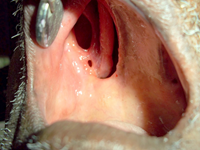
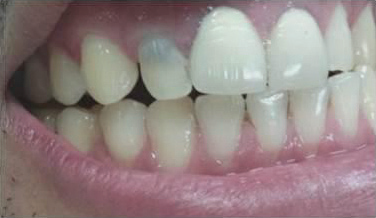
Multidiscpliniary Management of a Severe Cleft Lip and Palate
Department of Porsthodontics, Department of Porsthodontics, Smile O Dental Clinic, Howdah, Department of Oral Biology, Faculty of Dentistry, Melaka Manipal Medical College, Manipal, Karnatka.
Abstract
Cleft lip and palate is not an uncommon congenital anomaly of oro-facial region. The management of cleft lip and palate patients is always challenging as it involves the face and associated anatomical and functional problems. A multidisciplinary approach of oral surgery, prosthodontics and speech therapy is always needed in these cases. This case report discusses the prosthetic management of untreated adult cleft lip and palate. After placement of temporary obturator, surgery was done to close the lip and pre-maxillary setback. Definitive obturator was fabricated and speech therapy was given. The prosthetic treatment not only closed the defect, but also improved speech, swallowing, esthetics and psychological well being of the patient.
Key words: cleft lip and palate, obturator, speech therapy.
INTRODUCTION
Although cleft palate and cleft lip are not very often seen in general dental practice, their number is not negligible. Cleft lip and cleft palate is an opening in the lip or palate and is a common disfiguring birth defect where two sides of the mouth are not able to fuse into one structure. Their prevalence among general population depends on race, ethnicity, geographic and socioeconomic factors. It is present in around 1:500 to 1:2500 live births, among which cleft lip occurs in 20-30%,cleft palate in 30-45% and both cleft lip and palate in about 35-50%.1,2 The etiology of cleft lip and palate is multi-factorial mostly being genetic. Difficulties associated with cleft palate are eating, breathing, speaking and more importantly psychological well being. Any treatment should aim at improving both physical and psychological performances and also quality of life.3
In developed countries with the advancement of medical sciences and patient awareness it is very rare to find adults with un-operated cleft lip and palate but in developing countries, it is not the case.4 The prosthetic rehabilitation of patients with a cleft lip or palate requires a multidisciplinary care so that long-term success in treatment can be achieved.5
In the recent past patients have been benefited from alveolar bone grafting, orthodontic alignment and required little or no prosthodontic treatment. Patients with bilateral cleft lip and palate have pre-maxillary displacement in all three dimensions. As a result of this intrinsic anatomical aberration, surgery alone is not sufficient. The patients who have not received early surgical and orthodontic treatments present greatest prosthodontic challenge. An alternative conservative treatment with conventional fixed or removable prosthesis can be considered based on the nature of the defect.6,7 The treatment of such patients involves technical as well as psychosocial problems. In cleft rehabilitation the maxillofacial prosthodontist plays a role in replacement of missing teeth and other structures and also to camouflage the inadequate treatment.8,9,10 This case report discusses the surgical and prosthetic management of an untreated bilateral cleft lip and palate involving the nose.
CASE REPORT
A 35 year old female patient reported to the clinic with the chief complaint of difficulty in speech, mastication and poor looks. The clinical examination revealed untreated bilateral cleft lip and palate involving upper lip and nose. The pre-maxillary segment was hanging with a incisor. (Fig 1 a, b). The patient had a poor speech articulation with naso- oral regurgitation. The intra oral examination revealed that the patient had two healthy maxillary molars on either side. In the mandibular arch 36, 37, 46 and 47 were missing (Fig 2). The patient presented with a class III profile. A multi disciplinary approach with oral surgery, prosthodontics and speech therapy was planned. Since the patient was in a state of depression, psychiatric counseling was given prior to the commencement of the treatment.
Preliminary impressions were made using irreversible hydrocolloid impression material. A Special tray was fabricated with autopolymerising resin and molded with low fusing compound. A temporary partial denture for the missing teeth in mandible and interim obturator prosthesis for maxilla to close the defect was given initially as a confidence building measure (Fig. 3). The patient responded well, and also followed post treatment oral hygiene instructions. A single stage surgery with pre-maxillary setback involving extraction of the incisor which was attached to the premaxillary segment, lip closure with nose repair was performed.(Fig 4) The palatal defect was left open to be closed prosthetically.(Fig 5 a, b) Remarkable change in the patient’s appearance motivated the patient to continue the prosthetic treatment. (Fig 6 a, b)
An intermediate obturator was planned after two months. Impressions were made using addition silicone material. A custom tray was fabricated and the tissues were molded with impression compound. Borders were recorded with low fusing compound. Thermoplastic wax was used to mold the static defect areas in a custom tray to enhance retention and stability. Jaw relation records were made and trial denture was fabricated. To obtain maximum retention. wrought wire Clasps were made on 16, 17, 26 and 27. The denture base was sealed to the cast with wax. After dewaxing, self cure acrylic resin was used to make Shin covering the floor, and the walls of the defect. The defect in the cast was filled with Salt sprinkled wax (Lost Salt Technique). The acrylization was done using Heat-cure Acrylic Resin. After processing, perforations were made to remove the salt and make the obturator hollow and they were sealed using self cure acrylic resin. The hollow bulb made the obturator light and comfortable for the patient. (Fig 7 a,b). The patient was referred to the department of audiology for speech analysis and therapy.
After 6 months of considerable improvement in speech, definitive prosthesis was planned. Mouth preparation was done. The impression was repeated using addition silicone impression materials followed by fabrication of framework using 16, 17, 26 and 27 as abutments. The cast partial framework was tried in the patient’s mouth to verify complete seating. (Fig. 8) Using the framework as the impression tray, thermoplastic impression compound was used

Fig 1(a,b): Pree oprative-extra oral

Fig 2
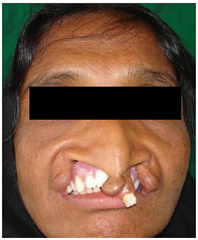
Fig 3:temporary obturator

Fig 4 surgery

Fig 5 (a,b):post surgery intra oral

fig-6 (a,b): Post surgery-extra oral

Fig-7(a,b): interim obturator in place

fig-8 framework trial

Fig-9(ab): Definitive prosthesis in place-intra oral
to mold the static as well as functionally mobile tissues. The palatal surface of the prosthesis was also molded using the thermoplastic wax. Altered cast was obtained. Maxillo-mandibular jaw relations were recorded and teeth were arranged using acrylic denture teeth. The prosthesis was acrylized and tried on the patient. (Fig 9 a, b). Since the patients salivary flow was normal, pressure indicating paste was used to check the tissue displacement. The patients appearance, speech and feeding improved with the prosthesis. She was also more confident to face the society. (Fig 10 a, b). The patient was educated about the use of the obturator and periodic follow up was done to assess the outcome.
DISCUSSION
Un-operated adult cleft lip and palate is often observed mostly in developing countries. The reason being poor medical care, ignorance and poverty. Treatment planning in these situations primarily depends on the age of the patient, the severity of the defect and also the socio

Fig-10(a,b): Definitive obturator in place-Extra Oral
economic status of the patient. It is often challenging for the surgeon and the prosthodontist because it involves the face, the most exposed portion of the human body. The other problems include mastication, compromised oro- nasal seal, nasal reflux and defective speech. A multidisciplinary approach is needed in these situations which involve surgeons, the orthodontists and prosthodontists to attain esthetic and functional success. The prosthodontist can assist both surgeon and patient, and the mutual understanding among the specialists in a well organized team is of great benefit to the patient by not only obturation of the defect, but also to replace the missing teeth, retains the remaining teeth.
The primary goal in the management of cleft lip and palate is to improve the quality of life by improving the esthetics and function. These patients are often depressed due to their appearance, fear of social rejection, poor self image and low self esteem often needs psychological counseling .11 A psychologist is integral to identify patients with significant psychological and psychiatric problems and to help patients manage their expectations and maximize their satisfaction with the outcome of the treatment plan.12
This patient presented with an array of problems. As there was no early treatment, there was discrepancy and disharmony of maxillary and mandibular relationship and also presented with defective speech. The patient had poor self esteem and was reluctant to show her face. The goal to improve the esthetics , function and get her out of the depression. The patient had abnormal nasal resonance due to the velopharyngeal dysfunction. Velopharyngeal dysfunction may be treated by surgery, prosthesis, speech therapy or a combined approach.13 In the present case, the speech therapy was started prior to prosthetic management for good results. Temporary Prosthesis and adequate speech therapy helped her in improving the speech and self confidence which was very evident after the surgical lip closure. Palatal contouring was done in the final prosthesis to aid in the adaptability of the tongue.
Achieving retention for the interim obturator engaging all the four maxillary molars was difficult as the shelves were not very rigid because of the nature and extent of the defect. Other problems encountered include multiple axes of rotation, compromised support and stability on the defect side; lack of cross arch stabilization due to loss of palatal structure and the forces of gravity.
CONCLUSION
Patients with congenital craniofacial defects are unique and treating adult patients with cleft lip and palate demands a different approach. The surrounding environment, psychological make-up and motivation of the patient play a key role in the treatment outcome. The success in cleft lip and cleft palate treatment can be ensured only in a team approach involving all the specialties. The prosthodontist must collaborate with the oral surgeon and the speech therapist during the period of interventions.
REFERENCES
- Slayton RL, Williams L, Murray J et al. Genetic association studies of cleft lip and / or palate with hypodontia outside the cleft region. Cleft Palate Craniofac J 2003;4L274-9.
- Takashi Ohyama. Prosthodontic considerations for patients with cleft lip and palate. International Dental Journal (1986);36,140-145.
- Alan Joseph Hickey, Margery Salter. Prosthodontic and psychological factors in treating patients with congenital and craniofacial defects; J prsothet dent 2006 vol 95,392-396.
- Jyotsna Murthy. Management of cleft lip and palate in adults. Indian J Plast Surg. Oct 2009;42(suppl): S116-S122.
- Javier Montero, Carla Macedo, Manuel Rodriguez et al. Prosthetic rehabilitation of an edentulous cleft palate using a denture with a palatal obturator: a clinical report. J Clin Exp Dent. 2011;3(Suppl 1):e365-8.
- Watanabe I, Kurtz KS, Watanabe E, Yamada M et al. Multi-unit fixed partial denture for a bilateral cleft palate patient: a clinical report. J Oral Rehabil. 2005;32: 620-2.
- Moore D, McCord JF. Prosthetic dentistry and the unilateral cleft lip and palate patient. The last 30 years. A review of the prosthodontic literature in respect of treatment options. Eur J Prosthodont Restor Dent 2004;12:70–4.
- Beumer J, Curtis T, Firtell D. Maxillofacial rehabilitation prosthodontic and surgical considerations. In: Cleft palate Rehabilitation. London. C.V Mosby. 1979. Pg: 292-310.
- Chalian VA, Drane JB, Standish SM. Maxillofacial prosthetics Multidisciplinary practice. In: Prosthodontic rehabilitation for cleft palate patients. Baltimore. Williams and Wilkins publishing. 1972. Pg:404-423.
- Reisberg DJ. Dental and prosthodontic care for patients with cleft or craniofacial conditions. Cleft Palate Craniofac J 2000;37:534–7.
- Wiens J, Wiens R, Taylor T. Phychological management of the maxillofacial prosthetic patient. In: Talor TD, editor. Clinical maxillofacial prosthetics. Chicago:Quintessence, 2000. P.1-13.
- Cher Bing Chuo, Yvonne Searle, Alison Jeremy et al. The Continuing Multidisciplinary Needs of Adult Patients With Cleft Lip and/ or Palate. Cleft Palate–Craniofacial Journal, November 2008, Vol. 45 No. 6. Pg 633-638.
- Joao Henrique Norgueira Pinto, Gisele da Silva Dalben, Maria Ines Pegoraro-krook. Speech intelligibility of patients with cleft lip and palate after placement of speech prosthesis. Cleft Palate- Craniofacial journal, November 2007, Vol. 44 No.6: pg 635-641.
Acknowledgements:
We appreciate the contribution of Dr. Premalatha Shetty, Professor and Head, Department of Oral surgery, MCODS, Mangalore and Department of Audiology, KMC Mangalore. We are also thankful to Dr. Madhumitha for always being a source of inspiration. We also are grateful to the management of Manipal University, Karnataka, India for providing us the scientific journals for our research.
Disclaimer from Guident
The views and opinions expressed in articles published in Guident are solely those of the authors and do not necessarily reflect the views of the editors, the editorial board or the publisher, Ivory India. Guident does not endorse any product, technique or treatment described. Clinical content is intended for qualified dental and medical professionals and is not a substitute for individual clinical judgement. Guident, its editors and the publisher accept no liability for any consequence arising from the use of information published in the journal.
How to cite this article
Dr. Arun prakash, Dr. Abhay Sonthalia, Dr. Bharath Rao.K. Multidiscpliniary Management of a Severe Cleft Lip and Palate. Guident. 2014 Jun;7(7). Available from: https://ivoryindia.in/articles/prosthodontics/multidiscpliniary-management-of-a-severe-cleft-lip-and-palate.html