
Overlay Removable Partial Dentures: An Alternative for the Restoration of Worn Teeth
Department of Prosthodontics, I.T.S Dental College, Ghaziabad, Muradnagar, UP, India.
ABSTRACT
Tooth wear is commonly found in every dentition and may have physiological and pathological causes. Tooth wear is considered pathologic when compared with the amount of wear typical for the patient’s age and when an intervention is necessary for cosmetic or functional purposes. Many treatment options are present for the restoration of worn teeth which includes composite restoration, crowns, FPD etc
This article describes cast overlay denture as a treatment option for the restoration of worn teeth.
INTRODUCTION
Tooth wear occurs as a natural physiological process, the average wear rates on occlusal contact areas were estimated to be 29μm/year for molars and 15μm/year for premolars. Pathologic wear occurs when the normal rate of wear is accelerated by endogenous and exogenous factors. Tooth wear caused by parafunction is estimated to progress 3 times faster than physiological wear.
Tooth surface loss is classified into: - Attrition, Abrasion and Erosion. Attrition is physiological wearing away of a tooth as a result of tooth-to-tooth contact, as in mastication and it involves occlusal, incisal and proximal surfaces of teeth. Abrasion is the pathological wearing away of tooth substance through some abnormal mechanical process. Dental Erosion is irreversible loss of dental hard tissue by a chemical process that does not involve bacteria.
The rate of wear may be greater depending on the factors such as:- Age, gender, occlusal condition, parafunction, Gastrointestinal disturbances, excessive intake of citrus fruits or beverages with low pH, environmental and salivary factors, congenital anomalies (amelogenesis imperfecta, dentinogenesis imperfecta). Signs and symptoms of tooth wear is transparency (at the incisal edge), sensitivity, discolouration (yellow) rounded teeth, cracks, cupping.
Situation where tooth wear is excessive, require evaluation of the vertical dimension of occlusion (VDO). Loss of VDO caused by physiological tooth wear is usually compensated by continuous tooth eruption and alveolar bone growth. In situations where tooth wear exceeds compensatory mechanisms, loss of VDO occurs.
To determine whether VDO has been altered
- Loss of posterior support: Posterior collapse places undue stress on the anterior segment that eventually becomes mobile or wears excessively, resulting in loss of VDO.
- History of wear
- Phonetic evaluation: Normal mandibular position during |s| sound places the incisal edge of the mandibular incisors about 1 mm inferior and lingual to the incisal edge of maxillary incisors. Vertical positioning significantly more than 1 mm apart means loss of VDO.
- Interocclusal distance: Vertical Dimension of Occlusion and Vertical Dimension at rest are measured and if the difference is more than 2-4mm, VDO is decreased.
- Facial Appearance: Diminished facial contour, commissures of the mouth, turned down thin lips, loss of muscle tone with the face appearing flabby instead of firm, presence of angular chelitis.
When there is no need to increase VDO, the worn teeth can be restored by periodontal surgery to gain clinical crown length, orthodontic movement with limited intrusion and surgical repositioning of a segment of teeth and supporting alveolus and placement of crowns and Fixed Partial Dentures. A carefully constructed conventional restoration or Cast Overlay RPD may be a treatment option whenever clinical evaluation demonstrates the necessary to restore VDO.
PROCEDURE
A thorough medical and dental history is compulsory before arriving at any diagnosis and treatment plan. Usually the patient’s complaint will be sensitivity of teeth, poor appearance and difficulty in chewing food. After recording the patient history, clinical examination should be done to evaluate the severity of tooth wear. Loss of Vertical dimension of Occlusion is also determined by facial measurements.

Fig 1

Fig 2

Fig 3
Impressions were made of both arches using alginate and diagnostic casts were poured. The diagnostic casts were articulated with centric relation record and face bow transfer.
Diagnostic wax up was made to establish the new VDO and the plane of occlusion on the basis of anatomic landmarks and average values. These diagnostic arrangements were duplicated using alginate and cast was poured. Thermal forming material, 1.0 mm thick, was then applied over the duplicated cast. This thermal forming template was lubricated and then filled with autopolymerising acrylic resin and placed over the diagnostic cast. After polymerization, the occlusal aspects of the thermal forming materials were cut away to expose the underlying acrylic resin teeth. This serves as a transitional VDO device which is transferred to the patient.
For most patients, moderate alteration of the VDO may be well tolerated. The transitional VDO devices were worn for approximately 6 weeks, occlusal adjustments were made on a weekly basis on the basis of phonetics and esthetic principle, as well comfort and ease of function.
The diagnostic casts were surveyed to determine the most suitable path of insertion of the definitive prosthesis.
The information from the diagnostic cast is replicated intraorally. Unsupported enamel was recontoured and polished. Facial reduction of anterior teeth was done for porcelain veneers. Guide planes were placed on proximal tooth surfaces. Enamel surfaces were modified to create an undercut of 0.25 mm, for cast half-rounded circumferential clasp. Rest seat preparations were not needed because entire occlusal surface of all the teeth may serve as rest under the cast framework.
Definitive impressions were made using addition silicone material and custom trays. Casts were made and mounted in centric relation. The incisal guiding pin was then adjusted for a 4 mm increase in VDO. Once the path of insertion was established for both casts, refractory casts were made.
The frameworks were waxed, over the teeth to be included in the prosthesis, except for the surfaces to be clasped. The posterior occlusal surfaces were waxed to occlusion and patterns for clasp and mesh to retain the acrylic teeth were added. A butt joint was places on the lingual surfaces of the anterior portion of the frameworks to support porcelain veneers. The wax pattern was cast in a cobalt-chrome alloy.

Fig 4
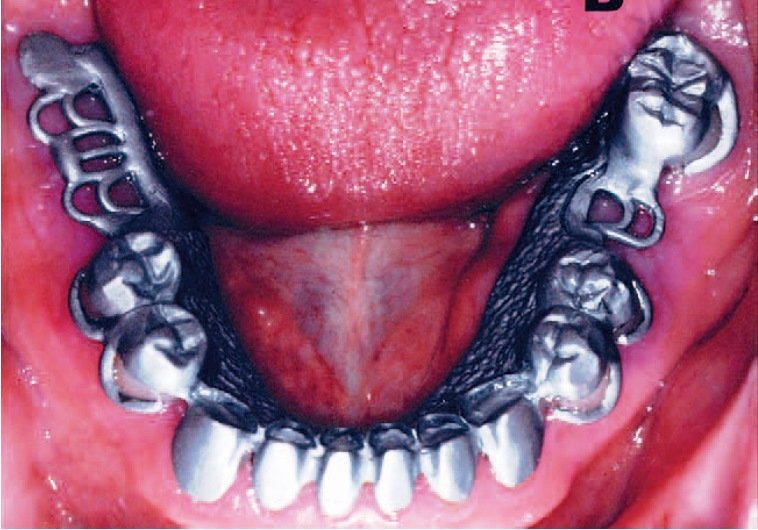
Fig 5
The frameworks were evaluated intraorally for fit, occlusion, retention and stability. A new maxillomandibular relationship record was made with the frameworks in position, and the definitive casts were mounted in the articulator. The frameworks were returned to the laboratory for the application of porcelain veneers in the esthetic zone and artificial acrylic teeth in the edentulous posterior regions. After processing the casts were remounted and the occlusion was adjusted to remove any processing errors.
At the next appointment, the Cast Overlay Removable Partial Denture (CORPD) was inserted. Instructions were given on how to properly insert the prosthesis and also about oral hygiene. The patient was also instructed to remove CORPDs at night and wear a soft night guard made of thermal forming material. Minor corrections were made after 2 weeks.

Fig 6
CONCLUSION
Overlay denture is defined as a removable partial denture that has a metal casting or an acrylic resin extension on or over the occlusal or incisal surfaces of natural teeth. The advantages of CORPD include noninvasiveness, low cost and less chair side time. Potential disadvantages include compromised esthetics when the dentures are removed, development of caries or periodontal problem, porcelain or resin fractures or discolouration and possible patient dissatisfaction with a removable prosthesis. Despite these disadvantages, Cast Overlay Removable denture is a good treatment option for patients who express concern over treatment longevity, invasiveness, cost and long term maintenance.
REFERENCES
- Analyzing the etiology of an extremely worn dentition J Prosthodont 2001; 10:224-33.
- A text book of Oral Pathology, Shafer– Fifth edition.
- Clinical Indications for Altering Vertical Dimension of Occlusion; Quintessence International, Vol 31, No 4 (April 2000).
- Maxillary and Mandibular Overlay Removable Partial Denture for the restoration of worn teeth; (J Prosthodont 2004, 91:210-4).
- The prevalence, etiology and management of tooth wear in UK; J Prosthet Dent (1997.78:367-72).
- Removable occlusal overlay splint in the management of tooth wear: J Prosthet Dent: April 2000; 83:392-5.
- Evaluation of dental erosion in patient’s with gastroesophageal reflux disease; J Prosthet Dent 2000;83;670-80
- Tooth wear treated with direst composite restorations at an increased vertical dimension, Results at 30 months; J Prosthet Dent 2000;83:287-93
- Bartlett, DW. "The role of erosion in tooth wear: etiology, prevention and management." Int Dent J. (2005) 55, 277-264.
- Addy M., Dentine hypersensitivity: New perspectives on an old problem. Int Dent J. 2002; 52
Disclaimer from Guident
The views and opinions expressed in articles published in Guident are solely those of the authors and do not necessarily reflect the views of the editors, the editorial board or the publisher, Ivory India. Guident does not endorse any product, technique or treatment described. Clinical content is intended for qualified dental and medical professionals and is not a substitute for individual clinical judgement. Guident, its editors and the publisher accept no liability for any consequence arising from the use of information published in the journal.
How to cite this article
Dr. Sunil Pal, Dr. Arjita Dutta, Dr. Mansi Singh. Overlay Removable Partial Dentures: An Alternative for the Restoration of Worn Teeth. Guident. 2024 Feb;17(3). Available from: https://ivoryindia.in/articles/prosthodontics/overlay-removable-partial-dentures-an-alternative-for-the-restoration-of-worn-teeth.html


