Loop Connectr Fixed Dental Prosthesis: A Clinical Series
Department of Prosthodontics and Crown & Bridge, Army Dental Center (Research & Referral), Dhaula Kuan, New Delhi
ACKNOWLEDGEMENT
The authors express their sincere gratitude to Dr. Kamal Verma for his invaluable contribution to the creation of this article.
ABSTRACT
Patients with missing anterior teeth along with diastema or generalised spacing present as a peculiar clinical situation. For patients seeking fixed modality of treatment and who wish to retain their existing diastema or spacing, rehabilitation with a conventional fixed dental prosthesis, resin bonded fixed dental prosthesis would lead to unesthetic results leaving them with limited treatment options. Loop connector fixed dental prosthesis is a simple solution for such patients with excellent treatment outcomes.
Keywords: Loop Connector, Diastema, Fixed Denal Prosthesis, Esthetics.
INTRODUCTION
Patients with missing anterior teeth with edentulous space larger than the tooth to be replaced represents a distinct clinical condition which is challenging to treat. The treatment options for such patients include implant supported prosthesis, fixed dental prosthesis or a removable partial denture with or without orthodontic tooth movement.1 Rehabilitating the patient with conventional fixed dental prosthesis (FDP) will result in excessively wide pontic leading to poor aesthetics. Thus the connector design needs to be modified in order to achieve an acceptable aesthetic outcome. In such situations loop connector fixed dental prosthesis is the treatment of choice.2 This article presents two patients rehabilitated with loop connector fixed dental prosthesis.
CASE 1
A 31-year-old male reported a chief complaint of missing upper front tooth due to trauma. Intraoral examination revealed missing 11 (Fig 1). Width of the edentulous span was 15 mm, width of 21 was 9.5 mm and a overjet of 2 mm and an overbite of 3 mm was present. The patient gave a history of spacing between his natural teeth and wanted to retain the same. A loop connector fixed dental prosthesis was planned for the patient with 12 and 21 as abutments and 11 as pontic, with maintenance of midline diastema.

Fig. 1: Pre-operative photograph
PROCEDURE
Diagnostic impressions were made using irreversible hydrocolloid impression material (Algingum, Prime dental products) and a diagnostic cast retrieved. Diagnostic wax-up was done and discussed with the patient (Fig 2). An index of the wax-up was made using silicone impression material. Tooth preparation was done for ceramo-metal retainers on 12 and 21. Gingival retraction was done using knitted #000 retraction cord (Ultrapak, Ultradent) (Fig 3) and final impressions were made in addition silicone impression material (Peakosil, Neosil Corp).

Fig. 2: Diagnostic Wax-up

Fig.3: Tooth preparation, retraction
Provisional FDP was fabricated using Bis-GMA resin (Protemp 4, 3M ESPE and luted with zinc oxide non eugenol cement (NETC, Meta Biomed). Try-in of the metal copings was done and occlusal adjustments made. Definitive prosthesis was cemented using Type-1 GIC (GC Corp) (Fig 4). Post operative instructions were given to the patient with special emphasis on oral hygiene maintenance.
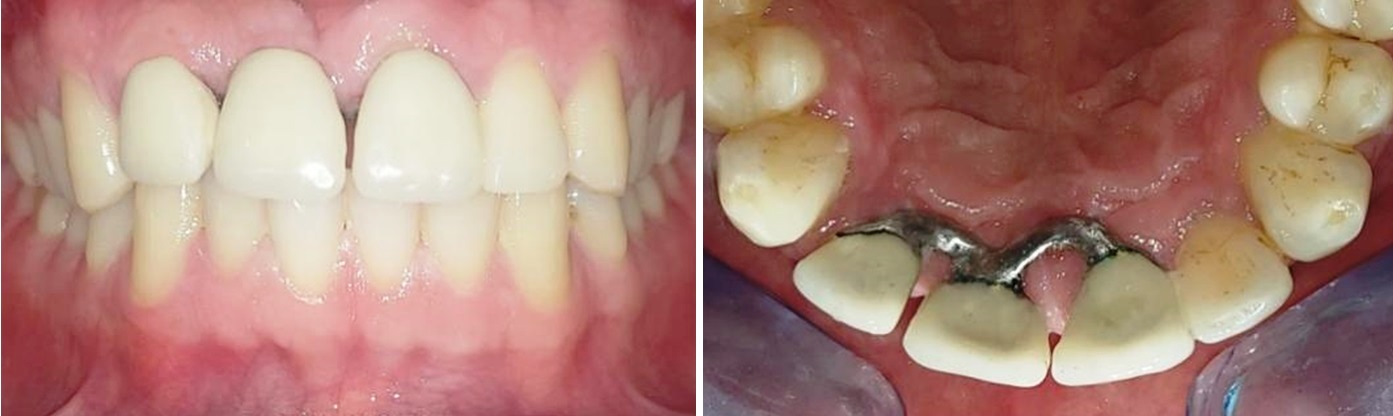
Fig.4: Definitive prosthesis in situ
CASE 2
A 37 year old male reported with a chief complaint of missing upper front tooth due to trauma (Fig 6). Intraoral examination revealed missing 11. Width of the edentulous span was 14 mm, width of 21 was 9mm and a overjet of 2 mm and overbite of 4 mm was present. The patient had a midline diastema in maxillary arch prior to avulsion and wanted to retain the same after the prosthetic treatment. A loop connector fixed dental prosthesis was planned for the patient with 12 and 21 as abutments and 11 as pontic with maintenance of midline diastema.

Fig. 5: Pre-operative photograph
The laboratory and clinical procedures carried out were similar to those mentioned for Case 1 (Fig 8 and 9).

Fig.6: Tooth preparation, gingival retraction

Fig.7: Metal coping trial

Fig.8: Final prosthesis
DISCUSSION
Rehabilitation of patients with missing anterior teeth with spacing can be done using implant supported prosthesis, removable partial denture or fixed dental prosthesis.3 The advent of predictable osseointegration has transformed the field of restorative prosthodontics and rehabilitation of missing teeth using implants is often the primary option offered to most patients. At times dental implant cannot be placed due to medical condition of the patient, financial implications or if the patient is unwilling to undergo a surgical procedure. In such clinical situations, if the patient desires a fixed replacement for the missing tooth/teeth, then loop connector fixed dental prosthesis is the only viable treatment option available for the patient. It is a simple solution which can provide an excellent esthetic outcome.
A Connector is that part of a fixed partial denture or splint that joins the individual components (retainers or pontics) together.4 The connectors can be broadly classified into rigid and non-rigid connectors4. Loop connector is a type of non rigid connector. The loop may be cast from sprue wax that is circular in cross section or shaped from a platinum–gold–palladium (Pt–Au–Pd) alloy wire4. There should be adequate thickness of the connector to prevent deformation (2mm cross sectional diameter). Loop connector is primarily indicated for replacement of missing anterior teeth in patients with a diastema or generalised spacing in anteriors. Use on conventional retainers in such cases would fail to create an esthetically pleasing appearance due to wide mesiodistal dimensions of the artificial teeth. Other indications of loop connectors are :
- As an interim treatment modality in growing children where implant placement is delayed until growth completion.5
- Prosthetic restorations for pathologically migrated and peridontally weak teeth.6
- Fractured or failed anterior implant in patient with diastema.7
The disadvantages associated with loop connector prosthesis include difficulty in maintaining oral hygiene, transient discomfort in speech especially linguopalatal sounds8, relatively weaker design as compared to rigid connectors. Contraindications include patients with deep bite and patients who cannot maintain their oral hygiene9. Thus oral hygiene maintenance should be reinforced which can be accomplished by using dental floss (Superfloss, Oral B), oral irrigation devices and interdental brush.
CONCLUSION
This clinical report describes the use of loop connector for replacing missing central incisors with space larger than the tooth to be replaced, resulting in an excellent esthetic treatment outcome. Loop connector fixed dental prosthesis is an exceptional non surgical and cost effective treatment modality for missing anterior teeth in patients with generalised spacing or diastema.
REFERENCES
- Marinello CP, Meyenberg Kh, Zitmann NU, Et al. Single tooth replacement: some clinical aspects. J Esthet Dent 1997; 9(4): 169-178.
- Kamalakanth S, Arbaz S. Anterior loop connector fixed partial denture: A simple solution to a complex prosthodontic dilemma. Journal of Indian Prosthodontic Society 2008;8:162-4.
- Al-Quran FA1, Al-Ghalayini RF, Al-Zu’bi BN. Single-tooth replacement.factors affecting different prosthetic treatment modalities. Oral Health. 2011;11:1-7.
- Rosenstiel S, Land M, Fujimoto J. Connectors for partial fixed dental prosthesis. Contemporary prosthodontics. 4th edition. New Delhi, Elsevier, 2007;843-69.
- Mathew TA, Koshy AT, Thomas AS, Joseph AM, Mathew N. Using loop connectors as an interim mode of treatment: An interdisciplinary approach. Indian J Dent Res. 2016 Nov-Dec;27(6):672-676.
- Bhadari U, Bakshi S. Survival and complications of unconventional fixed dental prosthesis for maintain diastema and splint pathologically migrated teeth: A case series up to 8 years follow?up. Indian J Dent Res 2013;24:375?80.
- Yadav A, Gupta A, Tandan A, Kumar S. Management of fractured implant case using loop connector fixed partial denture. BMJ Case Rep. 2013 May 24;2013.
- Kalra A, Gowda ME, Verma K. Aesthetic rehabilitation with multiple loop connectors. Contemp Clin Dent 2013;4:112-5.
- Balkaya MC, Gur H, Pamuk S. The use of a resin?bonded prosthesis while maintaining the diastemata: A clinical report. J Prosthet Dent 2005;94:507?10.
Disclaimer from Guident
The views and opinions expressed in articles published in Guident are solely those of the authors and do not necessarily reflect the views of the editors, the editorial board or the publisher, Ivory India. Guident does not endorse any product, technique or treatment described. Clinical content is intended for qualified dental and medical professionals and is not a substitute for individual clinical judgement. Guident, its editors and the publisher accept no liability for any consequence arising from the use of information published in the journal.
How to cite this article
Dr. Sahil Verma, Dr. Guruprasada, Dr. Rishu Koul. Loop Connectr Fixed Dental Prosthesis: A Clinical Series. Guident. 2024 Jan;17(2). Available from: https://ivoryindia.in/articles/prosthodontics/loop-connectr-fixed-dental-prosthesis-a-clinical-series.html