Prevalence of Undiagnosed TMJ Disorder Among Students of Various Health Science Colleges in South Coastal Region of Karnataka
Department of Prosthodontics A.B.Shetty Memorial Institute of Dental Sciences, Nitte University, Deralakatte, Mangalore, India
Abstract
Temporomandibular Joint (TMJ) disorders are a group of disorders affecting the TMJ and prevail undiagnosed in many subjects of different gender predilection, age groups, occupations etc. Temporomandibular disorders (TMDs) usually start at a younger age but remain undiagnosed and as the subject ages, the TMD prevails or gradually worsens. Subjects may have an array of symptoms such as pain, clicking or grinding sounds from the joint, soreness in the muscles in the facial region etc.
This article aims to highlight the prevalence of TMDs in students of various health science colleges in South Coastal Region of Karnataka so as to define the presence of the ailment in the said population.
Keywords:Temporomandibular disorder, Prevalence, Clicking, Stress, Bruxism
INTRODUCTION
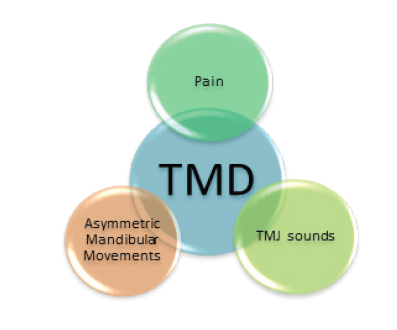
Temporomandibular disorders (TMDs) are a heterogeneous group of pathologies that affect the temporo mandibular joint (TMJ), the jaw muscles, or both1 and are characterized by a classically described triad of clinical signs, such as muscle and/or TMJ pain; TMJ sounds; and restriction, deviation, or deflection of the mouth opening path.2
Temporomandibular pain is defined as Pain, usually localized in the muscles of mastication, the preauricular area, and/or the temporomandibular joint (TMJ).3 It usually aggravates by jaw functions such as chewing or others. Along with pain, patients also present with limited or asymmetric mandibular movements and TMJ sounds.4 TMJ sounds include clicking and grinding, but these sounds are also found in patients who do not have TMJ distress. TMDs are recognized by pain that is reported in the masticatory system.5
Criteria, Materials & Methodology:
200 students from the south coastal region of Karnataka were selected randomly from various health science colleges. The students were segregated based on gender, age, presence of pain, clicking, grinding, consumption of medication etc
Inclusion Criteria : Subjects who have pain in the TMJ, who have no pain but exhibit parafunctional habits, TMJ sounds, inability/difficulty in opening or closing the mouth.
Exclusion Criteria : Subjects who have no pain, who have pain but no parafunctional habits, no TMJ sounds.
They were asked to fill up a questionnaire consisting of 20 questions designed to assess the prevalence, location of pain, parafunctional habits as well as medication or various other treatment options used for the TMD. The students were required to sign a consent form prior to filling the questionnaire.After obtaining the consent of the subjects to participate in the study, they were then examined using diagnostic instruments and the findings recorded. The total number of patients reporting with signs of TMJ disorder were recorded using the survey form.
Questionnaire:
A survey to assess the prevalence of undiagnosed TMJ disorder among students of various health science colleges in south coastal region of Karnataka

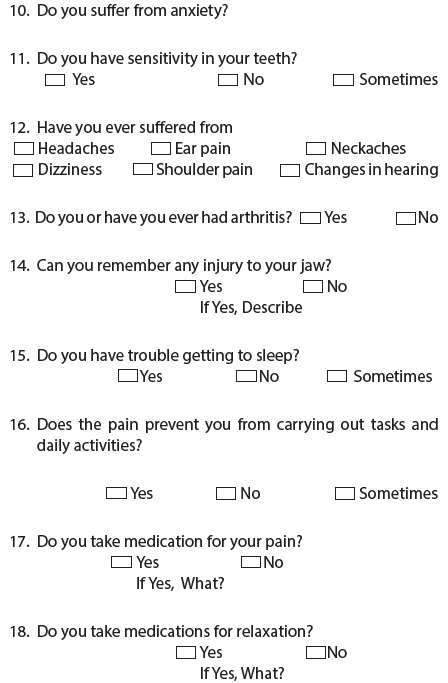
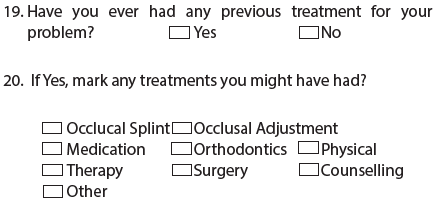
The questionnaire consisted of 20 questions. Four questions assessed the pain experienced by the patient, the location of the pain, the duration and the time of affliction. Four questions assessed the presence of TMJ sounds, inability/disability to open or close the mouth and parafunctional habits. Two questions assessed the anxiety and stress present in the subjects. Four questions assessed any injury to the jaw, sensitivity of the teeth. Two question assessed the problems caused by the TMD such as sleep deprivation and difficulty carrying out daily activities. Four questions assessed any treatment undertaken for anxiety, pain or relaxation in relation to the TMD.
A score of one was allotted to every positive answer, and zero to every negative answer. A score of one was allotted to every ailment such as headache, neckache, ear pain, dizziness etc. Subjects were siphoned based on factors such as presence of pain, or presence of TMJ sounds and inability/difficulty moving the jaw if pain was absent and parafunctional habits. A score of 10 on the questionnaire shows positive prevalence of TMDs.
RESULTS

Among the total sample size of 200 subjects 96 of 200 were male (48%) and 104 out of 200 were females (52%).From the age group of the subjects in the survey, 75/200 (38%) were lesser than or equal to 20 years of age and 125/200 (62%) were greater than 20 years of age.

Presence of a TMJ disorders were seen in 110/200 (55%) and 90/200 (45%) subjects had no signs of disorder. Majority of the subjects were female. Subjects oh higher age group were a majority.
Out of 200 subjects, 78/200 (39%) reported of pain with respect to the TMJ while 122/200 (61%) subjects did not have pain.

Students reported with signs such as clicking and/or grinding, 46/110 (42%) complained of clicking in the TMJ, 4/110 (4%) complained of grinding, while 60/110 (54%) did not show any signs.
Students having tenderness in the muscles of mastication were 15 while patients not having tenderness numbered 95.

GRAPH 7: Indicates samples who administer drugs/ medication for the TMJ related discomfort.
DISCUSSION
Pain is very common among adolescents and its severity has a potential impact on day to day activities.6-9 However, the types of pain that prevail the most are headaches and abdominal pain.8 In younger age groups, the prevalence of headaches are reported for both genders, but the frequency increases for girls as they reach adolescence.9 Hormonal variations may influence the biologic mechanisms of pain transmission, sensitivity and perception.10 Therefore female reproductive hormones may be a contributing factor for the development of a TMD.11
The presence of headaches was found to be higher in girls than boys, which is consistent with other studies conducted.6,9,12,13,14 Students showed a low prevalence of pain in the jaws, face, TMJ or mandibular movements similar to findings in other studies.6,15,16,17,18 The prevalence of a TMD was higher as age advanced, results obtained in other studies show similar results.12,15,16,18,19
TMJ sounds, the next sign commonly seen among the students. Although clicking is a common symptom, it rarely becomes a severe complication.20 Students reported with clicking, pain or sometimes both, but the incidence of clicking with pain was higher. Clicking could result from disc displacement21 or from an irregular TMJ surface.22
Bruxism as defined by the American Academy of Orofacial Pain is a diurnal or nocturnal parafunctional activity that includes unconscious clenching, grinding or bracing of the teeth.4 Lobbezooet al.23defined bruxism as a repetitive jawmuscle activity characterised by clenching or grinding of the teeth and/or by bracing or thrusting of the mandible.
Some students reported with parafunctional habit, clenching and grinding, tightness in the jaws in the morning. However this was not a significantly large number of students.Reports of bruxism were increased as age progressed, this can be attributed to stress due to work or personal reasons. Bruxism is considered to be themost detrimental among all parafunctional habits of the stomatognathic system and poses a major risk for temporomandibular disorders.24
Many factors could be responsible for TMD, trauma could also be one of them4. However the incidence of men reporting with trauma causing TMD is higher than with women.
The treatment needs could be assessed either by the patients need or by the clinician’s judgement.25 Pain is the most common reason for seeking treatment 26 even in young adolescents.27
As a result of chronic pain, patients tend to have behavioural changes, such as taking leave of absence from work or college, reducing strenuous activities and self-administering medication.28,29,30
As found by Lee et al, 31 patients who reported with pain refrained from consulting a physician for the same because the pain was not perceived to be serious enough. For both genders, pain from TMD seems inconsequential due to being exposed to frequent pain from other causes; Sports related pain or trauma for boys and dysmenorrhea in girls. Headaches were a common finding in both genders. The temporalis muscle, is a powerful elevator of the mandible. It is localized in the region where both TMD and pain associated with headaches are reported as found in other epidemiologic studies.12,32
Patients who are found to have tenderness upon palpation in the muscles of mastication could be found to have myofascial pain, which is higher in females than males.3
Certain studies state that TMD pain is reported higher in females during their reproductive years.33
Factors such as Estrogen levels may interact with pain34 and may contribute to the development of a TMD.
This study reveals a sharp escalation in number of subjects affected as age increases. Anxiety levels were observed to be higher in an elder age group in relation to occupation, education, personal matters. So anxiety as a factor is responsible for attenuating the TMD.
The study also shows a large section of women suffering from TMD. It was observed that many individuals although reported negative for pain, showed TMJ sounds and abnormal jaw movements on clinical examination. These findings were usually coupled with parafunctional habits such as bruxism or clenching and were considered as positive. Self-administered medication although consumed by more subjects for pain due to various causes, only 19% were under medication due to the TMD.
CONCLUSION
Many adolescents and even adults in the health profession are unaware of Temporomandibular disorders. The TMD may have an insidious onset, initially manifesting itself as a click on opening or closing the jaws or mild pain occurring during mandibular movements during various times of the day.
As discussed earlier the need for treatment may be assessed by either the clinician or the patient themselves. As the subjects may suffer chronic pain from other causes, the pain from the TMD seems trivial in comparison, and they tend to medicate with over-the-counter medication. It is not until the pain becomes severe that professional help is sought. The etiological causes for TMD’s are vast and need to be diagnosed as soon as possible to provide the right medical help to the patient so as to restrict the disorder if not prevent it from worsening.
REFERENCES
- McNeill C. Management of temporomandibular disorders: concepts and controversies. J Prosthet Dent 1997;77:510-22.
- Laskin DM. Etiology of the pain-dysfunction syndrome. J Am Dent Assoc 1969;79:147-53.
- List T, Wahlund K, Wenneberg B, Dworkin S. F,TMD in Children and Adolescents: Prevalence of Pain, Gender Differences, and Perceived Treatment Need. J OROFAC PAIN 1999;13:9-20
- The American Academy of Orofacial Pain, Okeson JP (ed), Orofacial Pain: Guidelines for Assessment, Diagnosis, and Management, Chicago: Quintessence, 1996:116.
- Von Korff M, Dworkin SF, LeResche L, Kruger A, An epidemiological comparison of pain complaints. Pain 1988:32:173-183.
- Wänman A, Agerberg G, Mandibular dysfunction in adolescents, I. Prevalence of symptoms. ActaOdontolScand 1986;44:47-54.
- Larsson BS, Somatic complaints and their relationship to depressive symptoms in Swedish adolescents. J Child Psychol Psychiatry 1991;32:821-832.
- McGrath PA. Pain in Children: Nature, Assessment and Treatment, New York: Guilford Press, 1990:16,251-257.
- Barea LM, TannhauserM, Rotta NT, An epidemiological study of headache among children and adolescents of southern BraziLCephaialgia 1996;16:545-549.
- Unruh AM, Gender variations in clinical pain experience. Pain 1996;65:123-167.
- Leresche L. Epidemiology of temporomandibular disorders: implications for the investigation of etiologic factors. Crit Rev Oral Biol Med 1997;8:291-305.
- Egermark-Eriksson L Prevalence of headache in Swedish school children. ActaPediatrScand 1982;71:135-140.
- Brattberg C, Wickman V, Prevalence of back pain and headache in Swedish school children: A questionnaire survey. Pain Glin 1992;5:211-220.
- Linet MS, Stewart WF, Gelcntano DD, Ziegler D, Sprecher M, An epidemiologic study of headache among adolescents and young adults, J Am Med Assoc1989;261:2,211-2,216.
- Nilner M, Lassing SA, Prevalence of functional disturbances and diseases of the stomatognathic system in 7-14- year-olds, SwedDentJ 1981;5:173-187.
- Nilner M, Prevalence of functional disturbances and diseases of the stomatognathic system in 15-18-year-olds, Swed Dent J 1981;5:189-197.
- Könönen M, Nyström M, Kleemola-Kuiala E, Kataja M, Evalahti M, Laine P, Peck L, Signs and symptoms of craniomandibular disorders in a series of Finnish children. ActaOdontolScand 1987;45:109-I14.
- Pilley JR, Molin B, Shaw WG, Kingdeii A, A survey of craniomandibular disorders in 500 19-year-olds, Eur J Orthod 1997;19:57-70.
- Egermark-Eriksson I, Ingervall B, Carlsson CE, Prevalence of mandibular dysfunction and orofacialparafunction in 7-, 11-, and 15-year-old Swedish children, Eur J Orthod1981;3:163-172.
- Konönen M, Waltimo A, Nyström M, Does clicking in adolescence lead to painful temporomandibular joint locking? Lancet 1996;347:l,080-l,081.
- Wescesson P-L, Lundií H. Arthrographic and clinical characteristics of patients with disc displacement who progressed to dosed lock during a 6-inonth period. Oral Surg Oral Med Oral Pathol Oral RadiolEndod lS89;67:654-657.
- Nanthavitoj S. Omnell KA, Randow K, öberg T. Clicking and temporary locking in the temporotnandibularjoint. A clinical radiographical and electromyographical study. DentomaxilbfacRadiol 1976;5:33-38.
- Lobbezoo F, Ahlberg J, Glaros AG, Kato T, Koyano K, Lavigne GJ et al. Bruxism defined and graded: an international consensus. J Oral Rehabil. 2013;40:2–4.
- Manfredini D, Lobbezoo F, Relationship between bruxism and temporomandibular disorders: a systematic review of literature from 1998 to 2008. Oral Surg Oral Med Oral Pathol Oral RadiolEndod 2010;109:26-50.
- Magnusson T, Carlsson GE, Egermark-Eriksson 1. An evaluation of the need and demand for treatment of craniomandibular disorders in a young Swedish population. J Craniomandib Disord Facial Oral Pain 1991;5:57-63.
- List T, Dworkin SF. Comparing TMD diagnoses and clinical findings at Swedish and US TMD centers using Research Diagnostic Criteria for TemporomandibuiarDisorders. J Orofac Pain 1996; 10:240-253.
- Skeppare J, Nilner M. Treatment of craniomandibular disorders in children and young adults. J Orofac Pain 1993;7:362-369.
- Goodman JE, McGrath PJ, The epidemiology of pain in children and adolescents: A review. Pain 1991;46:247-264.
- Carlsson J, Larsson B, Mark B, Psychosocial functioning in school children with recurrent headache. Headache 1996;36:77-82.
- Collin C, Hockaday JM, Waters WE. Headache and school absence. Arch Dis Child 1985;60:245-247.
- Lee P, Helewa A, Smythe HA, Bombardier C, Goldsmith CH. Epidemiology of musculoskeletal disorders (complaints) and related disability in Canada. J Rheumatol 1985;12:1169-1173.
- Wärmian A, Agerberg G. Headache and dysfunction of the masticatory system in adolescents. Cephalalgia 1986; 6:247-255.
- Carlsson GE, LeResche L. Epidemiology of temporomandibular disorders. In: Sessle B, Bryant P, Dionne R (eds). Progress in Pain Research and Management. Seattle: IASP Press, 199.5:211-226.
- Berkley KJ. Sex differences in pain. Behav Brain Sci1996;19:1-33.
Disclaimer from Guident
The views and opinions expressed in articles published in Guident are solely those of the authors and do not necessarily reflect the views of the editors, the editorial board or the publisher, Ivory India. Guident does not endorse any product, technique or treatment described. Clinical content is intended for qualified dental and medical professionals and is not a substitute for individual clinical judgement. Guident, its editors and the publisher accept no liability for any consequence arising from the use of information published in the journal.
How to cite this article
Dr. Krishna Prasad, Dr. Manoj Shetty, Dr. Curie Colaco. Prevalence of Undiagnosed TMJ Disorder Among Students of Various Health Science Colleges in South Coastal Region of Karnataka. Guident. 2014 Oct;7(11). Available from: https://ivoryindia.in/articles/prosthodontics/prevalence-of-undiagnosed-tmj-disorder-among-students-of-various-health-science-colleges-in-south-coastal.html