Tooth Supported Overdenture
Department of Prosthodontics K.D. Dental College & Hospital Mathura, India
INTRODUCTION
Overdenture is defined as any removable dental prosthesis that covers and rests on one or more remaining natural teeth, the roots of natural teeth, and/or dental implants; a dental prosthesis that covers and is partially supported by natural teeth, natural tooth roots, and/or dental implants .It is also called as overlay denture, overlay prosthesis and superimposed prosthesis. Preserving few teeth in partially edentulous patient may be helpful for patient in terms of retention and support.
Advantages of Tooth supported Overdenture :-
- Improved esthetics.
- Improved stability.( reduces or eliminates prosthesis movement)
- Improved occlusion.
- Decrease in soft tissue abrasions.
- Improved chewing efficiency and force.
- Increased occlusal efficiency.
- Improved retention.
- Improved support.
Disadvantages of Tooth supported Overdenture :-
- Long term maintenance ( Attachments need to be changed like nylon caps.)
- Need to be relined.
- Continued posterior bone loss.
- Food impaction.
This article describes a case report of the tooth supported overdenture and access post attachments have been used to support the denture.
CASE REPORT
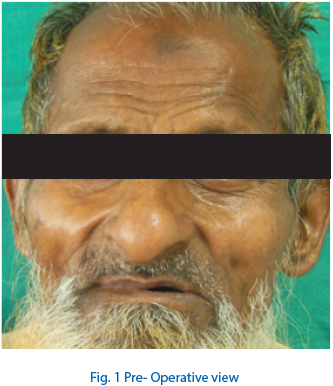
A 60 yr old male patient reported to the department of prosthodontics with chief complaint of difficulty in mastication due to missing teeth teeth in maxillary and mandibular arches.On intra oral examination 33, 34 and 43 ,44,45 teeth were present. Case history ,radiographs and photographs were taken to formulate a treatment plan . Due to patient’s apprehension to extraction teeth were preserved and used as overdenture abutments .
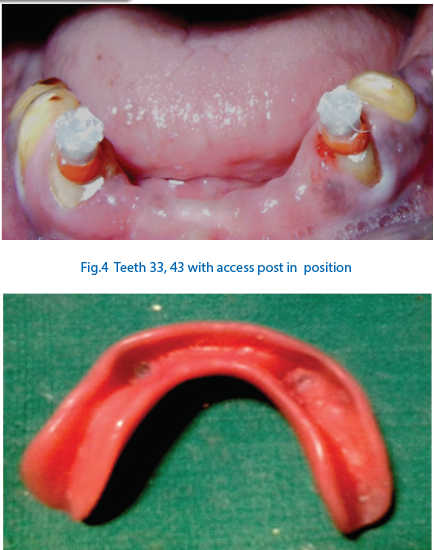
Root canal treatment was done for all the teeth present and then 33 , 43 were prepared for access post and all the remaining teeth were reduced to serve as overdenture abutments.
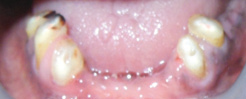
Fig.2 Prepared teeth
- Primary impression was made and special trays were fabricated.
- Secondary impression was made for the mandibular arch and this was followed by jaw relation and try in.

Steps for Placement of access post:-

- Tooth no. 33,43 was selected for installation of post.
- Working length was determined by intra oral periapical radiograph.
- Peeso reamers were used in a sequential order to remove the gutta percha from the canal, leaving the apical 1/3rd intact.
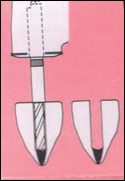
4.The flange and second tier preprations were made using the drill provided. This was done to enhance the post stability and retention.
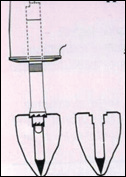
5.Trial insertion of the post was done to determine the fit.The apical end was trimmed to ensure full fitting of flange and second tier.
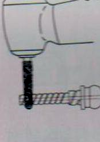
6.The luting cement was introduced in the prepared canal space, lentulo spirals were used to avoid void formations. Post was cemented ensuring that the flange was properly seated in second tier preparation.

7. The nylon (female) cap was placed on the ball of the post, covering the height of contour of the head .
8.Self cure resin was applied in the prepared cavities inside the denture.
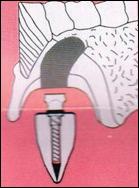
9.The denture was seated and patient asked to close in pre determined centric relation position. Self cure resin was allowed to polymerize.

10. The extra flash was trimmed and denture was finished and polished.

DISCUSSION
Preventive prosthodontics emphasizes the importance of any procedure that can delay or eliminate future problems.The basic overdenture concept requires preservation of residual hard and soft tissues.Tallgren concluded that overdenture patients had a chewing efficiency which was one-third higher than that of complete denture wearers .The psychological aspect of losing teeth should not be underestimated .The success of overdenture treatment depends upon the proper attachment selection. Attachment selection is based on available bucco-lingul width, interarch space, Amount of bone support, clinical experience, maintainence problem and cost.
Access post are stud attachments that occupy small vertical space and male units on different roots do not require parellelism.The ball and socket attachment of access post allows rotation of denture attachment.Small head of attachment limits the amount of material that has to be removed from denture. Access post overdenture is superior to any other passive overdenture because flange and second tier dissipate functional stresses and prevents high apical stresses which are common to other passive posts.The incorporation of attachments in overdentures into everyday dental practise will open new dimensions in treatment planning and patient satisfaction.
Lack of retention in complete denture patients is a common complaint, so preserving few teeth in the arch to support the denture can be a boom for the patient.
CONCLUSION
To obtain sucessful overdenture rehabilitation the dentists must be careful during case selection and attachment selection with proper periodic follow up.This case report highlights the sucessful rehabilitation of patient with tooth supported overdenture using access post.
The graphical representation of the steps in Access post system have been derived from the manual provided with the posts.
Disclaimer from Guident
The views and opinions expressed in articles published in Guident are solely those of the authors and do not necessarily reflect the views of the editors, the editorial board or the publisher, Ivory India. Guident does not endorse any product, technique or treatment described. Clinical content is intended for qualified dental and medical professionals and is not a substitute for individual clinical judgement. Guident, its editors and the publisher accept no liability for any consequence arising from the use of information published in the journal.
How to cite this article
Dr. Siddharth Sisodiya, Dr. Rahul Nagrath, Dr. Anubhav Srivastav. Tooth Supported Overdenture. Guident. 2014 Oct;7(11). Available from: https://ivoryindia.in/articles/prosthodontics/tooth-supported-overdenture.html