Rehabilitation of a Congenital Combined Hard and Soft Cleft Palate in an Adult Patient Using a Prosthetic Obturator Relined with a Long Term Reliner: A Case Report
Department of Prosthodontics, Post Graduate Institute of Dental Sciences, Pt. B.D Sharma University of Health Sciences, Rohtak, Haryana, India
ABSTRACT
Cleft palate in an adult patient is not a rare finding in a developing country due to lack of awareness of the treatment procedure and financial restraints. Cleft palate in an adult patient occurs either due to lack of any surgical intervention or a failure to repair the cleft. Cleft palate leads to immeasurable difficulties including oral abnormalities, nasal regurgitation, hypernasality of speech, compromised esthetics and psychological problems. This case report entails the fabrication of a prosthetic obturator relined using a long term reliner for the management of a combined palatal defect in an adult patient.
Keywords: Adult cleft palate, Hypernasality, Obturator, Reliner, Quality of life.
INTRODUCTION
Cleft palate is one of the most common congenital defects affecting the palate resulting in an abnormal communication between the oral and nasal cavities. Congenital palatal defect leads to substantial amount of problems including oral anomalies, difficulty in deglutition, mastication, speech, and esthetic deformities.1,2 Adult cleft patients who have not undergone any surgical interventions or have undergone unsuccessful attempts at cleft repair in childhood experience oronasal communication resulting in dysphagia, hypernasal speech and impaired masticatory function.3
The growth and abnormalities of the facial bones are specifically impacted by the failure of bone and matrix fusion caused by the cleft from the embryonic stage through full growth. The facial bones have a normal capability for growth, despite being malaligned in cleft patients. Following surgical repair, growth abnormalities, particularly midface retrusion, are a frequent occurrence in cleft patients. Studies on adult cleft patients who have not undergone any surgical procedures have revealed that the majority of them have normal development potential with maxillary protrusion on the noncleft side.4 This case report discusses the prosthetic management of an adult cleft palate patient using a removable obturator relined with a long term reliner.
CASE REPORT
A 55-years-old male reported to the department of prosthodontics with the chief complaint of looseness of the removable prosthesis and wanted a similar replacement of the prosthesis with a better fit. Extraoral examination revealed a mid-facial collapse with deviation of the nasal septum. Intraoral examination revealed a combined hard and soft palate defect (Figure 1A) with multiple missing teeth in both the upper and lower arches (Figure 1B,C). Various treatment options including surgical procedures, implant-supported prosthesis, metal-based prosthesis, two-part prosthesis, hinged prosthesis and relined removable obturator were advised to the patient. Patient was willing for a relined prosthetic obturator, so this was chosen as the treatment modality. An informed consent was obtained from the patient regarding the treatment protocol.
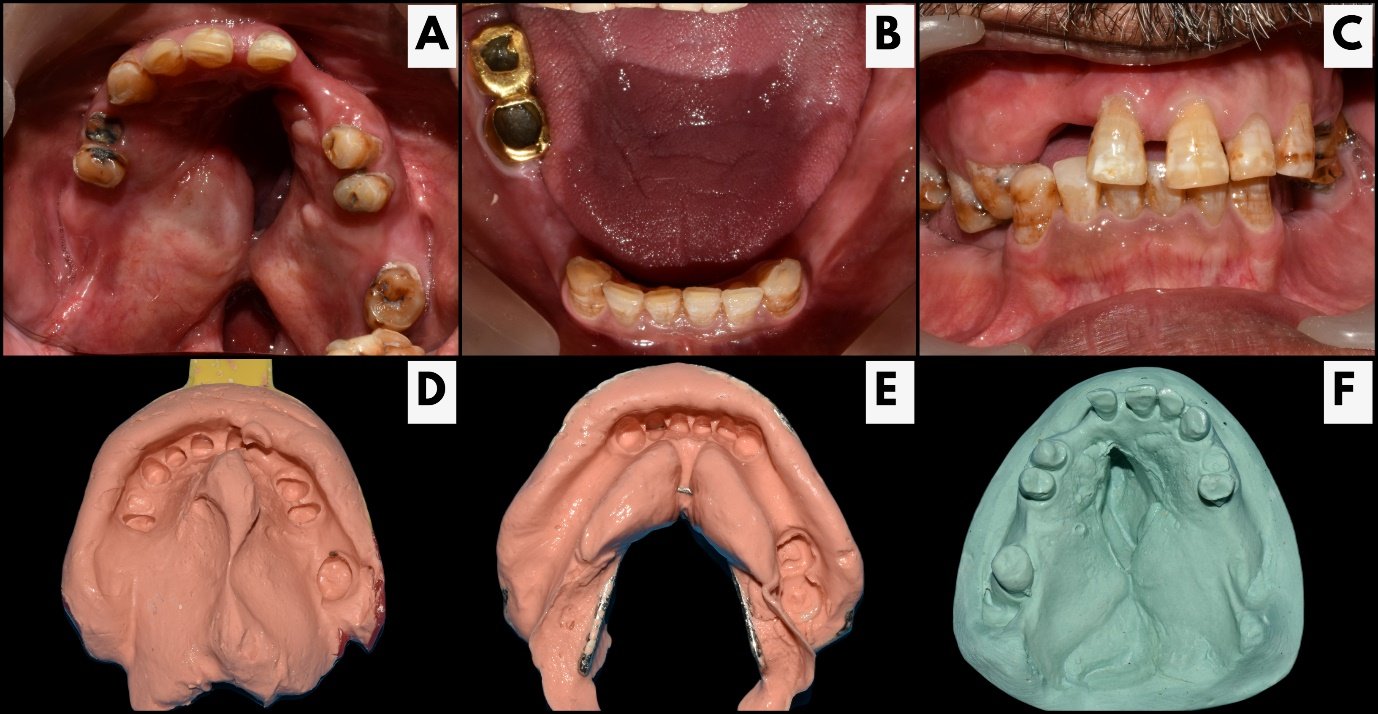
Figure 1: A) Intraoral maxillary view showing the defect in both hard palate and soft palate, B) Intraoral mandibular view, C) Pre-rehabilitative frontal view, D) Primary impression of the maxillary arch, E) Primary impression of the mandibular arch, F) Primary maxillary cast.
Primary impressions of the maxillary (Figure 1D) and mandibular arches (Figure 1E) were made using the irreversible hydrocolloid impression material (Imprint, DPI, India) and the casts were obtained (Figure 1F). Special trays were fabricated and the definitive impressions was made using the dual impression technique with the medium body and putty consistency addition silicone impression material (3M ESPE, Soft Putty, USA). The definitive casts of the maxillary (Figure 2A) and mandibular arches were obtained (Figure 2B). The occlusal rims were fabricated and the jaw relation was recorded (Figure 2C). The facebow was transfer was carried out and mounting of the occlusal rims was done on the semi-adjustable articulator (Hanau Wide Vue, USA) (Figure 2D). The teeth arrangement was carried out using artificial anatomic acrylic teeth. The try-in was done followed by curing of the prosthesis in a conventional manner. The final prosthesis was obtained followed by finishing and polishing of the maxillary (Figure 2E,F) and mandibular prosthesis (Figure 3A).

Figure 2: A) Definitive maxillary cast, B) Definitive mandibular cast, C) Recording of jaw relation, D) Mounting of occlusal rims on semi-adjustable articulator, E & F) Views of definitive prosthesis.
A long-term chair-side relining material (Molosil, Soft relining, Germany) was used to enhance the retention of the prosthesis (Figure 3B). Adhesive was applied followed by mixing of both the base and catalyst pastes of the relining material in a ratio of 1:1. The material was applied on the obturator portion of the prosthesis and inserted into the oral cavity of the patient. The material was allowed to set and prosthesis was retrieved on setting (Figure 3C). The extra flash was removed and the prosthesis was inserted in the oral cavity of the patient (Figure 3F).

Figure 3: A) Maxillary and mandibular definitive prosthesis, B) Armamentarium for relining prosthesis, C) Prosthesis relined with long-term relining material, D) Previously worn prosthesis, E) Definitive maxillary prosthesis, F) Post-rehabilitative frontal view.
Post-operative instructions regarding the oral and prosthesis hygiene were given to the patient. The patient was kept on a regular follow-up and necessary modifications were carried out. Patient was satisfied with the outcome of the treatment (Figure 4A,B).

Figure 4: A) Pre-rehabilitative smile view, B) Post-rehabilitative smile view.
DISCUSSION
Reconstructive prosthodontic treatment with removable prosthesis is a crucial component when an adult patient with cleft palate reports with no or inadequate treatment. A cleft palate has a negative impact on the appearance of the individual, which may result in sociopsychological repercussions.5 The degree of retention provided by the obturator prosthesis depends on the direct and indirect retention offered by remaining natural teeth, the presence of tissue undercut around the defect, the size of the defect, and the maturation of muscular control. There will be varying degrees of undercut along the defect into the nasal or paranasal cavity depending on site of the palatal defect. The extension of the prosthesis into the defect serves as a resistance against both vertical and horizontal displacement.6,7 Implant supported prosthesis is a better treatment modality but is not feasible taking into the consideration the general medical condition of the patient and the financial restraints.
The restorative dentist faces a difficult challenge when it comes to the prosthetic rehabilitation of adult patients with unrepaired cleft palates. In such cases, removable obturator dentures are a relatively easy treatment option where one relies on the tissue undercuts and the border seal along the oronasal defect for retention and stability of the prosthesis. The functional adaptation of the impression material and the functional contouring of the palatal defect are essential factors to the success of the soft palate defect prosthesis. This is accomplished using the resilient soft liner. It is capable of being employed as a functional impression and has viscoelastic qualities.8,9 This case report discusses a simple, effective, convenient, feasible and cost-effective management of an adult patient with cleft palate leading to formation of separate oral and nasal cavities. The prosthetic obturator led to improvement in the hypernasality of speech, effective mastication and ultimately enhancing the quality of life of the patient.
CONCLUSION
Rehabilitation of a cleft palate in an adult patient must be managed while taking both the psychological and prosthetic treatment into consideration. The simple, cost-effective and feasible approach used in this case report reduces the numerous oral problems and enhances the quality of life of the patient.
REFERENCES
- Phalke N, Goldman JJ. Cleft Palate. [Updated 2022 Sep 26]. In: StatPearls [Internet]. Treasure Island (FL): StatPearls Publishing; 2022 Jan.
- Arshad M, Ameri N, Heidari A, Shirani G. Dental rehabilitation of a cleft lip and palate patient by implant-supported overdenture: A case report. Clin Case Rep. 2020;8:1932–1936.
- Vyas T, Gupta P, Kumar S, Gupta R, Gupta T, Singh HP. Cleft of lip and palate: A review. J Family Med Prim Care. 2020;30;9(6):2621-2625.
- Narayanraopeta S, Vemisetty HK, Marri T, Konda P. Rehabilitation of a Unilateral Cleft Palate with Endosseous Implants in an Edentulous Elderly Patient. Contemp Clin Dent.2020;11(3):285-289.
- Guven O, Gurbuz A, Baltal E, Ylmaz B, Hatipoglu M. Surgical and Prosthetic Rehabilitation of Edentulous Adult Cleft Palate Patients by Dental Implants. Journal of Craniofacial Surgery.2010;21(5):1538–1541.
- Krezel JD, Friel T, Waia S, Clark P, Taylor PD. Prosthetic Rehabilitation of a Repaired Cleft Palate with Use of a Two?Part Hinged Magnet Retained Removable Prosthesis. Journal of Prosthodontics.2021;30(5):454–457.
- Yenisey M, Cengiz S,Sankaya ?.Prosthetic Treatment of Congenital Hard and Soft Palate Defects. The Cleft Palate-Craniofacial Journal.2012;49(5):618–621.
- Varghese K. Prosthetic Rehabilitation of a Congenital Soft Palate Defect. J Indian Prosthodont Soc. 2014;14(1):181-6.
- Sheldon W (2009) Essentials of complete denture prosthodontics, 2nd edn. AITBS publishers, India, pp 81–87.
Disclaimer from Guident
The views and opinions expressed in articles published in Guident are solely those of the authors and do not necessarily reflect the views of the editors, the editorial board or the publisher, Ivory India. Guident does not endorse any product, technique or treatment described. Clinical content is intended for qualified dental and medical professionals and is not a substitute for individual clinical judgement. Guident, its editors and the publisher accept no liability for any consequence arising from the use of information published in the journal.
How to cite this article
Dr. Divya Dahiya, Dr. Sujata Chahal, Dr. Surbhi Mittal. Rehabilitation of a Congenital Combined Hard and Soft Cleft Palate in an Adult Patient Using a Prosthetic Obturator Relined with a Long Term Reliner: A Case Report. Guident. 2022 Dec;16(1). Available from: https://ivoryindia.in/articles/prosthodontics/rehabilitation-of-a-congenital-combined-hard-and-soft-cleft-palate-in-an-adult-patient-using-a-prosthetic.html