Role of Stem Cells in Regenerative Prosthodontics
Department of Prosthodontics & Implantology, K.D. Dental College & Hospital, Mathura (U.P) India
ABSTRACT
Stem cells are the body’s "master" cells that regenerate the body’s many cells, tissues, and organs. Most cells in your body can only make new cells of the same type - blood cells make blood cells, skin cells make more skins cells and so on. Stem cells are unique not only because they can turn into many different types of cells - a stem cell might create blood, kidney, heart, or bone for example - but also because they can divide many more times than other cells.
In dentistry, tissue engineering is also considered to be a new frontier in the regeneration of missing oral tissues/organs. For example, various degrees of alveolar bone resorption occur after tooth loss/extraction because of periodontal disease, severe caries, root fractures or accidental trauma. In addition, the bone resorption in the residual ridge, particularly in the mandible, continues throughout life in many edentulous patients3.The severe bone resorption in edentulous areas makes it difficult to restore the missing teeth with dental implants or denture treatment. Therefore, stem cell and tissue engineering therapies are expected to provide a novel capability to regenerate large defects in periodontal tissues and alveolar bone, and to ultimately replace the lost tooth itself. The tissues and organs targeted for such regenerative medicine strategies in dentistry include the salivary gland, tongue and craniofacial skeletal muscles, as well as the condylar cartilage of the temporomandibular joint.
INTRODUCTION
In dentistry, tissue engineering is considered to be a new frontier in the regeneration of missing oral tissues/organs. Various degrees of alveolar bone resorption occurring after tooth loss/extraction in many edentulous patients makes it difficult to restore the missing teeth with dental implants or denture treatment. Stem cell and tissue engineering therapies provide a novel capability to regenerate large defects in periodontal tissues, alveolar bone and to ultimately replace the lost tooth itself. The tissues and organs targeted for such regenerative medicine strategies in dentistry include the salivary gland tongue, craniofacial skeletal muscles, as well as the condylar cartilage of the temporomandibular joint.
Stem cells are special cells that have the capacity to renew themselves and evolve to form different variety of cells( fig 1) . They renew and multiply by the process of cell division. They are found in almost all organisms. They are grown in labs and have the ability to form three dimensional structures if given proper growth factors and others.
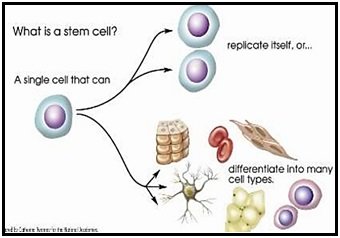
Fig 1: stem cell
HOW DO STEM CELL WORK (fig 2)?
Stem cells work by replacing the damaged cells in our body with healthy cells. These healthy cells are formed by utilizing the manpower of our own body.

Fig 2: working of stem cells
STEM CELL RESEARCH
It is the latest research that is in the process of utilizing the property of potency and multiplication of stem cells to form whole organs or parts of the body. In dentistry, scientists are trying to find the possible applications of stem cells for restoring and regenerating the dental and dentofacial structures.
PROPERTIES OF STEM CELL (fig 3)
- Pluripotent- ability of the stems cells to form any kind of cell except that of embryogenic origin or from the embryonic membrane.
- Unipotent- ability to produce one type of cells
- Multipotent- ability to distinguish to different type of adult cells
- Totipotent- Ability to produce all types of cells even the germ cells.

Fig 3: properties of stem cells
TYPES OF STEM CELLS
- Embryonic stem cell
- Adult stem cell

ADULT STEM CELL
They are cells that are found in undifferentiated state in already developed cells in an organ. Sources are mainly bone marrow, brain, dental pulp etc. They are not totipotent.

CAN STEM CELLS BE USED IN DENTISTRY?
If you have the following problems in your teeth (fig 4)
- Non vital tooth
- Loose teeth
- Teeth loosing support of the bone

Fig 4
FROM WHERE CAN WE COLLECT STEM CELLS ?

Five different human dental stem cells have been isolated and characterized:
- Human adult dental pulp stem cells(ADPSCs)
- Stem cells from human exfoliated deciduous teeth (SHEDs) .
- Periodontal Ligament Stem Cells (PDLSCs).
- Stem Cells of Apical Papilla (SCAPs).
- Dental Follicle Precursor Cells (DFPCs).
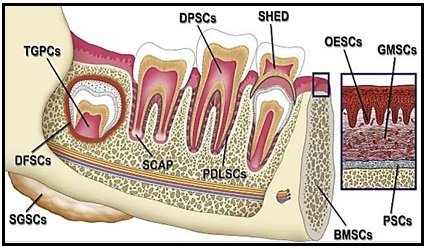
Fig 5: Human dental stem cells
CAN STEM CELLS BE FOUND IN EVERY TOOTH?
Stem cells can only be retrieved from teeth which are perfectly healthy and do not have any cavity in them. For wisdom teeth they have to be extracted in one piece without undergoing surgical extraction.
HOW ARE STEM CELLS STORED
The stem cells are stored in special laboratories by the process of cryopreservation in top screwed glass vials (fig 6) .
Cryopreservation (fig 7): It is the process of cooling the cells quickly to a subzero degree temperature at -196 degree Celsius, impending any cellular action. This way the cells can be used at the time of need for individual activity.

Fig 6: glass vials, Fig 7: cryopreservation
STEM CELLS IMPLICATION IN PROSTHODONTICS
- BIOENGINEERED TOOTH
- PERIODONTAL REGENERATION
- CRANIOFACIAL REGENERATION
- ALVEOLAR BONE REGENERATION
- MANDIBLE CONDYLE REGENERATION
The current state of the art in tooth replacement is a dental implant that involves screwing a threaded metal rod into a predrilled hole in the bone, which is then capped with a plastic or ceramic crown. Implant use requires a minimum amount of bone to be present. Because these implants attach directly to the bone without the PDL ‘shock absorber’, the forces of mastication are transmitted directly to the bone, which is one reason implants can fail. In cases where there is insufficient bone for implants, such as tooth loss as a consequence of the bone loss that occurs in postmenopausal osteoporosis, implants have to be preceded by bone grafts. The ultimate goal in dentistry is to have a method to biologically replace lost teeth.
Techniques (Fig 8 & 9 ):
a. The idea is to take adult stem cells, treat them in a cell culture so they would be programmed to develop into teeth and then transplanted into the patients jaw where the gap is. Then are placement tooth grows just as happens when humans grow their original adult teeth. It is thought it would then take two to three months for the tooth to fully develop. The cost should not be more than existing treatments making it an attractive alternative to other technologies such as implants and dentures
b. The tooth bud is then implanted in the jaw and the gum stitched or sealed with a clinical "glue". They have not started human clinical trials yet, however they expect the procedure to be less invasive than a tooth extraction and the requirements for post-procedure care would be similar. After implantation it takes the tooth about 3weeks to set in the jaw of a mouse. As long as the tooth is not under heavy load, it sets well. The technology to grow replacement teeth could mean the end of dentures.

Fig 8: Technique in bio-regeneration

Fig 9: Technique in bioengineered tooth formation
The periodontium is a set of specialized tissues that surround and support the teeth to maintain them in the jaw. Periodontitis is an inflammatory disease that affects the periodontium and results in irreversible loss of connective tissue attachment and the supporting alveolar bone. The challenge for cell-based replacement of a functional periodontium is therefore to form new ligament and bone, and to ensure that the appropriate connections are made between these tissues, as well as between the bone and tooth root. . One aim of current research is to use different populations of dental stem cells to replicate the key events in periodontal development both temporally and spatially, so that healing can occur in a sequential manner to regenerate the periodontium.
Regenerative medicine aims to use tissue engineering to restore damaged and lost tissue . In a report, the first randomized, controlled, human trial employing stem cell therapy for the regeneration of craniofacial bone was carried on. TRCs were grafted into osseous defects of the jaw and biopsies harvested for analyses at 6 and 12 weeks. Reconstruction of these sites was completed with oral implant therapy and treatment sites were followed for 12 months postoperatively. Clinical and laboratory analyses of treatment sites demonstrated that the cell therapy accelerated the regenerative response as determined clinically, radiographically, and histologically. Further, there was a significantly reduced need for secondary bone grafting procedures in the group that originally received the cell therapy.
A modern strategy in Regenerative Medicine is the approach to combine living cells and scaffold material to establish a biological alternative for the diseased organ or tissue that can restore the functions. Some degradable polymers, ceramics, or a combination of both can provide desirable mechanical and osteoconductive properties as basic scaffold material for bone replacement. Different factors should be considered for the use of such a biomaterial scaffold. It should imitate the three dimensional environment of the extracellular matrix, it should provide stability until replaced by regrown bone tissue and serve as an extended surface area for migration, adhesion, and differentiation of cells to encourage the growth of new tissue. The proliferating cells cover the scaffold and can grow into three dimensional tissue within. They are also an important factor for forming new tissue through extracellular matrix synthesis (Bonassar & Vacanti, 1998).
Due to the development of new blood vessels towards, and to some extent onto, the new tissue, the scaffold begins to degenerate from the outside and is reconstituted by new natural bone tissue. As tissue related cell types cannot always be obtained in an adequate number or quality, SCs are a useful alternative for tissue regeneration.
There are defects of the alveolar bone which occur as a result of trauma, inflammation, respective surgical intervention such as tumor resection, bone loss after periodontal disease or athrophia after tooth loss or agenesis. In the posterior maxilla the phenomenon of pneumatization of the sinus maxillaris increases after tooth loss, which results in a vertical compromized bone level .
Thus, bone reconstruction before or simultaneously to implant placement is often necessary. To do so guided, bone regeneration with autologous material such as bone graft material or other autologous or artificial grafting procedures are methods of choice. Nevertheless, there exist many unsolved problems such as e.g. higher morbidity in conjunction with the second wound of the donor site.
Therefore the use of stem cells (SCs) as source material for bone regeneration could represent an interesting approach for dental implantology.
Damage to the temporomandibular joint disc or condyle (condylar osteochondral defect) arising from trauma or arthritis can result in lifelong pain and disturbed masticatory function for patients. Tissue regeneration strategy on these defects can hold promise to affect the quality of life of these patients.
In a goat model, the combination of cartilage tissue engineering using cartilage-derived progenitor cells carried in a hydrogel and distraction osteogenesis was successfully used to reconstruct condylar osteochondral defects.
Additionally, a human-shaped mandibular condyle was successfully engineered from chondrogenically and osteogenically induced rat BMSCs encapsulated in a biocompatible polymer.MSCs were isolated from femoral and tibial bone marrows of adult rats and exposed separately to either chondrogenic or osteogenic supplemented culture medium. MSC derived chondrogenic and osteogenic cells were encapsulated in PEGDA hydrogel into a negative mold of an adult human cadaver mandibular condyle in two stratified and yet integrated layers. The photopolymerized osteochondral construct was implanted into the dorsum of immunodeficient mice for up to 12 wks.
De novo formation of a structure having the same shape and dimensions as the cadaver human mandibular condyle was observed after 4 wks of in vivo implantation. The tissue-engineered mandibular joint condyles retained the macroscopic shape and dimensions of the cadaver mandibular condyle.

Fig 10: Engineered neogenesis of human-shaped mandibular condyle from mesenchymal stem cells
CONCLUSION
The ultimate goal of tooth regeneration is to replace the lost teeth. Stem cell-based tooth engineering is deemed as a promising approach to the making of a biological tooth (bio-tooth). Dental pulp stem cells (DPSCs) represent a kind of adult cell colony which has the potent capacity of self-renewing and multilineage differentiation. A bio-tooth made from autogenous DPSCs should be the best choice for clinical tooth reconstruction. It is also suggested that everyone should get there stem cell preserved because as the research is advancing soon we will be using the stem cells for solving a lot of dental problem.
REFERENCES
- Stem Cell Basics: Introduction. In Stem Cell Information. Bethesda, MD: National Institutes of Health, U.S. Department of Health and Human Services, 2002
- Kaigler D, Mooney D. Tissue engineering’s impact on dentistry. J Dent Educ 2001;65:456–62.)
- Atwood DA. Reduction of residual ridges: a major oral disease entity. J Prosthet Dent 1971;26:266–79
- Darby I, Chen S, De Poi R. Ridge preservation: what is it and when should it be considered. Aust Dent J 2008;53:11–21.
- Egusa H, Saeki M, Doi M, Fukuyasu S, Matsumoto T, Kamisaki Y, et al. A small-molecule approach to bone regenerative medicine in dentistry. J Oral Biosci 2010;52:107–18.
- Langer R, Vacanti JP, Tissue engineering Science ,DCNA 1993,260:920–926).
- Ohazama A, Modino SA, Miletich I, Sharpe PT (2004) Stem-cell-based tissue engineering of murine teeth. J Dent Res 83:518–522).
- Nakao K, Morita R, Saji Y, Ishida K, Tomita Y, et al. (2007) The development of a bioengineered organ germ method. Nat Methods 4: 227–230.
- Otsu K, Kishigami R, Oikawa-Sasaki A, Fukumoto S, Yamada A, Fujiwara N, et al. Differentiation of induced pluripotent stem cells into dental mesenchymal cells. Stem Cells Dev 2011;21:1156–64.)
- McAllister BS, Haghighat K, Gonshor A. Histologic evaluation of a stem cell-based sinus-augmentation procedure. J Periodontol 2009;80 679–86.)
- Stem cell - Wikipedia, the free encyclopedia. en.wikipedia. org/wiki/ Stem_cell.
- Behjati S, Huch M, van Boxtel R, et al. Genome sequencing of normal cells reveals developmental lineages and mutational processes. Nature. 2014;513:422–425.
Disclaimer from Guident
The views and opinions expressed in articles published in Guident are solely those of the authors and do not necessarily reflect the views of the editors, the editorial board or the publisher, Ivory India. Guident does not endorse any product, technique or treatment described. Clinical content is intended for qualified dental and medical professionals and is not a substitute for individual clinical judgement. Guident, its editors and the publisher accept no liability for any consequence arising from the use of information published in the journal.
How to cite this article
Dr. Preeti Sagar, Dr. Manesh Lahori. Role of Stem Cells in Regenerative Prosthodontics. Guident. 2020 Nov;13(12). Available from: https://ivoryindia.in/articles/prosthodontics/role-of-stem-cells-in-regenerative-prosthodontics.html