Spring Cantilever: Simple Solution to a Complex Prosthodontic Dilemma
Department of Prosthodontics, A.M.E`S Dental College, Raichur
ABSTRACT
Drifting of teeth into the edentulous area may reduce the available pontic space; whereas a diastema existing before an extraction may result in excessive mesio-distal width to the pontic space. If an implant-supported prosthesis is not possible or not selected as a treatment option, loop connector fixed partial denture may be the simplest and best solution to maintain the diastema and provide optimum restoration of esthetics. Unlike the conventional bridges, it has a somewhat controversial design in that the anterior pontic is connected to its retainer on a posterior abutment by a relatively long flexible palatal bar. This article describes the procedure for the fabrication of a spring cantilever fixed partial denture to restore an excessively wide anterior edentulous space.
Key words: Anterior Edentulous Space, Diastema, Palatal bar, Spring Cantilever Fixed Partial Denture.
INTRODUCTION
Different esthetic treatment options are available for replacement of single anterior tooth i.e. implant supported restorations as well as conventional porcelain fused to metal and resin bonded fixed partial dentures1 But sometimes a diastema which exists before an extraction may result in excessive mesiodistal dimension to the pontic space.2 diastema is to be maintained and implant- supported prosthesis is not selected as a treatment option, loop connector fixed partial denture may be the simplest and best solution which also provides optimum restoration of esthetics.3 Loop connectors are non rigid type of connectors required to maintain the existing diastema.4 by Loop loop on the lingual aspect of the prosthesis that connects adjacent retainer and/or pontics. This spring bridge is essentially tissue-supported but abutment tooth-retained. Thus, forces of mastication acting on the pontic are absorbed by the supporting palatal mucoperiosteum and completely dissipitated before they reach the abutment tooth which merely acts to retain the bridge in place.5 This article presents a case with excessive space in the anterior region treated with a loop connector to achieve ideal esthetic results in the maxillary anterior segment.
CASE REPORT
A 47-year-old female patient reported to the Department of Prosthodontics, with a chief complaint of replacement of missing teeth in upper left front region. On oral examination right maxillary central incisor was grade III mobile so advised extraction which create large edentulous space (Fig.1a,1b).
A conventional fixed partial denture could not be planned since the space was large and also present in between adjacent teeth and existing spaces between her anterior teeth was to be maintained.

FIG 1A. PRE OPERATIVE INTRA ORAL LABIAL VIEW

FIG 1B. EXTRACTION OF MOBILE TOOTH
A single tooth implant was a viable alternative as it would allow a restoration maintaining both the mesial and distal diastema. However, an implant would entail surgery,bone grafting, more time required for permanent restoration which is more expensive treatment.3But the patient was not willing for surgery for implant placement Another conservative treatment was restoration with the help of removable partial denture which we gave as immediate removable partial denture . But the patient was neither willing for implant placement as it would entail surgery nor removable partial denture and wanted a fixed alternative for her missing teeth. There were only two treatment options left: 1) a loop connector fixed partial denture and 2) a spring cantilever (which is in fact a variation of loop connector). Therefore, it was decided to fabricate a spring cantilever fixed partial denture with the left central incisor as pontic and the left canine as the abutment teeth, maintaining diastema between the pontic and the retainers.6
PROCEDURE
Tooth preparation was done with left canine, with sub gingival finish line (Fig 2). Retraction procedures were carried out with gingival

FIG 2 TOOTH PREPARATION
retraction cord (000 Knit Trax, ultratek ) and a polyvinyl siloxanes (Aquasil Soft Putty and Aquasil ultra LV, Dentsply, Germany) impression was made using the putty reline technique 4 in a stock impression tray.7
Two sets of cast were poured, one for laboratory procedures and one for mounting respectively.Wax pattern for metal copings were fabricated using blue inlay wax and The palatal spring cantilever connecting the pontic to the retainers on the left central incisor and the left canine were made with round 14 gauge wax on the working casts and were checked on the mounted casts in the articulator Then working cast is duplicated(Fig 3)(wax spacer is placed at rugae area) and made refractory cast and transfer wax pattern on it to gain support for loop during investment and casting to avoid distortion. The wax patterns were cast and copings were finished. Copings were tried in the patients mouth (Fig. 4). Ceramic buildup was completed and tried in patient mouth before cementation to check spring away from the rugae. The bridge was cemented using glass-ionomer luting cement (GC, GOLD LABEL, GC Corp, Tokyo, Japan). (Fig. 5,6).

FIG 3 WAX PATTERN ON REFRACTORY CAST
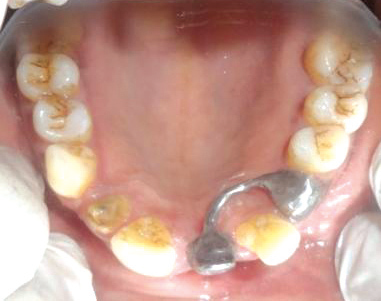
FIG 4 METAL TRY IN

FIG 5 POST INSERTION INTRAORAL

FIG 6 POST INSERTION
DISCUSSION
The spring bridge is a controversial prosthesis in that an area of mucosa is permanently covered by the rather long flexible palatal bar, when judiciously indicated and well maintained, it can provide many years of continued service functionally and aesthetically. The palatal connector in spring cantilever fixed partial denture is a type of loop connector. However, the connector here is a long, thin and resilient bar, closely adapted to the palate so that it is partly supported by soft tissue.8 It connects the pontic to a posterior tooth or teeth requiring full coverage crowns. Although in a rare instance healthy and sound, posterior teeth have been used as abutments to replace a maxillary anterior tooth with diastema, using a resin bonded spring cantilever fixed partial denture9 The long palatal connector in spring cantilever fixed partial denture may deform, if thin, and produce coronal displacement of the pontic; it may interfere with speech and is often poorly tolerated.10 When a diastema is required on either side of the pontic, the spring bridge is the answer as its retainer is placed on a posterior abutment and not connected to the adjacent teeth. The spring'bridge is not indicated in the lower jaw as the mucosa here is thinner, the shape of the jaw will have the bar coming close to the gingival margins, the bar will not be supported by the mucosal tissue as the bite is generally reverse and there is a greater tendency for calculus formation. The advantages of a spring bridge include: (a) readily achieved aesthetics, (b) relatively short clinical chairside time, (c) provision of diastema on either side of the pontic, (d) usually only one posterior abutment is required to support the bridge and (e) the flexible palatal bar acting as a shock absorber reduces the chances of pontic ceramic from fracturing.
CONCLUSION
Although they are rarely used, loop connectors are sometimes required when an existing diastema is to be maintained in a planned fixed prosthesis, as in the above case. A loop connector FPD offers a simple solution to a prosthodontic dilemma involving an anterior edentulous space.
REFERENCES
- Marinello CP, MeyenbergKh, Zitman N. Single tooth replacement: some clinical aspects. J Esthet Dent 1997;9:169-78.
- Tylman’s Theory and Practice of Fixed Prosthodontics.8th ed. St Louis: Ishiyaku Euroamerica Inc; 1989.p. 12-3
- Kamalakanth S, Arbaz S. Anterior loop connector fixed partial denture: A simple solution to a complex prosthodontic dilemma. Journal of Indian Prosthodontic Society2008;8:162-4
- Shillingburg HT Jr, Hobo S, Whitsett LD, Jacobi R, Brackett SE. F u n d a m e n t a l s o f f i x e d prosthodontics, 3rd edition. NewDelhi, Passi, 2002; 509-12.
- J L. Lui. 30-year life span of a spring cantilever bridge: case report. Annal Dent Univ Malaya 2008; 15(1): 48-54.
- Rosenstiel S, Land M, Fujimoto J.Connectors for partial fixed dental prosthesis. Contemporary fixed prosthodontics. 4th edition. New Delhi, Elsevier,2007;843-69
- Breeding L, Dixon D. Transfer of gingival contours to a master cast. The Journal of Prosthetic Dentistry1996;75(3):341-3.
- Bartlett D, Fisher N. Clinical problem solving in prosthodontics: Elsevier Health Sciences; 2004.
- Taggart J. Resin bonded spring cantilever bridge. Restorative dentistry1990;6(2):4-5.
- Mitchell D, Mitchell L, Brunton P. Oxford handbook of clinical dentistry: Oxford University Press, USA; 2005.
Disclaimer from Guident
The views and opinions expressed in articles published in Guident are solely those of the authors and do not necessarily reflect the views of the editors, the editorial board or the publisher, Ivory India. Guident does not endorse any product, technique or treatment described. Clinical content is intended for qualified dental and medical professionals and is not a substitute for individual clinical judgement. Guident, its editors and the publisher accept no liability for any consequence arising from the use of information published in the journal.
How to cite this article
Dr. Anshul Mel, Dr. Sunil Dhaded, Dr. Chandrashekar Sajjan. Spring Cantilever: Simple Solution to a Complex Prosthodontic Dilemma. Guident. 2014 Apr;7(5). Available from: https://ivoryindia.in/articles/prosthodontics/spring-cantilever-simple-solution-to-a-complex-prosthodontic-dilemma.html