Assessment of Prevalence of Myths Regarding Oral Health and Dental Treatment Among Patients Visiting to Dental Institute
Department of Prosthodontics, VSPM Dental College & Research Centre, Nagpur (MS) India
ABSTRACT
BACKGROUND
In this world of modern dentistry, where daily advance dental treatment are going on, myths regarding oral health and dental treatment are still prevalent among the population. The myths vary with age, gender, education, geographic area of living. Being a dental professional, it is our prime responsibility to find out the different myths so that the suitable awareness program can be conducted among the population.
AIM
Assessment of prevalence of myths regarding oral health & dental treatment among patients visiting to dental institute.
METHODOLOGY
A cross sectional questionnaire based study was undertaken among patients visiting to VSPM Dental College& Research Centre Nagpur (MS) for over a period of five months. The total sample size was 728. The survey instrument was a thirteen item validated questionnaire in vernacular language. The solved questionnaires were collected back and data was analyzed
RESULT
There were about 201 (28%) of patients who thought that eating chocolate was the only cause of cavities, 282 (39%) thought extracting upper teeth affect vision. At the same time, 234 (32%) of them showed their disagreement towards extracted teeth need no replacement with artificial teeth.
CONCLUSION
The myths regarding oral health and dental treatment is prevalent moderately in the present study samples. Patients with less education, female patients and patients residing in rural area showed their infuuence more in following the myths.
Keywords: Myths, prevalence, oral health, dental treatment,dental institute,patients.
INTRODUCTION
In this world of modern dentistry, where daily advance dental treatment are going on, myths regarding oral health and dental treatment are still prevalent among the population. The myths vary with age, gender, education, geographic area of living.
Myths are defined as stories shared by a group of people, which are part of their cultural identity, having a strong influence in seeking treatment during illness.1, 2, 3, 4 The word myth is defined as a popular belief or tradition that has grown up around something or someone5. The myths can be prevalent in a population due to a variety of reasons like poor education, cultural beliefs and social misconceptions.6
Culture is defined as learned behavior which is socially acquired.7 Culture has its own influence on health and sickness8, 3 and that is greatly depicted by the values, beliefs, knowledge, and practices shared by the people.2
Dentists have faced many myths and other unproven beliefs, which passed from one generation to another6. As systems are becoming more complex and people expectations of health care are rising dramatically, understanding the myths and misconceptions about oral diseases is important in providing excellent care and health education to both patients and healthy individuals.6
The underlying cultural beliefs and practices influence the conditions of the teeth and mouth, through diet, care-seeking behaviour, or use of home remedies.9 Myths related to oral diseases and oral health-related practices are very common in Indian population. It is difficult to break this chain as it is deep-seated in the society and understanding them becomes essential to provide a good care. Hence, importance should be given for public health awareness regarding myths about oral health at the individual as well as community level.10
In our institute, a varied strata of patients visits for dental treatment, so to identify the different myths,we decided to conduct such type of study in our institute.
AIM
Assessment of prevalence of myths regarding oral health and dental treatment among patients visiting to dental institute.
OBJECTIVES
- To assess myths regarding oral health.
- To assess myths regarding dental treatment.
- To access the variation of myths based on age, gender, education and geographical distribution.
MATERIAL AND METHODOLOGY
A cross-sectional study was conducted among the out patients visiting to VSPM Dental College & Research Centre Nagpur (Maharashtra) over a period of five months. The ethical approval was obtained by the Institutional ethical committee.
Study population
The study population was all the willing patients visiting to our dental institute for over a period of five months. The unwilling patients were excluded from the survey. The total sample size was 728.
Study design
A Cross-sectional questionnaire survey
Questionnaire
A number of studies have been conducted throughout the country to find out the dental myths. To find out the questions, which to be considered for the questionnaire, we have conducted one pilot study among 40 patients visited to VSPM Dental college & Research Centre, Nagpur for a period of one week. In this we have kept 18 questions of myths which have been used in different studies (1,3,8 ) and some where added by own and got validated.
By observing the result of pilot study, we kept only those questions were we got highest prevalence. This way we framed out the final questionnaire which consisted of thirteen item close-ended self-administered questions based on five point Likert scale and was translated in a vernacular language and got validated.
The questionnaire also comprises of socio-demographic details of the patients such as age, gender, education level, address followed by questions. The patients solved the questionnaire then and there itself in order to avoid bias.
The collected data was inserted in excel sheet and analyzed.
RESULT
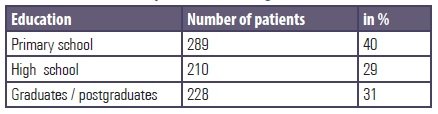
The present study was carried out among the patients visited to VSPM Dental College& Research Centre, Nagpur. The total sample size was 728. Out of which 295 (41%) were females and 433 (59%) were males. On basis of geographic distribution there were about 289 (40%) were rural patients and 439 (60%) were from urban. The distribution of patients according to age and education is shown in table 1 and 2 respectively.
Table 1: Distribution of patients according to age
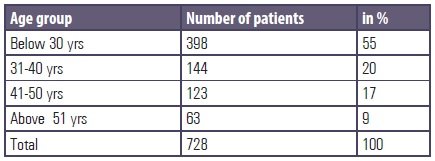
Table 2: Distribution of patients according to education
In the first question, 28% of patients strongly agreed that chocolates/sweets was the only cause of cavities, 32% of them agreed, whereas 26% of them disagreed to it and 6% of patients strongly disagreed to it.
38% of the patients were disagreed for the myth of use of finger or twigs instead of toothbrush for effective maintenance of good oral hygiene.
The next question was, brushing teeth using salt, whitens your teeth, 15% of them strongly agreed to it, 29% of them agreed, 27% of them disagreed to it and 11% of them strongly disagreed to it.
When gum bleed, it is better not to brush and floss your teeth, in this 24% of patients were agreed to it, while 31% of them disagreed and 20% of them strongly disagreed to it.
11% of them strongly agreed that brushing only once is enough for good oral hygiene, whereas 22% of them agreed, 40% of them disagreed and 19% of them strongly disagreed to it.
The next question was, poor brushing is the only cause of bad breath,32% of them strongly agreed to it, 28% of them agreed to it, 18% of them disagreed and 11% of them strongly disagreed to it.
Extracting any upper teeth leads to loss of vision,13% of them strongly agreed to it,39% of them agreed,17% of them disagreed and 10% of them strongly disagreed to it.
10% of patients strongly believed that professional scaling leads to sensitivity, mobility in teeth and creates gap, 23% of them agreed, 22% of them disagreed and 14% of them strongly disagreed to it.
Extracted teeth need no replacement with artificial teeth, 23% of the patients agreed to this, 32% of them disagreed and 18% of them strongly disagreed.
Decay in milk teeth not be treated as they are going to fall anyways,21% of them strongly agreed to it, 27% of them agreed, 28% of them disagreed and 11% of them strongly disagreed to it.
Wisdom teeth are related to human intelligence, 27% of them strongly agreed to it, 26% of them agreed, 22% of them disagreed and 12% of them strongly disagreed.
33% of them agreed that if there is no pain in teeth, no dental visit is required while at the same time 31% of them disagreed to it.
The last question was keeping cloves besides a painful tooth reduces the tooth pain, here we found 42% of the patients agreed to it and only 15% of them disagreed and 6% of them strongly disagreed.
The detailed result of the entire questionnaire is displayed in table 3. The comparison according to age, gender, education and geographic area of living is given in table 4,5, 6 and 7 respectively.
Table 3: Detailed result of all questions


Table 4: Detailed result of all questions on basis of age
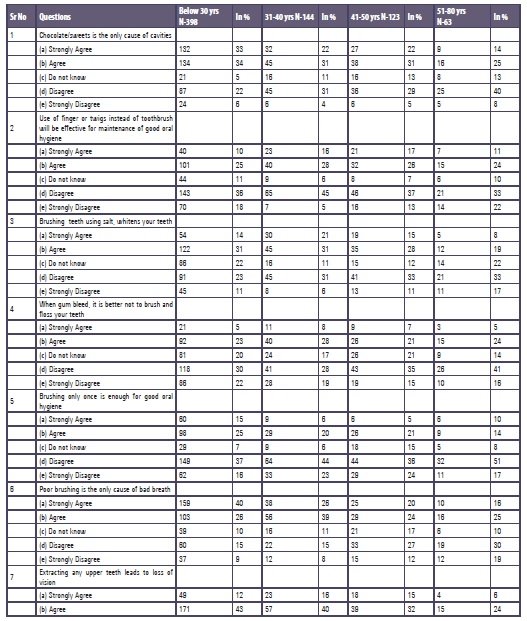
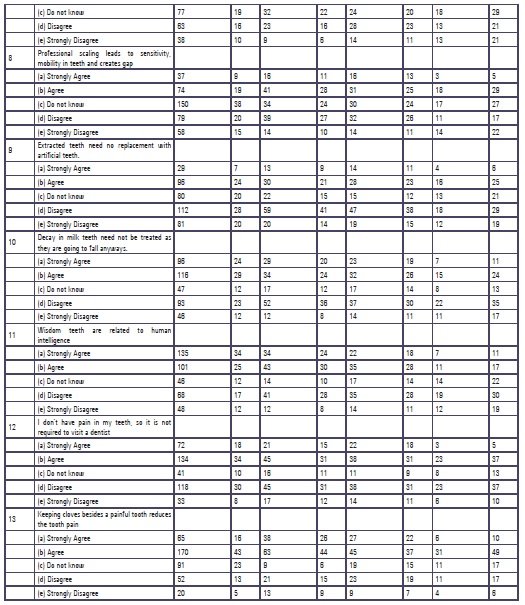
Table 5: Detailed result of all questions on basis of gender


Table 6: Detailed result of all questions on basis of education


Table 7: Detailed result of all questions on basis of geographic distribution


DISCUSSION
Nagpur is the third largest city and winter capital of the Indian state of Maharashtra. According to an Oxford Economics report, Nagpur is projected to be the fifth fastest growing city in the world from 2019-2035.11,12 In Nagpur; varied strata of people live with different culture, religion, socioeconomic and geographical background. The perception of every individual varies. Myth is a belief among people which has no relevance with reality.4 Most of the myths regarding the oral hygiene and dental treatment remains same and it passes on from one generation to generation. Education is the big factor which can alter this misconception of myths.
In our survey, we have first done pilot study and after getting its result we selected those questions only which were more prevalent in the patients which are coming to our institute. In our study we also compared these myths according to gender, age, education and geographical area.
Vignesh R etal1 and Ramandeep Singh Gambhiretal13 in their studies found the prevalence of myth about chocolate/ sweet is the only reason of cavities, among 189 (75.6%) and 414 (75%) of patients respectively. In our study also 97 (34%) of the rural patients were agreed with this myth while 135 (31%) of the urban patients disagreed to it.
It is the most common observation seen during examining the patients complaining of bleeding gums; they stop brushing the teeth because the gum bleeds, this myth was prevalent in the different studies as conducted by Tasneem S Ain etal,10 Archana Raietal7, Ramandeep Singh Gambhiretal13, Sadhana A Rainaetal8, Santosh Kumar etal14, Nagarajapparetal15, where they found 61.5% (320), 73.4% (257), 39.2% (216), 36.3%, 7.5%, 16.5% (33) of the patients don’t brush or floss when the gums bleed respectively. But in our study 228 (31%) of the patients disagreed to it. In comparison according education, the third group had shown 78 (34%) of disagreement towards this myth.
In addition to poor brushing, there are various causes of bad breath, but this is prevalent in patients that bad breath is only due to poor brushing. The study conducted by Sadhana A Raina etal8, at Nagpur, among 250 individuals found that, 47.2%, of patients thinks that bad breath comes only from poor brushing. At the same time they found that 34.4% of the patients thought; brushing only once is enough for good oral hygiene, in our study also 232 (32%) of the patients have shown their strong belief that bad breath comes only from poor brushing but at the same time there were about 289 (40%) of the patients had shown their disagreement towards only one time brushing is enough for keeping good oral hygiene.
Extracting upper teeth affects eye sight, this myth was seen in different studies conducted by Archana Rai etal7, Ramandeep Singh Gambhiretal13, Saumyendra V Singh etal16, Ghanta Bhanu Kiran etal3, Sadhana A Raina etal8, Ripika Sharma etal
The most common question asked by the patients before scaling, does it will loosen my teeth or create gaps in my teeth. Mostly this myth has spread from one person to another who undergone the scaling with a very poor oral hygiene and got a negative experience. This myth was found in the studies conducted by Tasneem S Ain etal10, Ramandeep Singh Gambhir etal13, Saumyendra V Singh etal16, Sadhana A Raina etal8, Ripika Sharma etal2, Poonam Pandya etal4, Dr. N Sarah Sheela Emerald etal17, Santosh Kumar etal14 where they found 72.7% (378), 57% (315), 47%, 48%, 59.3% (89), 46.7%, 40.3% (94), 18.95% of the patients respectively believed that professional scaling loosens teeth, in our study according to gender 25% (75) of the female patients were agreed with this while 26% (113) of the male patients were disagreed with this. On the basis of education about 26% (59) of the third group patients showed their disagreement towards this myth.
The study conducted by Vignesh R etal1 where they found among 250 patients that 48.8% (122) of them believed that extracted teeth needs no replacement with artificial teeth, in our study 23% (170 ) of them agreed to this myths. On the basis of education, 34% (78) of them disagreed to this myths of third group.
The patients are still unaware about the importance of retaining of deciduous teeth. Vignesh R etal1 showed in his study; about 44.8% (162) agreed that that decay in milk teeth need not to be treated as they are going to fall anyways. In our study about 29% (86) of the female patients were agreed to it while 31% (133) of the male patients were disagreed with this. According to geographical distribution, there were about 31% (133) or urban patients and 25% (71) of rural patients were disagreed with this myth. Education wise 37% (84) of the group III patient were disagreed with this myth.
Sadhana A Raina etal8, in her study found that 44.8% of patients believed that wisdom tooth is related to human intelligence; in our study also we found that 26% (190) of them believed that wisdom tooth is related to human intelligence and according to age 30% (43) and 28% (41) of the group I patients agree and disagree with myth. According to geographic distribution 30% (86) and 26% (116) of the rural and this urban patients were agreed with this myth respectively.
This is common finding that, until there is a problem, nobody wants to visit a doctor especially dentist for a routine dental check up. Sadhana A Raina etal (8), Ripika Sharma etal 2, found that 46%,76.7% (115), respectively patients believed that as there is no pain in teeth, visit to dentist is not required; whereas in our study we found that 33% (240) of them agreed with this myth. Gender wise also 32 % (93) and 34% (137) of female and male patients respectively agreed with this myth.
The study conducted by Tasneem S Ain etal10, Ripika Sharma etal2,Dr. N Sarah Sheela Emerald etal17 they found 75.2% (391), 54% (81), 62.7% (146) respectively that patients thinks that clove relieves tooth ache; whereas in our study we found that 42% (309) of patients believing the myth.
With the increasing education, most of the myths has been diminished in percentages but not vanished. In some of this myths like importance of deciduous teeth, replacement of missing teeth we got the positive awareness in the group III patients of education. But among the different age groups; surprisingly younger individuals believed more in myths. This is alarming sign which instructs us for conducting various dental awareness programs in the society about importance of oral and dental health. Also there is dire need of spreading dental education in schools, colleges to reach among the young crowd and give them facts for resolving all these misconceptions.
LIMITATIONS AND FUTURE DIRECTIONS
The questionnaire was self-reported therefore answers given by the participants could be biased. The study result cannot be generalised for the Indian population because, the survey was limited to patients who visited the institute for a dental treatment during the five month period only. The survey can be extended by conducting it in large scale for a long duration of time in different rural and urban areas to expand the sample size to get more precise results which can be generalised.
CONCLUSION
The present study result can be concluded that; the myths regarding oral health and dental treatment is prevalent moderately in the present study samples. Patients with less education, female patients and patients residing in rural area showed their influence more in following the myths. Among the different age groups; surprisingly younger individuals believed more in myths. This is alarming sign which instructs us to tie the shoes tight for conducting various awareness programs about importance of oral and dental health. There is dire need of spreading dental education in schools, colleges to reach among the young crowd and bring facts into notice against the various myths as they are the future backbones of the country.
ACKNOWLEGMENT
The authors would like to give their sincere thanks to the Dean of VSPM Dental College, Nagpur for conducting this survey in our institute and also give their thanks to all the participating patients for their co-operation and active participation in the survey.
Financial support and sponsorship
Nil
Conflicts of interest
There is no conflicts of interest
REFERENCES
- Vignesh R, Priyadarshni I. Assessment of the prevalence of myths regarding oral health among general population in Maduravoyal, Chennai. Journal of Education and Ethics in Dentistry. 2012 Jul 1; 2 (2): 85.
- Sharma R, Mallaiah P, Margabandhu S, Umashankar GK, Verma S. Dental myth, fallacies and misconceptions and its association with socio-dental impact locus of control scale. Int J. 2015 Jul; 1: 15.
- Kiran GB, Pachava S, Sanikommu S, Simha BV, Srinivas R, Rao VN. Evaluation of dent-o-myths among adult population living in a rural region of Andhra Pradesh, India: A cross sectional study. Journal of Dr. NTR University of Health Sciences. 2016 Apr 1; 5 (2): 130.
- Pandya P, Bhambal A, Bhambani G, Bansal V, Kothari S, Divya K. Dental Care: Social Myths and Taboos. People Journal of Scientific Research. 2016 Jul; 9(2): 42-6.
- Heglund S, Dental Myths: A Deterrent To Dental Care Seeking Behaviour In Developing Countries. http://oatext.com
- Mythri H, Kumar R. Perceived myths about oral health in India. Indian Journal of Dental Research. 2015 May 1; 26(3): 333.
- Rai A, Menon I, Aruna DS, Singh A. Association between taboos in dentistry and oral health behavior among adult population of Ghaziabad. Journal of Dental Specialities. 2016; 4(1): 14-20.
- Raina S , Jain P, Warhadpande M, Myths and taboos in dentistry. International Journal of Research in Medical Sciences, 2017 May; 5(5): 1936-1942
- Butani Y, Weintraub JA, Barker JC. Oral health-related cultural beliefs for four racial/ethnic groups: Assessment of the literature. BMC oral health. 2008 Dec; 8(1): 26.
- Ain T, GowharO,Sultan S, Prevalence Of Perceived Myths Regarding Oral Health And Oral Cancer- Causing Habits In Kashmir, India, International Journal Of Scientific Study, 2016 Jun; 4(3): 45-49
- “Maharashtra Population Sex Ratio in Maharashtra Literacy rate data”. Census2011.co.in. 2016 Nov
- Gupta, Surojit (6 December 2018). “’17 of 20 fastest-growing cities in the world will be from India’”. The Times of India. Retrieved 2019 April .
- Gambhir RS, Nirola A, Anand S, Gupta T. Myths regarding oral health among patients visiting a dental school in North India: A cross-sectional survey. International Journal of Oral Health Sciences. 2015 Jan 1; 5(1): 9.
- Kumar S, Mythri H, Kashinath KR. A clinical perspective of myths about oral health a hospital based survey. Univ J Pharm. 2014; 3: 35-7.
- Nagarajappa R, Sahare P, Shukla N, Tuteja JS, Bhalla A. Knowledge, attitude and practices regarding oral health among out patients at Rama dental college, Kanpur. Rama Univ J Dent Sci. 2015 Mar; 2(1): 8-14.
- Singh S, Tripathi A, Akbar Z, Chandra S, Tripathi A, Prevalence Of Dental Myths, Oral Hygiene Methods And Tobacco Habits In An Ageing North Indian Rural Population, The Gerodontology Society And John Wiley And Sons A/S, Gerodontology, 2012: 53-56.
- Dr Emerald N, Dr Reddy V, Dr Rao N, Dental Health Myths And Misconceptions Among Yanadi Tribe Of Gonepalli Village, Nellore District: A Cross-Sectional Study, 2016 Dec;5(12):9-15
- Khan SA, Dawani N, Bilal S. Perceptions and myths regarding oral health care amongst strata of low socio economic community in Karachi, Pakistan. J Pak Med Assoc. 2012 Nov 1;62(11):1198-203.
Disclaimer from Guident
The views and opinions expressed in articles published in Guident are solely those of the authors and do not necessarily reflect the views of the editors, the editorial board or the publisher, Ivory India. Guident does not endorse any product, technique or treatment described. Clinical content is intended for qualified dental and medical professionals and is not a substitute for individual clinical judgement. Guident, its editors and the publisher accept no liability for any consequence arising from the use of information published in the journal.
How to cite this article
Dr. Sanjana Agrawal, Dr. Anita Rama Kahar, Dr. Jayashree Joshi. Assessment of Prevalence of Myths Regarding Oral Health and Dental Treatment Among Patients Visiting to Dental Institute. Guident. 2019 Sep;12(10). Available from: https://ivoryindia.in/articles/research/assessment-of-prevalence-of-myths-regarding-oral-health-and-dental-treatment-among-patients-visiting-to.html