Identification of Common Periodontopathogenic Bacteria in Patients Undergoing Orthodontic Treatment
Department of Periodeontics, Mahe Institute of Dental Sciences and Hospital
Introduction:Periodontal health is usually essential to achieving the successful orthodontic therapy in short as well as the long term. The ability of the patient to achieve and maintain good oral hygiene while undergoing orthodontic treatment to prevent the chances of occurance of periodontal diseases is also very important.
Aim:To identify the common periodontopathogenic microorganisams in patients undergoing orthodontic treatment.
Materials and Methods:Supragingival plaque samples are collected from 10 patients who are undergoing orthodontic treatment with an age group between 13-35 years and the plaque samples are incubated in 37°C under aerobic conditions for 24 hours. Samples inoculated in to different medias (Blood agar, Chocolate agar, Mac conkey agar ) and incubated to 37°C under aerobic conditions for 24 hours. The colony characters and morphology on gram staining were observed. The different isolated colonies were subjected for phenotypic characterisation by automated bacterial identification system (MALDI-TOF-MS).
Results:Streptococcus and Enterobacter species are the predominent microorganisams followed by Neisseria species, Acinetobacter species,Pseudomonas species and Klebsiella species in patients undergoing orthodontic treatment.
Keywords:Periodontitis, Supragingival plaque, Microorganisms
INTRODUCTION
Dental plaque is a natural microbial deposits and a true biofilm which contain bacteria in a matrix mainly composed of bacterial extracellular polymers and salivary or gingival exudate.1 The maturation of the plaque is achieved by the accumulation of bacteria,growth and reproduction of bacteria,leads to release of number of organic and inorganic metabolites.2 It is generally accepted that the primary etiologic factor in periodontal disease is represented by the dental plaque microorganisms. However not all the infected sites suffer periodontal destructions, this phenomenon can be explained on the assumption that only a limited number of pathogens are present in the sufficient amount, capable of affecting the periodontal tissue, while the same pathogens present in a less amount are capable with a healthy periodontium.3 Fixed orthodontic appliances introduce mechanical plaque (biofilm) traps and impair plaque removal, proper oral hygiene, and gingival health. This promotes specific alteration in oral environment, including decreased PH,and increased plaque accumulation.4 Patient often exhibit gingival hypertrophy, bleeding, increased plaque accumulation and calculus formation during orthodontic treatment.5
The oral hygiene measures are recommended because the brackets, bands, elastics and ligature wire encourage the accumulation of microbial flora and food residues.6 In time the plaque accumulation which is present around the orthodontic appliances may cause periodontal disease.2 This study is to identify the common periodontopathogenic bacteria in supragingival plaque sample on patients undergoing orthodontic therapy.
Patients and ethical issues
The study will be carried out in a randomly selected cohort patients who were undergoing orthodontic therapy with an age between 13-35 years, in the Department of orthodontics in Mahe Institute of dental sciences and hospital, mahe, Pondicherry.
Inclusion criteria
Subjects undergoing orthodontic treatment with fixed appliance of 0.22 slot MBT prescription.
- Patient with minimum 20 teeth.
- Patient without any systemic diseases.
- The subjects who had not received any periodontal therapy for past 6 months.
EXCLUSION CRITERIA
- Patients with history of smoking and alcohol consumption.
- Known intake of antibiotics within last three month.
- Patient using mouthwashes/mouthrinses
Sample Collection And Processing
The study were conducted after obtaining ethical committee clearance from Mahe institute of dental sciences and hospital. Patients were counseled and informed consent were taken from each participant. Selected patients was subjected to oral prophylaxis by ultrasonic scaling. After placing orthodontic brackets patients are recalled for follow up after 1 month. All participants are ask to use orthodontic tooth brush during the study phase. Marginal plaque along the gingival margin are collected from all the teeth present.
The site is isolated from saliva by applying cotton rolls and gently dried with a compressed air to avoid contamination. With the help of sterile jaquette scaler, marginal plaque samples are collected and are immediately transported to the laboratory in brain heart infusion broth as the transport medium and further microbial analysis were done. Samples are incubated in 37°C under aerobic conditions for 24 hours. Samples inoculated in to different medias (Blood agar, Chocolate agar, Mac conkey agar ) and incubated to 37°C under aerobic conditions for 24 hours. The colony characters and morphology on gram staining were observed.The different isolated colonies were subjected for phenotypic characterisation by automated bacterial identification system (MALDI-TOF-MS) (It is one of the automated rapid,precise bacterial identification system by using proteomics based detection.)
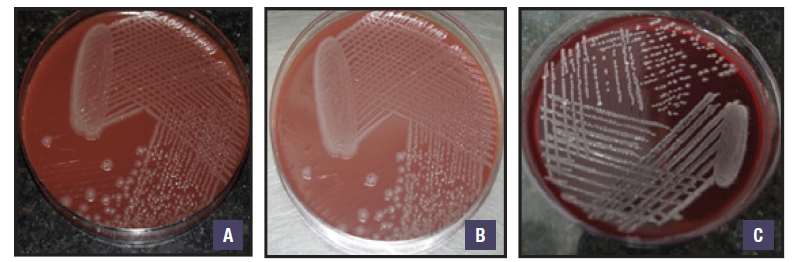
Fig 1. Media used for isolation of microrganisam from supra gingival plaque sample A) Blood agar B) Chocolate agar C) Mac conkey agar

Fig 2: MALDI-TOF-MS) - Automated rapid,precise bacterial identification system
RESULTS
Table 1. Different groups of organisms identified from supragingival plaque sample from patient undergoing orthodontic treatment.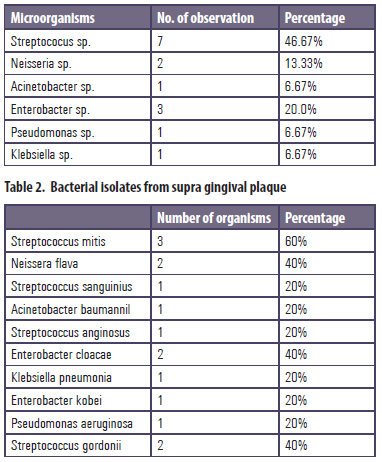
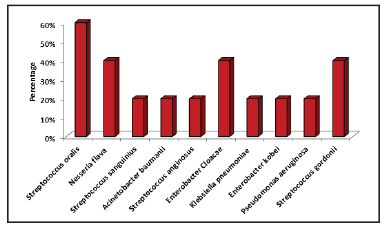
Fig 3. Distribution of bacterial isolates from supra gingival plaque
The supra gingival plaques are collected from orthodontic patient and the gram positive and gram negative organisms are identified. Streptococcus sp. (7,46.67%) and Enterobacter sp. (3,20%) are the predominant group identified,followed by Neisseria sp. (2,13.33%), Acinetobacter sp. (1,6.67%),Pseudomonas sp. (1,6.67%) and Klebsiella sp. (1,6.67%) (Table 1)
Among the isolated Streptococcal species Streptococcus mitis (3,60%) is the predominant species isolated from supra gingival plaque sample, followed by,Streptococcus gordonii (2,40%),Streptococcus sanguinius (1,20%) (1) Streptococcus anginosus (1, 20%).Other organism identified are Enterobacter cloacae (2, 40%), Neisseria flava (2, 40%), Actinetobacter baummanil (1, 20%), Klebesiella pneumoniae (1, 20%), Enterobacter kobei (1, 20%) and Pseudomonas aeruginosa (1,20%). (Table 2, Figure 2)
DISCUSSION
This study examined the microbiological status of patients undergoing orthodontic therapy. Several studies have investigated the effects of orthodontic treatment on periodontal health,most of the investigators concluded that the overall gingival changes produced by the orthodontic appliances are transient with no permanent damage to the periodontal tissues.
The plaque is the most important ethiological agent for the occurrence of periodontal disease,thus proper plaque control must be emphasized as the most important factor in presenting periodontal health in patients undergoing orthodontic therapy. The orthodontic appliance present a challenge to proper removal of plaque from the tooth and gingival surface. The main organisms commonly present in early plaque are gram positive rods and cocci, overtime these organisms are replaced by more gram negative and anerobic organisms,which may initiate a periodontal reaction. The biofilm may become unbalanced and pathological due to the result of changes in the environment due to the impact of orthodontic appliances.
From this study it was identified that the streptococcal species mainly streptococcus mitis are the predominant species isolated from the supragingival plaque samples from the patients undergoing orthodontic treatment. The study done by Vizitu et al in 2011, they evaluated the changes of oral microflora, concentrating on oral streptococci after 3-6 months of orthodontic treatment and the results showed that the most common identified streptococcal species were Streptococcus salivarius, Steptoccus oralis and Streptococcal mutans (37.5%, 22.5%, 10%).7
Other than the streptococcal species different organisams are identified from the supragingival plaque samples of patients undergoing orthodontic treatment eg- Neissera flava, Enterobacter Cloacae, Acinobacter Baumannil, Klebsiella pneumonia, Enterobacter kobei, Pseudomonas aeruginosa it was similar with the study done by U. Hagg et al in 2004, in there study they evaluated the prevalence of candida and Enterobacteriaceae in a group of adolescents during fixed orthodontic therapy and they identified 8 coliform species, include Klebsiella pneumonia, Enterobacter sakazakii, Enterobacter cloacae, Enterobacter gergoriae, Pseudomonas aeruginosa, Enterobacter aggomutans, Acinetobacter and Yersinia species.8
Study done by Brett Eckley in 2012 concluded that there was a concurrent increase in the BANA positive peridontopathogens P. Gigivalis, T. Denticola and T. Forsythia with the orthodontic treatment and the dark field microscopy confirmed an increase in the populations of large and small spirochetes, filaments bacteria,non motile rods and fungiforms9. Another study done by W. Sukonta patipark et al, assess the bacterial plaque accumulation adjacent to orthodontic brackets using SEM study and demonstrate that excess composite around the bracket base is the critical site for plaque accumulation due to its rough surface and also the presence of distinct gap at the composite enamel interface are the main ethiological factor for plaque accumulation.10 Farronato et al, describes some of the main periodontal risk factors that are likely to arise during orthodontic treatment. Presence of orthodontic bands, poor oral hygiene and intrusive movements of dental elements can lead to the movement of deeper bacterial plaque into the gingival site and subsequent variations in the microflora and development of gingivitis into full-blown periodontal disease. For this reason, the authors advise preventive screening that will help detect the presence of periodontal-pathogenic bacteria or possible genetic predisposition to periodontal diseases in each treated patient.
The periodontal test is a basic tool used for diagnosis and treatment planning in periodontal diseases. Specific advantages of this test are as follows:
- Identify and quantify the pathogens during diagnostic stage of orthodontic therapy
- Measure the presence of periodontal bacteriae and their anticipated risk profile during therapy
- Objectively control excess surgical therapy and up keeping of orthodontic and periodontal protocols
- Improve patient compliance to therapy after making them aware of their correct microbial profile during treatment planning
- Accurate diagnosis patient disease before and any residual sites after therapy
- Innovation in orthodontic research.
- These parameters are fundamental and necessary to
- Define a therapy procedure.
- Plan intervals for follow-up.
- Therapeutic planning and promote patient involvement in therapeutic plan.
- Improve compliance of patient’s with oral hygiene.
- Certification of outcomes of therapy and decide possible further activities post-therapy.
- Monitoring the sustainability of therapeutic results via periodical check ups.11
- Lindhe J, Karring T, Lang NP. Clinical Periodontology and Implant Dentistry 4th Edition. Blackwell Publishing Munksgard. Oxford, United Kingdom. 2003.
- Michael G Newman, Henri H Takei, Fermin A, Caranza-Clinical P eriodontology 9th Edition, 2003.
- Darby I.B, Mooney J, Kinane DF. Changes in subgingival microflora and humoral immune response following periodontal therapy. J Clin Periodontol. 2001;796-805.
- Naranjo AA, Trivino ML, Jaramillo A, Betancourth M, Botero JE. Changes in the subgingival microbiota and periodontal parameters before and 3 months after bracket placement. Am J Orthod Dentofacial Orthop 2006;130:275.
- Türkkahraman H, Sayin MO, Bozkurt FY, Yetkin Z, Kaya S, Onal S. Archwire ligation techniques, microbial colonization, and periodontal status in orthodontically treated patients. Angle Orthod 2005;75:231-6.
- KiliçoÄŸlu H, Yildirim M, Polater H. Comparison of the effectiveness of two types of toothbrushes on the oral hygiene of patients undergoing orthodontic treatment with fixed appliances. Am J Orthod Dentofacial Orthop 1997;111:591-4.
- Vizitiu TC, Giuca MC, Ionescu E. Influence of orthodontic treatment on oral streptococci. Roum Arch Microbiol Immunol. 2011;105-8.
- U.Hagg et al, The effect of fixed orthodontic appliances on the oral carriage of candida species and entero bacteriaceae.Eur J Orthodont. 2004;623-629
- Eckly B, Thomas T, Crout R, Ngan P.Periodontal and microbiological status of patients undergoing orthodontic therapy.Hong Kong Dent J.2012:9:11-20.
- W.Sukonta Palipark et al,. Bacterial colonization associated with fixed orthodontic appliances. A scanning electron microscopy study. Eur J Orthodont.2001;475-484.
- Lauritano D, Caccianiga G. Periodontal aspects in orthodontics. OA Dentistry. 2013; 1:1
The presence or absence of pathogenic bacteria, their sub-types and proportions defines the level and intensity of periodontal disease during orthodontic therapy
CONCLUSION
The main principles of optimal orthodontic treatment in relation to oral hygiene include preference of banding for orthodontic attachments, use of short end bands, applying fluoride varnish around bracket bases, use of Glass Ionomer Cement for banding, re-cementation of loose bands and brackets, removing excess adhesive and cement remnants, prevent labial tipping of lower incisors in case of narrow or thin gingival propria, use of fluoride releasing materials in case of retainers with less interferences, intentional use of Hawthrone effect to improve oral hygiene compliance, use of single tufted brushes, chemical cleaning and horizontal scrub technique, use of self-ligating brackets and most important is instituting oral hygiene programme prior to orthodontic treatment.
REFERENCES
Disclaimer from Guident
The views and opinions expressed in articles published in Guident are solely those of the authors and do not necessarily reflect the views of the editors, the editorial board or the publisher, Ivory India. Guident does not endorse any product, technique or treatment described. Clinical content is intended for qualified dental and medical professionals and is not a substitute for individual clinical judgement. Guident, its editors and the publisher accept no liability for any consequence arising from the use of information published in the journal.
How to cite this article
Dr. Anil Melath. Identification of Common Periodontopathogenic Bacteria in Patients Undergoing Orthodontic Treatment. Guident. 2019 Dec;13(1). Available from: https://ivoryindia.in/articles/research/identification-of-common-periodontopathogenic-bacteria-in-patients-undergoing-orthodontic-treatment.html