Comparative Evaluation of Surface Roughness of Teeth After Application of Remineralizing Toothpastes an in Vitro Study
Department of Conservative Dentistry and Endodontics, M. A .Rangoonwala College of Dental Sciences & Research Centre, Pune - 411001
ABSTRACT
Introduction:The aim of this study reduction of surface roughness of teeth after application of Fluoridated, Calcium Sucrose Phosphate and CPP-ACP Toothpastes.
Materials and Method:60 premolars used in this study were decoronated at the cementoenamel junction 120 specimens. The specimens were mounted on acrylic blocks and placed in demineralising solution for 72 hrs. After 72 hrs, initial surface roughness was assessed. The teeth specimens were divided into three groups: Group A: Fluoridated toothpastes Group B: calcium sucrose phosphate toothpaste Group C: CPP-ACP tooth paste. The toothpastes were applied on the specimens for 3 mins and washed with distilled water and placed in artificial saliva. This routine was carried out for 30 days. Final surface roughness was assessed.
Results:In Group 1 (Fluoride), the distribution of mean initial surface roughness did not differ significantly compared to mean final surface roughness. In Group 2 (CSP), the distribution of mean initial surface roughness is significantly higher compared to mean final surface roughness. In Group 3 (CPP-ACP), the distribution of mean initial surface roughness is significantly/ higher compared to mean final surface roughness (P-value<0.001).
Conclusion:Within the limitations of this study, CPP-ACP and calcium sucrose phosphate showed the significant reduction in the surface roughness compared to fluoridated toothpaste.
Keywords:CPP-ACP, Calcium Sucrose Phosphate, Dental Caries, Surface Roughness
INTRODUCTION
Dental caries is most prevalent chronic disease affecting the human race. Its prevalence has been noted since the time of pre-Neolithic humans. With respect to all the definitions by various authors, dental caries is initiated via demineralisation of the dental hard tissues resulting in roughing of the hard tooth surface Caries results from an imbalance between many cycles of demineralization and remineralization rather than from continued demineralization. The earliest clinical sign is the “white spot lesion” which result in roughening of the surface of teeth.1<>
Over the last few decades, fluoride in various forms has been proven to reduce caries in both the primary and permanent dentitions when used in a variety of ways. The widespread reduction in dental caries worldwide is largely due to the extensive use of fluoride in the form of toothpaste. In recent years calcium and phosphate based nanocomplexes have also been demonstrated to have anticariogenic properties in both laboratory animal and human in situ experiments. Sodium monofluorophosphate is most widely used in dentifrices due to its greater compatibility with dentifrice abrasives.2-3
Since the process of remineralization can be limited by the availability of calcium and phosphorous ions, calcium phosphate based remineralization systems like Calcium sucrose phosphate toothpastes which is a mixture of calcium sucrose phosphate with inorganic amorphous calcium phosphate are commercially available.4
Casein, a bovine milk protein is known to interact with calcium and phosphate and is a natural food component.5
Casein, a bovine milk protein is known to interact with calcium and phosphate and is a natural food component. CPP (Caesin phosphopeptide) has the potential to be added to mouth rinses, gels, toothpastes, chewing gums and confectioneries. Casein phosphopeptide is a sticky protein that binds and stabilizes calcium and phosphate ions in an amorphous state. CPP-ACP maintains saturation of levels of minerals, especially calcium and phosphate, at the tooth surface thereby depressing demineralization and enhancing remineralization.6-10
Thus, the aim of this study reduction of surface roughness of teeth after application of Fluoridated, Calcium Sucrose Phosphate and CPP-ACP Toothpastes.
MATERIALS AND METHOD
Specimen Preparation
After obtaining the Institute Ethical clearance, the study was conducted in the Department of Conservative Dentistry and Endodontics. Sixty human extracted single-rooted teeth with single canal and well-formed root apices, were collected from Department of Oral and Maxillofacial Surgery with informed consent of the donor.
Inclusion Criteria
i. Non-carious single rooted canal teeth with well-formed root apices.Exclusion criteria:
- Deeply carious teeth
- Teeth with development anomalies
- Teeth with Cracks, Fractures or defects
- Teeth with more than on root canal
- Teeth with resorption
Preparation of Demineralisation solution
Demineralizing solution was prepared in the Department of Biochemistry. A digital pH meter (Slope Labtronics, Model LT-11, Panchkula, Haryana, India) was used to check pH during and after preparation of solution. The composition of demineralizing solution used was as follows:
- 2.2 mM calcium chloride, CaCl2 2H2O (Loba Chemie Pvt. Ltd., Mumbai, Maharashtra, India)
- 2.2 mM monosodium phosphate, NaH2PO4 7H2O (Loba Chemie Pvt. Ltd., Mumbai, Maharashtra, India)
- 0.05 M lactic acid, C3 H6 O3 (Loba Chemie Pvt. Ltd., Mumbai, Maharashtra, India).
The final pH was adjusted to 4.5 with 50% sodium hydroxide, NaOH
(Loba Chemie Pvt. Ltd., Mumbai, Maharashtra, India)
Preparation of Artificial Saliva: 11
We made the artificial saliva we used in our study according to the formulation used by Mcknight Hanes and Whiteford which contained 0.65 grams per liter potassium chloride 0.058 g/L magnesium chloride BP, 0.165 g/L calcium chloride BP, 0.804 g/L dipotassium hydrogen phosphate, 0.365 g/L potassium dihydrogen phosphate, 2 g/L sodium benzoate, 7.8 g/L sodium carboxymethyl cellulose BP, deionized water to make 1 L.
Specimen Treatment
The acrylic blocks were placed in artificially prepared deminerazation solution using Standard Ph cycle. A daily schedule of 3 cycles of 30 mins of demineralisation and 2.5 hrs of remineralization was performed after which the specimens were placed in artificial saliva for 72 hrs. The specimens were then divided into 3 groups:
Group A: Specimens with application of fluoridated (Colgate, Colgate Palmolive, India) toothpaste
Group B: Specimens with application of Calcium sucrose phosphate (Toothmin, Abbott India Ltd.) toothpaste
Group C: Specimens with application of CPP-ACP toothpaste.
Initial Surface roughness was analysed using surface profilometry prior to the application of the toothpaste. Toothpastes were applied on the crown disks using a microbrush applicator tip and toothbrushing was performed using a micromotor and bristle brush for about 3 mins. The blocks were rinsed with distilled water and place in artificial saliva. This cycle was follows after a window of 12 hrs for the next 30 days. After 30 days, final surface roughness was checked using Surface Profilometry. The readings of the Initial and Final surface roughness was statistically analysed.
Statistical Analysis
One-way analysis of variance (ANOVA) with Tukey’s Post-Hoc test was used the analyse the intergroup mean distribution of surface roughness from results of surface profilometry for multiple group comparisons using the SPSS software (Sigma Stats, Version 2.03, SPSS, Chicago).
Results
Table 1) The intra-group comparison of mean surface roughness.
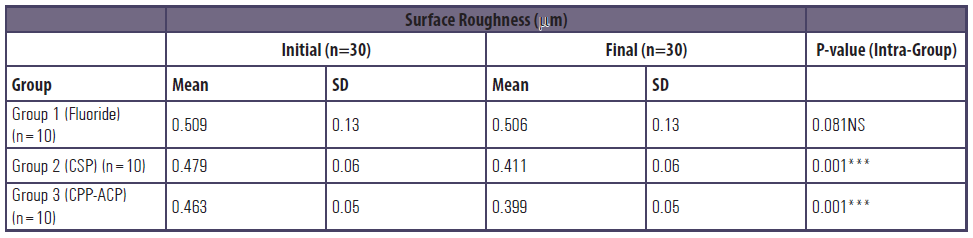
Table 1 shows intra-group reduction in mean surface roughness.
In Group 1 (Fluoride), the distribution of mean initial surface roughness did not differ significantly compared to mean final surface roughness. In Group 2 (CSP), the distribution of mean initial surface roughness is significantly higher compared to mean final surface roughness. In Group 3 (CPP-ACP), the distribution of mean initial surface roughness is significantly/ higher compared to mean final surface roughness (P-value<0.001).

Figure 1: Intra-group Distribution of Mean Surface Roughness

Figure 2: Application of Fluoridated toothpaste

Figure 3 : Application of CPP-ACP toothpaste
DISCUSSION
The most common oral disease affecting a large number of people is dental caries. The occurrence of caries is pH dependent. When pH drops below 5.5, enamel dissolution starts, embarking demineralization. It marks the beginning of early enamel caries. During demineralization, Ca2+, OH−, PO4 2−, F−, CO3−, Na+ and Mg2+ get displaced from the enamel surface to the exterior. More the acidic environment, greater is the outward flow of ions. However, mineral content of surface is higher than the body of the lesion.[11] Thus, pH plays a major role in the loss of these ions resulting in surface roughness. The pH-cycling protocol carried out in the present study was in accordance to the protocol used by Ten Cate and Duijsters resulting in sub-surface demineralisation replicating early enamel caries.12,13
The artificial saliva contained potassium chloride, magnesium chloride, calcium chloride, dipotassium hydrogen phosphate and potassium dihydrogen phosphate, which may help remineralize enamel. Results from several studies showed that artificial saliva can reharden acid-softened enamel with a six-hour window period.14
In order to simulate the daily routine of oral environment, this model was designed to apply toothpastes two times a day, i.e. early morning, before bed-time. Also, studies have shown that the average time for any remineralisation agent to remineralize after an acid challenge is also approximately two weeks. Considering thus this fact, the current study was designed to carry out pH-cycling for 30 days.15 This surface roughness invites adhesion of bacteria and further invasion of the bacterial process. However, with the recent advance and in-depth knowledge of cariology, demineralization process occurring in dental caries can be arrested or reversed when remineralization agents are applied to incipient carious or non-cavitated carious lesions.16
Undoubtedly tooth brushing is the most widely used and socially accepted form of oral hygiene. Yet it is not clear to what extent tooth brushing itself, exclusive of therapeutic dentifrices, alters the caries attack.17
The aim of this study was to evaluate reduction of surface roughness of teeth after application of Fluoridated, Calcium Sucrose Phosphate and CPP-ACP Toothpastes.
In this study, Fluorides showed the least reduction in surface roughness compared to the other two toothpaste agents used. Fluorides has been widely recommended as a remineralization agent for preventing early enamel carious lesions. The cariostatic effects of fluoride are mostly topical to precipitate calcium fluoride minerals on the surface of enamel and bacterial plaque. Such cariostatic therapeutic effects of fluoride are inadequate to deal with high caries risk patients. Promising remineralization effects are possible using high fluoride concentration agents. However, fluoride has a dose-response relationship, and careless handling of fluoride toothpastes may lead to adverse effects such as fluorosis. Also, with the help of many researches on remineralisation agents it is now said that, fluorides only help in repair and not in remineralization process and thus is a misnomer. Thesemight be the possible reasons why there was no significant reduction in the surface roughness in the fluoridated group.18
With the recent knowledge there has been an evolution of remineralising agents that has focused on a more calcium and phosphate-based products than fluorides due to their ability to solubilize calcium and phosphate ions already in the saliva and also act as a reservoir for the replace of lost tooth structures.19
There was no statistical significance in the reduction in the surface roughness between the Calcium Sucrose Phosphate group and Caesin Phosphatide Amorphous Calcium Phosphate (CPP-ACP) Group.
Calcium Sucrose phosphate, supplies both calcium and phosphate in soluble form. These calcium and phosphate ions are released into the solution increase the rate of remineralization due to the common ion effect. The sucrose phosphate ions are adsorbed on the enamel surface which helps in decreasing the rate of acid dissolution of hydroxyapatite.4,14
Similarly, CPP-ACP nano-complexes are peptides derivative from casein, where the ACP is stabilized by CPP, acting as a calcium and phosphate reservoir, which can be incorporated in the dental surface. CPP ACP promotes an effect of supersaturation of the ions, reducing demineralization and increasing mineralization.[11] This mechanism provides anticariogenic properties to CPP ACP. According to Walker et al, CPP-ACP nanocomplexes have been shown to be superior to other forms of calcium phosphate in the remineralization of enamel subsurface lesions in situ. This might be the possible reason why CPP-ACP showed a better reduction in surface roughness as compared to Calcium Sucrose Phosphate.20
Future studies are needed to be carried on the effect of dental hard tissues by these remineralising toothpastes with a bigger sample size and different study designs.
CONCLUSION
Within the limitations of this study, CPP-ACP and calcium sucrose phosphate showed the significant reduction in the surface roughness compared to fluoridated toothpaste.
However, when compared to calcium sucrose phosphate toothpaste, CPP-ACP toothpaste showed a better result. This study design helps us to brighten the possibility to explore these remineralizing agents for its long term use in toothpastes with different study designs with bigger sample size.
REFERENCES
- Loesche WJ. Role of Strepfptococcus mutans in human dental decay. Microbiol Rev 50:353-80,1986
- Riordan PJ. Dental fluorosis, dental caries and fluoride exposure among 7-year-olds. Caries Res 27:71-7,1992.
- Riordan PJ, Banks JA. Dental fluorosis and fluoride exposure in Western Australia. J Dent Res 70:1022-8,1991. Riordan PJ. Perceptions of dental fluorosis. J Dent Res 721268-74, 1993.
- de Rooij JF, Nancollas GH. The formation and remineralization of artificial white spot lesions: A constant composition approach. J Dent Res 63964-7,1984.
- Holt C, van Kemenade MJJM. The interaction of phosphoproteins with calcium phosphate. In: Calcified tissue. Hukins DWL, editor. Boca Raton, FL: CRC Press, 1989
- Hegde AM, Naik N, Kumari S. Comparison of salivary calcium, phosphate and alkaline phosphatase levels in children with early childhood caries after administration of milk, cheese and GC tooth mousse: An in vivo study. J Clin Pediatr Dent 2014;38:318-25.
- Elizabeta S, John W. A preliminary study of enamel remineralization by dentifrices based on recaldentTM (CPP-ACP) and NovaMinR (calcium-sodium-phosphosilicate). Acta Odontol Latinoam 2010; 23: 234-239.
- Petrou I, Heu R, Stranick M, et al. A breakthrough therapy for dentin hypersensitivity: how dental products containing 8% arginine and calcium carbonate work to deliver effective relief of sensitive teeth. J Clin Dent 2009; 20: 23-31.
- White DJ. The application of in vitro models to research on demineralization and remineralization of the teeth. Adv Dent Res 1995; 9: 175-193.
- McKnight-Hanes C, Whitford GM. Fluoride release from three glass ionomer materials and the effects of varnishing with or without finishing. Caries research. 1992;26(5):345-50.
- Winston AE, Bhaskar SN. Caries prevention in the 21st century. J Am Dent Assoc 1998; 129: 1579-1587. [20] Meurman JH. Ten Cate, Pathogenesis and modifying factors of dental erosion. Eur J Oral Sci 1996; 104: 199-206.
- Azrak B, Callaway A, Knözinger S, Willershausen B. Reduction of the pH-values of whole saliva after the intake of apple juice containing beverages in children and adults. Oral Health Prev Dent 2003; 1: 229-236.
- Ten Cate JM, Duijsters PP. Alternating demineralization and remineralization of artificial lesion. Caries Res 1982; 16: 201-210.
- Reynolds EC. Casein Phosphopeptide-amorphous calcium phosphate: the scientific evidence. Adv Dent Res 2009; 21: 25-29.
- Heshmat H, Ganjkar MH, Jaberi S, et al. The effect of Remin Pro and MI paste plus on bleached enamel surface roughness. J Dent (Tehran) 2014; 11: 131-136.
- Cheng ZJ, Wang XM, Cui FZ, Ge J, Yan JX. The enamel softening and loss during early erosion studies by AFM, SEM and nanoindentation. Biomed Mater 2009; 4: 015020.
- Remineralization of early enamel caries lesions using different bioactive elements containing toothpastes: An in vitro study. Technology and Health Care 24 (2016) 701–711
- Kumar VL, Itthagarun A, King NM. The effect of casein phosphopeptideâ€amorphous calcium phosphate on remineralization of artificial cariesâ€like lesions: an in vitro study. Australian Dental Journal. 2008 Mar;53(1):34-40.
- Panich M, Poolthong S. The effect of casein phosphopeptide–amorphous calcium phosphate and a cola soft drink on in vitro enamel hardness. The Journal of the American Dental Association. 2009 Apr 1;140(4):455-60.
- Walker GD, Cai F, Shen P, Adams GG, Reynolds C, Reynolds EC. Casein phosphopeptide-amorphous calcium phosphate incorporated into sugar confections inhibits the progression of enamel subsurface lesions in situ. Caries research. 2010;44(1):33-40.
Disclaimer from Guident
The views and opinions expressed in articles published in Guident are solely those of the authors and do not necessarily reflect the views of the editors, the editorial board or the publisher, Ivory India. Guident does not endorse any product, technique or treatment described. Clinical content is intended for qualified dental and medical professionals and is not a substitute for individual clinical judgement. Guident, its editors and the publisher accept no liability for any consequence arising from the use of information published in the journal.
How to cite this article
Dr.Hussain Mookhtiar, Dr. Vivek Hegde, Dr. Srilatha. Comparative Evaluation of Surface Roughness of Teeth After Application of Remineralizing Toothpastes an in Vitro Study. Guident. 2019 Dec;13(1). Available from: https://ivoryindia.in/articles/research/comparative-evaluation-of-surface-roughness-of-teeth-after-application-of-remineralizing-toothpastes-an-in.html