Abutment Selection for Anterior Implants
Department of Prosthodontics, Crown, Bridge and Implantology, AME’s Dental college and Hospital, Raichur
ABSTRACT
Over the Years, Implant treatment has become the most sought after treatment for missing teeth. With the increase in demand for implant treatment, the availability of implant restorative components has also increased to restore the function and esthetics .Accurate prosthetic rehabilitation is what ultimately decides the success and survival of an implant and hence the selection of an appropriate implant abutment for a given clinical situation becomes very important . This article reviews the various implant abutments and the indications in different clinical situations.
KEYWORDS: abutment, anterior, implants.
INTRODUCTION
The wide spread adaptation of dental implants have made the clinician to use implant materials and protocols that further expand their use. This has contributed in part to the evolution of “restoration-driven” implant dentistry .
An abutment is the primary component which provides retention to the prosthesis. The parts of an abutment include, the base, which fits into the internal core of the implant, the head, which protrudes and serves as the prosthetic retainer and the collar that is placed at per gingival level and connects the base and the head. Abutment may be of the one piece or the two piece type1.

Abutment-crown complex for single-tooth restorations was first introduced in 1986.1 Subsequently, for obtaining better esthetics, this complex was changed to a two-piece restoration consisting of a cemented metal-ceramic crown that was supported by a prefabricated titanium abutment . Afterward, the University of California Los Angeles (UCLA) abutment was introduced in 1988, which made it possible to use custom cast metal component that can be screwed into the implant. This abutment type gained popularity in time and still continues to be preferred for both screw- and cement-retained implant-supported restorations. Until today, a large number of clinical studies have displayed perfect survival rates for metal abutments used in both anterior and posterior regions. fabricating zirconia abutments with CAD/CAM system led to significant improvements in implant dentistry enabling the replacement of a missing anterior tooth with an implant supporting a restoration with ideal esthetics and function. Currently, preparation of individual custom abutments is also possible in accordance with the patients’ anatomic needs and/or with the ideal emergence profile of the missing tooth.2

Fig. UCLA abutment connects restoration directly to implant fixture whereas conventional components connect restoration to transmucosal abutment cylinder.4

CLASSIFICATION OF IMPLANT ABUTMENTS 3
CATEGORIZATION OF DIFFERENT IMPLANT ABUTMENT DESIGNS.

ABUTMENT SELECTION BASED ON IMPLANT CONNECTION
EXTERNAL HEXAGON (EH)
This system was initially designed to provide a rotational torque transferring mechanism suited for surgical placement of the implant into the osteotomy.2
- Long-term follow-up data are available
- Compatibility among multiple implant systems
- simplicity and predictability
- great variety of prosthetic components and facilitating the choice of the appropriate solution for each case.
- Higher prevalence of screw loosening
- Higher prevalence of rotational misfit
- Less esthetical results since the height of this implant is limited to 1,0 mm to guarantee the final aesthetics of the implantable prosthesis
INTERNAL CONNECTIONS(IH)
In external hex Although providing ways for prosthesis indexing and antirotational capabilities, the extension of use of EH from full-mouth splinted reconstructions to single-unit prosthesis leads to concerns regarding the mechanical challenges imposed by loads mainly borne by the abutment screw.2

External hex connection
Advantages5
Disadvantages5
When an external hex implant is used to replace a single tooth, the weakest link between the implant, abutment connection, screw, and bone is the screw. This is because with this connection type the screw alone secures the abutment.
To overcome the clinical complications with external implant-abutment connections, internal connection implants were developed. The goals of new designs are to improve connection stability throughout function and placement and simplify the armamentarium necessary for the clinician to complete the restoration. One of the first internally hexed implants was designed with a 1.7 mm-deep hex below a 0.5 mm wide, 45° bevel.6

Internal hex connection implant placed in the lower anterior region10
Carossa M, Alovisi M, Crupi A, Ambrogio G, Pera F. Full-Arch Rehabilitation Using Trans-Mucosal Tissue-Level Implants with and without Implant- Abutment Units: A Case Report. Dentistry Journal. 2022 Jul 1;10(7):116.
Advantage
- proven to distribute intraoral forces deep within the implant and thus improve the implant-abutment joint stability
- suitable for installation approaches in one stage and immediate loading5
- greater stability and antirotation effect due to the greater area of connection between the implant and the abutment
- more suitable for unitary restorations
- greater resistance and lateral loads due to the more apical rotation center,
- better distribution of occlusal forces in the adjacent bone
DISADVANTAGE 5
- Thinner walls around the connection area and difficulties in adjusting angulation divergences between implants
- In a study conducted by Lucas et al7 to investigate the effect of implant-abutment connection types on reliability and failure modes of anterior single-unit crowns where fifty-four implants were divided in 3 groups : external hexagon (EH), internal hexagon (IH), and Morse taper (MT) connection. it was concluded that Reliability was higher for the EH and MT relative to IH groups, whereas the characteristic strength was significantly higher for implants with MT connection
- In another study conducted by Wesley Fernandes Roque5 The internal hexagon prosthetic connections were found to be superior to those of the external hexagon because a deeper connection is created with greater contact of the abutment with the internal walls of the implant, reducing the possibility of micromovements.
Other types of implant abutment connections include hexagonal connection, octagonal connection, conical, spline and Morse taper connection.

Implant-abutment connections: (A) Hexagonal connection, (B) octagonal connection,(C) spline connection, (D) tripod connection and (E) Morse taper connection


External, internal and morse tapered connections
- In a systematic review conducted by Bruna et al8 it was found that Morse taper performs better for survival, success, and marginal bone loss whereas Internal hexagon performed better for esthetic parameters. Also The most frequent complications were dehiscence for external hexagon, crown-cement loosening for the internal hexagon, and ceramic fracture for the Morse taper with a global annual failure rate of 0.90% and 0.2% for Morse taper, 0.3% for external hexagon, and 2.2% for internal hexagon.

Note the esthetic advantage with an internal connection (a) over that of an external connection (b). Courtesy of Zimmer Dental.
Internal connection are undeniably superior in their ability to provide an esthetic restoration. They permit a sufficient bulk of restoration while at the same time permitting a smooth buccal contour. In addition, the internal connection may provide a better prosthetic emergence profile because technicians can trim the abutment accurately.
RESTORATION COMPLEX OVER THE ABUTMENT
Implant-supported restorations may be classified into two types according to the method by which they are attached to the implant:11
- Screw- Retained Implant Restorations- enable the direct attachment of the restoration to the implant or the abutment
- Cement-Retained Implant Restorations- used for the retention of the restoration onto the abutment for cement-retained implant restorations .

OVERVIEW OF COMPARATIVE EVALUATION OF SCREW RETAINED AND CEMENT RETAINED RESTORATIONS

SITUATIONS PREFERRING SCREW RETAINED 12,13
- Screw retention may be recommended in the presence of minimal interarch space (minimum 4 mm)
- for FDPs with a cantilever design
- for long-span FDPs
- to avoid an additional risk factor with the use of cement and a possible cement remnant
- in the esthetic zone, for provisionalization of implants to enable soft tissue conditioning and finalization of the emergence and mucosal profile
- when retrievability is desired Implants must be placed in a prosthetically ideal position with the future access hole of the planned crown below the planned incisal edge in order to facilitate screw retention.

Labial and palatal view of screw retained prosthesis14
Ahmad M, Dhanasekar B, Aparna IN, Naim H. Replacement of missing anterior tooth using screw retained implant prosthesis in the esthetic zone: A case report with 3 years of follow up. The Journal of Indian Prosthodontic Society. 2014 Sep;14:297-300.
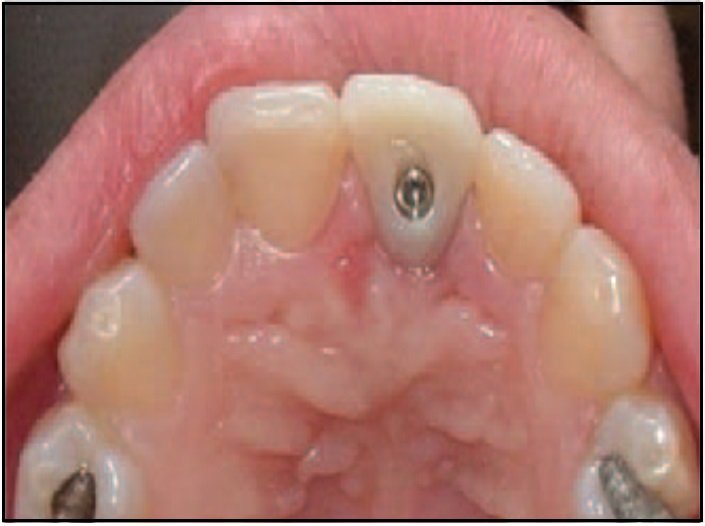
Intraoral view of screw retained prosthesis15
Assaf M, Alaa’Z AG. Screwretained crown restorations of single implants: A step-by-step clinical guide. European journal of dentistry. 2014 Oct;8(04):563-70.
SITUATIONS PREFERRING CEMENT RETAINED 12,13
- for short-span prostheses with margins at or above the mucosa level
- to compensate for improperly inclined implants
- for cases where an easier control of occlusion without an access hole is desired – for example, with narrow-diameter crowns
The cementation procedure should be carried out with great caution, with the FDP margins placed at or above the tissue level

In the esthetic zone a cemented implant restoration is often required. Abutment margins are kept at or slightly under the gingival margins.
Daher T, Mokbel RG, Meserkhani VP. Preventing Peri-implantitis with a proper Cementation Protocol and with the consideration of alternatives to Cement-Retained Implant Restorations.
1.3 ABUTMENT SELECTION BASED ON TYPE OF FABRICATION
Abutments are basically categorized into two types according to the fabrication technique:
- Prefabricated abutments
- Custom abutments
PREFABRICATED IMPLANTS
The prefabricated abutment is prepared by the manufacturer from different materials. These abutments can be fabricated from titanium or its alloy, titanium with titanium nitride coating, or ceramic (alumina or zirconia) materials. They may also be angled or straight. The preangled abutment has varied angulations provided by manufacturers, usually 15 and 25 degrees off-axis.2


Titanium straight and angled abutment

Standard abutments made of zirconia dioxide
They consist of two pieces, the abutment and the abutment screw. A variety of heights are available with smooth collars extending from the implant head to the crown margin. Nobel biocare implant - Ceraone, fits a flat top and engages a raised hexagon to give an anti-rotation element for the abutment. The abutment is retained by the implant head using a gold screw. A conical headed (Astratech, Frialit, Straumann) abutment has a matched conical fit surface along with an anti-rotational element. The coronal part of a single tooth abutment, needs adequate retention and resistance for the crown to be retained by cement to the abutment. Other designs (Astratech -single tooth) have a space between the abutment and the crown to allow for cement release.17
Advantages
- simple to use,
- require, minimal chair side time and
- offer predictable retention and fit of the crown
Disadvantages-
- their margins do not follow the gingival contour
- not suitable for labially placed cases

Prefabricated implant abutment
CUSTOM ABUTMENTS 11,2
Customized abutments can be fabricated by either copy-milling techniques or computer-aided design/ computer-assisted manufacture (CAD/CAM) systems.
METHOD OF FABRICATION
For both procedures, a resin or wax cast of the desired abutment is designed on a master cast by the dental technician. This prospective abutment (proabutment) can be used as a guide to individually shape an ingot with a copy milling machine. For CAD/CAM systems, the proabutment can be scanned and digitized, and the data are then sent to a central production facility via the internet.Another possibility to customize abutments with CAD/CAM systems is to virtually design the desired abutment without previous fabrication of a proabutment.

CAD for the custom angled abutment: (a)surface fitting; (b)virtual prosthesis; (c)inclination of the implant; (d)middle sagittal and coronal plane of the virtual prosthesis; (e)design cervical line; (f)design collar shape; (g)custom angled abutment; (h)conventional angled abutment and (i)the integrated system with the final custom angled abutment18
Wu T, Liao W, Dai N, Tang C. Design of a custom angled abutment for dental implants using computer-aided design and nonlinear finite element analysis. Journal of biomechanics. 2010 Jul 20;43(10):1941-6.
ADVANTAGES
- Create a natural emergence profile between an implant and crown
- Crown margin depth can be customized
- Allows for better hygiene
- Allows for better aesthetics
- Allows for better alignment with angled implants
- Zirconia and Gold Hue abutments enhance aesthetics of the final case
Ting Wu et al18 explored a novel method to design a CAD/CAM custom angled abutment, evaluated the biomechanical performance of the whole system and compared the difference between the custom and the conventional abutment through 3D nonlinear finite element analysis (FEA) and found that there was no distinct difference in the stress distribution and magnitude of implant-bone interface and screw using the custom or the conventional angled abutment. In another study Correntine19 et al used Acetal to fabricate the custom-made abutments, instead of the conventional metals for restoration of four maxillary anteriors . The white post did not give a grayish appearance to the surrounding soft tissues, and the possible gingival recession around the post will not compromise esthetics. The results indicated excellent esthetic and functional results.
In yet another study by Vanl?o?lu et al20 it was seen that Custom-made zirconia abutments offered sufficient stability to support all-ceramic restorations over narrow implants in anterior regions over a 5-year follow up period. The soft and hard tissue reactions to zirconia were favourable However in terms of peri-implant clinical outcomes within short-term period no significant differences between two abutment fabrication methods have been observed 21
1.4 ABUTMENT SELECTION BASED ON TYPE OF MATERIAL
- TITANIUM :- TITANIUM IS WELL known for its ideal implant properties with its excellent biocompatibility and considered as Gold standards because of their clinical success rates11,2
Disadvantages :- cause reflection and grayish coloration of the mucosa around the implant. - YTTRIUM-STABILIZED TETRAGONAL ZIRCONIA POLYCRYSTALS (Y-TZPS):- have begun to be used as abutment materials due to their durability and biocompatibility in implant-supported fixed dentures. Besides the esthetic qualities of zirconia abutments, they have a high corrosion resistance and a low plaque build-up.
- ZIRCONIA-TITANIUM HYBRID ABUTMENT:- a system is created in which a zirconia abutment is made up of a titanium neck and a neck of the abutment-implant connection. and this system is called a “hybrid abutment.” With this system, the durability of titanium and the esthetic qualities of zirconia have been used together to become an alternative treatment for individual abutments.
- OTHER METAL ALLOYS :- Several alternatives were introduced for fabrication of abutments like gold alloy ,stainless steel , cobalt chromium and nickel chromium alloys .Because of exorbitant gold price and Advancemnt in CAD cCAM , the paradigm has now been shifted to non precious metals . These rae not ideal implant materials as a cast object can never have a desired surface configuration ,required for seating onto the implant fixture.
- POLYETHERETHERKETONE :- are recently introduced implant materials because of its high biomechanical strength and inert properties.

Hybrid abutment Titanium base and custom zirconia
De Kok IJ, Katz LH, Duqum IS. CAD/CAM custom abutments for esthetic anterior implant-supported restoration: materials and design. Current Oral Health Reports. 2018 Jun;5:121-6.

Hybrid zirconia abutments with different shades


Gold and stainless steel abutments
Standard abutments made of zirconia dioxide


1.4 ABUTMENT SELECTION BASED ON THE COLOUR
The abutments availability in various colours are as follows:-
- Gold
- Silver (metallic finish)
- Pure white
- Customized white
- Customized pink/gingival shade at the cervical region
In a study conducted by Marco et al23 investigated the Influence of Abutment Color and Mucosal Thickness on Soft Tissue Color. whether ZrO2 and TiN abutments could achieve better esthetics in comparison with titanium (Ti) abutments, regarding the appearance of soft tissues.
The three tested abutment materials (titanium, titanium nitride, and zirconia) performed similarly in terms of quantitative influence on soft tissue color. When peri-implant mucosal thickness was recorded as ≤ 2 mm, all abutment materials influenced the color of the peri-implant soft tissues. Conversely, when the mucosal thickness was > 2 mm, only 2 out of 64 measurements showed color changes beyond the clinical threshold.
FACTORS TO BE CONSIDERED FOR SELECTION OF ANTERIOR IMPLANT ABUTMENT
Different types of implant abutments have been described in the literature for use in the anterior region. The selection of an implant abutment in the anterior region is related to the factors:
- Smile line,- When the smile line of the patient is low, there is no need to use esthetic abutment in no case .When the patient’s smile line is from medium to gummy smile, then it depends on Thickness
- Thickness of the peri-implant mucosa -selection of abutment material depends on the thickness of the buccal peri-implant mucosa. The abutment should be ceramic when the thickness of the buccal gingiva is ≤2 mm regardless of the bone thickness. When the buccal mucosa thickness exceeds 2 mm, there will be no esthetic problems due to titanium abutment use. Previous studies reported that 80% of the patients have buccal gingiva thickness less than 1.5 mm in the anterior region that means that zirconia abutment is necessary for most of the anterior restorations
- implant angulation,
- restoration material,
- interocclusal space,
- type of the restoration related with the retention(screw- or cement-retained),
- clinician’s selection, and
- cost of the treatment
CONCLUSION
A variety of abutment designs and materials are available for the clinician for the success of implants especially w.r.t anteriors. Custom abutments designed individually with CAD/CAM systems provide optimal esthetics and function while preventing the technician to make possible mistakes during fabrication. In terms of retention the various factors requires for the success of screw or cement retained restoration needs to be assessed before the placement and although long term clinical data is available for external hex connection ,the various benefits of internal connection especially in terms of anterior implants cannot be neglected . Thus it is the combination of all the factors and individual clinical scenario that decides the abutment design for the success of the implant restorations in terms of esthetics as well as function.
REFERENCES
- Kalpana D. Dr. Kalpana D, Dr. Nadira Jabeen S, Dr. Naila Perween and Dr. Iti Badola.
- Turkoglu P, Kose A, Sen D. Abutment selection for anterior implant-supported restorations. InAn Update of Dental Implantology and Biomaterial 2019 Jan 30. Intechopen.
- Bidra AS, Rungruanganunt P. Clinical outcomes of implant abutments in the anterior region: a systematic review. Journal of Esthetic and Restorative Dentistry. 2013 Jun;25(3):159-76.
- Lewis SG, Llamas D, Avera S. The UCLA abutment: a four-year review. J Prosthet Dent. 1992 Apr;67(4):509-15. doi: 10.1016/0022-3913(92)90082-l. PMID: 1507135.
- Internal Vs. External Hexagon Implants: Best Match ACTA SCIENTIFIC DENTAL SCIENCES (ISSN: 2581-4893) Volume 3 Issue 12 December 2019
- Muley N, Prithviraj DR, Gupta V. Evolution of external and internal implant to abutment connection. Int J Oral Implantol Clin Res. 2012 Sep;3(3):122-9.
- Machado LS, Bonfante EA, Anchieta RB, Yamaguchi S, Coelho PG. Implant-abutment connection designs for anterior crowns: reliability and failure modes. Implant dentistry. 2013 Oct 1;22(5):540-5.
- Vetromilla BM, Brondani LP, Pereira-Cenci T, Bergoli CD. Influence of different implant-abutment connection designs on the mechanical and biological behavior of single-tooth implants in the maxillary esthetic zone: A systematic review. The Journal of prosthetic dentistry. 2019 Mar 1;121(3):398-403
- Katagiri W, Suda D, Hasebe D, Funayama A, Kobayashi T. The prosthodontic recovery of the damaged external hexagon due to improper implant position. A case report. Advances in Oral and Maxillofacial Surgery. 2021 Oct 1;4:100184.
- Carossa M, Alovisi M, Crupi A, Ambrogio G, Pera F. Full-Arch Rehabilitation Using Trans-Mucosal Tissue-Level Implants with and without Implant-Abutment Units: A Case Report. Dentistry Journal. 2022 Jul 1;10(7):116.
- Shah RM, Aras MA, Chitre V. Implant-abutment selection: a literature review. Int J Oral Implantol Clin Res. 2014 May;5(2):43-9.
- Shadid R, Sadaqa N. A comparison between screw-and cement-retained implant prostheses. A literature review. Journal of Oral Implantology. 2012 Jun;38(3):298-307.
- Wittneben JG, Joda T, Weber HP, Brägger U. Screw retained vs. cement retained implant?supported fixed dental prosthesis. Periodontology 2000. 2017 Feb;73(1):141-51.
- Ahmad M, Dhanasekar B, Aparna IN, Naim H. Replacement of missing anterior tooth using screw retained implant prosthesis in the esthetic zone: A case report with 3 years of follow up. The Journal of Indian Prosthodontic Society. 2014 Sep;14:297-300.
- Assaf M, Alaa'Z AG. Screw-retained crown restorations of single implants: A step-by-step clinical guide. European journal of dentistry. 2014 Oct;8(04):563-70.
- Daher T, Mokbel RG, Meserkhani VP. Preventing Peri-implantitis with a proper Cementation Protocol and with the consideration of alternatives to Cement-Retained Implant Restorations.
- Implant abutments :A review Kalpana D. Dr. Kalpana D, Dr. Nadira Jabeen S, Dr. Naila Perween and Dr. Iti Badola.
- Wu T, Liao W, Dai N, Tang C. Design of a custom angled abutment for dental implants using computer-aided design and nonlinear finite element analysis. Journal of biomechanics. 2010 Jul 20;43(10):1941-6.
- Corrente G, Vergnano L, Pascetta R, Ramadori G. A new custom-made abutment for dental implants: a technical note. International Journal of Oral & Maxillofacial Implants. 1995 Sep 1;10(5).
- Vanl?o?lu BA, Özkan Y, Evren B, Özkan YK. Experimental custom-made zirconia abutments for narrow implants in esthetically demanding regions: a 5-year follow-up. International Journal of Oral & Maxillofacial Implants. 2012 Oct 1;27(5).
- Raee A, Alikhasi M, Nowzari H, Djalalinia S, Khoshkam V, Moslemi N. Comparison of peri?implant clinical outcomes of digitally customized and prefabricated abutments: a systematic review and meta?analysis. Clinical Implant Dentistry and Related Research. 2021 Apr;23(2):216-27.
- De Kok IJ, Katz LH, Duqum IS. CAD/CAM custom abutments for esthetic anterior implant-supported restoration: materials and design. Current Oral Health Reports. 2018 Jun;5:121-6.
- Ferrari M, Carrabba M, Vichi A, Goracci C, Cagidiaco MC. Influence of Abutment Color and Mucosal Thickness on Soft Tissue Color. Int J Oral Maxillofac Implants. 2017 Mar/Apr;32(2):393–399. doi: 10.11607/jomi.4794. Epub 2016 Aug 15. PMID: 27525517.
Disclaimer from Guident
The views and opinions expressed in articles published in Guident are solely those of the authors and do not necessarily reflect the views of the editors, the editorial board or the publisher, Ivory India. Guident does not endorse any product, technique or treatment described. Clinical content is intended for qualified dental and medical professionals and is not a substitute for individual clinical judgement. Guident, its editors and the publisher accept no liability for any consequence arising from the use of information published in the journal.
How to cite this article
Dr. Amritha Chandran, Dr. Sunil Dhaded. Abutment Selection for Anterior Implants. Guident. 2023 Feb;16(3). Available from: https://ivoryindia.in/articles/implantology/abutment-selection-for-anterior-implants.html