
Esthetic Rehabilitation of Anterior Maxillary Tooth Using Dental Implant: A Case Report
Department of Prosthodontics and Crown & Bridge, K.D. Dental College & Hospital, Mathura, UP, India
ABSTRACT
Replacement of missing teeth in the anterior maxillary region presents a significant clinical challenge due to high esthetic demands and functional considerations. Dental implants offer a conservative and predictable treatment modality, particularly in young patients. This case report describes the rehabilitation of a missing maxillary central incisor in an 18-year-old female patient using a Neobiotech implant system. Following flap reflection and osteotomy preparation using Densah burs, a 3 × 13 mm implant was placed in the 21 region. Bone grafting was performed to enhance peri-implant hard tissue support. After a healing period of 3 months, prosthetic rehabilitation was completed using an open tray impression technique. The final prosthesis demonstrated satisfactory esthetics, functional stability, and high patient satisfaction. This case highlights the importance of precise surgical and prosthetic planning in achieving successful outcomes in the esthetic zone.
KEYWORDS: Anterior esthetic zone, dental implant, trauma, Neobiotech, osseointegration, implant prosthesis
INTRODUCTION
The anterior maxillary region, commonly referred to as the esthetic zone, plays a crucial role in facial appearance, phonetics, and smile harmony. Loss of teeth in this region can significantly impact a patient’s psychological and social well-being.1
Trauma is one of the most common causes of anterior tooth loss in young individuals, often resulting in both hard and soft tissue deficiencies. Rehabilitation in such cases is challenging due to the need for preservation of alveolar bone, maintenance of gingival architecture, and achievement of an ideal emergence profile.2
Conventional treatment options such as fixed partial dentures require preparation of adjacent teeth, leading to unnecessary loss of sound tooth structure. Implant-supported prostheses provide a more conservative and predictable alternative with superior esthetic and functional outcomes.3
Advancements in implant design and surgical techniques, including osseodensification, have further improved implant stability and success rates in the esthetic zone.4
This case report describes the esthetic rehabilitation of a missing maxillary central incisor using a dental implant.
CASE REPORT
Patient Information
An 18-year-old female patient reported to the Department of Prosthodontics with a chief complaint of a missing upper front tooth.
Chief Complaint
The patient complained of a missing anterior tooth due to trauma sustained while playing approximately 2 years ago, which was affecting her smile and esthetics. She expressed a desire for a fixed replacement.
CLINICAL AND DIAGNOSTIC EVALUATION
Clinical examination revealed a missing tooth in relation to 21. Adjacent teeth (11 and 22) were present and periodontally sound. Soft tissue condition appeared favorable for implant placement.
A diagnostic cast was prepared, and routine blood investigations, including CBC, hemoglobin, bleeding time, clotting time, HBsAg, HIV, blood sugar, HCV, and Vitamin D levels, were evaluated.
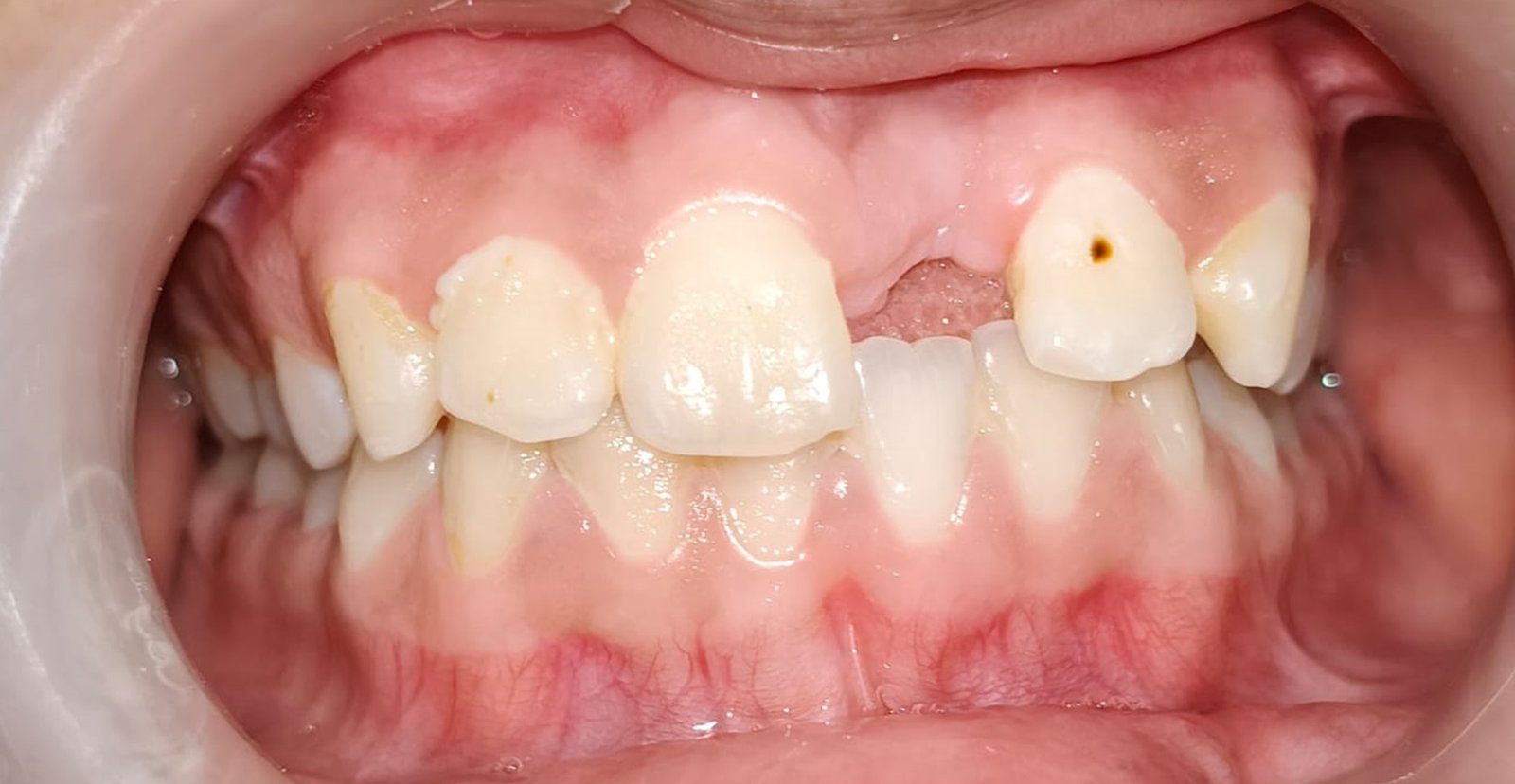
Figure 1: Pre-operative intraoral view

Figure 2: Diagnostic cast
TREATMENT PLAN
- Implant-supported prosthesis with respect to 21
- Alternative treatment: Fixed partial denture (11–21–22)
Considering the patient’s young age and the need to preserve adjacent tooth structure, implant therapy was selected.
SURGICAL PROCEDURE
Local infiltration anesthesia was administered in relation to 12, 11, 21, and 22. A full-thickness mid-crestal incision with two vertical releasing incisions was made, and a mucoperiosteal flap was reflected.
Sequential osteotomy was performed using Densah burs following the principle of osseodensification. A 3 × 13 mm implant from the Neobiotech system was placed in the 21 region, achieving adequate primary stability. A cover screw was placed.
Bone grafting was performed in the 11–21 region to enhance hard tissue support. Hemosponge was placed, and the surgical site was sutured.

Figure 3: Flap reflection and osteotomy

Figure 4: Implant of size 3*13mm placed

Figure 5: Graft was placed

Figure 6: Suturing done
POST-OPERATIVE PHASE
Post-operative instructions and medications were prescribed. The patient was recalled after 1 week for suture removal.
A healing period of 3 months was allowed for osseointegration.

Figure 7: Post-operative radiograph

Figure 8: Suture removal
PROSTHETIC PHASE
After 3 months, a healing abutment was placed to allow soft tissue contouring. After one week, an open tray impression technique was used to record the implant position accurately.
A jig trial was performed to verify the accuracy of the master cast. The final prosthesis was fabricated and delivered in relation to 21, ensuring proper occlusion and esthetics.

Figure 9: Open tray impression procedure

Figure 10: Jig trial

Figure 11: Post prosthetic radiograph

Figure 12: Final Prosthesis delivery
RESULT
The implant-supported prosthesis showed excellent esthetic integration with adjacent teeth. Soft tissue contours were well maintained, with satisfactory papillary fill and gingival harmony.
Functional stability was achieved, and the patient reported high satisfaction with the outcome.

Figure 13: Pre-operative view

Figure 14: Post-operative view
DISCUSSION
Rehabilitation of anterior tooth loss using dental implants requires careful planning due to high esthetic demands. Proper three-dimensional positioning of the implant is critical for achieving optimal esthetic and functional outcomes.2
In the present case, osseodensification using Densah burs was utilized, which enhances bone density and improves primary implant stability by preserving bone structure during osteotomy preparation.4
Bone grafting was performed to maintain ridge contour and provide adequate support for soft tissue architecture. Adequate hard tissue volume is essential for long-term success and prevention of peri-implant soft tissue collapse.5
The open tray impression technique ensured accurate transfer of implant position, minimizing prosthetic discrepancies. Achieving a proper emergence profile and papillary fill is crucial for success in the esthetic zone.6
Implant-supported restorations offer clear advantages over conventional fixed partial dentures, particularly in young patients, by preserving adjacent tooth structure and maintaining alveolar bone levels.3
CONCLUSION
Implant-supported rehabilitation of anterior tooth loss provides a predictable and esthetically pleasing outcome when proper surgical and prosthetic protocols are followed. This case demonstrates successful restoration of function and esthetics using a dental implant in the anterior maxillary region.
PATIENT CONSENT
Informed consent was obtained from the patient for treatment and publication of clinical images.
REFERENCES
- Belser UC, Grütter L, Vailati F, et al. Outcome evaluation of early placed implants in the anterior maxilla. Int J Oral Maxillofac Implants. 2009.
- Buser D, Martin W, Belser UC. Optimizing esthetics for implant restorations in the anterior maxilla. Int J Oral Maxillofac Implants. 2004.
- Misch CE. Contemporary Implant Dentistry. 3rd ed. Mosby; 2008.
- Huwais S, Meyer EG. A novel osseous densification approach in implant osteotomy preparation. Implant Dent. 2017.
- Chen ST, Buser D. Clinical and esthetic outcomes of implants placed in postextraction sites. Int J Oral Maxillofac Implants. 2009.
- Tarnow DP, Magner AW, Fletcher P. The effect of distance from contact point to bone crest. J Periodontol. 1992.
- Kois JC. Predictable single tooth peri-implant esthetics. J Esthet Restor Dent. 2004.
- Jung RE, Zembic A, Pjetursson BE. Systematic review of zirconia vs titanium abutments. Clin Oral Implants Res. 2012.
- Albrektsson T, Zarb G, Worthington P. Long-term efficacy of dental implants. Int J Oral Maxillofac Implants. 1986.
- Kan JYK, Rungcharassaeng K. Immediate implant placement in esthetic zone. J Calif Dent Assoc. 2003.
Disclaimer from Guident
The views and opinions expressed in articles published in Guident are solely those of the authors and do not necessarily reflect the views of the editors, the editorial board or the publisher, Ivory India. Guident does not endorse any product, technique or treatment described. Clinical content is intended for qualified dental and medical professionals and is not a substitute for individual clinical judgement. Guident, its editors and the publisher accept no liability for any consequence arising from the use of information published in the journal.
How to cite this article
Dr. Prachi Bansal, Dr. Abhishek Sharma, Dr. Siddharth Sisodiya. Esthetic Rehabilitation of Anterior Maxillary Tooth Using Dental Implant: A Case Report. Guident. 2026 Aug;19(9). Available from: https://ivoryindia.in/articles/implantology/esthetic-rehabilitation-of-anterior-maxillary-tooth-using-dental-implant-a-case-report.html


