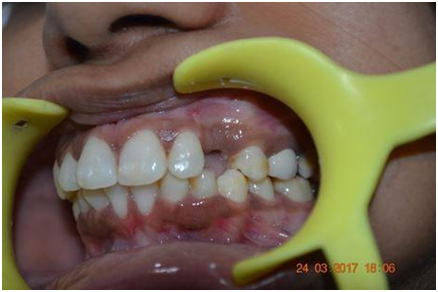
Immediate Dental Implant in Hypertensive Patient
SIPS Hospital, Lucknow (U.P), India
ABSTRACT
This case report describes extraction of root stumps of left and right mandibular posterior teeth, followed by immediate placement of a dental implant and bone graft in the prepared socket and temporization by bonded restoration. The socket was prepared to the required depth; this patient is hypertensive and is on medication.Hypertension, whether uncontrolled or managed well with medication, should be an important consideration in treatment planning of any major tooth implant procedure. Dental implant is placed in the bone and do not have any effect on blood pressure, nor does the blood pressure have any effect on the bone integration. The dental implant and provisional restoration provided the patient with immediate esthetics, function, and comfortand most important the preservation of tissues.
[Keywords:Immediate Dental implant, bone graft, hypertension, fix partial denture, extraction].
INTRODUCTION
Immediate placement of implant following tooth extraction in appropriately selected case has been considered the optimal procedure for the following reason: the natural healing process, no bone resorption has taken place yet, drilling is reduced, a number of surgical stages are eliminated, and design and construction of prosthesis is simplified and positive psychological patient. The posterior quadrants of the mouth are challenging for rehabilitation with dental implants, due to their anatomical and occlusal features. In cases where the distance between the implant and the socket is less than 2mm, spontaneous bone healing can be expected without the necessity for additional grafting procedure. If the distance is larger than 2mm, then grafting procedures are necessary Thus, this article aimed to discuss importanceof immediate placement implant supported prosthetics construction have the range of advantages as compared with traditional fixed dental prosthesis and removable denture. Medication should be taken to keep the blood pressure under control. Local anesthesia drug such as epinephrine have more intense effects on the heart when combined with non-selective beta blockers and can result in increased blood pressure. The best way to limit the stress on heart is to deliver an adequate dose of local anesthetic without adrenaline or procedure under general anesthesia.
INVESTIGATIONS REVEALS
HIV, HbsAg, Anti HCV (CARD TEST) - Negative
BLOOD SUGAR RANDOM – 102.0
PROTHROMBIN TIME – 13 sec
PROTHROMBIN CONCENTRATION – 100%
INR – 1.00
COMPLETE BLOOD COUNT - NORMAL
ECG– NORMAL

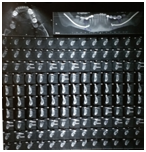
PRE – OPERATIVE X-RAY
CASE REPORT
A 53 year old male patient reported in the dental opd of SIPS hospital with chief complaintof replacement of old fix partial denture by dental implant. He was hypertensive and is under medication also, so before we could proceed to implant surgery he was advised to get his ECG and other laboratory investigations.After evaluating all the investigations, the result showed controlled blood pressure, had adequate sugar leveland hemoglobin level. The patient was given a detailed explanation concerning the present state, alternative treatment plans and proposed procedures.
Treatment with implantation of the posterior mandibular regions together with extraction and removal of old fix partial denture with respect to lower right and left posterior teeth and immediate implant placement was planned. Pre-surgical implant planning was performed by using cbct and opg scan to evaluate the height, width and density of bone. Also the position of inferior alveolar canal was detected. Patient is advised to take BP medicine in evening before the day of surgery to help the patient sleep well. The patient was premedicated with amoxicillin500 mg, antibacterial rinse (CHG 0.12%) and an NSAIDS, all starting 1 hour prior to surgery. The operation was performed under General anesthesia using nasoendotrachealintubation; the patient was given 1.5 gm Ampicillin and Dexamethasone IV preoperatively after induction of GA. The patients was scrubbed and draped according to the regular surgical procedure. Lidocaine anesthesia without adrenaline was injected at the site of implant placement to decrease intraoperative bleeding. After that, extraction of lower right and left posterior teeth (44, 45,47 and 37)done and the sockets were debrided with curettes. After that, supra crestal incision was given in right and left mandibular region, mucosal flap was reflected on buccal aspect and lingual side. The combined flap provides advantage of proper flap closure. Afterwards drilling and insertion of six implant ( xive implant [2{ 4.5/9.5mm}], 3.8/8mm, 4.5/11mm, 3.8/11mm,5.5/11mm ) was carefully placed in right and left posterior region (4.5/9.5 for 35,37), (3.8/8mm for 36), (4.5/11mm for 44, 3.8/11mm for 45 and 5.5/11mm for 46 ) and abutments were placed with the same teeth. The space between the implants was filled with hydroxyapatite with collagen granules and bio-oss graft which is xenograft (xenograft are bone grafts from a species other than human). Primary closure was performed for all implants using 3/0 vicryl suture and sterile gauze was placed. The patient was given postoperative instructions and kept under observation 30 minutes after the operation. Intraoral examination 30 minutes after the procedure showed no bleeding in surgical site. The gauze was exchanged, and a radiograph was taken post operatively to evaluate the angulation and position of all implants. Patient was discharged to be seen in 1 week. An antibiotic was prescribed (amoxicillin 500 mg, 3 times/day) for the next 10 days, and Analgesic ( diclofenac ) were to be taken only as required and chlorhexidinedigluconate 0.12 %. The patient was instructed to maintain good oral hygiene. Patient is recalled after 2 days for the temporary crowns, impression were made with alginate of upper and lower jaw. Shade selection was also done in this appointment. Casts and selected shade were sent to laboratory forpreparation of temporary crown. After 2 to 3 days temporary crowns were cemented with zinc phosphate cement for 3 to 4 months. Thisprovides the opportunity for optimal aesthetics and function in the temporary.


IMPLANT PLACEMENT DONE IN LEFT AND RIGHT POSTERIOR MANDIBULAR REGION.

GRAFT PLACEMENT
POST OPERATIVE CHECKUP
2 weeks after surgery, patient return for a quick follow-up examination. They also make their appointment to have the permanent restoration fabricated after 3 to 4 months.


POST OPERATIVE X-RAY
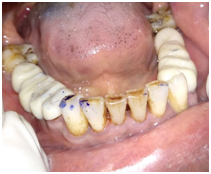


TEMPORARY CROWN PLACEMENT IN RIGHT AND LEFT POSTERIORMANDIBULAR REGION
DISCUSSION
The loss of a tooth can be emotionally difficult, especially when it is in esthetic zone. The opportunity to achieve better and faster functional results and a predictable treatment strategy with high rate of success has popularized the concept of “immediate implants”. In the present investigation, immediate mandibular implant healing progressed favorably. Immediate placement benefits include reduction in surgical procedures, preserving esthetics, conserving bone height and width and improving patient comfort, acceptance and satisfaction. It has been suggested that the implant should be placed in to a minimum of 3 mm of solid bone apical to the extraction site. In this case six xive implants with [2{4.5/9.5mm}], 3.8/8mm, 4.5/11mm, 3.8/11mm, 5.5/11mm)dimensions were inserted in posterior region of the mandible. The follow up period showed very promising results. After the dental implant procedure there are also considerations for the post operative recovery and healing period. Unmanaged high blood pressure limits the delivery of oxygen and nutrients to the veins and capillaries, which lowers their ability to regenerate and heal cells. Blood pressure managed by medication has very little impact on the progress of healing after tooth implant placement but still needs to be discussed between dentist and patient. For those who need to take medication for discomfort for extended periods of time, they are at risk of decreased effectiveness with drug interaction. NSAIDS like “ibuprofen” work against beta – blockers, alpha – blockers, vasodilators, ACE inhibitors, and diuretics when taken long enough (*1). But typically this is not a concern for dental implant. The bigger concern following tooth implant procedure is gum health and oral hygiene. In this case patient is under medication so blood pressure was controlled at the time of surgery and had good soft tissue architecture preservation at one week post surgery with minimal edema and there were no complaints of pain or discomfort during early post operative healing period.
CONCLUSION
The higher success rate of dental implants has changed the quality of life, for many patients.
Immediate implant placement following tooth extraction has been found to be a viable and predictable solution to tooth loss. Dental implants are placed in a wide range of patients; including elderly patients with very high blood pressure are at great risk for acute medical problems when undergoing stressful dental procedures.
Monitoring of the blood pressure is recommended for all the patients, if patient’s blood pressure is under control and takes their medications on regular basis, then there is no complication with the dental implant surgery.
REFERENCES
- *Eonclinics.com/blog/hypertension-and-dental-implants, Francisco- j Silvestre ( university of Valencia) ,VanSteenberghe D, Lekholm U, Bolender C, et al. Applicability of Osseo integrated oral implants in the rehabilitation of partial edentulism: a prospective multicentre study on 558fixtures. Int J Oral Maxillofac Implants. 1990; 5:272–281.
- Jemt T, Lekholm U, Grondahl K. 3-year followup study of early single implant restorations ad modumBranemark. IntJPeriodontics Restorative Dent. 1990; 10:340–349.
- Branemark PI, Hansson BO, Adell R, et al. Osseointegratedimplants in the treatment of the edentulous jaw. Experience from a10-year period.Scand J PlastReconstrSurg Suppl. 1977;16:1–132.
- Buser D, Weber HP, Bragger U, Balsiger C. Tissue integration of one-stage ITI implants: 3-year results of a longitudinalstudy with Hollow-Cylinder and Hollow-Screw implants. IntJOralMaxillofac Implants. 1991;6:405–412.
- Adell R, Lekholm U, Rockler B, Branemark PI. A 15-yearstudy of osseointegrated implants in the treatment of theedentulous jaw. Int J Oral Surg. 1981;10:387–416.
- Summers RB. A new concept in maxillary implant surgery: The osteotome technique. Compendium. 1994;152:154–6. 158 passim; quiz 162.
- Jaffin RA, Berman CL. The excessive loss of Branemark fixtures in type IV bone: A 5-year analysis. J Periodontol. 1991;62:2–4.
- Padmanabhan TV, Gupta RK. Comparison of crestal bone loss and implant stability among the implants placed with conventional procedure and using osteotome technique: A clinical study. J Oral Implantol. 2010;36:475–83.
- Palacci P, Nowzari H. Soft tissue enhancement around dental implants. Periodontol 2000. 2008;47:113–32.
- Goyal S, Iyer S. Bone manipulation techniques. Int J Clin Implant Dent. 2009;1:22–31.
- Quek CE, Tan KB, Nicholls JI. Load fatigue performance of a single-tooth implant abutment system: Effect of diameter. Int J Oral Maxillofac Implants. 2006;21:929–36.
- Hämmerle CH, Jung RE, Feloutzis A. A systematic review of the survival of implants in bone sites augmented with barrier membranes (guided bone regeneration) in partially edentulous patients. J ClinPeriodontol. 2002;29(Suppl 3):226–31.
- Fiorellini JP, Nevins ML. Localized ridge augmentation/preservation. A systematic review. Ann Periodontol. 2003;8:321–7.
- Saulacic N, Zix J, Iizuka T. Complication rates and associated factors in alveolar distraction osteogenesis: A comprehensive review. Int J Oral Maxillofacial Surg. 2009;38:210–7.
- Hahn J. Clinical uses of osteotomes. J Oral Implantol. 1999;25:23–9.
- Enislidis G, Wittwer G, Ewers R. Preliminary report on a staged ridge splitting technique for implant placement in the mandible: A technical note. Int J Oral Maxillofac Implants. 2006;21:445–9.
- Coatoam GW, Mariotti A. The segmental ridge-split procedure. J Periodontol. 2003;74:757–70.
- Sethi A, Kaus T. Maxillary ridge expansion with simultaneous implant placement: 5-year results of an ongoing clinical study. Int J Oral Maxillofac Implants. 2000;15:491–9.
- .Simion M, Baldoni M, Zaffe D. Jawbone enlargement using immediate implant placement associated with a split-crest technique and guided tissue regeneration. Int J Periodontics Restorative Dent. 1992;12:462–73.
- Summers RB. The osteotome technique: Part 2 – The ridge expansion osteotomy (REO) procedure. Compendium. 1994;15:422. 424, 426, passim; quiz 436.
- Scully C, Hobkirk J, Dios PD. Dental endoosseus implants in the medically compromised patient. Journal of Oral Rehabilitation. 2007;34:590–99
- Douketis JD, Berger PB, Dunn AS, Jaffer AK, Spyropoulos AC, Becker RC, Ansell J, American College of Chest Physicians. The perioperative management of antithrombotic therapy: American College of Chest Physicians Evidence-Based Clinical Practice Guidelines (8th Edition). Chest. 2008;133:299S–33
- Purcell CA. Dental management of the anticoagulated patient. N Z Dent J. 1997;93(413):87–92.
- Garcia DA, Regan S, Henault LE, Upadhyay A, Baker J, Othman M, Hylek EM. Risk of thromboembolism with short-term interruption of warfarin therapy. Archives of Internal Medicine. 2008;168:63–69. .
- Dunn AS, Turpie AG. Perioperative management of patients receiving oral anticoagulants: a systematic review. Archives of Internal Medicine. 2003;163:901–908.
Disclaimer from Guident
The views and opinions expressed in articles published in Guident are solely those of the authors and do not necessarily reflect the views of the editors, the editorial board or the publisher, Ivory India. Guident does not endorse any product, technique or treatment described. Clinical content is intended for qualified dental and medical professionals and is not a substitute for individual clinical judgement. Guident, its editors and the publisher accept no liability for any consequence arising from the use of information published in the journal.
How to cite this article
Dr. Vikram Ahuja Dr. Shivani Shrivastava Dr. Akansha Shukla Deoartment of Dentistry. Immediate Dental Implant in Hypertensive Patient. Guident. 2018 Jun;11(7). Available from: https://ivoryindia.in/articles/implantology/immediate-dental-implant-in-hypertensive-patient.html