Immediate Implant Loading of a Single Mandibular Incisor with a Space Constraint
s Dental Clinic Hyderabad, India
INTRODUCTION
When restoring teeth in the esthetic zone by using dental implants, the creation of a natural appearance is paramount. Achieving that goal requires attention to a number of factors. First and most obviously, osseointegration must be achieved.1 Beyond that, treatment planning for esthetic smile rejuvenation depends on both scientific and artistic principles.2-3 The gingiva facial to the restoration and the adjoining papillae are crucial esthetic elements. Assuming that the existing osseous and gingival architecture around the failing tooth is acceptable, preservation of the hard- and soft-tissue contours should be the therapeutic goal. Immediate placement of implants followed by immediate provisionalization has been suggested as an effective tool for achieving this result.4-6 After soft-tissue maturation, the choice of material selected for the restoration also can affect the appearance of the final restoration significantly
It was long assumed that crestal bone remodeling to the first implant thread was a natural consequence of all implant placement.1,7 However, increased understanding of some of the biomechanical sequelae of implant placement has led to a reconsideration of that assumption.8-10 Inflammatory reactions in the peri-implant soft tissues have been identified11 that appear to result from bacterial contamination at the implant-abutment junction on standard implant designs.12 Such designs position the abutment inflammatory cell infiltrate at the outer edge of the implant-abutment junction, in direct approximation to the crestal bone. Modifying that interface by using an abutment smaller in diameter than the implant platform shifts the perimeter of the implant-abutment junction inward toward the implant’s central axis. It has been theorized that such “medialized” designs also shift the inflammatory cell infiltrate inward, limiting crestal bone loss.10 Clinicians placing these “platform-switched” implants have reported significant reductions in peri-implant bone loss.8,13
The space to replace a tooth in the mandibular anterior region is at very best minimal, and the chance of touching an adjacent root during implant placement is more probable compared to any other position in the mouth.It is generally accepted protocol that there should be at least 1 1/2mm of crestal bone remaining adjacent a natural tooth beside which an implant is inserted, so that any crestal bone loss on the implant will not affect the bone around the natural tooth. ". This protocol will leave an adequate amount of crestal bone on an adjacent tooth and/or on an adjacent implant. This crestal bone is required to maintain the inter-dental papilla, and protect the esthetic component of the case.
CASE REPORT
A 20 year old male patient reported with a missing lower anterior tooth.
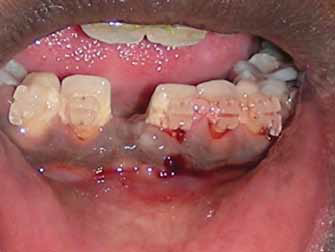
Fig 1: pre operative view
Extra oral examination was within normal limits, intra oral examination revealed a missing mandibular right central incisor with a space of 5 mm coronally and 3.5 mm at the CEJ.
Radiographs were taken to evaluate the space in which the implant could be placed and models were taken and studied.
After a thorough study it was decided to place a tapering root form implant of 3mm diameter and 13mm length giving sufficient space for the periodontal ligament. A single piece design implant with a narrow neck, similar to a platform switch was used. The flap was slightly raised to check for the bone integrity all around. The implant was placed so that the roughed surface og the implant was completely submerged in the bone
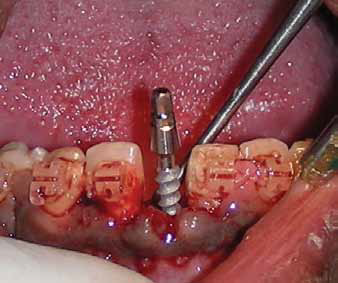
Fig 2: tapering root form implant being placed
Care was taken that the abutment was kept out of centric occlusion and also anterior guidance. Immediate provisional restoration using self cure resin was made (care was taken to keep it out of any occlusal inerferance, both centric and anterior guidance)
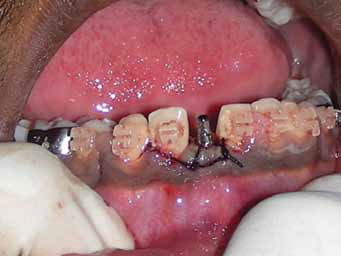
Fig 3: after implant placement
Provisional restorations were provided on the implant abutments prior to final impression to aid in soft tissue maturation

Fig 4 : provisional showing no interference in anterior guidance Final restoration was given maintaining a good mesiodistal width

Fig 5: radiograph showing space between adjacent teeth
DISCUSSION
Each region of the mouth presents with certain challenges. The mandibular anterior region has some very definite limitations as far as space is concerned in the mesial-distal dimension. In the mandibular anterior region where space is at a premium you have to plan an implant design and size for maximum utilization of the available space (mesio distally). Care should also be taken to keep into consideration the root angulations as we go apically. We like to see a minimum 1.5 mm of bone between implants and natural teeth to preserve bone and proper anatomy. Since this region also falls in the esthetic zone immediate provisionalization with a fixed implant supported restoration was planned. As there was sufficient space vertically to keep the implant abutment and provisional out of anterior contact, a single piece narrow diameter implant was planned. Another reason for planning a single piece implant was the unavailability of a very narrow ( < 3mm) conventional implant
CONCLUSION
In cases such as this where mesiodistal space is a challenge as immediate esthetics are of prime importance a narrow diameter tapering implant can be used along with immediate provisional. Though at all times care need to be taken to keep the implant restoration in immediate non functional loading thereby giving the patient also a pshycological comfort of an immediate fixed restoration.In conclusion, use of narrow-diameter implants can provide a predictable, cost-effective service for patients in situations where conventional-sized implants cannot be used.
REFERENCES
- Albrektsson T, Zarb G, Worthington P, et al. The long-term efficacy of currently used dental implants: a review and proposed criteria of success. Int J Oral Maxillofac Implants. 1986;1(1):11-25
- Kois JC. Predictable single-tooth peri-implant esthetics: five diagnostic keys. Compend Contin Educ Dent. 2004;25(11):895-907
- Ericsson I, Nilson H, Lindh T, et al. Immediate functional loading of Brånemark single tooth implants. An 18 months’ clinical pilot follow-up study. Clin Oral Implants Res. 2000;11(1):26-33.
- Vela-Nebot X, Rodríguez-Ciurana X, Rodado-Alonso C, et al. Benefits of an implant platform modification technique to reduce crestal bone resorption. Implant Dent. 2006;15(3):313-3120
- Baumgarten H, Cochetto R, Testori T, et al. A new implant design for crestal bone preservation: initial observations and case report. Pract Proced Aesthet Dent. 2005;17(10):735-740
- Davarpanah M, Martinez H, Etienne D, et al. A prospective multicenter evaluation of 1,583 3i implants: 1- to 5-year data. Int J Oral Maxillofac Implants. 2002: 17(6):820-828
Disclaimer from Guident
The views and opinions expressed in articles published in Guident are solely those of the authors and do not necessarily reflect the views of the editors, the editorial board or the publisher, Ivory India. Guident does not endorse any product, technique or treatment described. Clinical content is intended for qualified dental and medical professionals and is not a substitute for individual clinical judgement. Guident, its editors and the publisher accept no liability for any consequence arising from the use of information published in the journal.
How to cite this article
Dr. Vikas Gowd, Dr. Kirti Gowd, Dr. Gowd. Immediate Implant Loading of a Single Mandibular Incisor with a Space Constraint. Guident. 2018 Oct;11(11). Available from: https://ivoryindia.in/articles/implantology/immediate-implant-loading-of-a-single-mandibular-incisor-with-a-space-constraint.html