Use of Intra-Oral Welding to Stabilize Immediate Loading Implants
Wisdom Dental Clinics, Jaipur, India
ABSTRACT
The implants failure may be caused by micro motion and stress exerted on implants during the phase of bone healing, especially true in case of atrophic ridges. So the important goal that allow immediate loading and oral rehabilitation on the same day is primary stabilization and fixation of implants. Due to technique of welding titanium bars on implant abutments this goal is achieved. Errors or distortions due to impression can be eliminated by performing directly in the mouth. This case report describes about long-term success and high predictability of intraorally welded titanium bar in immediate loading implants.
Keywords: Implants, Immediate Loading, Intra-oral welding
INTRODUCTION
The technique of welding portions of intraoral prosthesis has demonstrated many advantages in clinical practice. Errors or distortions due to impression can be eliminated by performing directly in the mouth. When immediate loading of dental implants is positioned in atrophic edentulous ridges, intraoral welding is very effective. To prevent the risk of micromovements and loss of implants in immediate loading, adequate fixation and stability of implants are very important conditions. In this context, a rigid splinting seems to have an important role in response of peri-implant tissues, since it is able to reduce stress exerted on implants.
By intraoral welding of abutments, immediate fixation of more implants can be achieved. Intraoral welding allows getting immediate retention of osseointegrated implants. In this method a titanium bar is welded directly to the abutments in the oral cavity before the immediate loading.
Placing definitive restoration on the same day of surgery, or few days later is the main advantage of intraoral welding. Edentulous patients complains lack of stability and retention of denture which is the main discomfort.
Degidi and coll have published numerous studies about immediate loading of multiple implants by welding a titanium bar directly on abutments in order to create a metal-reinforced temporary or definitive restoration. The results showed that one-piece implant is better than two-piece for intraoral welding.1-8
Here in this case report we describes about long-term success and high predictability of intraorally welded titanium bar in immediate loading implants.
CASE REPORT
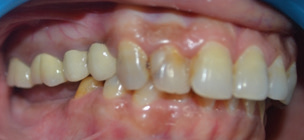
A 45 year old healthy female came with complain of failed bridge in 4th quadrant due to which she is unable to eat food and only on liquid diet. On the oral examination, very limited inter-occlusal space was observed. 3d CBCT was advised and which revealed available bone volume for implants (Figure. 1a, b)
(a)

(b)
Figure. 1: Pre-operative image of patient
Now it was planned to place 2 implants with rigidly splinting them together by intraoral welding and then immediately loading them.
So to begin with, first impressions were made of the respective arch and Pro-shell was fabricated. (Figure. 2)

Figure. 2: Fabrication of Proshell
Now, 2 Ankylos Implants A11 and B9.5 were placed parallel to each other, slightly sub-crestal to give good emergence of the prosthesis. Insertion torque of 35 NCM was achieved. (Figure. 3)

Figure. 3: Implants were placed
Before starting with the prosthetic rehabilitation ISQ was done, which came out to be 75 & 76 respectively, which was highly recommending for immediately loading the implants. (Figure.4 a,b)

Figure. 4 a, b: ISQ reading
Standard straight abutments were placed on both the implants which were torqued. Now two standard welding sleeves were taken and tapped on to the abutments and after which parallelism of the implants was confirmed. The excess height of the welding sleeves were prepared according to the occlusion. Now 2mm titanium wire is adapted on the buccal surface of welding sleeves and welded intraorally with the help of Weldone from Dentsply.
Now this metal framework is sandblasted extra orally and once again tapped on to the abutments. Meanwhile the proshells were prepared on to the welding sleeves after the intaglio surface of proshell is sandblasted. (Figure. 5)

Figure. 5: Intra oral welding
Now the framework is picked up with Proshell in Combolign resin material. After the initial setting time of the resin, the prosthesis is removed and sent for finishing and polishing. (Figure. 6)

Figure. 6: Picked up Prosthesis
Now on the same visit, this finished prosthesis is once again tapped on to the abutments and soft tissue profile were checked and stable occlusion was verified. (Figure. 7 a, b, c)
Proper diet and hygiene maintenance instructions were given, and strictly told to eat only semisolid food from that side until 2 months.
Patient was recalled after 1 week, 1 month, 2 months, 3 months and then every 6 months of time periods. Favorable hard and soft tissue architecture along with stable occlusion was maintained through out and now after an year, patient is happily using them in function.(Figure. 8)

Figure. 7 a, b, c: Post operative image of patient

Figure. 8: year follow up
DISCUSSION
Most of the oral complains are due to lack of stability and retention with dentures. But sometime in case of atrophic mandible implant rehabilitation may alsobecome impossible because of insufficient bone. Long-term success and high predictability have been demonstrated in immediate loading implants with definitive denture. Other studies confirm successful oral rehabilitation of edentulous atrophic maxilla with a fixed, definitive restoration supported by an intraorally welded titanium bar on the same day of implant placement surgery2, 3.
Avvanzo demonstrated that without problems of micromovements and implants loss dental abutments which are welded with a titanium bar intraorally allow immediate loading implants and provisional or definitive restoration during healing of bone,. Immediate denture improves patient’s
compliance due to a more comfortable prosthesis.9
When implants are positioned in zygomatic bone, immediate loading may be successfully achieved with intraoral welding technique especially to rehabilitate the edentulous atrophic maxilla with a permanently fixed prosthesis on the day of surgery. They show stability and prosthetic success rate at the 12-month4 and 3-year follow-up.5, 6 No adverse effect on marginal bone loss and implant survival by intraoral welding technique.7 Successful oral rehabilitation has been demonstrated in the edentulous mandible using SynCone 5-degree abutments in case of immediate loading.8
De Aguiar in his study compared the accuracy of fit of three types of implant- supported frameworks cast in Ni-Cr alloy: a framework cast as one piece, in sections and transverse or diagonal axis which later laser welded. According to the results, diagonally sectioned frameworks lowers misfit levels of prosthetic implant-supported frameworks and improves the levels of passivity.10
In implant-supported prosthesis, lack of passivity has been associated with biomechanical problems. De Castro concluded that there were no differences in forces exerted on implants when evaluated the passivity of three techniques to fabricate from a Co-Cr alloy by photoelasticity.11CONCLUSION
The idea for this case report is due to a procedure that involves using an intraoral welding unit to connect implants by a titanium bar over which a final restoration is inserted. Fixation in the early stage for bone healing along with a significant reduction of the micromovement problem and implants loss is due to rigid splinting of multiple implants with intraoral welding technique. Immediate loading may be successfully achieved with intraoral welding technique especially to rehabilitate the edentulous patient.
REFERENCES
- M. Degidi, P. Gehrke, A. Spanel, and A. Piattelli, “Syncrystallization: a technique for temporization of immediately loaded implants with metal-reinforced acrylic resin restorations,” Clinical Implant Dentistry and Related Research, vol. 8, no. 3, pp. 123–134, 2006. View at Publisher ⚬ View at Google Scholar ⚬ View at Scopus
- M. Degidi, D. Nardi, and A. Piattelli, “Immediate loading of the edentulous maxilla with a final restoration supported by an intraoral welded titanium bar: a case series of 20 consecutive cases,” Journal of Periodontology, vol. 79, no. 11, pp. 2207–2213, 2008. View at Publisher ⚬ View at Google Scholar ⚬ View at Scopus
- M. Degidi, D. Nardi, and A. Piattelli, “Immediate loading of the edentulous maxilla with a definitive restoration supported by an intraorally welded titanium bar and tilted implants,” The International Journal of Oral & Maxillofacial Implants, vol. 25, no. 6, pp. 1175–1182, 2010. View at Google Scholar ⚬ View at Scopus
- M. Degidi, D. Nardi, A. Piattelli, and C. Malevez, “Immediate loading of zygomatic implants using the intraoral welding technique: a 12-month case series,” The International Journal of Periodontics and Restorative Dentistry, vol. 32, no. 5, pp. e154–e161, 2012. View at Google Scholar
- M. Degidi, D. Nardi, and A. Piattelli, “Immediate definitive rehabilitation of the edentulous patient using an intraorally welded titanium framework: a 3-year prospective study,” Quintessence International, vol. 41, no. 8, pp. 651–659, 2010. View at Google Scholar ⚬ View at Scopus
- M. Degidi, D. Nardi, and A. Piattelli, “Immediate rehabilitation of the edentulous mandible with a definitive prosthesis supported by an intraorally welded titanium bar,” International Journal of Oral and Maxillofacial Implants, vol. 24, no. 2, pp. 342–347, 2009. View at Google Scholar ⚬ View at Scopus
- M. Degidi, D. Nardi, and A. Piattelli, “Prospective study with a 2-year follow-up on immediate implant loading in the edentulous mandible with a definitive restoration using intra-oral welding,” Clinical Oral Implants Research, vol. 21, no. 4, pp. 379–385, 2010. View at Publisher ⚬ View at Google Scholar ⚬ View at Scopus
- M. Degidi, D. Nardi, G. Sighinolfi, and A. Piattelli, “Immediate rehabilitation of the edentulous mandible using Ankylos SynCone telescopic copings and intraoralwelding: a pilot study,” The International Journal of Periodontics and Restorative Dentistry, vol. 32, no. 6, pp. e189–e194, 2012. View at Google Scholar
- P. Avvanzo, L. A. Fabrocini, D. Ciavarella, A. Avvanzo, L. lo Muzio, and R. A. de Maio, “Use of intraoral welding to stabilize dental implants in augmented sites for immediate provisionalization: a case report,” Journal of Oral Implantology, vol. 38, no. 1, pp. 33–41, 2012. View at Publisher ⚬ View at Google Scholar ⚬ View at Scopus
- F. A. de Aguiar Jr., R. Tiossi, R. C. Rodrigues, G. Mattos Mde, and R. F. Ribeiro, “An alternative section method for casting and posterior laser welding of metallic frameworks for an implant-supported prosthesis,” Journal of Prosthodontics, vol. 18, no. 3, pp. 230–234, 2009. View at Publisher ⚬ View at Google Scholar ⚬View at Scopus
- G. C. de Castro, C. A. de Araújo, M. F. Mesquita, R. L. Consani, and M. A. Nóbilo, “Stress distribution in Co-Cr implant frameworks after laser or TIG welding,” Brazilian Dental Journal, vol. 24, no. 2, pp. 147–151, 2013. View at Google Scholar
Disclaimer from Guident
The views and opinions expressed in articles published in Guident are solely those of the authors and do not necessarily reflect the views of the editors, the editorial board or the publisher, Ivory India. Guident does not endorse any product, technique or treatment described. Clinical content is intended for qualified dental and medical professionals and is not a substitute for individual clinical judgement. Guident, its editors and the publisher accept no liability for any consequence arising from the use of information published in the journal.
How to cite this article
Dr. Gaurav Gupta, Dr. D. K. Gupta, Dr. Neelja Gupta. Use of Intra-Oral Welding to Stabilize Immediate Loading Implants. Guident. 2019 Sep;12(10). Available from: https://ivoryindia.in/articles/implantology/use-of-intra-oral-welding-to-stabilize-immediate-loading-implants.html