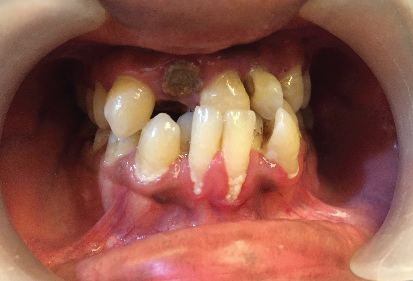
Multidisciplinary Ortho- Perio Treatment Approach in Treating Periodontally Compromised Adult Patient: Adult Orthodontics.
Goverment Dental College & Hospital, Ahmedabad, Gujarat, India
Abstract
In 21st century dental care, an increasing number of adult patients are seeking orthodontic treatment . In adult patients, a combined multidisciplinary therapy often offers the best option for achieving a predictable outcome to solve complex clinical problems. This case report demonstrates a combined therapy of Interceptive-Orthodontic- Periodontic treatment in young adult with wide midline diastema in mandibular arch, generalized anterior spacing, tongue thrust habit with class III gingival recession, grade II mobility and inadequate width of attached gingiva.
The orthodontic goal was to close all spaces and achieve alignment and leveling , periodontal goal was to improve periodontal health, gingival width and length. The overall treatment goal in patient was to improve dentofacial esthetics and oral health. The case was successfully managed by combined habit interception, free gingival grafting and orthodontic therapy followed by semi permanent retention. Results showed optimum Dentofacial esthetics, improved oral health and smile.
Keywords: Adult Orthodontics, Multidisciplinary, Free Gingival Graft, Mucogingival Defect, Perio-Ortho Treatment
INTRODUCTION
According to Ackerman, Adult orthodontics is defined as ‘The branch of orthodontics concerned with striking a balance between achieving optimal proximal & occlusal contact of the teeth, acceptable dentofacial esthetics, normal function & reasonable stability’1. Dentofacial esthetics is of great concern in the adult population, with an increasing demand for orthodontic treatment in appearance-conscious adults. In this group of patients the primary motivating factor is a desire to improve their dental appearance.2,3 In such cases, orthodontic treatment might enhance the possibilities of saving and restoring a deteriorated dentition. Orthodontic treatment is no longer a contraindication in the therapy of severe adult periodontal disease in the maintenance of a healthy periodontal status after orthodontic treatment 4.
CASE REPORT
A male adult aged 28 years reported to the Department of Orthodontics, Governmental Dental College, Ahmedabad, Gujarat with a chief complaint of , that “something was wrong with his smile” and seek treatment for same. Patient was self employed and reported that he would have better career opportunities if his smile would improve. This was the unique case of Adult orthodontics where a young patient seek Smile enhancement and for that individualized and strategic interdisciplinary treatment approach was needed.
Clinical Extraoral examination(Figure 1a-c) revealed Straight profile and competent lips. Smile evaluation revealed non consonant smile arc and adequate upper lip length. On grossly considering all components of smile, lack of integration in dental and gingival components was found to be main factor for esthetic compromise. Intraoral examination(Figure 2a-e) revealed spacing present in relation to 14,13,12,11,21,22,34,33,31,4143,44, rotations in relation to 14, 34, 15 and dental midlines were coinciding with Class I molar and canine relationship. Macroglossia, scalloping on lateral borders (Figure 3d) with tongue thrust habit were present which further added to anterior spacing and mobility of teeth.
Periodontal examination (Figure 3a-c) revealed that Class III gingival recession was present with grade II mobility and pathological migration in relation to 31 and 41. Positive tension test in relation to same teeth was observed which lead to wide midline diastema in lower dentition. Dark triangle (Figure 2b) was also present in relation to 11 and 21. IOPA evaluation (Figure 6a) showed intercrestal bone level was lowered in relation to upper and lower incisors. This horizontal bone loss was more severe in lower anterior region with only apical third alveolar bone support.
 |
| Figure 1: Pretreatment Extraoral Photographs -a) Frontal b)Smiling c) Profile view s |
 |
| Figure 2: Pretreatment Intraoral Photographs - a) left buccal b) front buccal c) Right buccal d) maxilary occlusal e) Mandibular Occlusal views. |
Treatment objectives:
Adult patient with mucogingival defects and dentofacial esthetic considerations mandated multidisciplinary approach and a comprehensive communication between Periodontist and Orthodontist.
• Control Etiology : Tongue training and habit interception.
• Periodontal goals : To improve oral hygiene.
- To prevent further worsening of mucogingival defect.
- To eliminate mucogingival stress at gingival margin.
- Surgical correction of mucogingival defect
 |
| Figure 3 : a)Miller's class ||| recession with thin labial gingiva apical to recession b) 4mm gingival recession was present i.r.t#41 c) 3mm gingival recession was present i.r.t#31 d)macro-glossia with scalloping present at lateral borders. |
TREATMENT PLANNING
On the basis of findings and examination two treatment options were possible.
- Surgical-Periodontic-Orthodontic Approach: Removal of etiology (Glossectomy) followed by periodontic and orthodontic therapy
- Interceptive-Periodontic-Orthodontic Approach: Instead of surgical procedure tongue thrust habit was intercepted and tongue training exercises were prescribed followed by Periodontic and orthodontic therapy.
Patient was informed about his clinical situation and on discussing options in detail patient was agreed to undergo second option.
TREATMENT PROGRESS
Interceptive Protocol: Fixed tongue crib was fitted for habit interception and tongue training exercises were prescribed. Patient kept on follow up for six months.
Periodontal Protocol: In Phase I Therapy, scaling and root planning were performed. Once the gingival health was optimally achieved surgical intervention was done in Phase II therapy for correction of mucogingival defects. Free gingival graft was transplanted to eliminate mucogingival stress at gingival margin and for gingival augmentation at the labial aspect of teeth in relation to #31, 41. Fixed tongue crib was removed at the time of surgery for easy instrumentation at donor site.
The free gingival graft procedure(Figure 4a-e) involved the autogenous keratinized epithelial graft of 1.5mm thickness which was taken from palate (Donor site). Free graft was placed at prepared recipient site and sutured. Periodontal pack was given at both donor site and recipient site. Tongue crib was placed again after 10 days of surgery (figure 4f). Patient was kept on follow up (Figure 5b). After 20 days marked gingival augmentation was observed (Figure 5c). The pre and post surgical findings are depicted in table no. 1(and Figure5b,c)
 |
| Figure 4 : Free Gingival Grafting procedure a)Prepared recipient site b) Autogenous free gingival Graft taken from donor site c)Free gingival graft placed and sutured at recipient site d), e) Periodontal pack at recipient and donor sites respectively f) After 10 days fixed tongue crib was placed again. |
 |
| Figure 5: Intraoral Photographs demonstrating progression of Periodontic -Orthodontic Treatment Approach in Adult patient with Muco gingival defect in lower anterior region a) Before treatment b)10 days after surgery c) 20 days after surgery d)1 months after surgery e) 6 months after surgery f) 12 months after surgery g) At 3rd month fixed tongue crib was replaced with transpalatal arch with acrylic bead for tongue training. |
• Orthodontic goals: Alignment, leveling and Closure of all spaces.
- Establish favourable crown root ratio.
- Achieve optimal dentofacial esthetics.
- To establish optimal occlusion and function.
 |
| Figure 6 : Periapical radiographs demonstrating Remineralization of intercrestal bone #31 and 41, following Perio-Ortho continum a)Before treatment at the level of apical one third b) 6 months after surgery , new bone apposition in between middle one third and cervical one third c) Just before debonding with lingual braided stainless steel retainer wire showing improved intercrestal bone level. |
|
Pre Surgical |
Post Surgical |
|
|
Mobility |
Grade II |
Grade I |
|
Migration |
Distally migrated |
Shifted Mesially |
|
Gingival Recession |
Present |
Absent |
|
Tension Test |
Positive |
Negative |
| Table no.1 Comparison of Pre and Post Surgical findings | ||
ORTHODONTIC PROTOCOL
Orthodontic treatment for alignment of migrated periodontally involved teeth was initiated only after control of the periodontal inflammation has been achieved5,6. Initially treatment started with the placement of 0.022Ë pre-adjusted edgewise brackets (3M, UNITEK, Monrovia, CA, USA ) in upper arch one month after free gingival grafting (Figure 5d). Then lower arch was bonded after 3 months of surgery after completion of healing phase(Figure 5e) 7.
The lower anterior brackets were bonded 0.5 mm more incisally in an effort to achieve bracket assisted intrusion which would further aid in achieving favourable crown root ratio 8. Treatment began with the leveling and alignment with 0.014 inch copper nickel titanium arch wires. They were engaged to deliver lighter and continuous forces (40gms) . Sequentially 0.016 inch nickel titanium arch wires, 17*25 inch Thermal nickel titanium arch wires, 17*25inch stainless steel arch wires were progressed and worked upto 19*25inch Thermal nickel titanium arch wires and 19 *25 inch stainless steel arch wires.
Then with lighter forces spaces were closed. Care was taken to put a light force to avoid patient discomfort. After space closure dark triangles appeared in between 21 and 22, 11 and 21, 31 and 41, 41 and 42. Proximal Stripping was considered to reduce dark triangles(Figure 5f). Patient was recalled every 4 weeks to check the progress. Patient was maintaining oral hygiene optimally and following all the instructions. After achievement of Orthodontic treatment goals , appliance was debonded. A fixed upper and lower lingual retainer was given in the upper and lower arches. Patient was asked to continue with tongue training exercises and kept on follow up.
RESULTS
The total interceptive, periodontic and active orthodontic treatment time duration was 1 year 8 months . The post treatment intraoral photographs(Figure 8a-e) showed a Class I molar and canine relationship with acceptable overbite and overjet. Diastema in the mandibular anterior region was closed. . Correction of mucogingival defects and closure of all spaces were achieved.
Clinical examination revealed a well-functioning dentition, natural in appearance and in a harmonious occlusion and periodontal state of health. Periapical Radiographic examination (Figure 6c ) revealed a favorable root/crown ratio, remineralization and improved intercrestal bone level in relation to 31 and 41. Small dark triangle , however, remained in relation to 31 and 41 . The patient was satisfied with the results of the interceptive - orthodontic-periodontic treatment therapy and his smile enhancement.
 |
| Figure 7: Post-treatment Extraoral Photographs - a) Frontal b) Smiling c) Profile views |
 |
| Figure 8 : Post-treatment Intraoral Photographs - a)left buccal b)front buccal c) Right buccal d)maxillary occlusal e)Mandibular Occlusal views. |
 |
| Figure 9: Smile esthetics a) Pre-Treatment and b) Post treatment Dentofacial Esthetics improvement |
DISCUSSION
Gingival recession regardless of etiology is a debilitating situation for the individual, which may cause dentinal hypersensitivity, root caries, dental abrasion, unsatisfactory esthetics and ineffective tooth brushing. High success rate in the previous studies 9 and achievement of both goals, i.e., root coverage and creation of keratinized gingival tissue 10 with one surgical procedure were the reasons for choosing free gingival graft in the present case. Previous reports have demonstrated that, with adequate plaque control, teeth with reduced periodontal support can undergo successful tooth movement without compromising their periodontal situation.11-13 Orthodontic therapy may have a dual effect on the morphology of the bone and gingiva with respect to the final position of the teeth. While severe labial inclination causes gingival recession and bone dehiscences 14,15 retraction of anterior teeth stops or even reverses the progressive recession process. 16-20 During active orthodontic treatment, attention was paid to the optimal force magnitudes of the wires, which stimulated bone formation in the periodontium.21
A controversy exists on the timing of mucogingival surgery in cases of pre-orthodontic gingival recession. 22 Some authors claim that mucogingival surgery should be performed before orthodontic therapy, particularly in patients presenting less than 2 mm width of keratinized tissue combined with thin-scalloped gingival biotype to prevent recession.23-29 On the other hand, the other investigators prefer to postpone root coverage surgery due to reason that the orthodontic movement of the tooth back into its alveolus may cover the exposed root surface in some cases.30,31 Our treatment approach was to perform mucogingival surgery before proceeding with the next steps of the orthodontic therapy in order to eliminate the mucogingival stress at the gingival margin in relation to 41 and 31 and to create a thick band of keratinized tissue at the labial aspect of the teeth. Since, a thicker marginal gingiva is expected to be less susceptible to tooth brushing trauma and biofilm-induced gingival inflammation that may cause labial recession or increase its severity. Dark triangles between teeth have been reduced by recontouring the interproximal surfaces and further closing the space. 32
CONCLUSION
In Periodontally compromised adult patient cases interdisciplinary approach plays a critical role for successful outcomes. Treating this case with the principles based on Adult Orthodontics and multidisciplinary approach helped us in achieving optimal dentofacial esthetics, normal function & reasonable stability(Figure 7a-c, 8a-e). Advanced Interceptive- Perio-Orthodontic approach not only restored periodontal status but also showed marked improvement in smile esthetics (Figure 9a,b).
REFERENCES
- Proffit W. Special considerations in comprehensive treatment for adults. In: Proffit W, Fields HW, eds. ContemporaryOrthodontics. 3rd ed. St Louis, Mo: Mosby; 2000:644–674
- McKiernan EX, McKiernan F, Jones ML. Psychological profiles and motives of adults seeking orthodontic treatment. Int J Adult Orthod Orthognath Surg. 1992;7:187–198.
- Claman L, Alfaro MA, Mercado AM. An interdisciplinary approach for improved esthetic results in the anterior maxilla. J Prosthet Dent. 2003;89:1–5.
- Re S, Corrente RS, Abundo G, Cardaropoli D. Orthodontic treatment in periodontally compromised patients: 12-year report. Int J Periodontics Restorative Dent. 2000;20:31–39.
- Marks M. Tooth movement in periodontal therapy. In: Goldman H, Cohen D, eds. Periodontal Therapy. 6th ed. St Louis,Mo: Mosby; 1980:565–568.
- Romano R, Landsberg CJ. Reconstruction of function and aesthetics of the maxillary anterior region: a combined periodontal/ orthodontic therapy. Pract Periodont Aesthetic Dent. 1996;8:353–361
- Viazis AD, Corinaldesi G, Abramson MM. Gingival recession and fenestration in orthodontic treatment: a case report. J Clin Orthod. 1990;98:633–636.
- Melsen B, Agerbaek N, Markenstam G. Intrusion of incisors in adult patients with marginal bone loss. Am J Orthod Dentofacial Orthop. 1989;96:232–241.
- Chambrone L, Pannuti CM, Tu YK, Chambrone LA. Evidencebasedperiodontal plastic surgery. II. An individual data metaanalysis for evaluating factors in achieving complete root coverage. J Periodontol 2012;83:477-90.
- Wennström JL, Zucchelli G. Increased gingival dimensions. A significant factor for successful outcome of root coverage procedures? A 2-year prospective clinical study. J Clin Periodontol 1996;23:770-7
More References are available on request
Disclaimer from Guident
The views and opinions expressed in articles published in Guident are solely those of the authors and do not necessarily reflect the views of the editors, the editorial board or the publisher, Ivory India. Guident does not endorse any product, technique or treatment described. Clinical content is intended for qualified dental and medical professionals and is not a substitute for individual clinical judgement. Guident, its editors and the publisher accept no liability for any consequence arising from the use of information published in the journal.
How to cite this article
Dr. Falguni Mehta, Dr. Swati Verma, Dr. Sandesh Laddha Department of Orthodontics. Multidisciplinary Ortho- Perio Treatment Approach in Treating Periodontally Compromised Adult Patient: Adult Orthodontics. Guident. 2016 Feb;9(3). Available from: https://ivoryindia.in/articles/orthodontics/multidisciplinary-ortho-perio-treatment-approach-in-treating-periodontally-compromised-adult-patient-adult.html