Acupuncture in Prosthodontics
Royal Dental College, Kerala, India
Authors : Dr Rohit Raghavan , Dr Shreshta Sathish .
Abstract
Acupuncture has been accepted to effectively treat chronic pain by inserting needles into the specific ‘‘acupuncture points’’ (acupoints) on the patient’s body. During the last decades, our understanding of how the brain processes acupuncture analgesia has undergone considerable development. Acupuncture holds the promise of being able to treat certain patients with chronic disease or otherwise difficult-to-treat conditions and to achieve immediate palliative effects with virtually no side effects. This article reviews the role of acupuncture therapy pertaining to prosthodontics.
Key words: Acupuncture, Chinese medicine, gagging, laser acupuncture,xerostomia.
INTRODUCTION
Acupuncture has been in use for more than two thousand years in China and Japan, dating from the second or third century BC. Hieroglyphs and pictographs have been found dating from the Shang Dynasty (1600‑1100 BCE), which suggests that acupuncture was practiced along with moxibustion. The earliest written record of acupuncture is found in the Huangdi Neijing (The Yellow Emperor’s Inner Canon), dating back to 200 BC. Acupuncture reached Japan in the sixth century of the Christian era, and was introduced to Europe by ten Rhijne (1683), who had learnt about it in Japan. The first European and American publications on acupuncture treatment appeared in the early nineteenth century. Acupuncture literally means “to puncture with the use of a needle.” Literally, the term “acupuncture” consists of two words from the Latin: Acus: Needle and puncture: Insertion. It is a treatment procedure in which, generally, steel, silver, or gold needles are inserted into specific acupuncture points.
The traditional Chinese medicine act in Singapore defines acupuncture as” the stimulation of certain points on or near the surface of the human body through any technique of point stimulation (with or without the insertion of needles), including the use of electrical, magnetic, light, sound energy, cupping, moxibustion to normalize physiological functions or to treat ailments or conditions of the human body”.
Varied techniques in acupuncture are:
- Traditional body acupuncture (Body needling)
- Microsystems acupuncture such as ear acupunctures (Auricular), face, hand & scalp acupuncture.
- Electro-acupuncture (electric acupuncture)
- Trigger point acupuncture
- Laser treatment (photo treatment)
- Moxibustion
- Acupressure (the application of pressure at specific sites).
- Okibari - Japanese style
CONCEPT OF ACUPUNCTURE IN TRADITIONAL CHINESE MEDICINE (TCM)
TCM believes in the concept of holism, whereby the human body is seen as an “organic whole” and all the constituent parts are inter-connected and they coordinate and interact with one another functionally, and with the external environment. According to TCM, the constitution of the body can be regulated by maintaining the yin-yang and qi-blood balance. The vital-qi, or life force, is what keeps the whole body system going. It circulates all over the body along designated pathways called meridians. Acupuncture therapy involves the stimulation of certain points along meridians to allow the free flow of qi. This promotes qi-blood equilibrium.
Traditional Chinese medicine also explains that the human body has thousands of nerve points or pressure points that control different parts of the body. These points are located along 14 major meridians or power lines inside the body. These power-lines carry energy or qi-chi which is distributed evenly in cases of a healthy body. However in sickness or disease, an obstruction at a particular point affects the rest of the body. Needles clean out the obstruction, redirecting energy into these affected parts and curing the problem over a period of time.
 |
| Fig 1: The pathogenesis of disease based on TCM philosophy. |
HOW DOES IT WORK - MECHANISM OF ACTION
Acupuncture therapy activates small myelinated nerve fibres in the muscles, which send impulses to the spinal cord and then activate the midbrain and pituitary-hypothalamus. The involvement of enkephalin, beta-endorphin, dynorphin, serotonin and noradrenalin in this process has been known. A painful stimulation activates two types of nerve fibres in the peripheral nervous system: A-δ-fibres and C-fibres which primarily terminate in the thalamus. From the thalamus, the pain sensation is transmitted via interneurons, to the cortex and we experience pain.
The insertion of needle in an acupuncture point will create a small inflammatory response with release of neurotransmitters such as bradykinin, histamine, etc. and subsequently stimulate A-δ-fibres located in the skin and muscle. The A-δ-fibres terminating in the thalamus and inhibits the incoming painful sensations by release of enkephaline. This model is the simplest mode of action and accounts for the pain relieving effect of acupuncture. Raphe magnus nucleus is the main producer of serotonin in the brain and is believed to play a key role in acupuncture’s mode of action.
ACUPUNCTURE POINTS AND FEATURES
Acupuncture points (acupoints) are areas of low electrical resistance and are regarded as energy concentrating points. The needle is inserted into the skin and muscle tissue. The insertion of needles to acupuncture points activates the skin receptors that are closely located. The body points can be divided into 2 groups:
General points & local points
- LI.4 Features: it is located in the middle of the second metacarpal bone on the radial side it is used as a distal point for all conditions in the face and is regarded as an excellent point for pain in face and teeth.
- Ht7 Features: it is located at the palmar flexion crease of the wrist, radial to the tendon of the ulnar flexor muscle of the wrist it is regarded as the best point to relax the patient
- PC.6 Features: it is located 2 cm proximal to the palmar flexion crease of the wrist that lies proximal to the pisiform bone, between the tendons of the palmar is longus muscle and the radial flexor muscle of the wrist and is regarded as the best point to be used when patient is suffering from vomiting and nausea
- LR3 Features: it is located on the dorsum of the foot between the first and second metatarsals, approximately 2 cm from the margin of the web between the toes, it is regarded as a powerful point to relax the patient relaxing action on muscles.
- Gb. 34 Features: it is located in a depression located antero-inferiorly to the head of the fibula ,it is used for general muscle relaxation
- LI.11 Features: it is located at the lateral end of the transverse cubital crease midway between LU5 and the lateral epicondyle of the humerus and is used to improve the immune system.
- TE.3 Features: it is located in the groove formed by the tendons of the fourth and fifth fingers behind the knuckles and is indicated in some conditions related to ear.
ACUPUNCTURE NEEDLES (FIG 2)
Acupuncture needles are typically made of stainless steel wire. They are disposable, sterile and involve minimal risk of infection. Needles vary in length between 13 and 130 mm (0.51-5.1 inch), with shorter needles used near the face and eyes, and longer needles in more fleshy areas. Needle diameters vary from 0.16 mm (0.006 inch) to 0.46 mm (0.018 inch) with thicker needles used on more robust patients. Thinner needles may be flexible and require tubes for insertion. The tip of the needle should not be too sharp to prevent breakage.
 |
| Fig 2. Types of needles used |
NEEDLING TECHNIQUE (FIG 3)
The needles used in acupuncture are very small and one probably feels a slight twitch when the needle goes in. The skin is sterilized with alcohol and the needles are inserted with a plastic guide tube. Needles may be manipulated in various ways, e.g. spun, flicked, or moved up and down relative to the skin. Since pain is mostly felt in the superficial layers of the skin, a quick insertion of the needle is recommended in these areas.
They will be inserted carefully to 1/2” or an inch in depth and will stay there from 45 minutes to an hour depending on the condition of the patient. If inserted properly, patient should feel some cramping, distention, electric sensation or tingling sensation which means that the treatment is working. The needles were stimulated manually until the appearance of De Qi, which is a needle sensation characterized by a subjective non painful symptoms, tingling or distention around the acupoint, or a radiating sensation originating from the needled point.
 |
| Fig 3. Needling technique |
Role of acupuncture in prosthodontics
The role of acupuncture is vastly accepted in the field of dentistry. Its use in prosthodontics is limited to:
- Management of analgesia
- Management of xerostomia
- Management of trigeminal neuralgia
- Management of temporomandibular disorders and orofacial pain
- Management of gag reflex
- Management of burning mouth syndrome
MANAGEMENT OF ANALGESIA
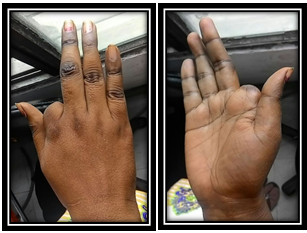
According to TCM theory, local acupuncture points on facial regions such as ST6 Jiache, ST7 Xiaguan and distant points like LI4 Hegu (fig 4a) can be used to treat dental pain. They belong to the stomach and large intestine meridians, with converge at the facial region and linkup with the maxillary and mandibular teeth. Acupuncture point LI4 Hegu, which is located on the radial side of the second metacarpal bone (fig 4b) on the dorsum of the hand, can elicit an analgesic effect on the orofacial region.
 |
 |
| Fig 4a | Fig 4b |
MANAGEMENT OF XEROSTOMIA
The use of acupuncture for xerostomia first appeared in the Western medical literature in 1981. Acupoints includes those on the head and neck region as well as distal points on the upper and lower limbs like Local (ST-3, ST-4, ST- 5, ST-6, ST-7, GB-2, SI-19, TB-21) (fig 5), distal (LI-4, LI-11, LR-3, ST36, KI-5, GV-20) (fig 6b) and auricular acupoints (fig 6a) were also included.
 |
| Fig 5 |
 |
 |
| Fig 6a. acupoints on ear | fig 6b. acupoint LI-2 on radial left index finger Management of trigeminal neuralgia |
MANAGEMENT OF TRIGEMINAL NEURALGIA
According to the international association for the study of pain defines TN as “sudden usually unilateral brief stabbing recurrent pain in the distribution of one or more branches of the fifth cranial nerve. Acupuncture points GB14 Yangbai and EX-HN5 Taiyang are used if the ophthalmic branch is affected, ST2 Sibai and ST3 Juliao are used if the maxillary branch is affected and ST6 Jiache and ST7 Xiaguan are used if the mandibular branch is affected. The protocol utilized local points of TH17 and 21, GB2, SI18, ST2, 3 and 7, GV26 and LI20. Systemic points include TH5, LI4, ST36, ST44, ST45 and LIV3. Auricular acupuncture points were also used.
 |
| Fig 7 |
MANAGEMENT OF TEMPOROMANDIBUAR DISORDERS AND OROFACIAL PAIN
A total of 7 acupoints have been located for treating TMD’s. They are:
- ST-6
- ST-7
- SI-18
- GV- 20
- GB-20
- BL-10
- LI-4
 |
| Fig 8: location of ST -6 and ST-7 |
ST-6 is on the stomach meridian, and it is located near the mandible angle and one middle-finger's breadth from the angle of the mandible. When the mouth is wide open, a depression can be felt on the acupoint, and when teeth are clenched, a bounce from masseter muscle can be felt. The acupuncture needle should be inserted at a perpendicular angle to the skin surface until it reaches a depth of approximately 2 cm in the masseter muscle (fig 8).
ST-7 is also located on the stomach meridian, under the zygomatic arch. Palpating from the targus toward the face, the practitioner first feels the condylar head and then there is a triangular depression between the mandibular notch and zygomatic arch, and the acupoint is located in the depression (fig 8). When the mouth is wide open, the condylar head will bounce up from the depression, and when the mouth is closed, the depression can again be felt. The needle should be inserted perpendicularly to the skin surface for approximately 1.5 to 2.5 cm, and a de qi feeling should be reached by that level.the needles penetrate through masseter muscle and reach the fascia of lateral pterygoid muscle or even the muscle, and the stimulation of these muscles brings relief of tenderness.
SI-18 is on the small-intestine meridian and is located below the zygomatic process from the frontal view. It is on the perpendicular line made from the lateral canthus, on the same horizontal level of the crosspoint of the nostril and nasolabial fold (Fig. 9). The needle should be inserted perpendicularly to the facial plane and can achieve the de qi feeling at a depth of approximately 1.5 cm. Insertion of the needle at the acupoint penetrates buccinators muscle and then reaches the fascia of the masseter muscle to stimulate the analgesic effect to the fatigued muscle.
 |
| Fig 9. Location of SI-18 acupoint |
GB-20 is on the meridian of the gall bladder and is located posterior to the mastoid process and inferior to the occipital bone in the depression between the sternocleidomastoid muscle and the trapezius muscle. The acupuncture needle should be inserted at a depth of approximately 2.5 to 4.0 cm. (fig 10)
BL-10 is located on the meridian of the bladder. This acupoint is on the depression lateral to the trapezius muscle, at the same level of the spinous process of the second cervical vertebra (C2) (Fig 11). The acupuncture needle is inserted at a depth of 2.5 cm to reach the trapezius muscle beneath the skin.
GV-20 is on the topmost of the meridian. It is located at the midpoint of the connecting line of two auricular apices (fig 12). The needle should be inserted from the anterior to the posterior, at an angle approximately 30 degrees to the skin surface at a depth of approximately 1.0 to 1.5 centimeters.
 |
 |
 |
| Fig 10.location of GB-20 | Fig 11. Location of BL-10 | Fig 12. Location of GV-20 |
LI-4 is located on the meridian of the large intestine on the dorsum of the hand, between the thumb and index finger, radial to the midpoint of the second metacarpal bone. (Fig 4)
A comparative study regarding acupuncture therapy and treatment of TMD’s using decompression splints showed that acupuncture therapy showed better and faster pain relief. It was concluded that the use of occlusal splints along with acupuncture therapy showed accelerated pain relief and also helped in improvement of restricted mouth opening. Better results were shown with ear acupuncture adjunct therapy.
MANAGEMENT OF GAG REFLEX
The most common complication or clinical situation faced by a prosthodontist is excessive gag reflex by the patient. The gag reflex (GR) is considered a normal, protective, physiological mechanism that occurs in order to prevent foreign objects or noxious material from entering the pharynx, larynx or trachea. The origin of gagging has been categorized as either somatic (initiated by sensory nerve stimulation from direct contact) or psychogenic (modulated by higher centre’s in the brain). In somatic gagging, touching a trigger area induces the reflex. Psychogenic gagging can be induced without direct contact and the sight, sound, smell or even the thought of dental treatment can be sufficient to induce the gag reflex in some individuals.
The use of acupuncture points like PC6 Neiguan(fig 14) and CV-24 Chengjiang (fig 13) have been reported to significantly reduce gag reflex. Auricular acupuncture has also been suggested for treating severe gag reflex and the role of acupuncture as a method of controlling the gag reflex is safe and quick.
Neiguan point (PC-6) is a concave area at medial aspect of medial forearm and slightly below the palm. Chengjiang point (CV-24) is located in horizontal mentolabial groove approximately midway between chin and lower lip.
 |
 |
| Fig 13. Location of CV-24 | Fig 14. Location of PC-6 |
MANAGEMENT OF BURNING MOUTH SYNDROME
BMS is a complex disease characterized by the manifestation of symptoms of pain, stinging or burning sensation in the oral cavity and lips, without any sign of abnormality. The International Association for the Study of Pain - defined it as “a burning pain in the tongue or other mucous membranes associated to signs and laboratory findings within the normal range for a period of at least 4-6 months.” The mechanism of action of acupuncture is explained as an alteration in the bloodstream, changing the dynamics of regional movements from micro-dilatations, muscle relaxation, solving spasm, reducing inflammation and pain. The points ST8 (Tou Wei), GB2, TE21, SI19 (Ting Gong), SI18 (Quan Liao), LI4 (Yuan) bilaterally as well as GV20 (Bai Hui) were used as acupoints.
LASER ACUPUNCTURE
The stimulation of acupuncture points with laser light can evoke specific effects in the periphery and in the brain. Laser needle acupuncture represents a new, painless method for primary optical stimulation of acupuncture points. It employs low level laser therapy.
Lasers with wavelength of 660 nm with power output 50 and a dose of 1.5–2.0 J/cm2 was used for treatment of burning mouth syndrome.
Acupuncture therapy with lasers has shown much lesser side effects as compared to conventional laser therapy.
CONCLUSION
The use of acupuncture based of traditional Chinese medicine has been advocated for use in dentistry for a long period of time. Acupuncture has shown to be simple and effective in management of various clinical situations like post operative pain, limited mouth opening and gag reflex. Acupuncture treatment is known to have minimal side effects if properly done with accurate knowledge regarding the therapy.
REFERENCES
- Kapoor C, Kar A, Nagpal A, Vaidya S, Jain A. Acupuncture: An alternative therapy in medicine and dentistry. European Journal of General Dentistry. 2013;2(3):219.
- Gupta D, Kumaran N. Acupuncture and Dentistry. OHDM. 2014;13(4):902-910.
- Rosted P, Rosted P. Acupuncture: Introduction to acupuncture in dentistry. British Dental Journal. 2000;189(3):136-140.
- Gupta D, Gupta R, Indra B, Jain A, Mehta P, Rastogi S et al. Acupuncture (é‡ç¸ ZhÄ“n JiÇ”) - An Emerging Adjunct in Routine Oral Care. Journal of Traditional and Complementary Medicine. 2014;4(4):218.
- Wong L. Acupuncture in Dentistry: Its Possible Role and Application. Proceedings of Singapore Healthcare. 2012;21(1):48-56.
- Katti G, Chitroda P, Shahbaz S. Use of Acupuncture as a Novel Practice in the Management of Dental Diseases: A Review. International Journal of Scientific Study. 2014;2(6):112-117.
- Kumar S, Dang R, Valiathan A, Jayaswal P. TREATMENT OF RESISTANT TRIGEMINAL NEURALGIA BY ACUPUNCTUREA REPORT OF 3 CASES. Int J Dent Case Reports. 2011;1(2):85-91.
- Chin S, Hsu M. Application of Acupuncture in Temporomandibular Joint Disorders. Journal of Prosthodontics and Implantology. 2013;2(2):2-10.
- Vicente-Barrero M, Si-Lei Y, Bingxin Z, Bocanegra-Perez S, Duran-Moreno D, Lopez-Marquez A et al. The efficacy of acupuncture and decompression splints in the treatment of temporomandibular joint pain- dysfunction syndrome. Med Oral. 2012;:e1028-e1033.
- Ferreira L, Grossmann E, Januzzi E, Gonçalves R, Mares F, Paula M et al. Ear Acupuncture Therapy for Masticatory Myofascial and Temporomandibular Pain: A Controlled Clinical Trial. Evidence-Based Complementary and Alternative Medicine. 2015;2015:1-9.
More References are available on request
Disclaimer from Guident
The views and opinions expressed in articles published in Guident are solely those of the authors and do not necessarily reflect the views of the editors, the editorial board or the publisher, Ivory India. Guident does not endorse any product, technique or treatment described. Clinical content is intended for qualified dental and medical professionals and is not a substitute for individual clinical judgement. Guident, its editors and the publisher accept no liability for any consequence arising from the use of information published in the journal.
How to cite this article
Dr Rohit Raghavan, Dr Shreshta Sathish Department of Prosthodontics. Acupuncture in Prosthodontics. Guident. 2016 Feb;9(3). Available from: https://ivoryindia.in/articles/prosthodontics/acupuncture-in-prosthodontics.html