Tongue Beads Retainer-a Fixed Retainer for Tongue Thrusting Habit
ABSTRACT
This article showcases the design of a retainer for the tongue-thrusting habit patients, which is tiny, fixed, easy to fabricate, and very comfortable for patients.
Keywords: Composite beads, Fixed retainer, Tongue thrusting habit.
INTRODUCTION
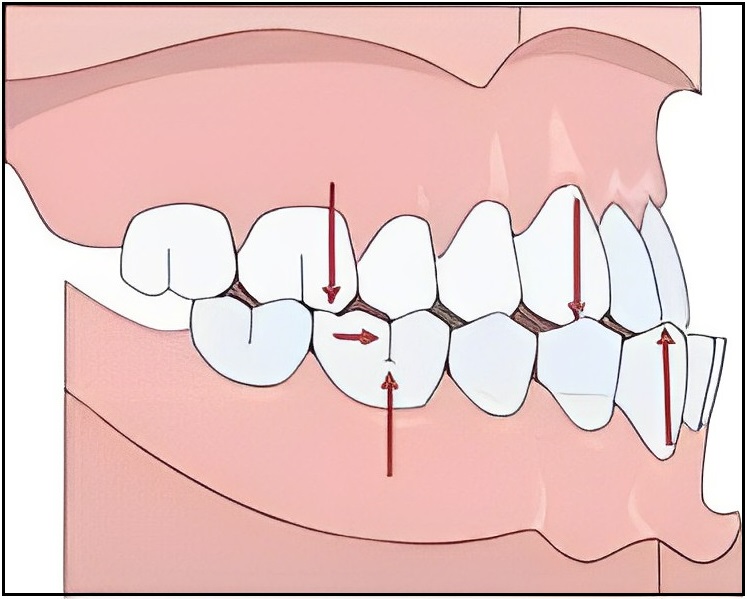
Tongue thrusting is a habit, which is very commonly seen in orthodontic patients. This habit can be seen in children as well as in adults that is very difficult to manage by wearing the tongue crib (the most commonly used habit-breaking appliance). As most of the patients deny wearing such a bulky appliance and want to complete the treatment. But as an orthodontist we know if the spaces get closed by orthodontic treatment alone without any habit-breaking appliance, there are chances of the opening of spaces after treatment.
As a retainer a removable tongue crib with Hawley’s appliance is the appliance of choice for tongue-thrusting habit patients, that is too bulky and uncomfortable for the patient.
Some other retainers are also available that are not so bulky but still removable.1,2
To break the persistent habit and change the resting position of tongue, we have designed a fixed lingual retainer i.e., “THE TONGUE BEADS RETAINER” which is comfortable, less bulky compared to the conventional habit breaking appliance and is also fixed so patient’s compliance is not needed.
This appliance is similar to fixed lingual retainer and provide retention with added loops and composite beads to act as a reminder therapy for patient to place the tongue palatally rather than on the palatal surface of incisors.
Appliance Design and Fabrication:
To fabricate tongue beads retainer we need (Figure 1):-
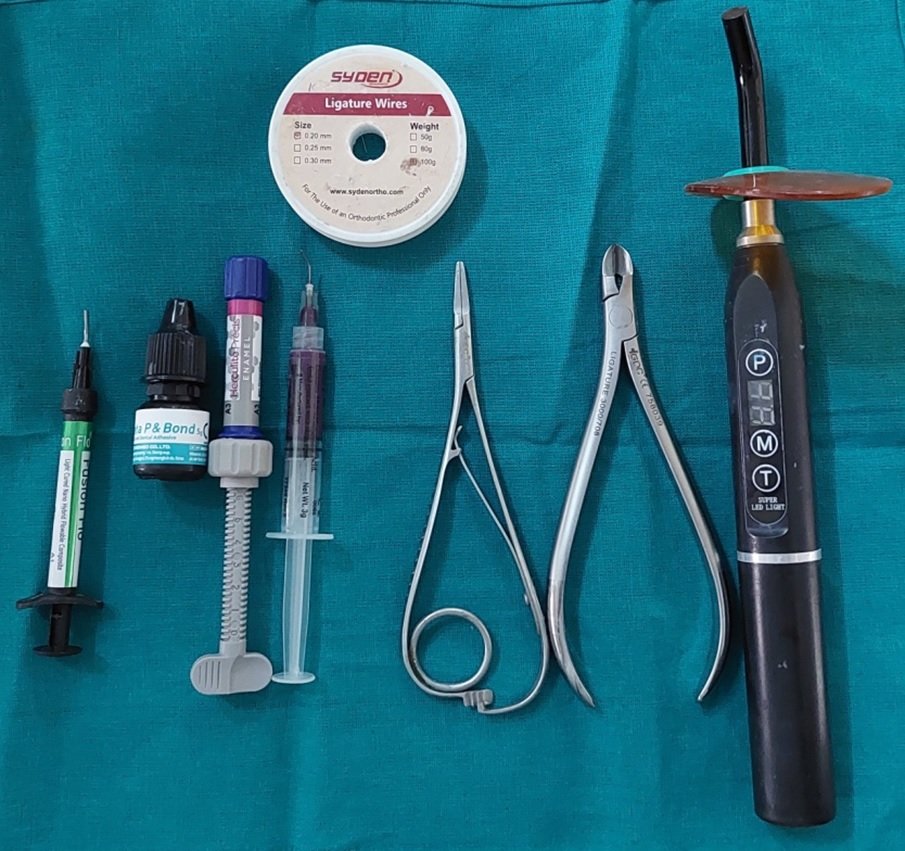
FIGURE 1: ARMAMENTARIUM
- 0.010” ligature wire
- Packable composite
- Artery forceps
- Ligature wire cutter
- Tucker
- Light cure unit
- Etchant
- Primer
Steps
- To reduce the chairside time take an upper arch impression one week before debonding and pour it with Orthokal / plaster of Paris/ dental stone and get maxillary arch model.
- Take a long segment of ligature wire and fold it three times and then twist it with the help of artery forceps similar to the fabrication of a fixed lingual retainer. (figure 2)
- Place this ligature wire segment in the canine region and start to give a bend on the twisted ligature wire on either the right or left side.
- Now give a 90 degree bend at the junction of canine and lateral incisor. To make a loop of 1cm length and adapt it over the lateral incisor. (figure 3.)
- Repeat this up to the canine of the other side.
- Give a 90-degree bend at the middle of the loop towards the palate. (Figure 4)
- Place a composite bead over the tip of the bend and cure it. (Figure 5a, 5b )
- Cure this retainer over the cingulum of the upper anterior teeth. (figure 6).

FIGURE 2: ligature wire twisted at 3-folds
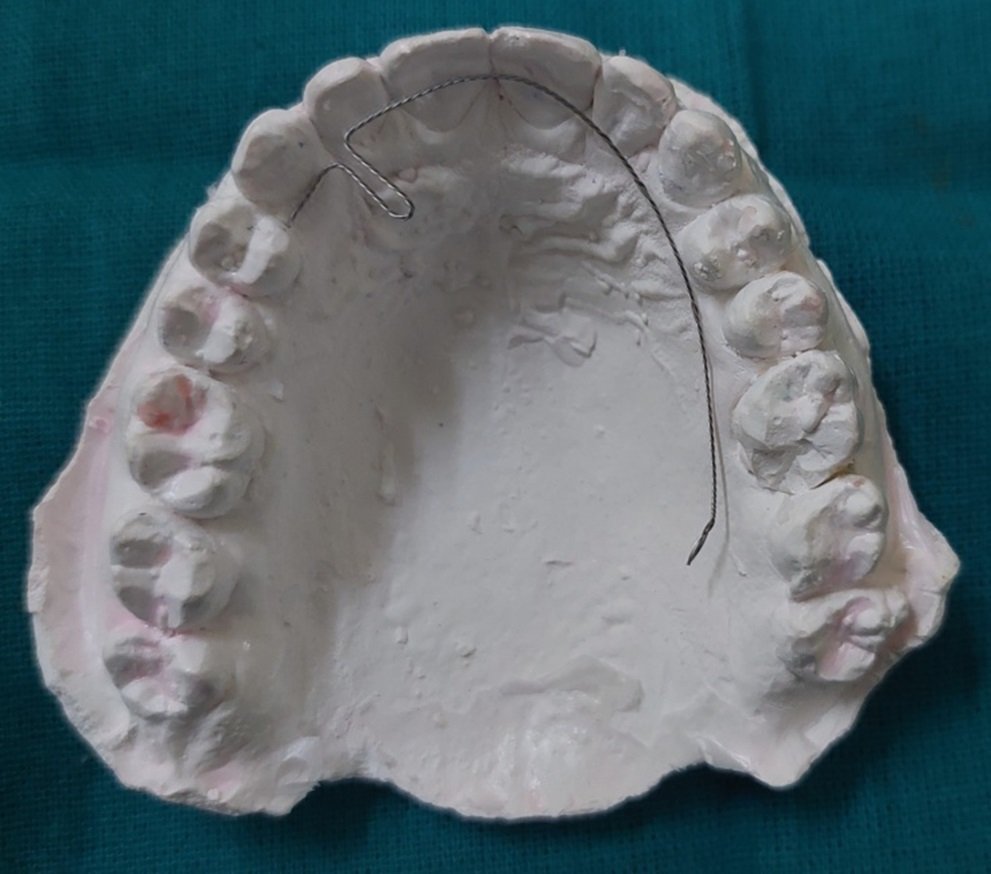
FIGURE 3: 90 degree bend given at junction of lateral and canine

FIGURE 4: – 90 degree bend given at middle of loop at palate.

FIGURE 5: Composite bead at the tip of bend.

Figure 6 – lingual bead retainer bonded at palatal surface of upper incisors.
We can do all these procedures directly in the patient mouth, to reduce the chairside time we follow this entire step.
Advantage
- Easy to fabricate.
- Comfortable for the patient because of its small size and is a reminder that is inserted into a fixed retainer.
- Reduced chair side time.
REFERENCES
- Thakur A, Mathur A, Toshniwal NG, Kharbanda OP. New Essix Retainer for Both Retention and Habit Control. Journal of Indian Orthodontic Society. 2013 Apr;47(2):107-9.
- Tripathi T, Kalra S, Rai P. Aesthetic Retainer cum Trainer. Journal of clinical and diagnostic research: JCDR. 2017 Jan;11(1):ZH01.
Disclaimer from Guident
The views and opinions expressed in articles published in Guident are solely those of the authors and do not necessarily reflect the views of the editors, the editorial board or the publisher, Ivory India. Guident does not endorse any product, technique or treatment described. Clinical content is intended for qualified dental and medical professionals and is not a substitute for individual clinical judgement. Guident, its editors and the publisher accept no liability for any consequence arising from the use of information published in the journal.
How to cite this article
Dr. Kanika Shrotriya, Dr. Kimi Mittal, Dr. Kamal Bajaj. Tongue Beads Retainer-a Fixed Retainer for Tongue Thrusting Habit. Guident. 2023 Mar;16(4). Available from: https://ivoryindia.in/articles/orthodontics/tongue-beads-retainer-a-fixed-retainer-for-tongue-thrusting-habit.html