Application of a Deprogrammer for Occlusal Analysis and Mounting Cases in Centric Relation
Department of Prosthodontics & Implantology K.D. Dental College & Hospital, Mathura (U.P) India
ABSTRACT
Centric relation (CR) has been well described in the literature(a partial list of appliances and techniques include the Lucia Jig,the leaf gauge, and the bilateral manipulation technique); and,although easy to understand, it often is elusive to achieve clinically.Anyone who has attempted to mount cases in CR knows that
some patients can be extremely difficult to manage for accurate
bite relationships.The Deprogrammer has been found to be an effective device for achieving these bite registrations.the purpose of the deprogrammer is to relax muscle and hence allows for an accurate examination of the relationship of the maxilla to mandible eith muscles relaxed and condyles seated in a particular position and consequently helps in accurate case mounting
KEYWORDS: Centric relation (CR), constricted path of closure (CPC), Deprogrammer
DEPROGRAMMER
Lucia jigs, NTI’s(Nociceptive Trigeminal inhibition tension suppression system), Cranham deprogrammers, and Dawson B-Splints all fall into the broad category of temporomandibular joint disorder diagnosis appliances.
They all achieve the same goal, getting centric relation by eliminating muscle hyperactivity. It has several other uses as well and is an invaluable tool in diagnosing the three most common types of abnormal occlusal attrition: occlusal dysfunctional, parafunction (e.g., bruxism), and a constricted path of closure
CENTRIC RELATION
Centric relation is described as the maxillomandibular relationship in which the condyles articulate with the thinnest avascular portion of their respective disks with the complex in the anterior-superior position against the shapes of the articular eminences.12 This position is independent of tooth contact and is clinically discernible when the mandible is directed superiorly and anteriorly. It is restricted to a purely rotational movement about the transverse horizontal axis
The significance and advantages of being able to placethe mandibular condyles into the centric relation position are as follows:
1. Centric relation is usually an easily reproducible and not uncomfortable position.
2. When the condyles are retruded, the mandible is capable of repeatedly making a purely rotational movement through an incisor separation of 10 to 25 mm, permitting location and transfer of this axis to an articulator.
3. Patients appear to function comfortably in centric relation after .a centric relation occlusal equilibration, after a full-mouth rehabilitation, during occlusal splint therapy, and in wearing complete dentures.
4. Numerous temporomandibular joint disturbances including pathologic changes may occur or are triggered when malocclusion exists because of tooth movement,dental restorations, or inadequate orthodontic treatment
5. Patients with painful temporomandibular jointsfrequently report surprisingly quick relief of their painand other symptoms after either wearing an occlusal splint, biting on a leaf gauge for several minutes,or after a dentist has removed the tooth or teeth that were prematurely contacting in the centric relation position.For a number of years the anterior jig and more recently the leaf gauge have been shown to be reliable methods for consistently placing and securing the condyles in a centric relation position. Both maintain the minimal increased vertical dimension necessary to negate tooth contact..
De-mystifying the Appliance
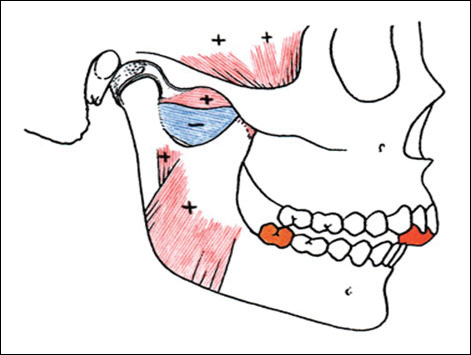
Unlike full coverage orthotics with classical occlusion milled in, the anterior deprogrammer creates a small contact point for the incisors to meet, while disengaging all of the posterior teeth. In essence, it “clears the dance floor” of any noxious posterior interferences. In not allowing the posterior teeth to contact, the hyper-functioning lateral pterygoid muscles will relax, the elevator muscles activity will decrease which allows the TMJ to seat in centric relation , often in minutes.

APPLICATIONS OF THE DEPROGRAMMER
It can be used for simplifying difficult bite registrations and for accurate
mounting of diagnostic casts, for patients that are difficult to manipulate
into CR, and for facilitating occlusal adjustments (during which time it
is worn). It can be used as a diagnostic tool to determine if the
mandible needs to move in the anterior or posterior direction to reach CR from maximal intercuspal position (MIP). The device is also used to differentiate among three types of abnormal occlusal attrition
- Constricted path of closure(CPC): Attrition occurs during closure into MIP when anteriorinterferences create a distal thrust that moves the condyles distal to CR

2. Occlusal dysfunction: Occlusal attrition as a result of excessive grinding triggered by interferences on the posterior teeth

3. Parafunction (true bruxism):Occlusal wear as a result of excessive grinding triggered by the brain. It has no functional purpose.
WHEN SHOULD WE USE A DEPROGRAMMER?
When our TMJ – occlusal examination reveals an occluso-muscle disorder (or dysfunction) that needs to be addressed, a deprogramming device can safely be used. This can be indicated by no tenderness of the joint during load testing while in the presence of other signs or symptoms of instability, especially a positive finding during muscle palpation of the pterygoids, masseters or temporalis.
WHEN SHOULD WE AVOID THEM?
Anterior deprogrammers should be avoided in the presence of intracapsular pathology. If chronic anterior disk displacement is suspected, seating the condyles with a deprogrammer can progress a reducing click to a non-reducing click, either on the lateral or the medial pole. Cautious use and careful monitoring should be utilized when using it on a patient with an intermittent lateral pole click, as well as those who recently developed a reducing lateral pole click. In the case of medial pole displacement, significant pain will result with its use, since pressure is being placed on the retrodiskal tissues. Therefore, it is crucial to remove the appliance if any discomfort is perceived at the level of the joint. Full coverage orthotics should be used to treat the joint first in such situations
Benefits of the deprogrammer
- It allows for the patient to deprogram over time. It hasbeen has shown that in patients with a centric prematurity introduced for a short period of time, a percentage of them may take days or weeks to lose the muscular discoordination in themuscles of mastication once the prematurity is removed. This explains why some patients will not deprogram instantly or in a few hours. In these cases, an accurate record cannot be taken untril they have been completely deprogrammed.
- The jaw is not manipulated into CR, but is determined by the patient and is reproducible. This is a key criterion to determine if the patient is deprogrammed .The patient must be able to close into the same position every time, passively, without any guidance or external force
HOW DOES IT WORK?
Proprioceptors in the periodontium provide feedback that programmes the muscles to close in MIP. Withoutreinforcement through repeatedtooth contact, the feedback and theinfluence of the dentition on the condylar position is lost. Tooth-deflecting inclines can trigger discoordination of the masticatory muscles. Until these muscles relax and function in a coordinated manner, the patient may be incapable of achieving a CR position. It breaks this cycle by discluding the teeth and allows the muscles to return to
normal function. The protocol also verifies that the muscles of masticationare deprogrammed. This ensuresthat the condyles are allowed to “move” to the CR position, being unaffected by uncoordinated muscles, tooth interferences, or operator error.
DISCUSSION
The "classic" patient for an anterior appliance is one who is experiencing obvious muscle disha.The CPC patient often can fool the clinician; he or she may be asymptomatic, easy to manipulate, and give reproducible mountings. Testing these patients with a deprogrammer will verify the achievement of CR. Patients that potentially fall into the CPC category include those with a deep overbite, a steep interincisal angle, those that have been overclosed during occlusal adjustment, post-orthodontic patients, patients with overcontoured anterior restorations, and patients who have been previously restored in CR. It has been the author,s experience that these CPC patients (those with condyles positioned posterior to CR in MIP)comprise a significant percentage of the population. Many of these patients were easy to manipulate using bilateral manipulation or anterior discluding devices,gave reproducible mountings, and then shifted significantly forward during deprogramming.
The CPC patients may develop significant wear on both the lingual surfaces of the maxillary incisors and on the labial surfaces of the mandibular incisors
Patients functioning anterior to CR are at a lower risk for becoming symptomatic as there is more "give" to the system. These patients, however, may develop significant attrition as a result of grinding caused by posterior interferences (occlusal dysfunction). This excessive attrition can be stopped by correcting the occlusal interferences. This will lower the restorative risk as well.
CPC attrition occurs during closure into MIP, and mastication. Dysfunctional attrition occurs throughout the entire day.
If the patient does develop a wear facet on the anterior discluding device, by process of elimination, the attrition is caused by the parafunction habit. (Note: There is a fourth category of patients who have a neurological disorder. Fortunately, they are relatively few in number. They will usually present with an underlying medical diagnosis and can be very difficult to manage.)
Making this distinction is important because each diagnosis requires a different type of treatment
WHEN IS THE PATIENT DEPROGRAMMED
The patient is deprogrammed when he or she reproduces the same single spot on the platform without guidance or support. The spot needs to be absolutely flat with no slide whatsoever and the spot must be repeatable. The patient should be asymptomatic and will know when he or she continues to contact the same spot on a tooth immediately after removing the deprogrammer. Patients marking in more than one place are not deprogrammed. They will then need to wear the deprogrammer more hours per day, or for more days Make sure that the patient is not hitting any teeth as he or she moves toward CR.
CONCLUSION
De programmer offers an easy CR mounting technique and protocol that help the restorative dentist achieve predictability and accuracy in an area that can be very difficult. De programming the patient can take time and for that reason, it may be extremely difficult to obtain a true CR position without de programming certain patients.
REFERENCES
- Jayne D .A Deprogrammer for Occlusal Analysis and Simplified Accurate Case Mounting. The journal of cosmetic dentistry 21(4):96-102,2006
- Dawson PE. Evaluation, Diagnosis, and Treatment of Occlusal Problems (2nd ed., pp. 183-200). St. Louis, MO: Mosby; 1989.
- Dawson PE. Optimum TMJ condyle position in clinical practice. Int J Periodont Rest Dent 5(3):10-31, 1985.
- Kois J. Occlusion: Complex restorative management. Course 8 Manual. Seattle, WA; 2004.
- Long JH. Locating centric relation with a leaf gauge. J Prosthet Dent 29(6):608-610, 1973.
- Lucia VO. A technique for recording centric relation. J Prosthet Dent 14:492-505, 1964.
- Posselt U. Terminal hinge movement of the mandible. 1957. J Prosthet Dent 86(1)2-9, 2001.
Disclaimer from Guident
The views and opinions expressed in articles published in Guident are solely those of the authors and do not necessarily reflect the views of the editors, the editorial board or the publisher, Ivory India. Guident does not endorse any product, technique or treatment described. Clinical content is intended for qualified dental and medical professionals and is not a substitute for individual clinical judgement. Guident, its editors and the publisher accept no liability for any consequence arising from the use of information published in the journal.
How to cite this article
Dr. Shaivy Ambuj, Dr. Manesh Lahori. Application of a Deprogrammer for Occlusal Analysis and Mounting Cases in Centric Relation. Guident. 2018 Dec;12(1). Available from: https://ivoryindia.in/articles/prosthodontics/application-of-a-deprogrammer-for-occlusal-analysis-and-mounting-cases-in-centric-relation.html