Denture Cleanser: A Narrative Review in Prosthodontics
Department of Prosthodontics, Post Graduate Institute of Dental Sciences, Pt. BD Sharma University of Health Sciences, Rohtak, Haryana, India., Department of Prosthodontics, Department of Conservative Dentistry and Endodontics
ABSTRACT
Oral hygiene remains crucial even when some or all teeth have been replaced with removable dentures. Proper cleaning of the prosthesis is essential for maintaining good oral health. With a focus on patient education and preventive dentistry, it is important for dentists to recommend a denture cleanser that is effective, safe for patients, and does not harm denture materials. Patients should remove their dentures while sleeping and keep them soaked or moist to prevent dimensional changes in acrylic resins caused by drying out. As a result of these recommendations and marketing by manufacturers, many patients prefer cleansers that involve soaking or immersion. Proper selection and use of denture cleansers tailored to the type of denture material and patient needs are essential for ensuring effective cleaning and minimizing potential adverse effects on both the denture and oral health.
Keywords: Denture, Cleansers, Stains, Debris, Prosthesis.
INTRODUCTION
Denture hygiene is an integral part of prosthodontic care, as it directly affects both the functional and aesthetic aspects of prosthodontic appliances. Dentures, partial dentures, and other removable prostheses are susceptible to biofilm formation, bacterial accumulation, and staining, which not only degrade the quality of the appliance but also pose a risk to the patient's oral health. Denture cleansers are specially formulated agents designed to remove debris, bacteria, stains, and food particles from dentures, ensuring proper hygiene and longevity of prostheses. This narrative review aims to explore the role of denture cleansers in prosthodontics, examining the various types available, their mechanisms of action, their effectiveness, and potential risks associated with their use. Poor denture hygiene has been reported to be associated with denture stomatitis, and increase the risk of dental caries and periodontal diseases among remaining teeth.1 Furthermore, pathogenic microorganisms from removable denture biofilms have been shown to be associated with numerous systemic diseases, including cardiovascular, gastrointestinal, and respiratory infections2 A failure to maintain proper oral hygiene with dentures can result in Bacterial Contamination and Infection, Plaque and Biofilm Formation staining and esthetic Degradation, and Bad Odor. As such, regular cleansing of dentures is a critical part of maintaining the health of the oral tissues and ensuring the optimal function and appearance of the prosthesis.3
Types of Denture Cleansers
Denture cleansers can be classified into various categories, primarily based on their formulation and action.5 These include chemical-based cleansers, mechanical cleaning methods, and combined approaches explained in [Table No.1].
Table No.1.

MECHANISMS OF ACTION
Denture cleansers work by utilizing various mechanisms that target different aspects of cleanliness, including debris removal, stain reduction, and microbial control. Mechanism of Action of Denture Cleanser explained in [Table No. 2].
Table No. 2
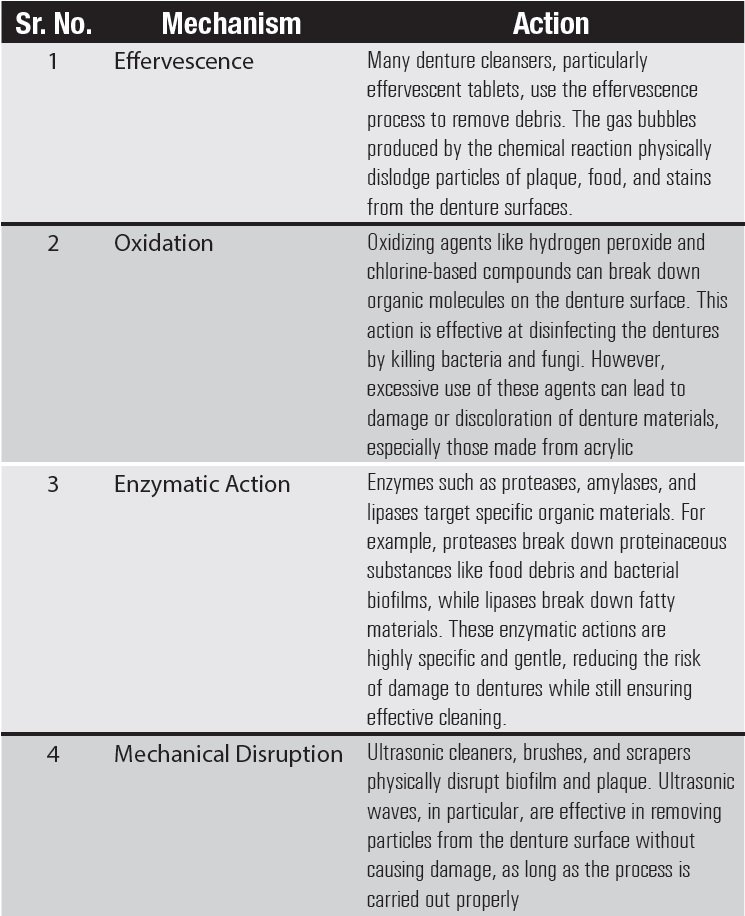
The effectiveness of a denture cleanser depends on several factors like Composition, duration of contact, type of material, frequency of use, etc.
RISKS AND CONSIDERATIONS
While denture cleansers are crucial for maintaining denture hygiene, improper use or over-reliance on certain types of cleansers may lead to adverse outcomes.[6] The potential risks include [Table No.3].
Table No.3.

DISCUSSION
Denture cleaning can be achieved using a variety of products, which are primarily categorized into two main types: mechanical and chemical cleansers. An ideal denture cleanser should be easy to use, effectively remove both organic and inorganic debris from the denture surface, possess bactericidal and fungicidal properties, and be compatible with all denture base materials. Chemical cleansers offer the advantage of ease of use, and several studies have demonstrated their effectiveness in reducing biofilm formation both in vitro and in vivo. Recently, sonic denture cleaners Combined with sterilizing UV light and chemical cleansers have also been utilized.4 However, no product currently on the market meets all of these ideal criteria. Many elderly patients in long-term care settings struggle to properly clean their dentures due to illness, dementia, or limited dexterity. This inadequate cleaning can result in the growth of Candida spp. and bacteria, which may serve as reservoirs for infections. Research shows that using denture cleansers significantly reduces the number of microorganisms on dentures, particularly in hospitalized geriatric patients. Various studies highlight both the benefits and potential drawbacks of using denture cleansers. However, investigations have shown that when used properly, chemical cleansers do not alter the mechanical properties of denture base materials. To date, there have been no reported cases of allergies or harmful effects from the correct use of cleansers, following the manufacturer’s instructions.5
CONCLUSION
Denture cleansers are essential for maintaining the hygiene and longevity of removable prostheses in prosthodontics. They help prevent microbial contamination, remove debris and stains, and promote oral health. With various types of cleansers available, including effervescent, oxidizing, enzymatic, and mechanical options, patients and dental professionals have a broad range of choices for effective cleaning. However, careful selection of a cleanser based on the type of denture material and the specific needs of the patient is critical to avoid adverse effects. Regular, proper use of denture cleansers can significantly enhance the patient’s comfort, appearance, and oral health, contributing to the success of prosthodontic treatment.
REFERENCES
- T.W. Lim, M.F. Burrow, C. McGrath, Evaluating risk factors associated with poor removable prosthesis hygiene in community-dwelling elders: a cross-sectional study, J. Prosthet. Dent. (2023)
- J.Y.M. Ng, T.W. Lim, N. Tarib, T.K. Ho, Effect of educational progressive web application on patient's oral and denture knowledge and hygiene: a randomized controlled trial Health Inform. J., 27 (2021)
- L.E. O'Donnell, K. Smith, C. Williams, C.J. Nile, D.F. Lappin, D. Bradshaw, M. Lambert, D.P. Robertson, J. Bagg, V. Hannah, G. Ramage Dentures are a reservoir for respiratory pathogens J. Prosthodont. 2016;25:99-104.
- Arab J, Newton JP, Lloyd CH. The effect of an elevated level of residual monomer on the whitening of a denture base and its physical properties. J Dent 1989;17:189-194.
- Mylonas P, Milward P, McAndrew R. Denture cleanliness and hygiene: an overview. Br Dent J. 2022 Jul;233(1):20-26.
- Kumar B, Sandhu P K, Kumar A N, Patil C P. A comparative study for plaque removing efcacy between commonly used denture cleansers in India. J Indian Prosthodont Soc 2017; 17: 295–300
- Porwal A, Khandelwal M, Punia V, Sharma V. Efect of denture cleansers on colour stability, surface roughness, and hardness of diferent denture base resins. J Indian Prosthodont Soc 2017; 17: 61–67.
Disclaimer from Guident
The views and opinions expressed in articles published in Guident are solely those of the authors and do not necessarily reflect the views of the editors, the editorial board or the publisher, Ivory India. Guident does not endorse any product, technique or treatment described. Clinical content is intended for qualified dental and medical professionals and is not a substitute for individual clinical judgement. Guident, its editors and the publisher accept no liability for any consequence arising from the use of information published in the journal.
How to cite this article
Dr. Arti, Dr. Monika Nagpal, Dr. HSJ Institute of Dental Sciences and Hospital Punjab University Chandigarh India, Dr. Manjot Kaur, Dr. HSJ Institute of Dental Sciences and Hospital Punjab University Chandigarh India.. Denture Cleanser: A Narrative Review in Prosthodontics. Guident. 2025 Jan;18(2). Available from: https://ivoryindia.in/articles/prosthodontics/denture-cleanser-a-narrative-review-in-prosthodontics.html