
Preserving Teeth with Precision: The ART of Endocrown Placement: A Review
Department of Prosthodontics and Crown & Bridge, K.D. Dental College & Hospital, Mathura, UP, India.
ABSTRACT
Endocrowns offer a conservative and effective solution for teeth with significant structural loss, especially after endodontic treatment. They integrate endodontic and prosthodontic principles, preserving natural tooth structure while providing enhanced stability and strength. This restoration is particularly useful for molars and premolars where traditional crowns may be impractical. The unique design extends into the pulp chamber for better force distribution. Various materials like zirconia and lithium disilicate offer durability and aesthetics. Indications include extensive decay or damage, while contraindications involve sufficient tooth structure or periodontal issues. Proper preparation, material selection, and cementation are key to long-term success.
INTRODUCTION
When a tooth undergoes endodontic treatment, significant loss of tooth structure often occurs, attributed to factors such as trauma or caries, along with the central destruction resulting from the endodontic access preparation. This situation typically leaves the tooth with insufficient sound tooth structure to independently support a casted restoration. The extent of tooth structure loss not only complicates subsequent restorations but also elevates the risk of tooth fracture during mastication.1 The selection of an appropriate restoration is thereby guided by factors like the tooth's location (posterior or anterior) and the remaining amount of tooth structure.2
The endocrown, a revolutionary advancement in the realm of restorative dentistry, stands as a testament to the integration of cutting-edge endodontic principles and crown restoration techniques. As an innovative procedure, the application of endocrowns comes into play when a tooth undergoes significant damage or decay, necessitating not only the removal of compromised pulp but also the strategic placement of a supportive crown for comprehensive rehabilitation.
At its core, the endocrown procedure embodies a holistic approach to tooth restoration, emphasizing the preservation of natural tooth structure as a paramount objective. By seamlessly blending endodontic and prosthodontic techniques, endocrowns have emerged as a sophisticated solution that goes beyond traditional crown placements. The process unfolds in a meticulous two-stage manner. Firstly, the compromised or infected pulp undergoes a comprehensive endodontic treatment, involving precise cleaning, shaping, and disinfection of the root canals.5 Once this crucial phase is successfully completed, an impression is taken to meticulously craft a customized crown that fits the prepared tooth with unparalleled precision.
The design philosophy of endocrowns is distinctive and purposeful. Encompassing the entire occlusal surface of the tooth and extending into the pulp chamber, this design not only ensures comprehensive coverage but also serves to evenly distribute chewing forces. The result is a restoration that minimizes the risk of fractures and fortifies long-term stability. Material choices, such as zirconia or high-strength ceramics, contribute significantly to the durability and biocompatibility of endocrowns, ensuring a restoration that not only withstands the rigors of daily use but also seamlessly integrates with the natural dentition.
The advantages offered by endocrowns are manifold. Beyond the preservation of natural tooth structure, they provide heightened strength and stability, offering a durable solution for teeth with compromised integrity. The aesthetic appeal is not to be understated, as the customizable materials enable the creation of endocrowns that harmonize seamlessly with the natural color of adjacent teeth, resulting in a restoration that is not only functionally robust but also visually pleasing.
Endocrowns find their primary indications in cases where teeth exhibit extensive cavities, significant damage, or have undergone root canal therapy.7 Their application is particularly pronounced in molars and premolars, where the need for robust restoration is often most critical.
This article aims to thoroughly explore the multifaceted dimensions of endocrowns, unraveling the intricacies of their purpose, the nuanced procedure involved, distinctive design features, material considerations, associated advantages, and the pivotal indications that position them as a forefront solution in contemporary dental practice.
INDICATIONS
Endocrowns, specialized dental restorations, find application in specific clinical scenarios where their distinctive advantages align with patient needs. They are particularly indicated when a tooth experiences significant structural loss due to factors like decay, trauma, or extensive prior dental work.3 Offering a conservative alternative to traditional crowns, endocrowns preserve maximal natural tooth structure. Their utility extends to situations with limited interocclusal space, where conventional crowns might pose challenges, as endocrowns can be internally placed without compromising occlusal clearance.
Furthermore, endocrowns become a recommended option when creating a sufficient ferrule is difficult, which is common in cases of short clinical crowns or extensive destruction of tooth structure. They are well-suited for teeth with curved, calcified, short, or narrow root canals, allowing effective restoration where applying a post may be intricate.7 Additionally, in instances where fractured instruments in the root canal hinder post application, endocrowns offer a suitable alternative.
Root canal-treated teeth benefit from endocrown restorations, reinforcing and restoring the tooth's integrity after pulp removal. Molars with extensive decay or damage, especially in posterior regions, have shown effective results with endocrowns due to their internal design that enhances stability and durability. Endocrowns also shine in situations where a single-visit restoration is preferred, providing a time-efficient option for patients. Dental practitioners meticulously evaluate each patient's circumstances, considering factors such as tooth condition, occlusal dynamics, and patient preferences to determine whether endocrown placement is the most appropriate and beneficial course of action.
CONTRAINDICATIONS
While endocrowns offer versatile solutions in various clinical scenarios, there are specific situations where their application may not be advisable, constituting contraindications. One notable contraindication is in cases where there is an ample amount of remaining tooth structure. Endocrowns are designed for teeth with significant loss of structure, and their conservative approach may not be justified when a substantial portion of the tooth is intact. Additionally, teeth with extensive periodontal involvement or compromised periodontal support may not be suitable candidates for endocrowns, as the restoration relies on a stable foundation for long-term success.
Another contraindication arises in situations where there is a lack of proper isolation during the bonding process. Achieving optimal bond strength is crucial for the success of endocrowns, and any challenges in maintaining a dry field may compromise the integrity of the restoration. Moreover, when the patient exhibits parafunctional habits such as bruxism or clenching, the increased forces on the restoration may pose a risk to its longevity.
The application of an endocrown also not recommended in situations where the pulp chamber is short and narrow, adhesion is uncertain, and there is minimal remaining tooth structure.4 Careful consideration and exploration of alternative approaches are essential in such cases to achieve an optimal restoration outcome. The contraindications highlight the importance of a thorough evaluation in ensuring the success and longevity of dental restorations.
INITIAL ASSESSMENT AND TREATMENT PLANNING IN ENDOCROWN PLACEMENT
The success of placing endocrowns relies heavily on a thorough initial assessment and precise treatment planning. In this crucial phase, dental practitioners conduct a detailed examination of the patient's oral health, considering existing restorations, signs of decay, and overall oral well-being. A comprehensive clinical history is obtained, incorporating past dental procedures, habits, and ongoing concerns.1 Radiographic tools like X-rays and cone-beam computed tomography (CBCT) are pivotal for assessing internal tooth structures, providing insights into decay, pulp condition, and potential complications.2
The radiographic examination aids in a precise diagnosis and treatment planning. A collaborative decision-making process follows, involving thorough discussions with the patient. This includes explaining the diagnosis, discussing treatment options, and addressing concerns. Alternative treatments are explored, ensuring the chosen approach aligns with the patient's preferences and oral health goals.
Based on the initial assessment, radiographic findings, and collaborative discussions, a customized treatment plan is formulated. This plan outlines the step-by-step process for endocrown placement, considering specific procedures and anticipating outcomes. This tailored approach ensures each patient receives individualized care, maximizing the benefits of endocrown placement for long-term oral health and aesthetic satisfaction.
The meticulous precision applied in the initial assessment and treatment planning serves as a solid foundation, guiding dental practitioners in delivering successful endocrown restorations that embody the principles of precision dentistry.
PREPARATION
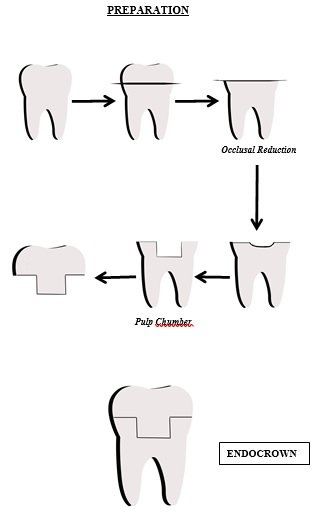
Endocrown restorations are a type of dental procedure in prosthodontics. They focus on holding onto the tooth through connections to the pulp chamber and cavity margins. Unlike regular crowns, they are less invasive and use bonding for support. The preparation process is different but can be adjusted for looks, strength, or material preferences. This ensures a customized and efficient approach to endocrown restorations in dental practice.
Occlusal reduction and Axial Wall Preparation:
In preparing teeth for ceramic or composite materials, it's crucial to consider specific guidelines. For ceramics, a recommended minimum occlusal reduction of 2 mm is advised, while a more conservative 1-1.5 mm suffices for composites due to their elastic properties. The thickness of ceramic restorations, ranging from 3 to 7 mm, measured from axial wall margins to the occlusal limit, shows a positive correlation with enhanced fracture resistance.
Achieving occlusal reduction involves a methodical approach, beginning with the drilling of 2 mm guide grooves.9 Subsequently, a wheel diamond bur is employed to systematically reduce the occlusal surface along the tooth's long axis, maintaining a parallel orientation to the occlusal plane. This meticulous process ensures proper alignment and results in a flat surface characterized by a butt joint margin.
The butt joint, also known as a cervical sidewalk, is a 90-degree circumferential enamel band, 1-2 mm wide, integral for enhancing bonding and providing stability against compressive stresses.7 This specific margin type is particularly relevant in dental applications, ensuring not only improved bonding but also a stable surface capable of withstanding significant forces during mastication.
Ferrule Effect:
The impact of ferrule in full coverage crowns with post and core support enhances fracture resistance and fatigue cycles. Einhorn et al. studied ferrule effects on molar endocrown failure resistance, finding increased dentin surface for bonding with ferrule addition.9 However, complex designs reduced endocrown inner surface adaptation. Ferrule-containing endocrown preparations showed superior failure loads compared to regular endocrowns, with no significant difference in calculated failure stress based on adhesive bonding surface area. Notably, 1 mm ferrule designs exhibited fewer disastrous failures.7
Pulp Chamber Preparation:
In preparing the pulp chamber for an endocrown, use a cylindrical conical diamond bur with a 7-degree occlusal taper to remove undercuts. Maintain a parallel bur alignment to create smooth, tapered walls without excessive pressure. Studies suggest that increasing pulp chamber depth may not enhance fracture resistance, advocating for a depth of 2 mm for stability. Caution is needed to avoid extending into canals, affecting stress distribution.
IMPRESSION
In the creation of an endocrown, obtaining a precise impression is pivotal, with practitioners employing either traditional or digital methods. Traditional impressions involve careful selection of materials like elastomers, meticulous isolation, and retraction techniques to prevent moisture interference. The material is loaded into an impression tray, covering the prepared tooth comprehensively. After setting, the impression is removed and thoroughly inspected for distortions. On the other hand, digital impressions utilize intraoral scanners for real-time feedback, creating a 3D digital model processed for virtual adjustments before transmission to the dental laboratory.6 Both methods demand precision, dependent on factors like case complexity and practitioner preference. The accuracy of the impression sets the foundation for successful endocrown fabrication, emphasizing the importance of attention to detail in either approach.

It is also essential, to acquire an impression of the opposing dentition to facilitate a thorough occlusion analysis. This step ensures a precise fit and proper alignment of the endocrown with the surrounding teeth, contributing to the overall stability and functionality of the restoration. The opposing tooth impression provides valuable information for prosthodontists to assess occlusal relationships and make necessary adjustments, ultimately enhancing the longevity and effectiveness of the endocrown.
SHADE SELECTION
After impression, a critical step involves the judicious selection of the appropriate shade to ensure a natural and aesthetically pleasing appearance. Prosthodontists, leverage their expertise to evaluate factors like tooth color, translucency, and surrounding dentition to seamlessly match the endocrown with the patient's natural teeth.1 This meticulous shade selection not only contributes to the restoration's visual harmony but also enhances the patient's satisfaction with the overall outcome. The attention to detail in choosing the right shade is fundamental in achieving a final result that seamlessly integrates with the patient's dentition, embodying both functional and cosmetic excellence.

MATERIAL SELECTION
The selection of materials for crafting endocrowns involves a thorough evaluation of distinct characteristics, each material offering specific advantages.
Zirconia, recognized for its outstanding strength and durability, is an optimal choice for posterior teeth subjected to substantial occlusal forces. Its biocompatibility further reduces the risk of adverse tissue responses, although its inherent opacity may pose limitations in achieving the highest natural aesthetics.
Lithium disilicate strikes a delicate balance between strength and aesthetics, proving particularly suitable for anterior teeth with its high translucency mimicking natural tooth appearance. This versatile material caters to both functional and cosmetic requirements.
Metal-ceramic combinations, robust and capable of withstanding significant biting forces, may face limitations in anterior teeth due to potential metal visibility.
Resin-based materials, exemplified by composite resins, offer a conservative approach by preserving tooth structure and providing good esthetics, although they may be more susceptible to wear over time.
Hybrid ceramic materials, blending the strength of ceramics with the flexibility of composites, offer a harmonious balance, providing consistent and natural-looking aesthetics suitable for both anterior and posterior endocrowns. Prosthodontists leverage their expertise to navigate these material considerations, ensuring a personalized and successful endocrown restoration that aligns with each patient's unique needs.
FABRICATION
Endocrown fabrication involves two key methods: heat pressing and CAD/CAM. In the heat pressing technique, a dental lab creates the endocrown using a cast from a conventional impression, incorporating a wax pattern and ceramic ingots in a straightforward process known for its efficiency and familiarity. On the other hand, CAD/CAM utilizes digital impressions obtained with a scanner, enabling one-session production of high-quality, aesthetically pleasing restorations. CAD/CAM offers advantages like anatomical adaptation without diagnostic wax and efficient data storage.7 Studies indicate superior marginal and internal fit with CAD/CAM compared to heat pressing, while both methods maintain clinically acceptable levels of discrepancy.

CEMENTATION
Cementing an endocrown is a critical step ensuring its stability. This involves thorough cleaning of the prepared tooth, potential etching, and the application of dental adhesive for a robust bond. The selection of an appropriate luting cement, typically resin cement for ceramic endocrowns, is pivotal. Precise placement and seating of the endocrown, followed by prompt removal of excess cement and, if applicable, light curing, contribute to a successful procedure. A final inspection verifies fit and occlusion, and post-cementation instructions guide patients on care. Executing these steps with precision ensures the endocrown's durability and functionality over the long term.
CONCLUSION
In summary, the endocrown restoration offers an effective solution for extensively damaged or treated teeth, blending conservative design with functional rehabilitation. Success relies on meticulous planning, precise tooth preparation, and the choice of appropriate materials. Cementation, often with resin or self-adhesive resin cements, is crucial for durability and aesthetics. The cement selection depends on material considerations and specific clinical needs. A well-executed endocrown, coupled with proper cementation, ensures lasting functional and aesthetic outcomes, contributing to overall oral health and patient satisfaction.
REFERENCES
- Rosenstiel S, Land M, Fujimoto J. Contemporary fixed prosthodontics. 5th ed. Philadelphia: Elsevier, 2015, 280281.
- Shillingburg H, Sather D. Fundamentals of fixed prosthodontics. 4th ed. Chicago: Quintessence Pub, 2012, 214-216.
- Sevimli G, Cengiz S, Selçuk OR. Endocrowns. Journal of Istanbul University Faculty of Dentistry. 2015 Apr 29;49(2):57-63.
- Elagra M. Endocrown preparation. Int J Appl Dent Sci. 2019;5(1):253-6.
- Papalexopoulos D, Samartzi TK, Sarafianou A. A thorough analysis of the endocrown restoration: a literature review. J. Contemp. Dent. Pract. 2021 Apr 1;22(4):422-6.
- AL-Zomur S, Abo-Madina M, Hassouna M. Influence of Different Marginal Preparation Designs and Materials on the Marginal Integrity and Internal Adaptation of Endocrown Restorations. Egyptian Dental Journal. 2021 Oct 1;67(4):3491-500.
- AlDabeeb DS, Alakeel NS, Alkhalid TK. Endocrowns: Indications, Preparation Techniques, and Material Selection. Cureus. 2023 Dec 5;15(12).
- Othmen IB, Nasri S, El Ayachi I, Boudabous E, Saafi J, Harzallah B. Endocrown–A Major Paradigm Shift in the Restoration of Endodontically Treated Molars: A Case Report. PROTETYKA STOMATOLOGICZNA. 2023 Dec 15;73(4):307-19.
- Einhorn M, DuVall N, Wajdowicz M, Brewster J, Roberts H. Preparation ferrule design effect on endocrown failure resistance. Journal of Prosthodontics. 2019 Jan;28(1):e237-42.
Disclaimer from Guident
The views and opinions expressed in articles published in Guident are solely those of the authors and do not necessarily reflect the views of the editors, the editorial board or the publisher, Ivory India. Guident does not endorse any product, technique or treatment described. Clinical content is intended for qualified dental and medical professionals and is not a substitute for individual clinical judgement. Guident, its editors and the publisher accept no liability for any consequence arising from the use of information published in the journal.
How to cite this article
Dr. Shikha Shahi, Dr. Sanskriti Tomar, Dr. Manesh Lahori. Preserving Teeth with Precision: The ART of Endocrown Placement: A Review. Guident. 2025 Jan;18(2). Available from: https://ivoryindia.in/articles/prosthodontics/preserving-teeth-with-precision-the-art-of-endocrown-placement-a-review.html


