Digitally Driven Esthetics: Anterior Implant Restoration with CAD,CAM Zirconia: A Case Report
Department of Prosthodontics and Crown & Bridge, Seema Dental College & Hospital, Rishikesh, Uttarakhand, India
ABSTRACT
Restoring missing anterior teeth creates a complex dilemma that requires seamless teamwork and a focus on the individual patient. For a flawless presentation in the smile zone, careful attention to implant positioning, soft tissue sculpting, and the final prosthesis design is crucial—particularly in younger patients still undergoing active orthodontics. This report details the management of a 25-year-old girl who, received a CAD/CAM zirconia prosthesis anchored to a dental implant and fixed partial denture in the area of her absent maxillary central incisors.
A detailed and collaborative treatment strategy was moulded between the orthodontist and prosthodontist. After carefully aligning the other teeth and preserving the necessary space, a dental implant was positioned in the maxillary right central incisor site. Once adequate integration and soft tissue contouring were achieved, a digital impression was captured. A high-strength monolithic zirconia crown was then milled through CAD/CAM techniques, ensuring impressive esthetics, perfect marginal fit, and biocompatibility. A 3D-printed diagnostic model served to confirm the design, occlusion, and overall prosthetic contours before final cementation. Upon delivery, the prosthesis exhibited harmonious gingival contours and an exact shade match, thereby restoring the patient’s smile and boosting her self-confidence.
Keywords:
Anterior implant, CAD/CAM zirconia, digital dentistry, esthetic zone, implant-supported prosthesis.
INTRODUCTION
Replacement of absent anterior teeth is one of the most demanding procedures of implant prosthodontics, especially in young patients with high esthetic demands. The anterior maxilla region, or the "esthetic zone," is demanding owing to limited bone availability, thin soft tissue biotype, and high visibility during smile and speech.1 Prostheses with implant support in the esthetic zone have to fulfill functional and esthetic demands while offering health and architecture of peri-implant soft tissues. The use of computer technologies such as computer-aided design and computer-aided manufacturing (CAD/CAM) has transformed modern day dentistry with greater accuracy, reduced clinical time, and greater patient satisfaction.2 Digital workflows eliminate many steps of conventional prosthodontics, reducing human error and allowing greater control of prosthesis design and fit. Digital implant planning and restoration using 3D printing and intraoral scanning can produce very predictable outcomes in single-tooth and multi-unit restorations.3
Zirconia has emerged as a preferred restorative material in the esthetic zone due to its excellent strength, fracture resistance, and favorable optical properties that resemble natural enamel.4 Compared to traditional porcelain-fused-to-metal crowns, zirconia prostheses provide superior biocompatibility and minimize the risk of gingival discoloration over time.5 Monolithic zirconia, milled via CAD/CAM, also reduces chipping and enhances long-term performance.
This case report presents the interdisciplinary management of a 25-year-old female patient with missing anterior teeth, rehabilitated with an implant-supported CAD/CAM zirconia prosthesis after her orthodontic treatment. The report highlights how digital workflows, combined with esthetic materials, can enhance treatment outcomes in challenging anterior implant restorations.
CASE REPORT
A 25-year-old female patient reported to the department of prosthodontics with a chief complaint of missing upper front teeth and a desire to improve her smile aesthetics. The patient was already undergoing fixed orthodontic treatment to manage crowding and spacing in the maxillary arch and had undergone implant placement surgery 3 months back (FIGURE 1). Her medical history was non-contributory.

FIGURE 1: Radiograph showing Implant Placement irt 12
After 3 months, the implant site demonstrated satisfactory osseointegration and soft tissue maturation. 2nd stage surgery was done (FIGURE 2). Due less space in second quadrant patient opted for FPD irt 21 22 23. An angled abutment was customized irt 12 for CAD-CAM implant supported prosthesis (FIGURE 3) and teeth preparation irt 21 23 was done for CAD-CAM Fixed Partial Denture (FIGURE 4).

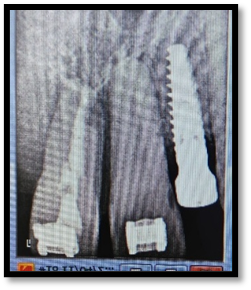
FIGURE 2: Intraoral Image & Radiograph showing 2nd Stage Implant Surgery irt 12


FIGURE 3: Intraoral Image of angled abutment irt 12 for implant supported prosthesis

FIGURE 4: Intraoral Image of prepared teeth (21,23) and adjusted abutment (12)
An intraoral digital scan (using an intraoral scanner) was made to record the implant position, soft tissue contours, and adjacent abutments (FIGURE 5).


FIGURE 5: Intraoral scan for prepared teeth (21,23) and adjusted abutment (12)
Then the final prosthesis was fabricated wrt 12 and FPD wrt 21 22 23for monolithic zirconia (FIGURE 6)


FIGURE 6: Final Prosthesis
DISCUSSION
Restoring missing anterior teeth in young patients presents a complex challenge requiring precise implant placement, soft tissue management, and highly esthetic prosthesis design. In this case, the integration of a digital workflow with CAD/CAM zirconia prostheses led to a successful and esthetically pleasing outcom.
The use of digital impressions, intraoral scanners, and 3D printed models allowed for accurate recording of soft tissue contours and implant positioning, eliminating conventional impression errors and enhancing marginal accuracy. As demonstrated in this case, digital planning improves communication among specialists and streamlines the prosthetic phase.
The choice of monolithic zirconia proved ideal due to its high flexural strength, minimal fracture risk, and excellent translucency, allowing a lifelike match to adjacent teeth. Coachmann et al noted that zirconia restorations offer better biocompatibility and esthetic stability over time compared to traditional metal-ceramic options.6
Moreover, the use of a customized angled abutment helped achieve ideal crown emergence and alignment, even in compromised space conditions. According to Tallarico M, et al. optimal implant abutment design is essential to support the peri-implant mucosa and avoid tissue recession.7
According to Revilla-León and Özcan, additive manufacturing reduces material waste and improves efficiency, making it ideal for digital prosthodontic workflows in both fixed and removable cases.8 Implant placement in the esthetic zone must also prioritize long-term survival and soft tissue stability. Gjelvold et al. emphasize that careful planning, flap design, and prosthetic emergence profile are key determinants in successful esthetic outcomes. Their systematic review supports the integration of digital technologies to enhance precision and predictability in implant placement and restoration.9
Andreiotelli et al. concluded that zirconia implants, when used appropriately, can be viable alternatives to titanium in esthetically demanding regions, though long-term evidence is still evolving.10
Papaspyridakos et al. proposed a comprehensive set of success criteria that include pink and white esthetic scores, occlusal function, and maintenance needs—criteria that were met in this case with favorable outcomes.11
The accuracy of intraoral scanning and digital modeling also plays a pivotal role in minimizing prosthetic errors. Güth et al. compared digital and conventional methods and found that direct digital impressions produced highly accurate virtual models, enhancing fit and reducing chairside adjustments—a key reason for the excellent marginal fit observed in this case.12
In full-arch and segmental implant restorations, digital workflows have led to improved prosthetic outcomes and reduced complications. Bidra et al. noted that CAD/CAM-based prostheses for full-arch restorations showed excellent fit, mechanical durability, and esthetics, echoing the benefits seen in single-unit anterior cases like the present one.13 The interdisciplinary approach between orthodontics and prosthodontics was critical in this case. Proper orthodontic alignment preserved space and ensured symmetrical gingival margins, aligning with the esthetic goals outlined by Sailer I, et al. who emphasized the importance of comprehensive planning using digital tools for anterior restorations.14
Ultimately, the combination of modern materials and digital techniques not only improved treatment efficiency but also maximized esthetic and functional outcomes, supporting findings by Mangano F et al, who reported higher patient satisfaction in digital vs. conventional workflows.15
CONCLUSION
This case report demonstrates the significant benefits of incorporating CAD/CAM technology and monolithic zirconia in anterior implant restorations, especially in young, esthetically demanding patients. A fully digital workflow enhanced precision, reduced clinical chair time, and improved patient outcomes. The synergy between orthodontic space management and prosthodontic rehabilitation was instrumental in achieving a natural and harmonious smile. As digital dentistry continues to evolve, it will play an increasingly vital role in delivering predictable, minimally invasive, and esthetically superior prosthetic solutions.
REFERENCES
- Belser UC, Buser D, Higginbottom F. Consensus statements and recommended clinical procedures regarding esthetics in implant dentistry. Int J Oral Maxillofac Implants. 2004;19 Suppl:73-74.
- Joda T, Brägger U. Patient-centered outcomes comparing digital and conventional implant impression procedures: a randomized crossover trial. Clin Oral Implants Res. 2016;27(12):e185-e189.
- Sailer I, Fehér A, Filser F, et al. Prospective clinical study of zirconia posterior fixed partial dentures: 3-year follow-up. Quintessence Int. 2007;38(8):755–763.
- Patel N. Integrating three-dimensional digital technologies for comprehensive implant dentistry. J Am Dent Assoc. 2010;141(Suppl 2):20S–24S.
- Raigrodski AJ. Contemporary materials and technologies for all-ceramic fixed partial dentures: a review of the literature. J Prosthet Dent. 2004;92(6):557–562.
- Coachman C, Calamita MA. Digital Smile Design: A tool for treatment planning and communication in esthetic dentistry. Quintessence Dent Technol. 2012;35:103–111.
- Tallarico M, et al. Clinical and radiographic outcomes of one-piece zirconia implants: a systematic review. Clin Implant Dent Relat Res. 2017;19(5):793–803.
- Revilla-León M, Özcan M. Additive manufacturing technologies used for processing polymers: current status and potential application in prosthetic dentistry. J Prosthodont. 2019;28(2):146–158.
- Gjelvold B, Sohrabi MM, Chrcanovic BR, Kisch J. Implant survival in the esthetic zone: a systematic review. J Esthet Restor Dent. 2018;30(4):317–327.
- Andreiotelli M, Wenz HJ, Kohal RJ. Are ceramic implants a viable alternative to titanium implants? A systematic literature review. Clin Oral Implants Res. 2009;20(Suppl 4):32–47.
- Bidra AS, et al. Clinical outcomes of full-arch fixed implant prostheses: a systematic review. J Prosthet Dent. 2013;109(6):361–370.
- Papaspyridakos P, et al. Success criteria in implant dentistry: a systematic review. J Dent Res. 2012;91(3):242–248.
- Güth JF, et al. Accuracy of digital models obtained by direct and indirect data capturing. Clin Oral Investig. 2013;17(4):1201–1208.
- Sailer I, et al. All-ceramic or metal-ceramic tooth-supported fixed dental prostheses (FDPs)? A systematic review of the clinical results. Int J Prosthodont. 2007;20(3):239–249.
- Mangano F, et al. Combining intraoral scans, CBCT, and facial scans for a digital workflow in implant dentistry: A clinical report. J Prosthodont. 2018;27(2):161–165
Disclaimer from Guident
The views and opinions expressed in articles published in Guident are solely those of the authors and do not necessarily reflect the views of the editors, the editorial board or the publisher, Ivory India. Guident does not endorse any product, technique or treatment described. Clinical content is intended for qualified dental and medical professionals and is not a substitute for individual clinical judgement. Guident, its editors and the publisher accept no liability for any consequence arising from the use of information published in the journal.
How to cite this article
Dr. Shradha Chauhan, Dr. Varun Kumar. Digitally Driven Esthetics: Anterior Implant Restoration with CAD,CAM Zirconia: A Case Report. Guident. 2025 Aug;18(9). Available from: https://ivoryindia.in/articles/prosthodontics/digitally-driven-esthetics-anterior-implant-restoration-with-cad-cam-zirconia-a-case-report.html