Immediate Implant Placement and Prosthetic Rehabilitation Following Failure of Maxillary Anterior Teeth: A Case Report
Wisdom Dental Clinics ®, Jaipur, India
ABSTRACT
Immediate implant placement following extraction of failed endodontically treated teeth in the anterior maxilla is a well-documented approach that helps preserve esthetics, function, and alveolar architecture. This case report presents a clinical scenario where previously treated maxillary incisors were extracted and replaced with implants followed by customized abutments and crowns using a digital workflow. A patient reported with esthetic and functional concerns due to previously endodontically treated maxillary central and lateral incisors. After atraumatic extractions, immediate implants were placed with healing abutments. A removable partial denture (RPD) was used during the healing phase. Two months post-operatively, digital impressions were taken to fabricate CAD/CAM-milled customized abutments, followed by delivery of definitive crowns. A carefully planned approach that includes atraumatic tooth extractions for immediate implant placement and optimal soft tissue contouring can greatly enhance the aesthetic outcome of the final restoration. This case highlights the benefits of immediate implant placement and digital restorative protocols in achieving a predictable, esthetic, and functional outcome in the anterior maxilla.
Keywords:
Immediate implant, customized abutment, anterior esthetics, digital dentistry, porcelain-fused-to-metal crowns
INTRODUCTION
Restoring anterior maxillary teeth poses a significant esthetic and functional challenge, particularly when the existing teeth have undergone endodontic treatment and present with poor long-term prognosis. Immediate implant placement has emerged as a favorable treatment modality to minimize treatment time, preserve alveolar architecture, and improve esthetic outcomes. The incorporation of digital technologies further enhances precision and prosthetic customization. Both patients and dentists now choose immediate implant insertion as a preferred course of therapy. This method is essential for maintaining peri-implant mucosal tissue after tooth extraction, in addition to reducing clinical morbidity and the overall length of treatment.1 The architecture of the extraction socket and the surrounding alveolar bone, for example, make it difficult to achieve the optimal three-dimensional location of the implant while maintaining primary stability.2
In order to minimize aesthetic compromise and maximize overall success, the adoption of rapid implant placement in the aesthetic zone requires careful consideration of various pre- and intraoperative considerations. Extensive research conducted over the past 20 years on immediate implant placement in individuals who are partially edentulous has shown survival rates that are comparable to those of delayed implant placement utilizing traditional surgical techniques.3,5
Immediate provisionalization aims to maintain soft tissue architecture, support the natural emergence profile, and provide predictability in the final aesthetic result. With this protocol, the final restoration can typically be placed after four months.6,7
CASE PRESENTATION
Patient History and Examination
A 51-year-old male patient presented with a chief complaint of esthetic dissatisfaction and discomfort in the upper front tooth region. The patient had a history of root canal treatment on teeth #11, #12, with signs of reinfection.
Clinical examination revealed discoloration, gingival inflammation, and compromised tooth structure. Periapical radiographs revealed periapical radiolucencies and bone loss associated with the involved teeth. Immediate treatment planning was made based on the requirements and esthetic as well as functional outcome. Informed consent was taken from the patient before beginning with the treatment. (Figure 1a,b)
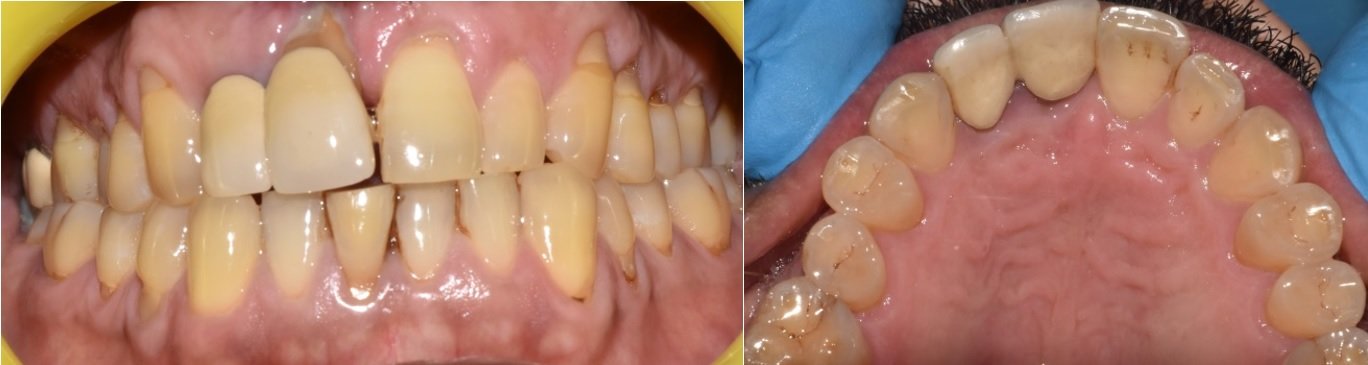
Figure 1a,1b Pre-treatment intraoral images
CLINICAL PROCEDURE
1. Surgical Phase
Teeth were extracted atraumatically to preserve the supporting bone. Two 10 and 11.5mm implants were placed in the extraction sockets with good primary stability of 70 -74 and 35Ncm torque. Healing abutments were placed to guide soft tissue healing.(Figure 2a,b,c)

Figure 2a,b. Radiograph after atraumatic extraction, two implants placed i.r.t #11,#12
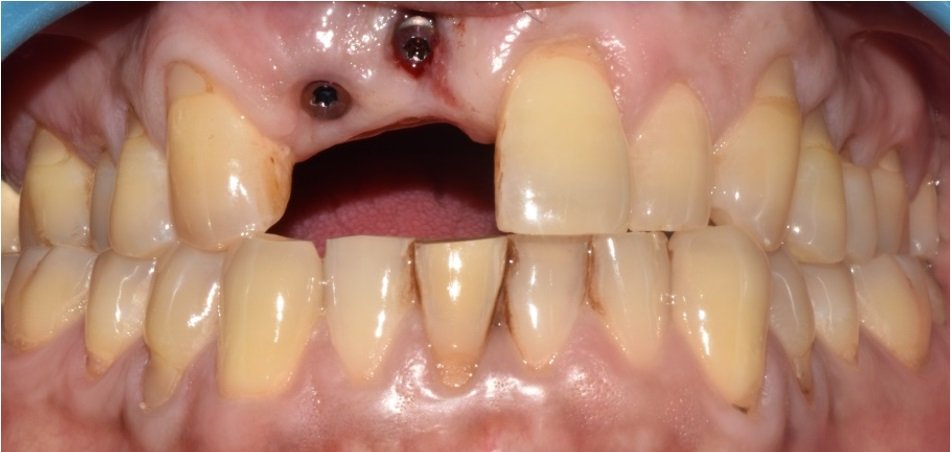
Figure 2c. Placement of healing screws
2. Interim Prosthesis
An interim RPD(Removable partial denture) was delivered immediately to restore function and esthetics during the osseointegration phase.(Figure 3)

Figure 3. Interim RPD delivered to restore function and esthetics
3. Digital Workflow
After 2 months, digital intraoral scanning was performed using a Primescan system. The scans were used to design customized abutments that replicated natural emergence profiles and maintained gingival architecture. Radiographic evaluation was carried to check for proper implant positioning and osseointegration..(Figure 4)

Figure 4. A radiograph was taken after two months to evaluate implant positioning and healing progress.
4. Definitive Prosthesis
PFM crowns were fabricated and cemented onto the custom abutments. Occlusion was adjusted to ensure proper contacts and functional harmony.(Figure5a,b)

Figure 5a,b PFM crown fabricated
Outcome and Follow-Up
At the 1 and 3 month post-prosthesis reviews, the patient exhibited excellent gingival health, satisfactory esthetics, and implant stability. Radiographic evaluation confirmed osseointegration and crestal bone maintenance. (Figure 6)

Figure 6. Final successful outcome
DISCUSSION
Immediate implant placement in the esthetic zone is well-supported in the literature for preserving alveolar dimensions and soft tissue contours. In this case, early intervention following endodontic failure enabled timely rehabilitation. Digital impressions allowed for precise abutment design tailored to the soft tissue contours.
By preserving the labial bone plate during extraction and keeping the mucosa intact without using an open flap approach, atraumatic extraction in conjunction with rapid implant insertion has been shown to balance aesthetics and the health of keratinized tissue.8
Determining if immediate provisionalization is feasible at the time of surgery is essential to prosthetic management. Patients are demanding more in terms of both appearance and functionality. As a result, meeting the demand for a quick course of therapy and minimizing discomfort throughout the healing process are equally essential.9
"Non-functionally loaded immediate provisionalization" is a new concept that refers to a load in which an interim restoration is modified to clear all occlusal contacts in both centric and eccentric movements. Adequate bone quality and quantity, as well as excellent primary stability, are prerequisites for the non-functionally loaded rapid provisionalization approach. The alveolar anatomy following tooth extraction will also have a role.10
Resonance frequency analysis (RFA), insertion torque, and primary stability are frequently the most commonly used criteria to choose loading procedures during implant implantation.11 A minimum torque of 30 Ncm, a minimum stability ratio (ISQ) of 50 to 62, and an implant that is at least 8 to 11 mm long are all recommended for immediate loading in a systematic review conducted by Schrott in 2014.12
A success rate of 87.5 to 100% can be anticipated for immediate implant placement with immediate loading.13
In the present case, all these prerequisites were satisfied. An implant exceeding 10 mm in length was placed, and an insertion torque of 35 Ncm was recorded, indicating excellent primary stability. These favourable conditions allowed for immediate provisionalization without functional loading. As a result, a proper emergence profile was established early in the healing phase, supporting the soft tissue contours and contributing to the esthetic and functional success of the final restoration.
CONCLUSION
This case underscores the value of a multidisciplinary approach incorporating immediate implant placement, digital workflows, and prosthetic planning for restoring esthetics and function in the anterior maxilla. The predictable outcome highlights the importance of case selection and technique sensitivity in achieving long-term success. Strategic treatment planning that incorporates gentle tooth extraction, immediate implant placement, and meticulous soft tissue contouring plays a crucial role in achieving superior aesthetic results.
REFERENCES
- van Nimwegen W. G., Goené R. J., van Daelen A. C. L., Stellingsma K., Raghoebar G. M., Meijer H. J. A. Immediate implant placement and provisionalisation in the aesthetic zone. Journal of Oral Rehabilitation . 2016;43(10):745–752. doi: 10.1111/joor.12420. [DOI] [PubMed] [Google Scholar]
- van Nimwegen W. G., Raghoebar G. M., Zuiderveld E. G., Jung R. E., Meijer H. J. A., Mühlemann S. Immediate placement and provisionalization of implants in the aesthetic zone with or without a connective tissue graft: a 1-year randomized controlled trial and volumetric study. Clinical Oral Implants Research . 2018;29(7):671–678. doi: 10.1111/clr.13258. [DOI] [PMC free article] [PubMed] [Google Scholar]
- Vidigal G. M., Jr., Groisman M., Clavijo V. G. R., Santos B. P., Fischer R. Evaluation of pink and white esthetic scores for immediately placed and provisionally restored implants in the anterior maxilla. International Journal of Oral and Maxillofacial Implants . 2017;32(3):625–632. doi: 10.11607/jomi.5149. [DOI] [PubMed] [Google Scholar]
- Mangano F. G., Mastrangelo P., Luongo F., Blay A., Tunchel S., Mangano C. Aesthetic outcome of immediately restored single implants placed in extraction sockets and healed sites of the anterior maxilla: a retrospective study on 103 patients with 3 years of follow-up. Clinical Oral Implants Research . 2017;28(3):272–282. doi: 10.1111/clr.12795. [DOI] [PubMed] [Google Scholar]
- Slagter K. W., Raghoebar G. M., Hentenaar D. F., Vissink A., Meijer H. J. Immediate placement of single implants with or without immediate provisionalization in the maxillary aesthetic region: a 5-year comparative study. Journal of Clinical Periodontology . 2021;48(2):272–283. doi: 10.1111/jcpe.13398. [DOI] [PMC free article] [PubMed] [Google Scholar]
- Morton D, Chen S, Martin W, Levine R, Buser D, et al. (2014) Consensus statements and recommended clinical procedures regarding optimizing esthetic outcomes in implant dentistry. Int J Oral Maxillofac Implants 29: 216-220.
- Eric Rompen, Nicolas Raepsaet, Olivier Domken, Bernard Touati, Eric Van Dooren (2007) Soft tissue stability at the facial aspect of gingival converging abutments in the esthetic zone: A pilot clinical study. J Prosthet Dent 97: 119-125.
- Mareque S., Castelo-Baz P., López-Malla J., Blanco J., Nart J., Vallés C. Clinical and esthetic outcomes of immediate implant placement compared to alveolar ridge preservation: a systematic review and meta-analysis. Clinical Oral Investigations . 2021;25(8):4735–4748. doi: 10.1007/s00784-021-03986-6. [DOI] [PubMed] [Google Scholar][Ref list]
- Alani A, Corson M (2011) Soft tissue manipulation for single implant restorations. Br Dent J 211: 411-416.
- De Rouck T, Collys K, Wyn I, Cosyn J (2009) Instant provisionalization of immediate single-tooth implants is essential to optimize esthetic treatment outcome. Clin Oral Implant Res 20: 566-570.
- Gallucci GO, Benic GI, Eckert SE, Papaspyridakos P, Schimmel M, et al. (2014) Consensus statements and clinical recommendations for implant loading protocols. Int J Oral Maxillofac Implants 29: 287-290.
- Schrott A, Riggi-Heiniger M, Maruo K, Gallucci GO (2014) Implant loading protocols for partially edentulous patients with extended edentulous sites--a systematic review and meta-analysis. Int J Oral Maxillofac Implants 29: 239-255.
- Gallucci GO, Hamilton A, Zhou W, Buser D, Chen S (2018) Implant placement and loading protocols in partially edentulous patients: A systematic review. Clin Oral Implants Res 16: 106-134.
Disclaimer from Guident
The views and opinions expressed in articles published in Guident are solely those of the authors and do not necessarily reflect the views of the editors, the editorial board or the publisher, Ivory India. Guident does not endorse any product, technique or treatment described. Clinical content is intended for qualified dental and medical professionals and is not a substitute for individual clinical judgement. Guident, its editors and the publisher accept no liability for any consequence arising from the use of information published in the journal.
How to cite this article
Dr. Gaurav Gupta, Dr. D.K. Gupta, Dr. Neelja Gupta. Immediate Implant Placement and Prosthetic Rehabilitation Following Failure of Maxillary Anterior Teeth: A Case Report. Guident. 2025 Aug;18(9). Available from: https://ivoryindia.in/articles/implantology/immediate-implant-placement-and-prosthetic-rehabilitation-following-failure-of-maxillary-anterior-teeth-a.html