Making the Unstable Stable Using Osborne Technique: An ART of Managing Flabby Tissue
Department of Prosthodontics and Crown & Bridge, Subbaiah Institute of Dental Sciences, Karnataka India
ABSTRACT
Flabby tissue is defined as excessive, movable tissue according to GPT. It is commonly associated with old denture wearers. Its etiology can be due to either unbalanced occlusal forces or residual ridge resorption. It is an area where tissue replaces the bony area in edentulous ridges. This area consist of hyperplastic tissue. It is more frequently seen in maxillary anterior region. On clinical examination it is displacable, soft and compressible. Therefore it pose an problem for denture retention and stability. Prosthodontist often face challeneges while treating patients with flabby ridge. Its management can be incorporation of various impression techniques, surgical intervention or relieving the denture. This case report presents a Osborne impression technique to manage flabby tissue.
Keywords :
Flabby tissue, anterior maxilla, completely edentulous ridge, sectional tray technique, impression technique, complete denture, stability.
INTRODUCTION
Hyperplastic or displacable tissue can pose certain problems like denture instability, soreness of tissue or causing extreme pain. Since the aim of prosthodontist is to rehablititate the edentulous arches to restore the lost function, comfort and esthetics. If the tissue is excessively mobile then surgical intervention like ridge augmention, injecting sclerosing agent or excision of flabby tissue is recommended. Massad classified flabby tissue according to displaceability of tissue as low, average and high. Low displaceability refers to tissue that is relatively firm and under pressure it is minimally displaced. Average refers to moderate degree of movement under pressue. While high displaceability refers to very mobile and easily displaced tissue. Prosthodontist should determine the appropriate impression making technique for flabby tissue in order to create a more stable denture.1
Static impression making is considered superior to dynamic impression making technique as it controls force factors like impression tray design, impression material type and impression seating velocity.2,3
According to Mastri et al “Viscosity of impression material has direct impact on amount of pressure applied during impression making process”.4
This case report presents the management of flabby tissue with help of OSBORNE IMPRESSION TECHNIQUE also called as palatal splinting using 2 part tray.5
CASE REPORT
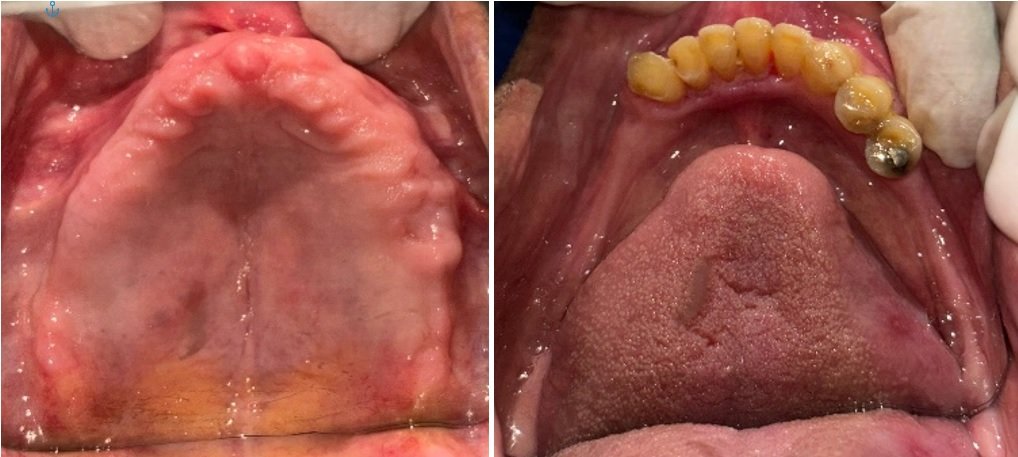
A 66 year old male reported to department of prosthodontics with a chief complaint of loosened prosthesis due to which he has difficulty in eating and talking since 2 years thus wants replacement for the same. Denture history revealed that he is denture wearer since 10 years. Thus, treatment plan was Re-Fabrication of complete denture for completely edentulous maxillary and mandibular arch with flabby ridge in maxillary anterior region.
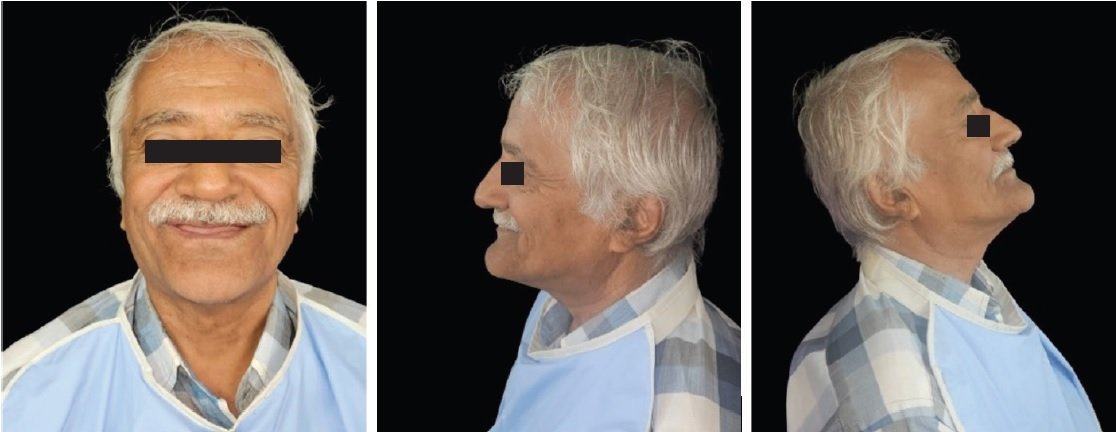
Extra-oral examination
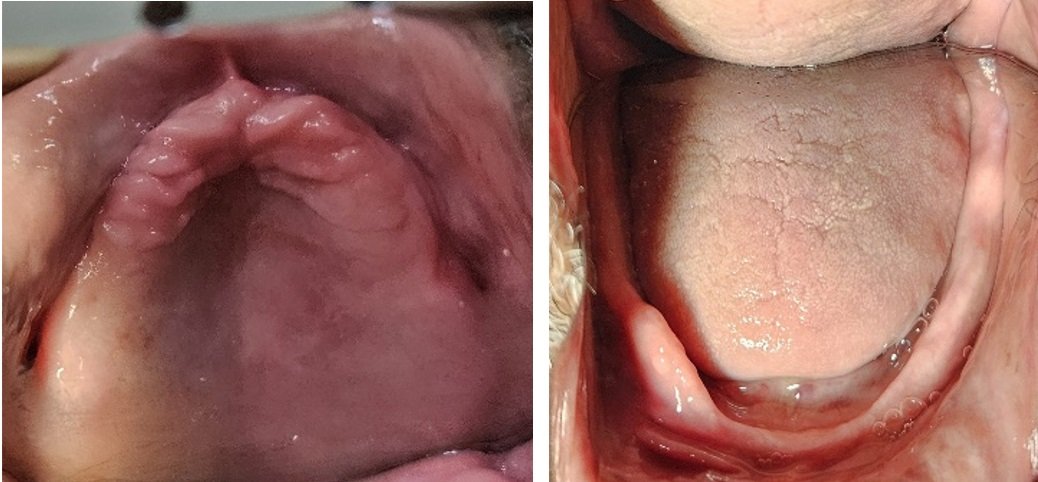
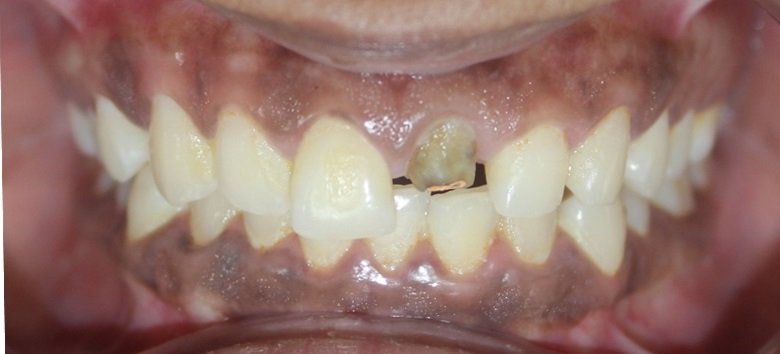
Intra-oral examination
Flabby area was marked with hematoxylin pencil to demarcate the area from adjacent mucosa.
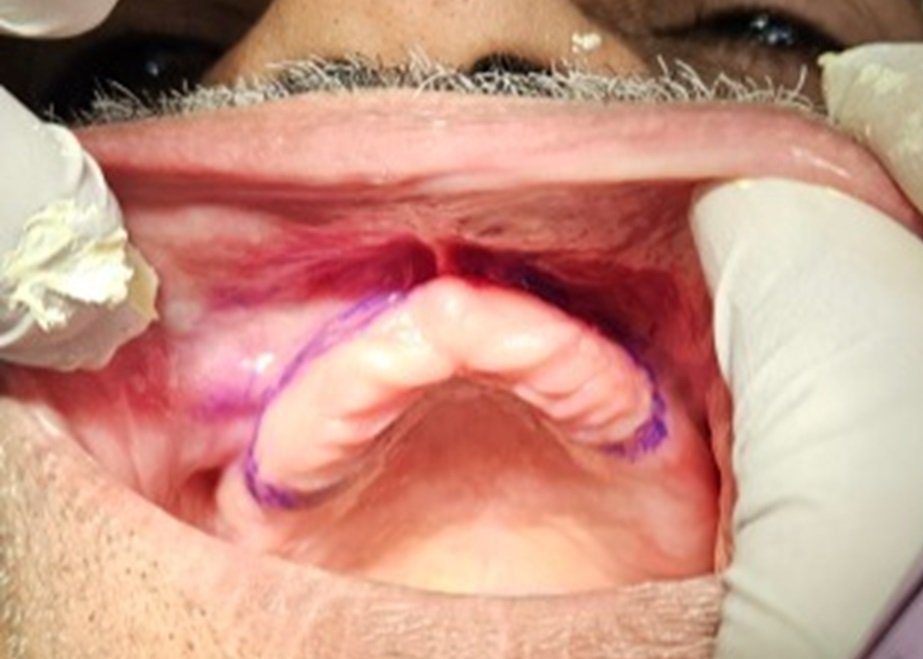
Flabby area was marked with hematoxylin pencil
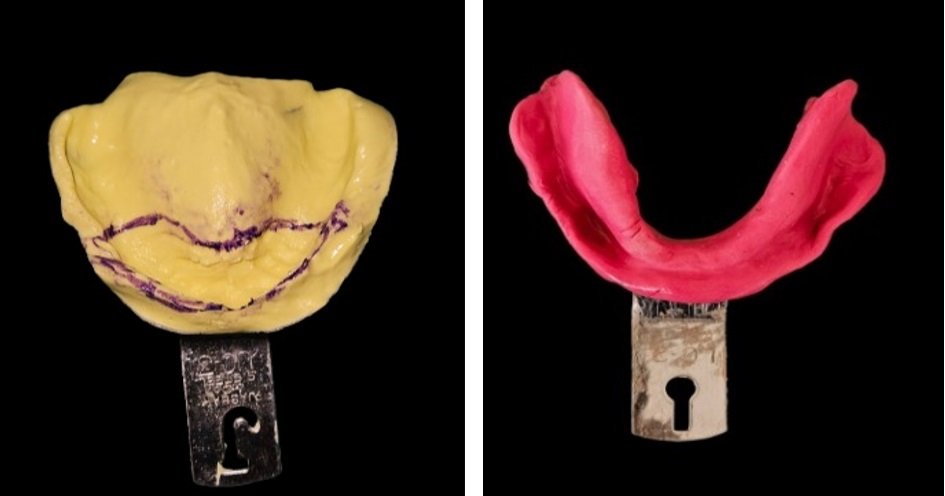
A) Primary impression was made with alginate for completely edentulous maxillary arch as it is flabby. B) Mandibular arch impression made with impression compound.
Maxillary primary impression was poured with dental stone while mandibular impression was poured with dental plaster. After pouring, primary cast were obtained. Spacer was made with wax and adapted on both the cast. On maxillary primary cast, custom tray was fabricated in 2 parts. First cold cure was adapted to cover all the area except the flabby area. A wire was inserted on the palatal vault to act as a key for second tray. Second tray was made by adaptation on flabby area and covering palatal vaut area of first tray. It was adapted around the key to act as keyway. While on mandibular cast, custom tray was fabricated in the convetional manner.

A) First part of custom tray B) Second part of custom tray C) Intaligo view of custom tray with spacer
Border molding was performed with low fusing compound (greenstick). Extenstions of custom tray was made 2mm short of sulcus and was confirmed intraorally. Maxillary border molding was done in 2 parts. First, the border molding was done on first part of tray and then on second part of tray. After border molding, relief holes were made on custom tray. Secondary impression of 1st part of tray was made with zinc oxide eugenol paste later light elastomeric impression material was loaded on 2nd tray and was placed in patients mouth using key and keyway method. Master cast was obtained.

Custom tray with border molding
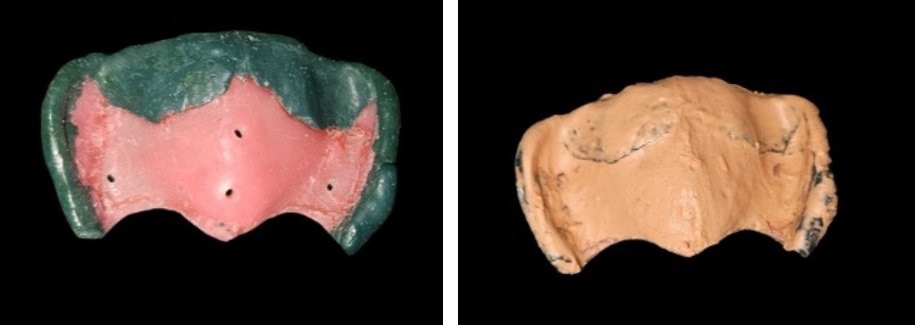
First part of Custom tray with border molding and secondary impression

1st part of custom tray secured in patient mouth

Final impression

Try-in intra-oral pictures

Final insertion pictures
Centric and vertical jaw relation was done. After jaw relation, try-in was done. patient was safisfied with try-in. Later, packing and acrylization was done with heat cure acrylic resin. Dentures were trimmed, polished and finished. Denture insertion was done and it was evaluated for stability and retention. Follow up after insertion was done for 6 months.2

Extra-oral pictures after Final insertion
DISCUSSION
Patient had improved function, esthetics and comfort with the new denture. Among several techniques, Osborne technique is simple, cost effective and provide adequate retention, stability and support.5 Long term follow is required to monitor tisuue changes. Patient counselling and education plays an important role in the prognosis of prosthesis. In conclusion, management of flabby tissue requires appropriate impression technique for long term success of prosthesis.
REFERENCES
- Kumar, et al.: Impression techniques for hypermobile alveolar mucosa. Int J Health Allied Sci 2012;1:255-67.
- Zarb GA, Bolender CL, Carlsson GE. Boucher's proshodontic treatment for edentulous patients. 11th ed. St Louis: Mosby; 1999. 312-23.
- Kelly E. Changes caused by a mandibular removable partial denture opposing a maxillary complete denture. J Prosthet Dent 1972;27:140-50.
- Al-Ahmad A, Masri R, Driscoll CF, et al. Pressure generated on a simulated mandibular oral analog by impression materials in custom trays of different design. J Prosthodont. 2006;15:95-101.
- Osborne J. Two impression method for mobile fibrous ridges. British dental journal.1970;117(6):392-394.
Disclaimer from Guident
The views and opinions expressed in articles published in Guident are solely those of the authors and do not necessarily reflect the views of the editors, the editorial board or the publisher, Ivory India. Guident does not endorse any product, technique or treatment described. Clinical content is intended for qualified dental and medical professionals and is not a substitute for individual clinical judgement. Guident, its editors and the publisher accept no liability for any consequence arising from the use of information published in the journal.
How to cite this article
Dr. Deeksha Tomar, Dr. Naveen YG, Dr. Chaitra SL. Making the Unstable Stable Using Osborne Technique: An ART of Managing Flabby Tissue. Guident. 2025 Aug;18(9). Available from: https://ivoryindia.in/articles/prosthodontics/making-the-unstable-stable-using-osborne-technique-an-art-of-managing-flabby-tissue.html