Full Mouth Rehabilitation-Introduction, Diagnosis and Treatment Navigation: Part-3
MIK Dental, Mumbai, India
This article is a direct extract from the book by Dr. Moez Khakiani, titled Clinical Fixed Prosthodontics- Master Volume. It is a color atlas suited for clinicians who wish to expand their horizons in advanced prosthodontics. It has over 400, pages, and over 2500 color illustrations distributed over 25 chapters. It is a MUST-HAVE guide for clinical prosthodontics, including chapters like master level occlusion, full mouth rehabilitation, porcelain veneers, table top prostheses, implant dentistry, digital dentistry, etc.
Why don’t you give this book a try?
It is available for preview and purchase on www.mikdental.in, or you could connect on +91 9833400664 for the same.
HOW CAN POSTERIOR INTERFERENCE BE DIFFERENTIATED FROM CONSTRICTED CHEWING PATTERN AS THE CAUSE FOR ANGULAR ATTRITION OF ANTERIOR TEETH?
The aetiology of anterior wear can only be established via deprogrammation of the mandible.
If the cause is a posterior interference, the lower incisors reorient backwards, as the condyles slip into their CR position. However, if the lower incisors reorient forward upon deprogrammation, the diagnosis of anterior interference and CCP can be established.

Fig. 7.33, 7.34: Left: Condyle pulled downward and forward to gain MIP. Right: Position of the lower incisor in CR is distal to that at MIP, diagnostic of a posterior interference as the cause of wear.

Fig. 7.35, 7.36: Left: Condyle pushed backward to gain MIP. Right: Note the position of lower incisor in CR is ahead of that at MIP, diagnostic of anterior interference as the cause of wear.
Differentiation between the aetiology of angular wear is extremely important, as treatment modalities for either vary vastly. Details on management of angular attrition are presented in chapter 14, from page 310-315.
WHAT ARE THE INDICATIONS FOR FULL MOUTH REHABILITATION?
Unfortunately, there is no single universally applicable answer to the above question, as every case is truly individual, and a plethora of factors cumulatively decide the fate of a dentition.
However, a clinically justifiable decision can be made on the basis of one’s response to a set of questions:
- Is reconstruction necessary to improve joint, muscles, teeth and/or periodontal symptoms?
- Is reconstruction required to improve masticatory function?
- Is reconstruction required to improve aesthetics?
- If left untreated, would a reconstruction eventually be needed?
- If left untreated, would it be possible to restore the dentition conservatively (using partial bonded restorations), or would the case then require full coverage prostheses?
In general, tooth loss becomes a concern once enamel gets penetrated and dentin is exposed to oral insult. Dentin being softer and more organic, is prone to accelerated mechanical wear and erosive dissolution.
A universally accepted recommendation is to cover exposed dentin with either an indirect prosthesis or direct dentin sealing (using composite resin) as soon as exposure is identified.
As the number of teeth affected with dentin exposure increase, the general complexity of treatment proportionally increases. When most or all teeth of both the arches get affected by wear, a full mouth rehabilitation is in order to restore the lost form, function, aesthetics and comfort.
A gross visual gradation system is presented next that can be used to assess the severity of tooth loss and serve as a guide towards a broad spectrum treatment approach.

Table
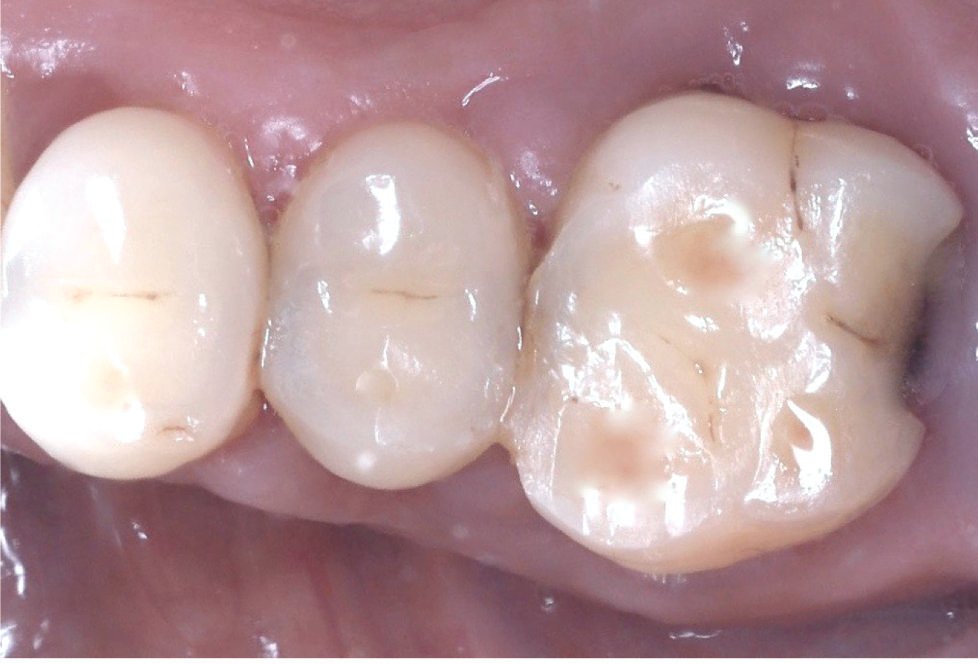
Fig. 7.37 Grade 1 wear

Fig. 7.38 Grade 2 wear

Fig. 7.39 Grade 3 wear
Note: It is extremely important that the need for treatment is not based merely on ‘how the bite looks in MIP’. Remember, some of the most unstable occlusions appear ideal when examined at MIP, and on the other hand, some of the most stable occlusions can appear as serious malocclusions (if analyzed solely on the basis of Angle’s classification and Andrews six keys of occlusion).
Never judge an occlusion by how it looks alone, rather judge it by how it functions.
There are many healthy and functionally stable dentitions that do not fit the preconceived ‘normal look’. Although such cases may seem pathologic or traumatic to the naked eye, they may actually be stable with no obvious signs and/or symptoms of disharmony.
- An anterior open bite can be as stable as an ideal occlusion, if the tongue substitutes for the missing contacts,
- Deep overbites can be amongst the most stable occlusions, provided anterior teeth have stable stops,
- Anterior crossbites do not always pose a problem of instability, as such patients often eliminate the need for translatory movements.
Such occlusions are very rightly termed ‘physiologic malocclusion’ and should be left untreated, unless for aesthetic reasons.
WHAT ARE THE OPTIONS FOR ACHIEVING PROSTHETIC SPACE IN A COLLAPSED BITE SCENARIO?
Increasing VDO is often thought of as a ‘must do’ for treating all collapsed bites. This may not be the case, as increasing the vertical is one of many ways to create the desired inter-occlusal space. Following are the options available for space management in collapsed bite cases:
A. RESTORING at the CR POSITION
This is always the first resort when restoring patients with full arch or full mouth prostheses. Following deprogrammation of the mandible to reposition the condyles into CR, often adequate vertical and horizontal space can be achieved to fulfil all essentials of occlusal stability without the need to alter the vertical dimension. Whenever possible, cases should be treated at the pre-existing VDO. Further details on this aspect are presented in the chapter titled ‘Vertical Dimension and its Determination’.
B. ORTHODONTIC REPOSITIONING
Anterior teeth that have supraerupted or flared often affect aesthetics and development of the desired anterior guidance. Similarly extruded or tipped posterior teeth can create occlusal plane issues and often even prevent development of mutually protected occlusion. Repositioning of such teeth orthodontically can allow for the case to be completed with ease and also achieve a far more stable result.
Following deprogrammation, if more space is required to restore teeth at CR, orthodontics should be considered as the first alternative to gain space, as it is the most natural and conservative method for correcting collapsed dentitions. Further details on this aspect are presented in the chapter titled ‘Management of Wear Using the Treatment Navigation Approach’.
C. CROWN LENGTHENING
When presented with severe wear, crown lengthening can be used to improve the clinical crown height for anterior and posterior teeth. This not only provides tooth material for establishment of the desired retention and resistance form in the preparation, but also helps improve the aesthetic outcome in cases where zenith correction is needed.
However, the decision towards crown lengthening should be weighed against possible drawbacks, which include:
- Development of black triangles with possible aesthetic concerns anteriorly and food lodgement posteriorly,
- Increase in crown-to-root ratio that can result in compromised periodontal support,
- Sensitivity from exposed root surfaces, and
- Risk of biologic width violation.
Further details on this aspect are presented in the chapter titled ‘The Restorative Periodontal Interface’.
D. INCREASING THE VERTICAL
Many FMR patients present with an edge-to-edge bite. Opening of the bite results in establishment of a favorable anterior relation, as increasing the VD positions the lower teeth downward and backward. This not only allows for improved function owing to development of a desirable anterior guidance, but also helps improve aesthetics via lengthening of anterior teeth. Further, as space opens up at the back, posterior teeth can be prepared in a fairly conservative manner.
Thus, within limits an increase in VDO can be considered as a safe clinical modality for gaining space.
Although, altering VDO can be a very useful tool for solving occlusal problems, it should be part of an armory of solutions and not the only one. Further details on this aspect are presented in the chapter titled ‘Vertical Dimension and its Determination’.
E. PROPHYLACTIC ENDODONTIC TREATMENTThis is the least preferred, yet far too commonly performed option.There are typically three justifications given for such barbaric treatment, (a) fear of de-cementation associated with short crowns, (b) fear of sensitivity, and (c) fear of pulpal exposure during preparation. Each of these ‘fears’ is baseless, as justified below:
a. Teeth with compromised clinical height (where in a sense, nature has already performed occlusal reduction) need only a minimal amount of further reduction, especially if other options for gaining space are used. Additionally, other modalities, like secondary retentive features, CAD/CAM technology, monolithic restorations, resin cements, etc. can be used to advantage in such situations, as described under the section ‘Management of Short Clinical Crowns’, on page 82 of the Starter Volume.b. Hypersensitivity is primarily a by-product of increased friction from a dull bur used during crown preparation. Further, over-reduction, low pH of the cement used for luting, marginal leakage and occlusal interferences also precipitate immediate and/or delayed sensitivity. Care at each step can potentially eliminate these iatrogenic causes of sensitivity, thereby disregarding endodontic treatment as a rational replacement for ethical dentistry. Further information on sensitivity and its clinical management is described under the section ‘Post Cementation Sensitivity and its Management’, on page 238 of the Starter Volume.
c. Owing to years of trauma, reparative dentin formation causes pulpal tissue to recede, minimizing the possibility of iatrogenic pulp exposure during crown preparation. Any clinician who has ever attempted to endodontically treat extremely thin canals found in patients with pathofunction would vouch for the difficulty encountered in locating the canals- a testament for the protective mechanism of pulp to shunt itself from injury. Further, it is important to take into equation that endodontically treated abutment teeth are weaker (than vital abutments) and far more prone to catastrophic horizontal tooth fractures. Full mouth endodontic treatments can and should be avoided, as they make the overall treatment far more complex and costly, both biologically and financially.
With multiple treatment modalities to choose from, it is eventually our responsibility to wisely decide on the best option (or their combination) to reduce the invasiveness of overall treatment.
WHAT ARE THE SEQUENCE OF STEPS TO BE FOLLOWED DURING FULL MOUTH RECONSTRUCTIONS?
Although every individual case is unique and needs to be planned in a systematic manner, a generalized sequence of steps when treating the entire mouth for full coverage prostheses are enlisted below:- Assessment of the patient’s presenting condition, as explained on page 192,
- Intraoral determination of the ideal maxillary incisal edge position (horizontal and vertical), as explained on page 195,
- Diagnostic impressions using A-silicone,
- Facebow record for mounting of maxillary cast, as explained on page 219,
- Centric relation bite record for mounting of mandibular cast, as explained on page 235,
- Protrusive bite record, if customization of the condylar guidance is needed, as explained on page 271,
- Determination of the final VDO on the articulator, as explained on page 289,
- Fabrication of diagnostic wax-up by the technician,
- Intraoral test drive for evaluation of functional aesthetics, as explained on page 299,
- Volumetric preparation of teeth- all in one appointment or phased over multiple appointments, as explained on page 342,
- Immediate chair-side provisionalization, as explained on page 343,
- Testing of provisionals by the patient,
- Following approval by the patient, final impression of all prepared teeth, as explained on page 347,
- New facebow record of all prepared teeth, as explained on page 347,
- New centric relation bite record, as explained on page 347,
- Alginate impression of the customized anterior temporaries, as explained on page 347,
- Anterior bisque try-in and customization of the anterior guidance, as explained on page 350,
- Full mouth try-in with adjustment of gross occlusion, as explained on page 351,
- Cementation of definitive prostheses, as explained on page 353,
- Splint insertion, where indicated, as explained on page 440,
- Regular follow-ups and bite adjustments, as explained on page 438.
WHAT ARE THE END GOALS WHEN TREATING PATIENTS FOR FULL MOUTH RECONSTRUCTION?
There are 10 questions that together constitute the ‘ESSENTIALS FOR OCCLUSAL STABILITY’, which can be used at different stages of reconstruction:
- During the diagnostic phase- to assess the case and determine the need and urgency for treatment,
- During the treatment planning phase- to finalize the most suitable treatment plan for long-term stability,
- Upon completion of treatment- to evaluate the level of success achieved,
- During recall visits- to review stability of the case over time.
These 10 questions are:
- Is there active disease in any component of the masticatory system?
- Are the TMJoints healthy, comfortable and stable?
- Is the periodontium healthy with no mobile teeth?
- Are any teeth wearing away?
- Is the anterior guidance in harmony with functional movements?
- Are the muscles comfortable and pain free?
- Are all teeth in vertical harmony with the elevator muscles?
- Are all teeth in horizontal harmony with the neutral zone?
- Is the patient comfortable chewing?
- Is the patient happy with aesthetics?
The same set of questions can function as the ‘essentials to be achieved’ at the end of each reconstruction. In other words, a case is said to be successfully completed if:
- There is no active disease in any component of the system,
- The TMJoints are healthy, comfortable and stable,
- The periodontium is healthy with no mobile teeth,
- Teeth are not in friction with each other,
- The anterior guidance is in harmony with functional movements,
- The muscles are comfortable and pain free,
- All teeth are in vertical harmony with the elevator muscles,
- All teeth are in horizontal harmony with the neutral zone,
- The patient is comfortable chewing,
- The patient is happy with the aesthetic outcome.
Memorizing these ‘Essentials for Success’ would help mould your thought process, allowing you to approach every case in a systematic manner with ‘The End in Mind’.
Non-clinical scenario: Imagine booking a cab online. It first asks for a pick-up location and a drop location, only after which it suggests route options and possible cost for the ride. Similarly, the patient’s pretreatment condition serves as the starting point, while the ‘essentials of success’ serve as your end destination. With these parameters set, you can chart the most suitable treatment plan which would allow you to smoothly navigate the case.
Note: Although we wish and strive to fulfil all essentials for every case, it is not realistic to achieve 100% success in all cases. Some patients present with irreversible damage that is far beyond repair, some have skeletal mal-relationships that cannot be restored with dental compensation, some have habits that cannot be controlled, some present with compromised systemic health, some have time related concerns, some have financial issues, while some simply don’t care about oral hygiene. In any such situation, two aspects become crucial:
- Letting the patient know in advance of the issues and possible complications prior to initiation of treatment, and
- Emphasizing on the importance of an extended recall/maintenance program, as there could be short and/or long-term consequences for not fulfilling any of the above stated essentials.
HOW TO CHOOSE THE MOST SUITABLE PROSTHETIC MATERIAL FOR FMR CASES?
Interplay of multiple factors influence the choice of prosthetic material for a given patient condition. These include:
- Location of the tooth,
- Length of the edentulous span,
- Inter-occlusal space,
- Need for bonding,
- Parafunctional habits,
- Color of the underlying tooth,
- Size of the pulp chamber,
- Allergies,
- Competence of the laboratory technician.
Details of each of these factors is presented in the chapter titled, ‘Material Options in Fixed Prosthodontics’, on page 14 of the Starter Volume.
With respect to reconstruction patients, where the occlusal forces are unfavorable in intensity, direction, duration and frequency, we need to consider not only the risk of fracture/wear/decementation of the restorative material, but also the biologic demand for strength within components of the masticatory system.
Hence, when choosing prosthetic materials, one of two approaches can be followed:
- Abutment preservation approach, which considers biologic principles of tooth conservation, or
- Prostheses preservation approach, which considers mechanical properties of restorative material.
If we abide by the ‘prostheses preservation approach’, we will most definitely have a super-strong restoration that would not chip or break, but in the bargain we may lose the abutment tooth to fracture. This is especially true for endodontically treated teeth that are inherently weak and susceptible to cracks and catastrophic root fractures. Remember, the weakest link in the chain gives-in first. Accordingly, if you choose a material that is extremely strong, the weakest link within the biologic system will be forced to succumb. This could be in the form of tooth fracture, periodontal mobility, muscular spasm or even disc displacement disorders. On the other hand, with the ‘abutment preservation approach’, you may lose the prosthesis to fracture, but you will still have the opportunity to replace it.
Specific to full mouth rehabilitations, clinicians often tend to focus excessively on material strength owing to the fear of prosthetic failure. However, such a decision may backfire as the stomatognathic system has a limit within which it can establish equilibrium. In this regard, exclusive dependence on monolithic zirconia restorations on all teeth may not be the best decision from a long-term stability perspective. Rather, a sensible clinical alternative would be to restore four terminal molars with monolithic zirconia or metal restorations, while the rest of the dentition is restored with LiDiSi, PFZ or PFM prostheses. Such an approach is extremely beneficial, as:
- It helps maintain the established VDO and CR contacts in the area of maximum force, and
- Terminal molars have the least amount of inter-occlusal clearance and a monolithic restoration provides necessary conservation for underlying tooth material.
From a conservation standpoint, metal free restorations are generally preferred as they require lesser amount of tooth reduction (in comparison with PFM). Added, when reconstructions are performed using partial bonded restorations, treatment can be achieved in the most minimally invasive manner, as this modality allows for tooth enamel to be retained. Besides, the monoblock effect associated with bonded e.max restorations, provides immense strength and the most aesthetic outcome. This makes LiDiSi my personal material of choice for tooth supported reconstructions. Also, the use of direct composite resins for rehabilitation is a fast growing branch that allows for a completely additive form of reconstruction, as no surface preparation is needed prior to bonding.
In general, full mouth reconstructions can be accomplished using the following materials or their combinations:
- Full coverage PFZ restorations for all teeth,
- Full coverage PFM restorations for all teeth,
- Full coverage LiDiSi restorations for all teeth,
- LiDiSi, PFZ or PFM reconstructions with monolithic zirconia or metal prostheses for terminal teeth,
- Combination of LiDiSi or PFZ for front teeth and PFM for back teeth,
- Table top rehabilitations, using partial bonded LiDiSi restorations,
- Composite based reconstructions,
- Combination of LiDiSi, PFZ or PFM for anterior teeth and composite for posterior teeth.
The primary determinant here would be patient finances, clinician’s preference and technical expertise available in the region. Note: Material combinations are not limited to these options and can also be determined on a tooth-by-tooth basis. Eventually, the requirements of each tooth for strength, protection and aesthetics are extremely individualistic.
WHAT ARE THE IDEAL PROVISIONALIZATION MATERIALS FOR FMR CASES?
The primary objective of any temporization material is to serve the purpose of biologic maintenance, functional assessment, comfort evaluation and aesthetic appraisal during the ‘trial-and-test’ phase.
Mechanical strength is one of the primary requirements of a provisionalization material to serve these purposes by maintenance of occlusal stops and vertical dimension without undergoing accelerated wear or fracture.
In this regard, if the provisionalization phase is expected to be only a few weeks, a chairside bis-acryl resin can be used to fabricate provisionals intraorally using the putty index technique. Because these materials are relatively brittle, prone to fracture, plaque accumulation, staining and discoloration, they are best suited for short-term provisionalizations, especially in cases with pontics.
On the other hand, if provisional restorations are expected to serve function over an extended period of time, it is advisable to have laboratory fabricated provisionals made. These have superior physical and mechanical properties and can serve function over extended periods of time. The advent of CAD/CAM provisionals has added a new dimension to reconstructions, as these prostheses can accurately replicate all occlusal and guidance profiles customized intraorally.
Regardless of the material used, provisional restorations should be cemented with either eugenol-free zinc oxide cement or temporary resin cement. In partial bonded table top cases (where retention/resistance form is inadequate), provisionals need to be spot bonded and shrink wrapped into undercuts. As bis-acryl resins are usually used for such cases, the provisionalization phase needs to be restricted in time as the possibility of debonding and fractures are higher (owing to their relative thinness from conservative preparations).
Disclaimer from Guident
The views and opinions expressed in articles published in Guident are solely those of the authors and do not necessarily reflect the views of the editors, the editorial board or the publisher, Ivory India. Guident does not endorse any product, technique or treatment described. Clinical content is intended for qualified dental and medical professionals and is not a substitute for individual clinical judgement. Guident, its editors and the publisher accept no liability for any consequence arising from the use of information published in the journal.
How to cite this article
Dr. Moez I. Khakiani. Full Mouth Rehabilitation-Introduction, Diagnosis and Treatment Navigation: Part-3. Guident. 2022 Jun;15(7-8). Available from: https://ivoryindia.in/articles/prosthodontics/full-mouth-rehabilitation-introduction-diagnosis-and-treatment-navigation-part-3.html