Prosthodontic Rehabilitation of Worn-Out Mandibular Dentition-a Case Report
Department of Prosthodontics, Crown, Bridge and Implantology, AME’s Dental college and Hospital, Raichur
ABSTRACT
Tooth wear is a common feature seen with increasing age and the reason could be multifactorial. The effective management of such tooth wear and thereby restoring the patient’s oral function and esthetics is where the skill of the clinician lies. This case report describes a mandibular full-arch rehabilitation with a fixed dental prosthesis.
Keywords:- attrition, fixed prosthesis, rehabilitation
INTRODUCTION
As teeth function for a lifetime and confront erosive, attritive, and abrasive conditions, tooth substance loss occurs which varies in extent among patients. The management of tooth wear is a challenging task for a clinician as the extent of tooth wear, the amount of VD increase, etiology of tooth wear, and patient’s expectations are important for treatment selection.1,6
Tooth wear is classified into 4 groups1,7:-
- Attrition which is the wear of teeth caused by tooth to tooth contact during mastication or parafunction
- Abrasion loss of tooth surface caused by factors other than tooth to tooth contact.
- Erosion caused by loss of tooth structure by chemical process
- abfraction, which is a non-carious cervical wedge-shaped defect caused by occlusal stresses.
A number of systems for the classification and measurement of incisal and occlusal tooth wear have been introduced. One such system of classifications is an Individual (personal) Tooth-Wear Index which was given to rank persons with regard to incisal and occlusal wear and was developed to investigate the prevalence and severity of tooth wear.6
The extent of incisal or occlusal wear for a single tooth was evaluated by the following four-point scale:6
- no wear or negligible wear of enamel;
- obvious wear of enamel or wear through the enamel to the dentine in single spots;
- wear of the dentine up to one-third of the crown height;
- wear of the dentine up to more than one-third of the crown height; excessive wear of tooth restorative material
This case report aims at restoring worn-out mandibular dentition with a fixed dental prosthesis.
CASE REPORT
A 60-year-old male patient reported with a chief complaint of worn-out lower teeth causing difficulty in function and esthetics.
His medical history was noncontributory. Past dental history revealed endodontic treatment of mandibular anterior teeth as well as maxillary teeth along with the restoration of all cervical abrasions. On Extra oral examination of the patient, no relevant findings such as asymmetry, pain, limited range of jaw opening or clicking were found.

Fig 1: Pre op Extra oral view
On Intraoral Examination generalized abrasion and severe attrition was noted on the incisal and occlusal surface of mandibular arch.

Fig 2: Intra oral view

Fig 3: Intraoral occlusal view –Mandible
Radiographic Examination
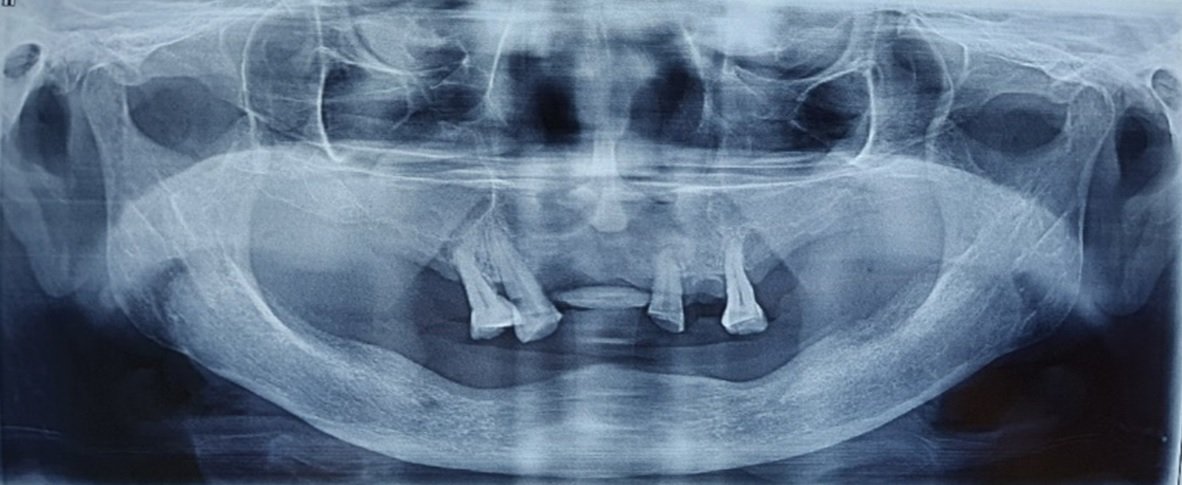
On examination of OPG, it was revealed that 34,33,32,31,41,42,43,44,24,25 were endodontically treated.

Fig 4: Orthopantamograph
Diagnostic Procedures
After the VD was clinically assessed, physiologic rest position was determined by facial measurements between the tip of the nose and chin and confirmed by phonetics. The patient’s intraoral examination revealed a collapsed VD and so a 2mm increase in the occlusal vertical dimension was planned.

Fig 5: Loss of vertical dimension
Treatment Plan
The treatment phase was divided into the Restorative phase followed by the Prosthetic Phase which included increasing the vertical dimension, tooth preparation, Provisional restoration and fixed metal-ceramic prosthesis restoration and finally the Maintenance phase
The treatment plan was presented to the patient. The type of restoration, restorative material, cost, esthetics, expectations, complications, limitations, and oral hygiene requirement was thoroughly explained to the patient.
TREATMENT PROCEDURE
The treatment procedures were started with oral prophylaxis and after the completion of endodontic procedures, the prosthodontic phase of the treatment was started. A maxillary and mandibular impression was taken with irreversible hydrocolloid impression material (Alginate) and the cast was poured in Type III dental stone.
The Hanau earpiece Face bow was used to record the orientation jaw relation. The maxillary and mandibular casts were then mounted in Hanau wide Vue articulator using facebow and centric relation record.
A maxillary hard8,9 occlusal splint was fabricated at an increased occlusal vertical dimension of 2mm, using self-cure clear acrylic resin. The occlusal splint was then inserted and adjusted. The patient was advised to wear this splint for a period of 3 weeks and recalled for review after a week. The patient was comfortable, did not have any problem, and was well adjusted to the increased vertical dimension3. A diagnostic wax-up was carried out at the increased VD of occlusion.

Fig 6: Occlusal splint
Tooth preparation were carried out starting with anterior mandibular teeth first i.e. 31,32,33,41,42,43 .Conservative preparations with minimal reduction in the incisal and occlusal surface were made.
In the following appointment, tooth preparation for mandibular left and right posterior teeth i.e. 34,35,36 and 44,45 and 46 were carried out. The provisional restorations were fabricated in 3 segments (1 anterior and 2 posteriors) and temporization was given.

Fig 7: Tooth preparation followed by gingival retraction for final impression
After 3 weeks of temporization of mandibular teeth, the patient was reviewed for any changes in the final restoration. This time period provided sufficient time to test patient adaptation to the new vertical dimension of occlusion.

Fig 8: Temporization
In the subsequent appointment, the final refining of preparation was done followed by gingival retraction of the prepared mandibular teeth. Impression of the mandibular arch with Polyvinyl siloxane impression material was carried out with 2 steps double mixing technique followed by pouring the cast in type IV dental stone.

Fig 9: Final impression
Metal framework was tried in patient mandibular arch for accuracy, proper path of insertion, absence of rocking and passive fit on the abutments were evaluated.
Wax bite with the metal framework was taken for the ceramic fabrication .

Fig 10: Metal framework try in
Finally, the ceramic trial was done and checked for any occlusal adjustments
The final restorations 3 metal ceramic FPD segments i.e. (33,32,31,41,42,43) (46,45,44) and (36,35,34) were cemented with a definitive restorative material.

Fig 11: Final Restoration
The patient was enrolled in a strict maintenance schedule for the consecutive months with a complete oral check-up examining the restorations, abutments, occlusal discrepancies, patient diet, clenching habits, and oral hygiene maintenance.
The patient was extremely satisfied with his new prosthesis which increased his chewing efficiency, speech and esthetic outcome .

Fig 12: Post -operative profile
DISCUSSION
For the therapeutic management of patients with tooth wear the extent of tooth wear, the dental and periodontal condition, the vertical dimension of occlusion, the etiology of tooth wear, patient’s habits, and expectations are important for treatment selection. In this patient, severe tooth wear in the mandibular anterior was the basic problem. The patient is categorized into Class II based on the severity of tooth wear. Tooth wear is a cumulative record of both functional and parafunctional activities and various factors such as age, gender, diet and bruxism are associated with tooth wear. All mechanisms of tooth wear rarely act alone and usually interacts with each other to cause wear. So the evaluation of tooth wear for predicting actual bruxism is controversial and is difficult to estimate the degree of contribution of bruxism to tooth wear alone.
The reconstruction of severely worn dentition is a very complex and difficult problem representing a real challenge to the dentist. The various other treatment options include crowns, laminates, and onlays. Conservative treatment options like laminates and Onlays were ruled out in this case because of the extensive nature of involvement of dentition.
The present case was treated with tooth preparation of mandibular teeth followed by a fixed dental metal-ceramic prosthesis in 3 segments (2 posteriors and 1 anterior) in the mandibular arch in alignment with the increased vertical dimension. A satisfactory clinical result was obtained by increasing the vertical dimension with an improvement in esthetics and function thereby justifying the procedures. Metal ceramic restorations were selected in this case, since they are the safest choice in cases having high load conditions and esthetics as well.1
CONCLUSION
The reconstruction of severely worn dentition is a very complex and difficult problem representing a real problem for the dentist. A fixed dental prosthesis as in this case still proves to be a successful treatment option in many situations of tooth wear due to greater longevity, superior esthetics, better abrasion resistance, and less discoloration. Careful diagnosis, treatment planning, occlusal adjustments of the final restoration, strict post-operative recall, and maintenance schedule contribute to the success of oral rehabilitation.
REFERENCES
- Thomadaki A, Tzanakakis EG, Ioannidi A, Pepelassi E, Tzoutzas I. Prosthodontic Rehabilitation of a Mandibular Worn Dentition: A Case Report. J Oral Biol. 2019;6(1):7.
- Zeighami S, Siadat H, Nikzad S. Full mouth reconstruction of a bruxer with severely worn dentition: a clinical report. Case reports in dentistry. 2015 Jul 1;2015.
- Viswambaran M, Dabra T. Comprehensive rehabilitation of a worn out dentition with complete coverage ceramic restorations. Medical Journal, Armed Forces India. 2015 Dec;71(Suppl 2):S486.
- Chidambaram R, Grover M, Veeravalli PT. Full mouth rehabilitation of a worn out dentition using multidisciplinary approach. Journal of Orofacial Research. 2013:54-6.
- Mainjot AK. The One step?No prep technique: A straightforward and minimally invasive approach for full?mouth rehabilitation of worn dentition using polymer?infiltrated ceramic network (PICN) CAD?CAM prostheses. Journal of Esthetic and Restorative Dentistry. 2020 Mar;32(2):141-9.
- Shetty S, Pitti V, Satish Babu CL, Surendra Kumar GP, Deepthi BC. Bruxism: a literature review. The Journal of Indian Prosthodontic Society. 2010 Sep;10(3):141-8.
- Addy M, Shellis RP. Interaction between attrition, abrasion and erosion in tooth wear. Dental Erosion. 2006;20:17-31.
- Abadi BJ, Okeson JP. Alteration of vertical dimension in the treatment of craniomandibular disorders. Journal of Craniomandibular Practice. 1983 Sep 1;1(4):55-
- Seifeldin SA, Elhayes KA. Soft versus hard occlusal splint therapy in the management of temporomandibular disorders (TMDs). The Saudi dental journal. 2015 Oct 1;27(4):208-14.
Disclaimer from Guident
The views and opinions expressed in articles published in Guident are solely those of the authors and do not necessarily reflect the views of the editors, the editorial board or the publisher, Ivory India. Guident does not endorse any product, technique or treatment described. Clinical content is intended for qualified dental and medical professionals and is not a substitute for individual clinical judgement. Guident, its editors and the publisher accept no liability for any consequence arising from the use of information published in the journal.
How to cite this article
Dr. Amritha Chandran, Dr. Sunil Dhaded. Prosthodontic Rehabilitation of Worn-Out Mandibular Dentition-a Case Report. Guident. 2022 Jun;15(7-8). Available from: https://ivoryindia.in/articles/prosthodontics/prosthodontic-rehabilitation-of-worn-out-mandibular-dentition-a-case-report.html