
Full Mouth Rehabilitation of Severely Attrited Teeth: A Case Report
Wisdom Dental Clinics ®, Jaipur, India
ABSTRACT
Full mouth rehabilitation is highly individualized treatment. Full mouth rehabilitation is done for the modification of the health of the entire mouth, including the teeth, gums and the occlusion. Mostly loss of normal occlusal plane and reduction in the vertical dimension of the occlusion caused due to the severe wear of anterior teeth and the collapse of posterior teeth. Hence it is important to replace or restore all teeth in the mouth using a combination of dental services. It requires proper diagnosis and detailed treatment planning. The most valuable diagnostic and clinical tool that has far-reaching consequences on implant dentistry is ISQ. It has the ability to monitor osseointegration and the life expectancy of an implant. This case report is of full mouth rehabilitation of a 65 years old patient with missing posterior teeth, anterior attrited teeth with loss of vertical dimension.
Keywords: Occlusal wear, Vertical dimension of occlusion (VD), Full mouth rehabilitation
INTRODUCTION
During a lifetime of a patient gradual wear of the occlusal surfaces of teeth is a normal process but excessive occlusal wear can result in occlusal disharmony, impaired function, pulpal pathology and esthetic disfigurement.1 Therefore, it is important to identify the factors that contribute to excessive wear and to evaluate alteration of the vertical dimension of occlusion (VDO) caused by the worn dentition.2 The treatment plan is planned according to the number of teeth to be treated, condylar position, the VDO and the choice of restorative material.3 Anterior guidance which protects the posterior teeth from wear during excursive movement is loss due to severe wear of anterior teeth.4
One of the most challenging procedures in dentistry is restoration of the severely worn dentition. Proper evaluation and diagnosis should include patient’s diet, history of eating and/or gastric disorders, along with the present state of the occlusion.3
The full mouth rehabilitation (FMR) implies the involvement of all diagnostic, therapeutic, and restorative procedures at our command for the treatment and prevention of dental disease i.e., to accomplish equilibration, extensive and intensive restorative procedures is done in which the occlusal plane is modified in many aspects.5 These modifications are motivated by various factors: improvement in esthetics and restoration of occlusal function.6
A combine aspect of dental treatment is necessary for successfully treating patients such as patient education, sound diagnosis, periodontal therapy, operative skills, occlusal considerations, endodontic treatment and achieving harmony between the TMJ and occlusion, hence maintenance of the entire oral mechanism.3,6,7
Pankey Mann Schuler’s philosophy advocates that condylar guidance does harmonization for the best possible esthetics, function and comfort and the determination of an occlusal plane based on anterior guidance.3,7
For many years, Porcelain fused to metal (PFM) restorations have represented the most widely used restorative technique for teeth, this popularity may have attributed to the clinical longevity and accepted esthetics.8 The aim of this case report was to show the sequence of FMR of a 65-year patient complained of severe attrition of anterior maxillary teeth with generalized attrition of the remaining teeth.
CASE REPORT
A 65 years healthy male patient reported with difficulty in eating from both sides along with pain on side of cheeks, ear, temple area and lower front teeth region.
On oral examination, multiple retained root stumps, old and severely attrited teeth and PFM crowns and bridges were present with loss of vertical space probably leading to TMJ related problems. (Figure 1a,1b 1c)


Figure 1a,1b ,1c: pre-operative picture of patient
Patient was advised for OPG. OPG revealed that there were decayed teeth present in lower arch, out of which some can be restored and some not. (Figure 2)

Figure 2: OPG of the patient
So full mouth rehabilitation of lower arch was planned along with increasing the vertical height. Endodontic procedure was carried out in teeth 36, 33, 32, 42 and 43 over which crowns were planned.
Meanwhile, 3 Nobel active implants were placed in 4th quadrant to restore that segment with fixed prosthesis. [Figure 3]
More than 45 NCM Insertion torques was achieved, followed by highly promising ISQ values of 81, 75 and 83. This compelled us to immediately make implant level impressions, after which healing caps were placed.

Figure 3: Intra-oral photographs after implant placement
After 3 days metal trial was done, meantime final crowns were given from tooth 36 to 43 and vertical height was increased with stable and functional occlusion.
Following couple of days, 4-unit prosthesis was screw retained on 3 Nobel Active implants with functionally loaded. Patient was instructed to maintain the oral hygiene properly. (Figure 4a,4b)

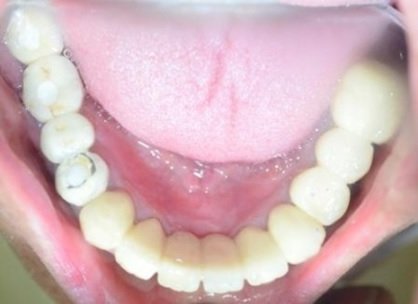
Figure 4a,4b: Four -unit prosthesis placed
Patient was advised for OPG. OPG revealed that there were decayed teeth present in lower arch, out of which some can be restored and some not. (Figure 2)
Patient was called for follow up after 6 months and satisfactory result was obtained. [Figure 5]

Figure 5: Follow-up OPG
DISCUSSION
Amongst the indications of the full mouth rehabilitation of the entire dentition are restoring the worn teeth, creating esthetic of the lower 1/3 of the face, to prevent the TMJ disorders. Assessment of the vertical dimension is important factor for the comprehensive treatment plan for each individual case. Articulated study casts and diagnostic wax-up can provide important information to dentist and patient. This is helpful for the evaluation of treatment options. Clinical evaluation of the patient having a diagnostic splint is confirmed with tolerance of changes to vertical dimension of occlusion.9
In prosthetic full mouth oral rehabilitation in adult patients, the treatment plan should consist of interdisciplinary evaluating the entire face and lip movement in relation to the teeth leading to excellent results in facial, dentolabial, phonetic, dental, and gingival parameters.11,12
A systemicapproach for FMR was described by Mattoo et al,13 which consists of, in the diagnostic phase we determined the tolerance towards increase in occlusal vertical dimensions by using splint and psychological evaluation of patient’s mental attitude and need for education and motivation. In the preparatory Phase, oral hygiene maintenance program with fluoride application and endodontic treatments for maxillary central and lateral teeth and other treatments of existing teeth. While in the restorative Phase, a full mouth PFM crowns were constructed and cemented. In the maintenance face, evaluation of all crowns during different periods with periodontal and endodontic treatment. In addition to that, the psychological improvement in the patient was recorded.13
Before commencing any appliance therapy for restoring the loosed vertical dimension, the dentist should be confident that the patient will benefit from the therapeutic approach. Though many controversy exists over which occlusal appliances reduce symptoms and the conclusions are that they all decrease parafunctional activity of the muscles.14
PFM crowns are still the choice for anterior as well as posterior teeth for their strength and esthetic reasons in the presence of limited economic status for the patients.15
The clinical significant of the this case is the optimal and esthetically pleasant occlusion was achievable by restoring the lost vertical dimension with PFM crowns. Also, the developed occlusion was coincided with the existing canine guidance. Although positive psycho-social changes were conveyed by patient's family and colleagues as shown in pre and post views.
CONCLUSION
Full mouth rehabilitation is a treatment modality which concentrates upon whole stomatognathic system by improving esthetics and functional aspect of the dentition. A detailed diagnosis and treatment planning is very important to achieve predictable success.
REPERENCES
- Turner, K. A., & Missirlian, D. M. (1984). Restoration of the extremely worn dentition. The Journal of prosthetic dentistry, 52(4), 467-474.
- Prasad, S., Kuracina, J., & Monaco, E. A. (2008). Altering occlusal vertical dimension provisionally with base metal onlays: a clinical report. The Journal of prosthetic dentistry, 100(5), 338-342.
- Song, M. Y., Park, J. M., & Park, E. J. (2010). Full mouth rehabilitation of the patient with severely worn dentition: a case report. The journal of advanced prosthodontics, 2(3), 106-110.
- Kumar, M., Kumar, S., & Sharma, S. (2014). A Holistic Approach to Full Mouth Rehabilitation. J Res Adv Dent.,3, 2s:38-42.
- Landa, J. S. (1955). An analysis of current practices in mouth rehabilitation. The Journal of Prosthetic Dentistry, 5(4), 527-537.
- Shetty, B. R., Shetty, M., Prasad, K., Rajalakshmi, S., & Jaiman, R. (2013). Philosophies In Full Mouth Rehabilitation – A Systematic Review. Int J Dent Case Reports, 3, 30-39
- Schuyler, C. H. (1963). The function and importance of incisal guidance in oral rehabilitation. The Journal of Prosthetic Dentistry, 13(6), 1011-1029.
- Trautmann, G., Gutmann, J. L., & Nunn, M. E. (2000). Witherspoon DE, Shulman JD. Restoring teeth that are endodontically treated through existing crowns. Part II: Survey of restorative materials commonly used. Quintessence Int., 31, 719-28.
- Hemmings, K. W., Howlett, J. A., Woodley, N. J., & Griffiths, B. M. (1995). Partial dentures for patients with advanced tooth wear. Dental update, 22(2), 52-59.
- Preethi, G. A., & Kala, M. (2008). Clinical evaluation of carbon fiber reinforced carbon endodontic post, glass fiber reinforced post with cast post and core: A one year comparative clinical study. Journal of Conservative Dentistry, 11(4), 162.
- Bal, A., Dugal, R., Shah, K., & Mudaliar, U. Principles Of Esthetic Evaluation For Anterior Teeth. IOSR Journal of Dental and Medical Sciences (IOSR-JDMS), 1(15), 28-38.
- de Almeida Cardoso, M., de Molon, R. S., de Avila, E. D., Guedes, F. P., Capelozza Filho, L.,Correa, M. A., & Nary Filho, H. (2016). Facial and occlusal esthetic improvements of an adult skeletal Class III malocclusion using surgical, orthodontic, and implant treatment. The Korean Journal of Orthodontics, 46(1), 42-54.
- Rathi, N., Mattoo, K., & Goswami, R. (2014). Synchronizing a multi-disciplinary team to rehabilitate an aesthetically handicapped patient suffering from developmental abnormality of amelogenesis imperfecta.
- Deshpande, R. G., & Mhatre, S. (2010). TMJ disorders and occlusal splint therapy–A Review. International journal of dental clinics, 2(2).
- Al Rabiah, A. M., Al Mansouri, S. (2016). Comprehensive dental treatment: A case report. Restorative Dent News, 2, 6-10.
Disclaimer from Guident
The views and opinions expressed in articles published in Guident are solely those of the authors and do not necessarily reflect the views of the editors, the editorial board or the publisher, Ivory India. Guident does not endorse any product, technique or treatment described. Clinical content is intended for qualified dental and medical professionals and is not a substitute for individual clinical judgement. Guident, its editors and the publisher accept no liability for any consequence arising from the use of information published in the journal.
How to cite this article
Dr. Gaurav Gupta, Dr. D.K. Gupta, Dr. Neelja Gupta. Full Mouth Rehabilitation of Severely Attrited Teeth: A Case Report. Guident. 2023 Feb;16(3). Available from: https://ivoryindia.in/articles/prosthodontics/full-mouth-rehabilitation-of-severely-attrited-teeth-a-case-report.html


