
Rapid Prototyping Technology: An Innovative Technique in Prosthodontic Dentistry
Department of Prosthodontics & Implantology, K.D. Dental College & Hospital, Mathura (U.P) India
ABSTRACT
Emergence of advanced digital technology has opened up new perspectives for design and production in the field of dentistry. Rapid prototyping (RP) is a technique to quickly and automatically construct a three-dimensional (3D) model of a part or product using 3D printers or stereolithography machines. RP has various dental applications, such as fabrication of implant surgical guides, zirconia prosthesis and molds for metal castings, maxillofacial prosthesis and frameworks for fixed and removable partial dentures, wax patterns for the dental prosthesis and complete denture. Rapid prototyping presents fascinating opportunities, but the process is difficult as it demands a high level of artistic skill, which means that the dental technicians should be able to work with the models obtained after impression to form a mirror image and achieve good esthetics. This review aims to focus on various RP methods and its application in prosthodontic dentistry.
INTRODUCTION
Rapid prototyping (RP) techniques, also termed solid freeform fabrication (SFF) or layered manufacturing, have been employed to build complex 3D models in medicine since the 1990s.1 Rapid Prototyping is a process that creates parts in an additive, layer-by-layer manner. It is a special class of machine technology that quickly produces models and prototype parts from 3D data using an additive approach to form the physical models precisely and in short time.2 It is a promising powerful technology that has the potential to revolutionize certain spheres in the ever changing and challenging field of medical and dental science. The procedure aims to build prototypes (working models) within a short time to product and test different design features, thought, theories, functionality as well as results and performance in special cases.3 Compared to traditional methods, new dental prosthesis work can be fabricated by RP techniques layer by layer directly from a computer model without part-specific tooling and human intervention. The labor cost will be substantially reduced, and better and faster dental restorations will be achieved. RP techniques are now regarded as a promising alternative for dental prosthesis production.1 In this article, we review the applications of RP techniques in prosthodontics.
WHAT IS RAPID PROTOTYPING?
RP is a type of computer-aided manufacturing (CAM) and is one of the components of rapid manufacturing. It is a technology that is capable of making physical objects directly from 3D computer data by adding a layer-upon-layer.4 Rapid prototypes contain mobile parts with complex geometry that is impossible to be made by other construction techniques. In addition, before definitive fabrication of prosthesis, this technique allows visualization and testing of objects, which reduces costs.5
Fabrication of models to ease surgical planning and simulation in implantology, neurosurgery, orthopedics as well as in prosthodontics, orthodontics and in several other applications in dentistry were made after its introduction in biomedical era.
Literature review 6
The first method for rapid prototyping was introduced in the 1980s in the field of engineering for the fabrication of a solid model based on a computed file and subsequently in dentistry. All CAD/CAM systems have three functional components: 1) A digitalization tool/scanner that transforms geometry into digital data that can be processed by a computer. 2) Software which processes scanner data and produces a data set readable by a fabrication machine. 3) A manufacturing technology that takes the data set and transforms it into the desired product by fabricating the restoration.6
To fabricate a physical prototype in industry and/or medicine, two different approaches have been utilized: subtractive and additive. In a subtractive method, material is subtracted from an initial block of material to leave the desired shaped part (such as a dental restoration). Alternatively, additive fabrication is a process in which the final desired part is manufactured by adding multiple layers of material on top of one another. The key idea of this innovative method is that the three dimensional CAD (3D-CAD) model is sliced into many thin layers and the manufacturing equipment uses this geometric data to build each layer sequentially until the part is completed. Hence, additive fabrication is often referred as “layered manufacturing”, “direct digital manufacturing”, “three-dimensional printing”, or “solid freeform fabrication”. Additive technology scan yield arbitrarily complex shapes with cavities and undercuts; frequently the case in human anatomy structures.
Subtractive methods have some limitations in comparison with additive techniques:
- A considerable amount of raw material is wasted because the unused portions of the mono-blocks must be discarded after milling and recycling of the excess ceramic material is not feasible.
- Milling tools are exposed to heavy abrasion and wear, therefore, withstanding only short running cycles.
- Microscopic cracks can be introduced into ceramic surfaces due to machining of this brittle material.
- It is neither easy nor economic for big, full undercuts and/or complex milling parts
The RP techniques have been employed to build complex 3D models in medicine since the 1990s. In current years, RP is becoming more appealing for dental purposes. In 2011, Morea et al. used the SLA technique for accurate insertion of the orthodontic mini screws. Yu et al. used this technique for producing the pre-surgical nasoalveolar molds in treatment of infants suffering from unilateral cleft lip and palate.
ADVANTAGES OF RAPID PROTOTYPING 2
:- The obvious benefit of rapid prototyping is speed.
- Rapid prototyping quickly delivers a better design communication tool, the physical prototype quickly and clearly communicates all aspects of a design
- Rapid prototyping facilitates the early detection and correction of design flaws.
- In its simplest form, the benefit of rapid prototyping is confidence in the integrity of the design.
CLASSIFICATION OF RP TECHNOLOGIES IN DENTISTRY 7
The frequent technologies that are adopted in dental practice are:
1. Stereolithography.
2. Selective laser sintering (SLS)
3. Inkjet-based system (3D printers [3DP])
4. Fused deposition modeling (FDM)
1. Stereolithography:
Hull (1984),was the first to patent this procedure for the production of 3D models from photopolymer resins. The components of stereolithography system are: a bath of photosensitive liquid resin, a model-building platform, and an ultraviolet (UV) laser for curing the resin(fig 1)2 .
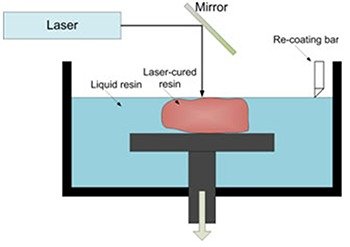
Fig 1: Schematic depiction of SLA6
Procedure6:
The layers of resins are cured sequentially and bond together to form a solid object beginning from the bottom of the model and building up. As the resin is exposed to the UV light, a thin well-defined layer thickness becomes hardened. After a layer of resin is cured, the resin platform is lowered within the bath by a small known distance. A new layer of resin is wiped across the surface of the previous layer using a wiper blade, and this second layer is subsequently exposed and cured. The process of curing and lowering the platform into the resin bath is repeated until the full model is complete. The self-adhesive property of the material causes the layers to bond to each other and eventually form a complete, en bloc 3D object. The model is then removed from the bath and cured for a further period of time in a UV cabinet(fig 2)

Fig: 2 Section view of the printing process8
Applications2:
This technology is used for impression purposes in reconstructive surgeries, sub-periosteal dental implant surgery and fabrication of high accuracy, high mechanical strength surgical drilling templates used for dental implant insertion
Limitations2:
Due to the high cost of raw materials and machine maintenance, it is less cost efficient than other 3DP technique, needs manual postbuild handling, it is labor– intensive and time-consuming.
2. Selective Laser Sintering:
Firstly discovered and developed in the middle of 1980s by Dr. Carl Deckard and Dr. Joe Beaman, it is an additive manufacturing technique which employed is a process of fusing together layers of specified powder material into a 3D model by a computer directed laser.3
Procedure
A roller distributes the powdered material over the surface of a build cylinder. Powder is spread layer-by-layer on top of the preceding hardened layer and sintered repeatedly. To hold the new fresh layer of powder, the supporting platform relegates one object layer thickness. The surface of this firmly compressed powder is then exposed to a beam of laser. The procedure is self-sustaining and all parts can be bond layer-by-layer6. After the object is fully formed, the piston is raised to elevate it. Excess powder is simply brushed away and final manual finishing may carried out3 (fig 3)

Fig 3 : A Schematic image of SLS technique6
Application6
SLS technique has significant advantages in dentistry, particularly prosthodontics, since various thermoplastic materials such as nylon composite, investment casting wax, metallic materials, ceramics and thermoplastic composites can be used in this method.
3. Inkjet-based system or 3DP(3 D Printing technology) 6
It is an additive rapid prototyping technique. The machine builds frameworks in a manner similar to that of ink jet printing. 3DP is a layer by- layer technique which continued progressively till the prototype is totally manufactured. This machine uses a single jet each for a plastic build material and a wax-like support material, which are held in a melted liquid state in reservoirs
Procedure:
A measured amount of the raw powder-form material is initially dispensed from a container by a moving piston. A roller then distributes and compresses the powder at the top of the fabrication chamber. A liquid adhesive is then deposited from the multi-channel jetting head in a 2D pattern onto the powder, make it bond and form a layer of the object. When a layer is completed, the piston helps spread and join the next powder layer. This incremental (layer-by- layer) method is gradually continued to achieve a complete built up of prototype. Unbound powder is swept up subsequent to a heating process, leaving the fabricated part sound and intact. The most outstanding characteristic of inkjet systems is the ability to produce extremely fine resolution and surface finishes, essentially equivalent to CNC machines. The technique is very slow for large object.(fig 4)

Fig 4 ; A schematic representation of 3DP technique
Application2:
The novel technique has great potential to produce, cost-efficiently, all-ceramic dental restorations at high accuracy and with a minimum of materials consumption.
Limitations3:
Due to its high tolerance, 3DP technology is not useful for impression purposes as SLA, this tolerance considers as a problem during creating delicate dental models such as casting patterns.
4. Fused Deposition Modeling (FDM)6
FDM is the second most widely used rapid prototyping technology, after stereolithography in which a thermoplastic material is extruded layer by layer from a nozzle, controlled by temperature.
Procedure:
A filament of a thermoplastic polymer material suckles into the temperature-controlled FDM extrusion nozzle dome. It is then heated to a free-flowing semi-liquid form. The motion of the nozzle head is controlled by a processor and traces and deposits the material in extremely thin layers onto a subsidiary platform. The head leads the material into place with an ample precision. A portion of the subject is built up layer by layer and the material solidifies within 0.1s after being ejected from the nozzle and bonds to the layer below. The supporting structures are contrived for overhanging geometries and are later removed by cutting them out from the object.(fig 5)

Fig 5 : Fused deposition modelling (FDM) Printing system8,9
Application:
The FDM process allows a variety of modeling materials and colors, such as medical grade ABS, polycarbonates and investment casting wax. FDM can produce models, as well as surgical guides and templates.
THE APPLICATIONS OF RP TECHNIQUES IN FACIAL AND DENTAL PROSTHESIS
RP techniques are now regarded as a promising alternative for dental prosthesis production. RP is particularly beneficial in prosthodontic planning and has provided a promising alternative method compared to conventional method. Various uses are a fabrication of wax pattern for prosthesis, all-ceramic crowns, metal prostheses (including fixed partial dentures and framework for removal partial dentures), and casts for prostheses10.
1. Dental prosthesis wax pattern fabrication
Traditionally, the fabrication of the wax pattern is the most critical and labor-intensive step in making the porcelain-fusedto-metal crown, pressed ceramic crown, and RPD framework. In this time-consuming task, the wax-up’s quality is dependent on the skilled labor of the individual.
With the advent and popularity of RP technology, a new approach is possible for automatic wax-up fabrication(fig 6). This approach simplifies the traditional fabrication process and accelerates the production turnaround period by using 3D imaging CAD, and RP.8-10 The new process involves the following three steps: (1) digitizing the master models with a 3D optical scanner (the full arch and opposing dentition digitization can be performed); (2) designing the wax pattern with the specialized CAD software, and (3) fabricating the wax-up with RP techniques, such as fused deposition modeling and 3D printing (3DP)11-13

FIG 6: Wax-patterns fabricated by RP technology6
Advantage1
- High production rate with RP technique as, the dental laboratory can easily reach a production rate of over 150 units per hour.
- High quality of wax copings, which results in a high precision fit and constant wall thickness.
- Reduced spruing time.
- The final advantage is the reduced finishing work needed on cast copings. The irregularities in wax coping thickness can be avoided, as they usually create extra work for finishing the metal after the cast.
After the wax pattern is fabricated by RP, the traditional lost-wax process is still needed. The process is more affordable than laser melting or sintering direct manufacturing processes, which still remains financially unattainable for most dental laboratories6.
2. Rapid prototyping of dental (facial) prosthesis mold (shell)
A. Mold (shell) for metal casting 1
Compared to conventional methods of casting production (including the construction of tooling and the pouring of a casting), ceramic molds can be produced for metal parts directly by CAD models. These molds are created on a computer screen by using RP techniques. Three-dimensional printing, such as the direct shell production casting process, produces ceramic casting molds for metal casting using a layer-by-layer printing process.
The process involves a multijet printhead depositing liquid binder onto a layer of ceramic powder. After a mold is “printed,” it is fired to create a rigid ceramic mold. This mold (shell) can then be poured in molten metal, producing a functional metal cast part.
Advantages6:
- Many labor-intensive and time-consuming steps of the traditional investment casting technique is eliminated.
- The technique also skips the process of design and manufacturing of wax and core tooling, wax and core molding, wax assembly, shell dipping and drying, and wax elimination
B. Mold for facial prosthesis
Patients suffering from facial deformity due to congenital defect, or defect due to trauma or ablative surgery are treated by maxillofacial units using a variety of surgical and prosthetic techniques so that the defect can be restored to normal function and appearance.
Over decades, New technologies such as 3D surface capture (3D scanning), 3D CAD and a layer additive manufacturing process (RP and manufacturing – RP and M) have been investigated in maxillofacial prosthetic applications. Pattern fabrication with, the aid of RP, has been a feasible procedure, although, the conventional flasking and investing procedures were still crucial to make the actual prosthesis. Using a mold would remove the conventional flasking and investment procedures, and would shorten the process of making the prosthesis. Moreover, the generated resin mold can be kept since the mold is long-lasting and allows the pouring in multiple times6.
This technology is based on the additive method of building an object by adding layer on layer which is further defined by a computer model that has been virtually sliced. A customized 3D anatomic models are developed using this RP technology that exhibit a level of complexity unknown with computer numerical control-based equipment. Even complex shapes with internal detail and undercut areas are produced. SLA can also be used in fabrication of maxillofacial prosthesis by curing a liquid resin under a computer-guided laser. A newer system is the thermoset printer (3D Systems)7.(Fig 7)

Fig 7: Typical SPPC process (All photographs were taken by the author, Guang-huai Xue)14
In maxillofacial prosthetics, RP are being used for.7
- Fabrication of obturators
- Production of auricular, nasal prosthesis
- Manufacturing of surgical stents for patients with large tumors scheduled for excision
- Manufacturing of lead shields to protect healthy tissue during radiotherapy treatment
- Fabrications of burn stents, where burned area can be scanned rather than subjecting delicate, sensitive burn tissue to impression taking procedures. Duplication of existing maxillary/mandibular prosthesis is especially crucial when an accurate fit to natural teeth or an osseointegrated implant is needed
C. Mold for complete dentures6
The limited available research articles reveals that advanced manufacturing technologies have not been successfully implemented in this field yet. The technology briefly is comprised of the instituting a 3D graphic record of artificial teeth for parameterization positioning, yielding 3D data of edentulous models and rims in centric relation, finding a CAD route and emergence of a software for complete dentures, fabricating physical flasks (molds) by 3DP, and finishing the complete denture using a traditional laboratory procedure.
3. Direct dental metal prosthesis fabrication 1,6
Metal prostheses are often used in a dental prosthetic clinic. The lost-wax casting method is the traditional way to fabricate a metal prosthesis. This method is a lengthy and labor-intensive process that comprises many manual steps such as fabricating, embedding and burning out the wax pattern, metal casting, and postprocessing.
With the introduction of a CAD/CAM milling system, a metal prosthesis can be fabricated by milling (according to the CAD design); however, this milling process is also time consuming, and the milling tools are exposed to heavy abrasion. Moreover, most of the material is wasted, and spatial restrictions limit the production of complex shapes such as the framework for the RPD .
RP technology, particularly selective laser melting (SLM) and selective laser sintering (SLS) technology have been on the focus of attention of scientists for the brisk fabrication of high-precision metal parts with various resources and shapes. Dental prostheses are very appropriate to be processed by employing SLS/SLM technique, regarding their complex geometry and their capability to be customized without the extensive manual pre- or post-processing steps.
4. All-ceramic restoration fabrication
Since the 1980s, research and development of dental CAD/CAM milling systems has been actively pursued worldwide.Recently, commercial dental CAD/CAM milling systems have been successfully introduced for specific fields such as all-ceramic restorations. These milling systems enabled zirconia ceramics to be used as a standard material for dental prosthetic restorations; however, the disadvantage of this system is the considerable amount of raw material waste, because the unused portions of the monoblocks must be discarded after milling, and recycling of the excess ceramic material is not feasible. The milling tools are also exposed to heavy abrasion and therefore withstand only short running cycles. Moreover, microscopic cracks can be introduced into the ceramic surface due to the tooling process of this brittle material1
For the fabrication of green– zirconia, all-ceramic dental restoration direct inkjet fabrication process has been anticipated using a slurry microextrusion process. This innovative method is a favorable CAD/RP system with great ability to produce all-ceramic dental restorations with high precision, cost competence, and minimum material intake. This method is still in the experimental phase7.
5. Implantology 7
The use of dental implants has evolved rapidly over the last decade since the advent of the concept of Osseointegration. Development in the field of oral implantology has led to the development of successful and predictable restorative options for partially as well as completely edentulous patients. Correct placement of implant is an important phase. Improper implant placement can have a detrimental effect on the long-term predictability and success of the implant-supported prosthesis.
The use of computer-aided design (CAD)/CAM technology has gained popularity in implant dentistry. Application of rapid prototyping in implantology pertains to 3D imaging and using 3D software for treatment planning. Surgical guides are fabricated using additive RP, while fabrication of all-ceramic restorations is done using subtractive RP. RP technology allows for industrial fabrication of customized 3D objects from CAD data.(fig 8)

Fig 8. General workflow of the surgical template.15
CONCLUSION
RP techniques have been substantially employed in dentistry, but applications of RP in prosthodontics are relatively rare. This article discussed the applications of RP techniques in prosthodontics. Dental prostheses can be fabricated layer by layer directly from a computer model easily and rapidly by various RP techniques without part-specific tooling and human intervention. This technique is a revolutionary change for dental prosthesis fabrication. With the development and research of the diversity for RP systems and correspondingly built materials, it is possible to generate different kinds of dental prostheses for different applications. These applications include dental prosthesis wax pattern, dental (facial) prosthesis mold (shell), dental metal prosthesis, and zirconia prostheses. We believe that RP techniques are playing a more important role in prosthodontics and will become one of the mainstream technologies for digital fabrication of dental prostheses.
REFERENCES
- Jian Sun, DDS, PhD,1 & Fu-Qiang Zhang, DDS, PhD2The Application of Rapid Prototyping in ProsthodonticsJournal of Prosthodontics 00 (2012) 1–4 c 2012 by the American College of Prosthodontists
- V. N. V. Madhav Rajendra Daule 1 2 Rapid Prototyping and its Application in Dentistry. Journal of Dental & Allied Sciences 2013;2(2)57-61.
- Dr Pooja Negi1 , Dr Astha Jaikaria2 , Dr. Suhani Kukreja. Rapid Prototyping in DentistryInternational Journal of Science and Healthcare Research (www.ijshr.com) 113 Vol.4; Issue: 4; October-December 2019
- Wolfaardt J, King B, Bibb R, Verdonck H, de Cubber J, Sensen CW, et al. Digital technology in maxillofacial rehabilitation. In: Buemer J, editor. Text Book of Maxillofacial Rehabilitation: Prosthodontic and Surgical Management of Cancer Related, Acquired, and Congenital Defects of the Head and Neck. 3rd ed. Illinois, USA: Quintescence Publishing Co, Inc; 2011.
- Winder J, Bibb R. Medical rapid prototyping technologies: State of the art and current limitations for application in oral and maxillofacial surgery. J Oral Maxillofac Surg 2005;63:1006-15.
- kianoosh et al. Rapid Prototyping Technologies and their Applications in Prosthodontics, a Review of Literature. J. dent (shiraz) 2015 Mar; 16(1): 1–9
- Quadri S, Kapoor B, Singh G, Tewari RK. Rapid prototyping: An innovative technique in dentistry. J Oral Res Rev 2017;9:96102
- https://i.materialise.com/blog/en/an-intro-to-our-3d-printing-technologies-stereolithography/
- Andrea Alice Konta et al. Personalised 3D Printed Medicines: Which Techniques and Polymers Are More Successful? Bioengineering 2017, 4, 79
- Sun J, Zhang FQ. The application of rapid prototyping in prosthodontics. J Prosthodont 2012;21:641-
- Williams RJ, Bibb R, Rafik T: A technique for fabricating patterns for removable partial denture frameworks using digitized casts and electronic surveying. J Prosthet Dent 2004;91:85-88
- Wu M, Tinschert J, Augthun M, et al: Application of laser measuring, numerical simulation and rapid prototyping to titanium dental castings. Dent Mater 2001;17:102-108.
- Bibb R, Williams RJ, Eggbeer D, et al: Use of CAD/CAM technology to fabricate a removable partial denture framework. J Prosthet Dent 2006;96:96-99
- Yong he et al. Fabrication of low cost soft tissue prostheses with the desktop 3D printer, Scientific Reports | 4 : 6973 | Doi: 10.1038/Srep06973
- XiaojunChen1, LuXu1, YueYang1 & Jan Egger2,3.A semi-automatic computer-aided method for surgical template designScientific Reports | 6:20280 | DOI: 10.1038/srep20280
Disclaimer from Guident
The views and opinions expressed in articles published in Guident are solely those of the authors and do not necessarily reflect the views of the editors, the editorial board or the publisher, Ivory India. Guident does not endorse any product, technique or treatment described. Clinical content is intended for qualified dental and medical professionals and is not a substitute for individual clinical judgement. Guident, its editors and the publisher accept no liability for any consequence arising from the use of information published in the journal.
How to cite this article
Dr. Preeti Sagar, Dr.Sumver Jain, Dr. Abhinav Agarwal. Rapid Prototyping Technology: An Innovative Technique in Prosthodontic Dentistry. Guident. 2020 Aug;13(9). Available from: https://ivoryindia.in/articles/prosthodontics/rapid-prototyping-technology-an-innovative-technique-in-prosthodontic-dentistry.html


