
Tooth Supported Overdenture a Known Yet Overshadowed Concept
Seema Dental College and Hospital, Rishikesh Dr. Lakshya Vishnoi (Intern), Department of Prosthodontics, K.G.M.C, Lucknow
ABSTRACT
The prosthetic management of complete or partially edentulous patient has long been a major impediment for dentistry. For a long time, complete maxillary and mandibular denture have been the traditional standard of care. However, most of the patients report significantly more problems adapting to their mandibular denture due to a lack of comfort, retention, stability and inability to chew and eat. Excessive occlusal wear and loss of multiple teeth can result in occlusal disharmony, impaired function and esthetic disfigurement. It is not desirable to extract all teeth in case of excessive wear so as to prevent bone loss.
Despite advancements in dental implantology, several anatomical and financial constraints can prevent their use in some patients. Also, the proprioceptive mechanism of teeth cannot be compensated by implant overdentures. Hence, the use of tooth supported overdentures can never be obsolete. Overdenture is a favored treatment modality for elderly patients with few remaining teeth with emphasis on psychological aspect of not being completely edentulous. Roots maintained under the denture base preserve the alveolar ridge, provide sensory feedback and improve the stability of the dentures.
This case report describes the utilization of the endodontically treated remaining natural roots to fabricate an overdenture that provided better retention than a conventional complete denture.
INTRODUCTION
Dentures & Implants are not a replacement for teeth; they are a replacement for no teeth. With advancements in dental implant science, implant supported prostheses are being increasingly used for treating patients. However, anatomical, medical and financial constraints often prevent patients from opting for the best possible treatment. They cannot fully compensate the loss of periodontal sensory mechanisms that guide and monitor gnathodynamic functions. Hence, overdentures have been successfully used for rehabilitation of patients with severe tooth wear and/or few remaining teeth.
Overdenture treatment uses a removable complete denture that overlies retained teeth, tooth roots, or dental implants.1 The goal of overdenture is to maintain teeth as a part of residual ridge. Instead of soft movable mucous membrane, the denture literally sits on teeth ‘pilings’, enabling the denture to withstand a much greater occlusal load without movement.2 Over dentures are the dentures which derive their support from one or more abutment teeth by completely enveloping them beneath the fitting surface. This treatment is not a new concept and practitioners have successfully employed existing tooth structures or retained roots to assist with complete denture treatment for more than a century.3 The presence of a healthy periodontal ligament maintains alveolar ridge morphology, whereas a diseased periodontal ligament, or its absence, is associated with variable but inevitable time-dependent reduction in residual ridge dimensions.4 To avoid this, two or more, coronally modified or restored retained teeth abutments are frequently endodontically prepared and are used as abutments for an overdenture. The objective is to distribute stress concentration between retained abutments and denture-supporting soft tissues.5 Retained root abutments can give better retention, support, and stability to an overdenture and also provide proprioception which would otherwise be lost with conventional denture treatment.
Overdenture is any removable dental prosthesis that covers and rests on one or more remaining natural teeth, the roots of natural teeth, and/or dental implants; a dental prosthesis that covers and is partially supported by natural teeth, natural tooth roots, and/or dental implants.6
Various terms have been used to describe this treatment modality: overlay denture, telescoped dentures, tooth supported dentures, hybrid prosthesis, crown and sleeve prosthesis, and the superimposing dentures.2
Over dentures help to partly overcome many of the problems posed by conventional complete dentures like progressive bone loss, poor stability and retention, loss of periodontal proprioception, low masticatory efficiency, etc.7
The present case report discuss the the fabrication of a tooth supported overdenture after endodontically treating the remaining teeth.
CASE DISCUSSION
A 56 year old male patient reported to the Department of Prosthodontics, with the chief complaint of difficulty in chewing, difficulty in speech and desire to improve esthetics. He wanted replacement of missing teeth so that the function can be restored. On intra oral examination, all the teeth in the maxillary arch were present and teeth present in mandibular arch were 41, 31, 32, 33, 34 (Figure 1). The edentulous span had favorable ridge with firmly attached keratinized mucosa. Further determination of the vertical dimension of occlusion (VDO) was achieved using phonetics, swallowing, and patient facial appearance. It was determined that there was loss of VDO. Temporo mandibular joint was normal. Diagnostic impressions were made using irreversible hydrocolloid impression materials (Zelgan 2002 dust-free easy mixing, Dentsply India Pvt. Ltd., Haryana). Impressions were poured in dental stone (Kalstone, Kalabhai Karson Pvt. Ltd., India). Diagnostic cast were articulated on a semi adjustable articulator using centric relation record and a face-bow transfer to evaluate inter arch space. During the following visit, the treatment option was discussed with the patient, which included endodontic therapy and fixed restoration in mandibular teeth followed by overdenture prosthesis. After considering invasiveness, amount of time and socioeconomic status, the patient elected to have root canal treatment of the remaining teeth in mandibular arch followed by tooth supported overdenture. After taking consent, the patient was sent for oral prophylaxis, hygiene instruction and maintenance. 41, 31, 32, 33, 34 were then endodontically treated. After completion of endodontic therapy, abutment preparations for cast metal restorations were done (Figure 2). Impression were made of both arches, wax pattern for primary coping were fabricated keeping mind that they are parallel to each other. Wax pattern were invested, casted in chrome cobalt alloy, finished, polished and evaluated intra-orally for fit, retention and stability and finally cemented in patient mouth (figure 3) .Preliminary impression of mandibular arch was then made with irreversible hydrocolloid and custom tray was fabricated with self-cure acrylic resin (Cold Cure Denture Base Material, Pyrax, Rapid Repair). Border molding was done with low fusing green stick compound (DPI Pinnacle). Dual impression was then made with zinc oxide eugenol impression material (DPI Impression Paste, Dental Products of India) and irreversible hydrocolloid (Zelgan 2002 dustfree easy mixing, Dentsply India Pvt. Ltd., Haryana) in over extended stock tray. Master cast was poured in dental stone (Kalstone, Kalabhai Karson Pvt. Ltd., India). Maxillomandibular relationships were made. Master casts were mounted on the semi-adjustable articulator (Hanau Wide Vue Articulator). Shade selection was done for better esthetics and acrylic resin teeth were arranged in the edentulous regions. After doing teeth arrangement with artificial acrylic resin teeth, tryin was done [Fig. 4]. Dentures were processed in heat cure acrylic resin (Trevalon Denture Material, Dentsply India Pvt. Ltd., India). Dentures were finished, polished [Fig.5] and inserted [Fig.6]. Occlusion was evaluated and adjusted.
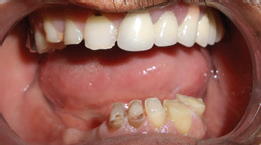
Fig 1. Pre-operative
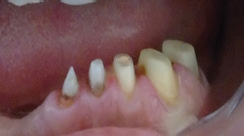
Fig 2. Abutment Preparation

Fig 3. Metal coping cemented

Fig 4. Try in
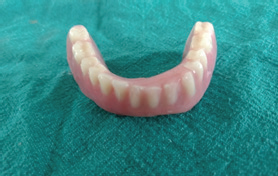
Fig 5. Final mandibular overdenture
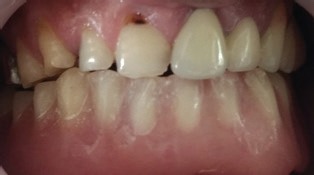
Fig 6. Insertion
Postoperative instructions were given as how to insert the prostheses and instructions on maintaining oral hygiene. After minor adjustments during post insertion visits, the patient was recalled after 6 month.
DISCUSSION
Preventive prosthodontics emphasizes the importance of any procedure that can delay or eliminate future prosthodontic problems and overdenture is an important part of the preventive treatment modality. A complete denture patient goes through a sequel of events like loss of discrete tooth proprioception, progressive loss of alveolar bone, transfer of all occlusal forces from the teeth to the oral mucosa and the most depressing sequel is the loss of patient’s self-confidence. An overdenture delays the process of resorption, improves denture foundation area and increases masticatory efficiency.1 DeVan golden statement: “Perpetual preservation of what remains is more important than the meticulous replacement of what is missing” still rings true. Overdenture is a definitely a better option as compared to a removable complete denture prosthesis, which certainly has its drawbacks. Overdenture is one of the most practical measures used in preventive dentistry.
After the loss of the teeth the residual alveolar ridge undergoes rapid loss in all dimensions. The phenomenon of residual ridge resorption (RRR) following removal of teeth have been well observed and documented in literature.8,9 While the bone loss following the removal of teeth is stated to be rapid, progressive, irreversible and inevitable, it is equally well observed that bone is maintained around standing teeth and implants.9,10 Over denture therapy constitutes essentially a preventive prosthodontics concept as it endeavors to preserve the few remaining teeth and the supporting structures.11 The teeth which are too weak to support a fixed partial denture and are considered unsuitable to support a removable partial denture can often at times be usefully conserved and suitably modified to act as abutments under over dentures for useful span of time.
Despite recent developments in dental implantology, the conservative approach to tooth preservation followed by an overdenture is still valid. The many advantages of root retention include preservation of the residual ridge, retention, support and stabilization for the denture base, proprioceptive feedback and psychological benefit to the patient. The masticatory performance in patients with overdentures is also higher than the complete denture patients.12 The use of overdentures is therefore, a practical alternative that provides a relatively quick, easy and cost-effective solution to the functional and esthetic oral rehabilitation in patients with pronounced edentulism and/or severe wear.
Crum and Rooney13 graphically demonstrated in a 5 years study an average loss of 0.6 mm of vertical bone in the anterior part of the mandible of overdenture patients through cephalometric radiographs as opposed to 5.2 mm loss in complete denture patients. Miller14 in his study concluded that alveolar bone resorption depends upon three variables which are:
- The character of the bone.
- The health of the individual.
- The amount of trauma to which the structures are subjected
Rissin et al12 in 1978 compared masticatory performance in patients with natural dentition, complete denture and over denture. They found that the over-denture patients had a chewing efficiency one‑third higher than the complete denture patients.
The success or failure of overdenture hinges on continued preservation of the underlying abutments. Many elderly patients lack the dexterity to adequately clean their teeth.8 Hence special attention towards meticulous oral hygiene practices and regular recall appointments are critical in the success of overdenture therapy.
CONCLUSION
Tooth-supported overdentures may be considered as a good alternative to the conventional removable dentures, because they provide better retention stability, support, stable occlusion, decrease in the forward sliding of the prosthesis and better control of the mandibular movements because of the proprioception feedback which increases the chewing efficiency and even phonetics, as compared to the conventional complete dentures.
Although the over denture is not a panacea, if fabricated well with good clinical and laboratory expertise and maintained with care, then each over denture treatment can be a successful one.
REFERENCES
- Fenton AH. The decade of overdentures: 1970–1980. J Prosthet Dent. 79:31–36
- Winkler S. Essentials of complete denture prosthodontics. 2013;505-31.
- Morrow RM, Powell JM, Jameson WS, Jewson CG, Rudd KD. Tooth supported complete dentures: an approach to preventive prosthodontics. J Prosthet Dent. 1969; 21:513–22.
- Burns DR. Mandibular implant overdenture treatment: consensus and controversy. J Prosthodont.2000; 9:37–46
- Zarb, Hobrick, Eckert, Jacob. Prosthodontic treatment for edentulous patients: complete dentures and implant—supported prostheses. 13th ed. St. Louis: Elsevier; 2012. 290–295.
- Glossary of Prosthodontic Terms. J Prosthet Dent. 2017;117(15):65.
- Reitz PV, Weiner MG, Levin B. An overdenture survey: Preliminary report. J Prosthet Dent. 1977;37:246-58.
- Toolson LB, Smith DE. A two year longitudinal study of overdenture patients, Part 1: Incidence and control of caries on overdenture abutments. J Prosthet Dent 1978; 40: 486-91.
- Tallgren. A.Positional changes of complete dentures–A seven year longitudnal study. Acta. Odontol. Scand. 1969; 27:539-61.
- Tallgren A. The continuing reduction of the residual alveolar rides in complete denture wearers: a mixed longitudnal study covering 25 years. J Prosthet Dent. 1972;27: 120-32.
- John J. Sharry: Complete Denture Prosthodontics. Third edition, New York, McGraw-Hill Book Co., 1974.
- Rissin L, House JE, Manly RS, Kapur KK. Clinical comparison of masticatory performance and electromyographic activity of patients with complete dentures, overdentures, and natural teeth. J Prosthet Dent. 1978; 39(5):508-11.
- Crum RJ, Rooney GE Jr. Alveolar bone loss in overdentures: A 5-year study. J Prosthet Dent 1978; 40:610-3.
- Miller PA. Complete dentures supported by natural teeth. Tex Dent J. 1965; 83:4-8.
Disclaimer from Guident
The views and opinions expressed in articles published in Guident are solely those of the authors and do not necessarily reflect the views of the editors, the editorial board or the publisher, Ivory India. Guident does not endorse any product, technique or treatment described. Clinical content is intended for qualified dental and medical professionals and is not a substitute for individual clinical judgement. Guident, its editors and the publisher accept no liability for any consequence arising from the use of information published in the journal.
How to cite this article
Dr. Varun Kumar, Dr. Abhishek Dubey Department of Prosthodontics. Tooth Supported Overdenture a Known Yet Overshadowed Concept. Guident. 2020 Jan;13(2). Available from: https://ivoryindia.in/articles/prosthodontics/tooth-supported-overdenture-a-known-yet-overshadowed-concept.html


