Knowledge, Attitude and Practice Towards Oral Health Care Among Parents of Autism Spectrum Disorder Children a Multicentric Questionaire Study
Department of Pediatric and Preventive Dentistry, Sumandeep Vidyapeeth, K. M. Shah Dental College & Hospital Piparia, Vadodara, Gujarat Dr. Ramya R Iyer (Reader), Department of Public Health Dentistry, Sumandeep Vidyapeeth, K. M. Shah Dental College & Hospital Piparia, Vadodara, Gujarat
INTRODUCTION: Autistic children are at an increased risk of developing caries and periodontal diseases due to poor Knowledge, attitude and practice among parents of autistic children. Dental care for such patients is neglected as they often face significant adversities in accessing dental care, due to the difficulty to locate a dentist specialized to treat such individuals. Parents are the decision makers in matters of health care for children with special health care needs; thus, they play an important role in achieving the best oral health outcomes for their children. Thus, parents should be educated about importance of oral health care that in turn also influences general health of their children.
AIM: The aim of this study is to assess Knowledge, attitude and practice towards oral health care among parents of Autism Spectrum disorder children.
MATERIAL AND METHODS: The study was started after obtaining the clearance from Institutional ethics committee. The parents of all the children who were previously examined and diagnosed medically as ASD patients according to the centre’s medical records were included in the study. A participant information sheet, an informed consent form and questionnaire were sent to the all participant. The response which were received were recorded and subjected to statistical analysis.
RESULT: A total of 64 participants responded to the questionnaire. Out of the total participants, 67 % (n = 43) were male respondents and 33 % (n = 21) were female respondents. The age group of the children at both the centres varied from 5 years to 35 years,it was divided into three age groups of children between 5-20 years 76%(n=49), 21-35 years 23% (n=15). Majority of the parents were not aware about the subsequent dental visits. Out of 64 children, 50 children brushed once a day and parents assisted them in brushing. 62 children used manual brushes. Majority of children also used mouthwash for oral hygiene maintenance apart from toothbrushing.
CONCLUSION: In the present study, we could see clearly that many of the parents were not aware of oral hygiene practices. The significance of oral hygiene should be made aware to all caretakers, parents, and hospital members so that the autistic child can lead a healthy and independent life as they mature. The results of this study show that most of the children brushed once a day, which put them at higher risk of developing dental caries.
KEYWORDS Autistic children, oral health, awareness
INTRODUCTION
Autism spectrum disorder (ASD) is a lifelong neuro development disorder characterized by a restricted, stereotyped, repetitive repertoire of interests and activities.1 It was first described by the American child psychiatrist Kanner in the year 1943.2 ASD includes Autistic disorder, Asperger syndrome, Rett’s syndrome, childhood disintegrative disorder and pervasive developmental disorder not otherwise specified as defined by the Diagnostic and Statistical Manual of Mental Disorders, Fourth Edition.3 This disorder is present since birth. However its symptoms are gradually noticed after the age of 6 months and become established by age two or 3 years.1 The prevalence has been estimated to be 1-2/1000 for autism and close to 6/1000 for ASD, with about four times as many males as females being affected.1
Boulet et al.5 reported 96% of children with autism had a coexisting developmental condition. The most common conditions seen were learning disability, attention deficit hyperactivity disorder, mental retardation, and stuttering. Children suffering from ASD are more likely to have a variety of medical and psychiatric conditions requiring frequent physician visits for preventive, non-emergency and emergency care and are on high medication usage6. The onset of autism usually occurs before 3 years of age. Males are 4-5 times more affected than females. Females, however, are more likely to show signs of more severe mental retardation. Most current diagnostic criteria for autism are based on the Diagnostic and Statistical Manual of Mental Disorders. A recent study conducted in New Jersey estimated the prevalence of all autism spectrum disorders to be 6.7 cases per 1,000 children.7 The Center for Disease Control (CDC) estimates that 1 in 110 children under the age of 8 have an ASD. A recent study in South Korea reports a prevalence rate of 2.6% or 1 in 38 individuals. This represents a 57% increase from 2002 estimates. The importance of oral health cannot be overestimated; oral health impacts an individual’s overall health as well as his or her quality of life.Dental practitioners should be able to serve the needs of children and adults with ASD diagnoses, particularly as this population continues to grow. The CDC estimates that approximately 730,000 individuals from birth to age 21 have an ASD9. Autistic children are at an increased risk of developing caries and periodontal diseases due to poor Knowledge, attitude and practice among parents of autistic children. Dietary habits, damaging oral habits such as bruxism or pica, and poor oral self-care.7,8 Dental care for such patients is neglected as they often face significant adversities in accessing dental care, due to the difficulty to locate a dentist specialized to treat such individuals.8 Parents are the decision makers in matters of health care for children with special health care needs; thus, they play an important role in achieving the best oral health outcomes for their children. Since parents are responsible for almost all health issues related to their children, their role in modeling their children toward practicing preventive oral health throughout life is crucial. Thus, parents should be educated about importance of oral health care that in turn also influences general health of their children.
MATERIALS AND METHODS
The parents of all the children who were previously examined and diagnosed medically as ASD patients according to the centre’s medical records will be included in the study. The study was conducted at 2 centres of Vadodara and Surat and started after obtaining the clearance from the Sumandeep Vidyapeeth Institutional Ethics Committee (SVIEC no. SVIEC/ON/DENT/SRP/19095). A self-designed questionnaire was used in this study. The questionnaire was evaluated by subject experts and suggested modifications were incorporated. Face validity and content validity of the preliminary questionnaire were tested during a pilot study that included expert pediatric dental health and dental public health professionals. Improvisations in the preliminary questionnaire were made based on the responses. The content validation ratio (CVR) was computed for each of the items included in the questionnaire and the final questionnaire was arrived by including items with CVR more than or equal to 0.49.- A self-administered questionaire in English/Gujarati/Hindi was distributed to the parents after checking its content.
- The questionnaire included questions on demographic information (name, age and gender of the child and parent), their knowledge on oral health, child’s oral hygiene practices and visits to their dentist.
- Total 3 visits were made at both the centers within the interval of 15 days.
- During the visit the questionnaire was given to the Single parent-either Mother or Father or the caretaker whoever was present.
The responses received were recorded and incorporated to statistical analysis. The response which were received after 12 weeks were not be included in study. Statistical analysis will be analysed using chi Square Test for categorical data.
RESULTS
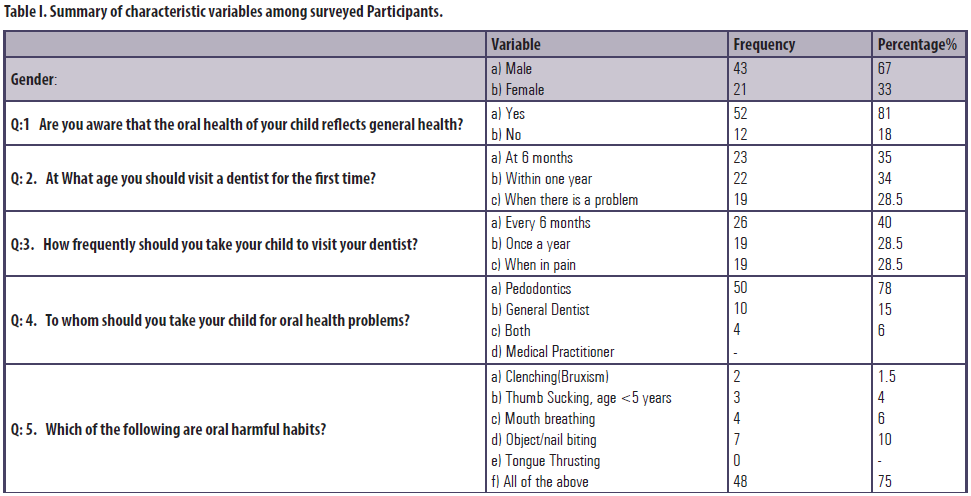
Out of the total population at both the centres, 64 participants responded to the questionnaire. Out of the total participants, 67 % (n = 43) were male respondents and 33 % (n = 21) were female respondents. (Graph: 1) The age group of the children at both the centres varied from 5 years to 35 years,it was divided into three age groups of children between 5-20 years 76%(n=49) ,21-35 years 23% (n=15). (Graph: 2) Table I Describes the sample characteristics variables among participants. About 81% of the parents had the knowledge that oral health affects the overall health of the child. 78% thought that they should consult a pediatric dentist when the child had dental problems. 44.5% parents thought that Autistic child should be given special care. 98.5% parents think that they should visit dentist regularly.. However 89% parents knows the importance of preventive measures advised by dentist. 78.5% parents brushed their child’s teeth once daily. 97% of the parents used conventional toothbrushes for their children. Attitudes and practice of parents seemed to be governed by financial restraints, and preconceived notions regarding co-operation of their child.


GRAPH 1

GRAPH 2
DISCUSSION
This study was carried out with the aim of assessing Knowledge, attitude and practice towards oral health care among parents of Autism Spectrum disorder children.
Autism Spectrum Disorder Children are an important group with special oral health care needs. These children are completely dependent on the parent or care taker for dietary care, oral hygiene maintenance and dental health care utilization. Hence, it is imperative to assess the parents’ knowledge, attitudes and practices with regard to oral health of autistic children. Furthermore, parents and care takers are important stakeholders in clinical as well as public health interventions for this target group, even when these children age through adolescence and even to adulthood.
This was a questionnaire based study at the two centres of different cities of Gujarat.Total 65 participants responded to the questionnaire.
The results of the present study revealed that majority of the parents are aware about the oral health of their child do reflect the general health. Parents responded that they visited the dentist when there was a need. But there is lack of awareness about subsequent dental visits.Most of the children were reported to be brushing once a day. The parents studied in this research reported that parents’ presence and assistance was inevitable during brushing. Decreased self efficacy has negative implications on the child’s oral hygiene performance, early identification of dental problems, dental trauma etc. Furthermore, the fact that many of the children have history of systemic diseases , eating disorders and speech impediments compounds to the existing risks for oral diseases. Poor oral health can lead to difficulties in eating, speech impediments, oral pain, disturbances in sleep, and decreased self-esteem which results in a negative effect on health and quality of life.9 Health-related quality of life in young autistic patients has been studied extensively whereas considerably less attention has been given to the oral health-related quality of life in young autistic patients. Parents are the decision makers in matters of health care for children with special health care needs; thus, they play an important role in achieving the best oral health outcomes for their children. Hence, this study suggests that oral health promotion programs should be introduced to special care to the children along with parental education When parents attend the clinic with their children, it is important they are educated on the need to reduce and as much as possible to substitute cariogenic snacks with fruits and vegetables. Since parents are responsible for almost all health issues related to their children, their role in modeling their children toward practicing preventive oral health throughout life is crucial. Dental care should be viewed as an integral part of a comprehensive health-care program. It is essential to practice good oral hygiene practices to maintain good oral health The attitude and behavior toward oral health maintenance are very important to maintain good oral hygiene. Dental care can sometimes be a forgotten part of a healthy lifestyle. Hence, every parent should be made aware of ways to keep their autism affected children healthy.
CONCLUSION
In the present study, we could see clearly that many of the parents were not aware of appropriate oral hygiene practices. The significance of oral hygiene should be made aware to all caretakers, parents, and hospital members so that the autistic child can lead a healthy and independent life as they mature. The results of this study show that most of the children preferred to brush once a day , which put them at higher risk of developing dental caries. And also parents are not aware about the subsequent dental visits. Appropriate oral health encouragement and treatment programs should be established to create awareness among parents and students to prevent oral diseases. Frequent tooth brushing, regular dental visits are highly recommended for parents to follow as preventive measures.
REFRENCES
- Jyoti M, Ashmitha K, Prakash C, Latha A, Punitha S. , Usha I. Knowledge, attitude and practice towards oral health care among parents of autism spectrum disorder children.Journal of Advanced Clinical & Research Insights (2015): 1, 1–5.
- P. Chaitanya Shree1, V. Rakshagan2, S. Dhanraj2, Ashish R. Jain2*. Knowledge, attitude, and practice on oral hygiene status in autistic children.Drug Invention Today(2018):10 :2115-2119
- UDhya J.1, VaraDharaJa M.M2, Parthiban J.3, ila SriniVaSan, Autism Disorder (AD): An Updated Review for Paediatric Dentists.Dentistry Section.Journal of Clinical and Diagnostic Research. 2014 Feb:8(2):275-279
- Konstantina D, Peter A, Reichart ,Michael M, Christos L.Management of children with autism spectrum disorder in the dental setting: Concerns, behavioural approaches and recommendations.Med Oral Patol Oral Cir Bucal. 2013 Nov 1;18 (6):e862-8.
- Önol, Z KırzıoÄŸlu. Evaluation of Oral Health Status and Influential Factors in Children with Autism Spectrum.Niger J Clin Pract 2018;21:429-35.
- Mohamed Abdullah JABER. Dental caries experience, oral health status and treatment needs of dental patients with autism.J Appl Oral Sci. 2011;19(3):212-7
- DeMattei R, Cuvo A, Maurizio S. Oral assessment of children with an autism spectrum disorder. J Dent Hyg 2007;81:65.
- Glassman P, Henderson T, Helgeson M, Niessen L, Demby N, Miller C, et al. Oral health for people with special needs. J Calif Dent Assoc. 2005;33:619-23.
- Peter S. Essentials of Preventive and Community Dentistry. 3rd ed. New Delhi: Arya (Medi) Publishing House; 2008. p. 594.
- WHO. Oral Health Survey-Basic Methods. 5th ed. Geneva: WHO; 2013.
- WHO. Oral Health Survey-Basic Methods. 4th ed. Geneva: WHO; 1997.
- Fombonne E. Epidemiology of pervasive developmental disorders. Pediatr Res 2009;65:591-8.
Disclaimer from Guident
The views and opinions expressed in articles published in Guident are solely those of the authors and do not necessarily reflect the views of the editors, the editorial board or the publisher, Ivory India. Guident does not endorse any product, technique or treatment described. Clinical content is intended for qualified dental and medical professionals and is not a substitute for individual clinical judgement. Guident, its editors and the publisher accept no liability for any consequence arising from the use of information published in the journal.
How to cite this article
Dr. Bhavna Dave, Dr. Drashti Jani. Knowledge, Attitude and Practice Towards Oral Health Care Among Parents of Autism Spectrum Disorder Children a Multicentric Questionaire Study. Guident. 2020 Jan;13(2). Available from: https://ivoryindia.in/articles/research/knowledge-attitude-and-practice-towards-oral-health-care-among-parents-of-autism-spectrum-disorder-children-a.html