Prevalence of Occupational Noise Induced Hearing Loss Amongst Traffic Police of Amravati City
Department of Public Health & Preventive Dentistry, VYWS Dental College & Hospital, Amravati, Department of Oral Medicine Diagnosis & Radiology, VYWS Dental College & Hospital, Amravati
ABSTRACT
IntroductionNoise is unwanted or undesirable sound which can be either environmental or occupational. Noise causes number of adverse health effects to humans with noise-induced hearing loss (NIHL) being one of the serious outcomes. Hearing loss attributed to noise is one of the most common occupational disease and second most common self-reported occupational illness or injury.
Aim of the study To study the incidence of noise induced hearing loss amongst traffic police personnel in Amravati city.
Material & methods A cross sectional, descriptive inter-institutional study was conducted at Dr Punjabrao Deshmukh Memorial Medical College and VYWS Dental college, Amravati. Audiometric survey was carried out on 90 Traffic police personnel from Amravati city. Hearing will be measured in a sound treated room by pure tone audiometry (PTA) (air and bone conduction) in the frequencies 0.25, 0.5, 1, 2, 4 and 6 kHz for both ears using Midimate 602 Clinical Audiometer. Measurements were taken using 5 dB increments.. Demographic characteristics and study variables were analyzed using descriptive statistics. Means, standard deviations and ranges were reported for continuous variables. Frequencies and percentages were reported for categorical variables.
Results The overall prevalence of Oro-mucosal lesions was 10(11.11%) with OSMF followed by 8(8.88%) with Leukoplakia. Prevalence of subjects with hearing loss belongs mostly to age group less than 40 years of age. Mean hearing threshold is highest in left ear of below age group of 30 years. 22 participants (24.44%) were having right ear hearing impairment and 17 (18.88%) were having left ear hearing impairment. Only 1% of participant was having severe hearing impairment in left ear while none of the participant was having hearing impairment in Right ear.
Conclusion Periodic checking of traffic policeman (clinically and audio logically) should be done regularly at frequent intervals of time. Awareness should be created among traffic policemen about the auditory and non-auditory effects of noise by implementing education and training programs.
INTRODUCTION
Noise is unwanted or undesirable sound which can be either environmental or occupational. Noise causes number of adverse health effects to humans with noise-induced hearing loss (NIHL) being one of the serious outcomes. NIHL is a sensory-neural hearing loss occurring in people who are exposed to noise for a long period with other reasons for hearing loss being excluded.1
Noise rarely damages the tympanic membrane and middle ear. High intensity impulse noise (explosions) can rupture the eardrum and disrupt the ossicular chain. Middle ear muscles play no part in the defense of the inner ear against high intensity impulse noise. Other mechanisms that protect the inner ear are slippage of the incudomalleal joint, a maximal limit of stapes displacement, and unlinking of the ossicular chain.2
Hearing allows us to be involved with the world around. Hearing impairment is one of the major problems in our country. Hearing loss attributed to noise is one of the most common occupational disease and second most common self-reported occupational illness or injury.3
Noise causes auditory and non auditory effects on our body. Noise has many ill effects on body even though air pollution, water pollution has attracted majority of researchers but little attention has been paid to noise pollution and its effects. Noise acts upon the body very much as other stress do & so its effects are far reaching affecting body functions mainly hearing.4
Automobiles are an important source of not only air pollution but also of a significant proportion of noise pollution. The traffic police engaged in controlling traffic, particularly at heavy traffic junctions belong to the high risk group to be affected by the health hazards of noise & air pollution.5 Most of traffic policemen are aware of the air pollution but a majority of them remains unaware about the long term ill effects of noise on their hearing ability as this is an insidious process and takes long time to become overt.
Sound is produced by compression and rarefaction of particles in an elastic medium such as air and water. Frequency of sound is measured in cycles/second or Hertz (Hz). Sound of frequencies less than 20Hz are called infra-sonic and greater than 20,000 Hz are ultra-sonic. Normally, human ear can hear sounds of frequencies between 20 to 20,000 Hz. The amplitude of a sound is expressed in decibel (dB). A range of 120 to 160 dB is classified as painful; 90 to 110 dB is classified as extremely high; 60 to 80 dB is classified as very loud; 40 to 50 dB is moderate; and 30 dB is faint.6 Practically, there is no difference between sound and noise.
Sound is a sensory perception and noise corresponds to the undesired sound. By extension, noise is any unwanted disturbance within a useful frequency band.7 Noise has become very important “stress factor” in the environment of people. Noise has multiple adverse effects making noise pollution a public health concern although it has not been well addressed. Some of them are elevated blood pressure, noise-induced hearing loss (NIHL), sleep disorders, and irritability.8
Noise-induced hearing loss (NIHL) is second only to age induced hearing loss or presbycusis. It occurs as a result of exposure to recreational and occupational noise that results in damage to hair cells of the cochlea in the inner ear. These hair cells are indispensable components of the inner ear that are responsible for conversion of sound energy to electrical signals transmitted to the brain. The damage is irreversible once it occurs. Usually, prolonged noise exposure causes NIHL.8
An average traffic sound in the city is about 60-100 dB by a close observer. When there is exposure to sound level approximately 85dB, initially it causes temporary dullness of hearing (temporary threshold shift) which usually recovers within 24 hours of exposure; whereas if there is repeated sustained exposure, the threshold shift becomes permanent (permanent threshold shift) due to nerve fiber degeneration.9,10
Occupational Safety and Health Association (OSHA) has set 90 dBA as the time-weighted average (TWA) for an 8-hour work day exposure to noise.11 This limit according to National Institute of Occupational Safety and Health (NIOSH) is 85 dBA.12 The ill effect of noise exposure is well evidenced by researchers which include both auditory and nonauditory effects such as fatigue, depression, impulsive behavior, and inability to concentrate on tasks.13,14 Further, it could lead to either temporary or permanent shift in the threshold of hearing due to unwanted exposure of noise on daily basis. The rapid growth of many cities in developing countries like India increases the use and ownership of motor vehicles.15 Further, lack of awareness among general public in connection with when and where to use horns during driving vehicles leads to noise pollution.16 This could be the reason, the traffic police who are engaged in controlling heavy traffic are more susceptible to NIHL as they are continuously exposed to the high level of noise.17 In India, occupational permissible noise levels limit for 8 h time-weighted average is 90 dB.18
AIM & OBJECTIVE
- To study the incidence of noise induced hearing loss amongst traffic police personnel in Amravati city.
- To find out whether hearing loss was associated with age, duration of service or any risk factors.
- To create awareness regarding noise induced hearing loss.
- To suggest preventive measures to reduce incidence of noise induced hearing loss.
MATERIAL & METHODS
A cross sectional, descriptive inter-institutional study was conducted at Dr Punjabrao Deshmukh Memorial Medical College and VYWS Dental college, Amravati. Audiometric survey will be carried out on 90 Traffic police personnel from Amravati city. Prior to audiometric assessment, a detailed medical, personal and occupational history was taken.
Questionnaires elicited more detailed information on risk factors like smoking, alcohol consumption, acute noise trauma, ototoxic drugs and prior ear diseases. Hearing will be measured in a sound treated room by pure tone audiometry (PTA) (air and bone conduction) in the frequencies 0.25, 0.5,1,2,4 and 6 kHz for both ears using Midimate 602 Clinical Audiometer. Measurements were taken using 5 dB increments.
Middle ear pathology will be assessed by otomicroscopy, impedance audiometry and air-bone gap. A threshold of >25dB was considered to be hearing loss in any of the above frequencies.
Audiogram of noise induced hearing loss showed air and bone conduction losses both reduced unilaterally or bilaterally with notch at 4 kHz. Air conduction with average hearing loss of >25 dB at 1,2,3 KHz. Typical audiogram of NIHL along with exclusion of all other associated causes of hearing loss confirmed diagnosis of NIHL.
As per World Health Organization (WHO,1986), hearing loss was then assessed: less than 25 dB (normal), 25–40 dB (slight), 41–60 dB (moderate), 61–80 dB (severe), and above 80 dB (extreme). According to American Academy of Otolaryngology-Head and Neck Surgery (AAO-HNS)’s definition in 1997 asymmetric hearing loss is defined as HTL (hearing threshold level) difference of greater than 15 dB at 0.5, 1, or 2 kHz or 30 dB at 3, 4, or 6 kHz between two ears.
The audiometric data was analyzed for their sex, age, duration of exposure in years of service, hearing loss, symmetrical or asymmetrical hearing loss, risk factors etc.
All the responding traffic police personnel working in Amravati city with normal looking tympanic membrane and no diseases of the external ear during the time of examination were included in the study. Patient of hypertension, diabetes, history of meningitis, ear surgery (apart from myringoplasty), hereditary loss, usage of ototoxic drugs, any history of head injury or mechanical hearing loss ( air- bone gap > 10 dB) were excluded.
STATISTICAL ANALYSIS
The data was calculated in an excel spreadsheet which was be then exported SPSS (15.0) for analysis. The statistical significance was set to p< 0.05. Demographic characteristics and study variables were analyzed using descriptive statistics. Means, standard deviations and ranges were reported for continuous variables. Frequencies and percentages will be reported for categorical variables.
RESULTS
A cross sectional descriptive study was conducted to assess the prevalence of Occupational Noise Induced Hearing Loss and Oral health status of 90 traffic Police Personnel of Amravati City. The data was collected during the month of Dec –April 2018. Among the study population, 54 (60%) were males and 36 (40%) were Females [Table 1]. Most of the subjects belong to 30-39 age group [Table 2]. 12% of the study population were only Tobacco chewers, 2% were Smokers, 2% habituated to both Smoking and Tobacco chewing, 2% to Smoking as well as Betel nut chewing and 2 % habituated to Tobacco Chewing as well as Betelnut chewing [Table 3]. The overall prevalence of Oro-mucosal lesions was 10(11.11%) with OSMF followed by 8(8.88%) [Table 4] with Leukoplakia. Number of Teeth decayed was 56 (62.22%) [Table 5]. Attrition was the most common wasting disease accounting to 22 (24.44%) followed by participants with both attrition and abrasion accounting to 4 (4.44%) [Table 6]. Prevalence of subjects with hearing loss belongs mostly to age group less than 40 years of age [Table 7]. Mean hearing threshold is highest in left ear of below age group of 30 years[ Table 8] 22 participants (24.44%) were having right ear hearing impairment and 17 (18.88%) were having left ear hearing impairment[Table 9]. Only 1% of participant was having severe hearing impairment in left ear while none of the participant was having hearing impairment in Right ear. [Table 10].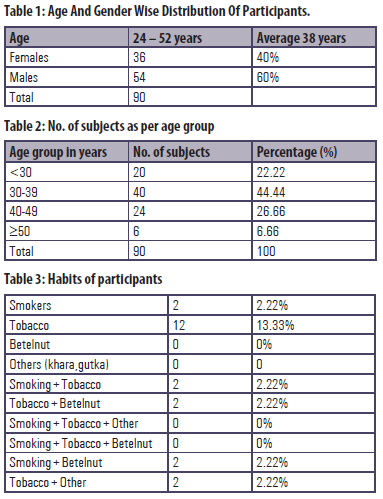
Pic A: Pre-Operative OPG

Pic A: Pre-Operative OPG

Pic A: Pre-Operative OPG
For Participants with grade 1 impairment: Counselling. Hearing aids may be needed.
For Participants with grade 2 impairment: Hearing aids usually recommended.
For Participants with grade 3 impairment: Hearing aids needed. If no hearing aids available, lipreading and signing should be taught.
For Participants with grade 4 impairment: Hearing aids may help understanding words. Additional rehabilitation needed. Lip-reading and sometimes signing essential

Pic A: Pre-Operative OPG
DISCUSSION
Noise is defined as unpleasant sound that the listener does not want to hear.12 Noise induced hearing loss (NIHL) is one of the causes of Sensorineural hearing loss (SNHL) which occurs as a result of damage to the outer hair cells of the cochlea in the inner ear. It is a permanent hearing impairment resulting from prolonged exposure to high levels of noise.13 It is the most common cause of sensorineural hearing loss which is preventable. High frequencies are affected first, typically at 4 kHz, followed by middle and lower frequencies.14 The problem needs to be addressed as there is no medical therapy for hearing loss caused by noise. Once established, the hearing loss is irreversible.15 Internationally, the contribution of occupational noise exposure to total deafness rates is approximately 7% in the most developed nations and 21% in developing countries.16 This study was conducted in 90 healthy traffic policemen to detect noise induced hearing loss.
Out of 90 subjects, Noise induced hearing loss was observed in 56 (62%) whereas 34 traffic personnel (38%) were having normal hearing. Our study is in agreement with a study conducted in Malaysia, who studied noise exposure and noise induced hearing loss among Kuala Lumpur traffic point duty personnel and found that 80% were positive for noise induced hearing loss.16 Amongst all the 56 NIHL cases, most of the subjects had mild impairment (26-40 dB) followed by moderate impairment (41-55dB) which is consistent with a study who concluded that 24% of the traffic policeman of Dhaka had mild to moderate sensorineural hearing loss due to noise exposure which was related to duration of exposure.19 Our study showed right sided predominance, which is in consonance with a study who also reported right sided hearing loss.20
CONCLUSION
- Periodic checking of traffic policeman (clinically and audiologically) should be done regularly at frequent intervals of time.
- Traffic policemen should be provided with hearing protective devices such as ear muffs, ear plugs and ear canal caps free of cost.
- Awareness should be created among traffic policemen about the auditory and non-auditory effects of noise by implementing education and training programs.
REFERENCES
- Pyykkö, I. et al. (2007). Individual susceptibility to noise-induced hearing loss. Audiological Medicine, 5(1): 41–53. Available at: http://informahealthcare.com/doi/abs/10.1080/16513860601175998 [Accessed March 5, 2015].
- Jahrsdrefer, R., (1979): The effects of noise on the eardrum and middle ear. Otolaryngological Clinics of North America. 12; 515–520.
- Ashraf M, HussainNisar et al. Noise Induced Hearing loss - An occupational Hazard. Ind J Qtology.2005 :11 : 17-21.
- UrvashiRazdan, TS Sidhu. Need for research on Health hazards due to Noise pollution in Metropolitan India. J Ind Med Assoc. 2000;98(8):453-456.
- TripathiSomnath, TiwariRajnarayan, Self reported hearing quality of traffic policemen : A qustionaire - based study. Ind J OccupEnvinon Med. 2006;10:82-84.
- Barrett KE, barman SM, Boitano S and Brooks HL. Hearing and equilibrium. In: Ganong’s Review of Medical Physiology, 23rd edition. Tata McGraw Hill Edition, New Delhi 2010; chapter 13:209.
- National Institute of Occupational Safety and Health (NIOSH). Criteria for a recommended standard: occupational noise exposure- revised criteria, 1998. Cincinnati(OH): US Department of Health and Human Services 1998; publication number 98-126.
- Goines L and Hagler L. Noise pollution: a modern plague. Southern Med J 2007;100:287-294.
- Thorne PR, Ameratunga SN, Stewart J , Reid N,Williams W, Purdy SC, Dodd G, Wallaart J. Epidemiology of noise-induced hearing loss in New Zealand. Journal of the New Zealand Medical Association 2008;(121):1280.
- Dobie RA. Medical-Legal Evaluation of Hearing Loss (2nd ed.). San Diego: Singular / Thompson Learning; 2001.
- Occupational Safety and Health Administration (OSHA): Final regulatory analysis of the hearing conservation amendment. Report No. 723-860/752 1B3. Washington, DC: Government Printing Office; 1981.
- NIOSH. A proposed national strategy for the prevention of noise-induced hearing loss, Chapter 8 in: Proposed National strategies for the Prevention of Leading Work-Related Diseases and Injuries, Part 2. Cincinnati, OH: National Institute for Occupational Safety and Health; 1988.
- Goines L, Hagler L. Noise pollution: A modem plague. South Med J 2007;100:287
- Leon Bluhm G, Berglind N, Nordling E, Rosenlund M. Road traffic noise and hypertension. Occup Environ Med 2007;64:122-6.
- Agarwal S, Swami BL. Road traffic noise, annoyance and community health survey – A case study for an Indian city. Noise Health 2011;13:272-6.
- Thomas N, Mariah AN, Fuad A, Kuljit S, Philip R. Noise exposure and noise induced hearing loss among Kuala Lumpur traffic point duty personnel. Med J Malaysia 2007;62:152-5.
- Venkatappa KG, Shankar V, Annamalai N. Assessment of knowledge, attitude and practices of traffic policemen regarding the auditory effects of noise. Indian J Physiol Pharmacol 2012;56:69-73.
- Prakash A, Joute K, Jain VK. An estimation of annoyance due to various public modes of transport in Delhi. Noise Health 2006;8:101-7.
- Sharif A, Taous A, Siddiqui BH and Dutta PG. Prevalence of noise induced hearing loss among traffic police in Dhaka Metropolitan City. Mymensingh Med J 2009;18(1):24-28.
- Sharif A, Taous A, Siddiqui BH and Dutta PG. Prevalence of noise induced hearing loss among traffic police in Dhaka Metropolitan City. Mymensingh Med J 2009;18(1):24-28.
Disclaimer from Guident
The views and opinions expressed in articles published in Guident are solely those of the authors and do not necessarily reflect the views of the editors, the editorial board or the publisher, Ivory India. Guident does not endorse any product, technique or treatment described. Clinical content is intended for qualified dental and medical professionals and is not a substitute for individual clinical judgement. Guident, its editors and the publisher accept no liability for any consequence arising from the use of information published in the journal.
How to cite this article
Dr. Roshani Chawla, Dr. S. M. Rawlani, Dr. Shashwati Choube. Prevalence of Occupational Noise Induced Hearing Loss Amongst Traffic Police of Amravati City. Guident. 2020 Jan;13(2). Available from: https://ivoryindia.in/articles/research/prevalence-of-occupational-noise-induced-hearing-loss-amongst-traffic-police-of-amravati-city.html