
Management of Fratured Teeth
Seema Dental College & Hospital, Rishikesh, Uttrakhand, India
INTRODUCTION
Provision ofinnovative treatment solutions to various problems has always been the motto of medical scientific brains. Dentistry is no exception to this endeavor. The acceptance ofadvances in material science has really helped this cause. Ribbond is one such material, which has occupied an important place in the dentist's repertoire.
It is bondable fibre reinforced material, made from the same ultra-high molecular weight polyethylene and ceramic fibers used to make bulletproof vests.
The key to Ribbond's success is its patented leno weave. Designed with a lock-stitch feature, it effectively transfers forces throughout the weave without stress transfer back into the resin, providing excellent manageability characteristics.
Having virtually no memory, Ribbond adapts to the contours of the teeth and dental arch. It is translucent, practically colorless and disappears within the composite or acrylic withoutshow-through offering excellent esthetics. Ribbond's fibers are the standard in biocompatibility.
The same material is also used in the construction of artificial hip and knee joints.
By virtue of such wide spectrum of intended properties, it enjoys varied applications in day to day dentistry like: endodontic posts, periodontal splints, aesthetic space maintainers, bondable bridges and single bridges and orthodontic retainers.
CASE 1
An18 year patient reported in the Department Of Conservative Dentistry and Endodontics in Seema Dental College and Hospital with a chief complaint of fractured teeth in the anterior teeth region. The patient had history of trauma was hit by cricket ball.
On clinical examination it was found:
- Grade II mobility with respect to Right Maxillary Central Incisors
- Rotated crown portion in the Right Maxillary Central Incisors
- Periodontal was normal

On radiographic examination:
The two fracture segment was on approximation to each other
Horizontal line fracture was present in the mid section of the root
A treatment plan was suggested to the patient which included:
- Stabilization of the fractured segments.
- Followed by the stabilization of the fractured root.
- Crown in relation to tooth
The immediate goal was to stabilize the fracture segment. The teeth was stabilized by composite material ((Tetric N-Ceram, Ivoclar Vivodent)

Working length was determine

Calcium hydroxide with idoform was placed inside the canal as per to reduce any chance of any persistingperapical lesions

Calcium hydroxidewas removed after time duration of 15 days as the patient was asymptomati

A plugger was selected to make a MTA plug in the apical area of the canal as to prevent external/internal resorption

MTA was mixed with chorhexidine as studies has indicated as it enhances antibacterial property by 35%which is statistically very significant

MTA plug formation -MTA plug formed slowly as it was carried through a no.25 K File whose tip was cut to make the instrument blunt
After MTA plug formed cotton pallet dipped in chlorhexidine was placed to the canal as MTA takes 72 hours to completely set.
Patient recalled after 72 hours as MTA has set
Ribbond material was selected for the filling of the root canal as per to maintain the stabilization of fracture segment and canal
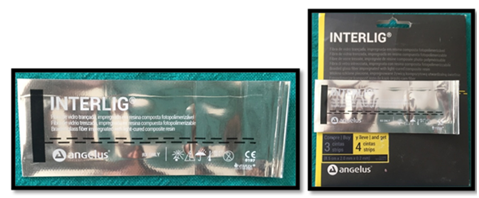
Ribbond fibers -Placed the fiber in the bonding agent as per to increase the wettabilty to properly adhere to the root canal
Placed fibers in the canal
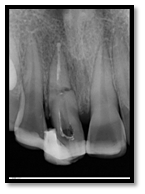
Post operative radiograph after the placement of Ribbond fibers in the canal
CASE 2
A55 year patient reported in the Department Of Conservative Dentistry and Endodontics in Seema Dental College and Hospital with a chief complaint of fractured teeth in the anterior teeth region.
On clinical examination it was found:
- Root canal treated in Right Maxillary Canine
- Fractured crown portion in the Right Maxillary canine
- Periodontal was normal
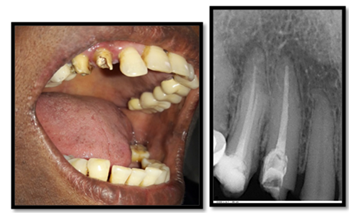
A treatment plan was suggested to the patient which included:
- Placement of Post and Core
- Followed by the crown in relation to tooth

Post sapce was prepared

Canal was etched with 37% phosphoric acid

Fibers were placed in bonding agentFibers placement in the canals

Core buildup w.r.t. 13
CASE 3
A 25 year patient reported in the Department Of Conservative Dentistry and Endodontics in Seema Dental College and Hospital with a chief complaint of fractured teeth in the anterior teeth region. The patient had history of root canal treatment done of the same tooth 3months back.
On clinical examination it was found:
- Fractured crown with respect to maxillary left central incisor.
- Periodontium was normal with respect to fractured tooth.
On radiographic examination:
- Fracture involving crown portion of the tooth.
- Root canal treatment was performed.

MANAGEMENT
The immediate goal was to restore the fractured tooth surface.
Post space was prepared with peso reamer 1, 2 and 3.

Ribbond material was selected for the filling of the root canal space.

Placed the fiber in the bonding agent as per to increase the wettabilty to properly adhere to the root canal.

Placed fibers in the canal and initial core build up was done with GIC.

Post operative

DISCUSSION
In the restoration of traumatized anterior teeth, both esthetics and mechanical resistance to fracture are of great importance in obtaining good long lasting results. Ribbond fibers represent an effective means to confer a higher mechanical strength to composite restorations, without changing the esthetic results.
The translucency of Ribbond fibers make them more esthetic than carbon fibers. In these clinical cases, we found it was very easy to lay Ribbond fibers and stratify composite materials, allowing a quick restoration of the dental morphology. In the case of a complex crown fracture , the dental restoration by Ribbond fibers and composite create a central support stump could be a useful therapeutic approach in order to shorten the recovery period following prosthetic restoration.
CONCLUSION
The use of Ribbond, a polyethylene fiber, is based upon the clinical reports of tooth replacement by Bredenstein and Sperber, Marcus, Miller, and Portilla, among others.Ribbond. also has been described as being used for periodontal splints, strengthening removable prosthesis, post and core fabrication, provisional and permanent bridges, denture repairs, and a framework for composite onlays and crowns.
Splinting teeth for periodontal, orthodontic, or posttraumaticreasons is a common procedure. Althoughtraditional methods are successful, splinting teeth withreinforcement fibers that can be embedded in compositeshas gained popularity.
Ribbond is a biocompatible, esthetic material made from a high-strength polyethylene fiber. The various advantages of this material include ease of adaptation to dental contours and ease of manipulation during the bonding process. Because it is a relatively easy and fast technique (no laboratory work is need), procedures can often be completed in a single appointment. It also has acceptable strength because of good integration of fibers with the composite resin; this leads to good clinical longevity. Because a thinner composite resin is used, the volume of the retention appliance can be minimized. In addition, in case of fracture during wear, the appliance can be easily repaired. There is no need for removal of significant tooth structure, making the technique reversible and conservative. It also meets the patients’ esthetic expectations.
REFERENCES
- DeliperiS , Bardwell D, Colana C, "Reconstruction of Devital Teeth Using Direct Fiber-reinforced Composite Resins: A Case Report" Journal Adhesive Dentistry, 7, 1-7,( 2005).
- Dickerson W.G, "A Conservative Alternate to Single Tooth Replacement: A Three Year Follow-Up," Practical Periodontics and Aesthetic Dentistry, 43-49,(1993).
- S. Belli, H. Orucoglu, C. Yildirim, G. Eskitascioglu., "The effect of fibre placement or flowable resin lining on microleakage in class II adhesive cavities," Abstract presented at The 2nd International Congress on AdhesiveDentistry Tokyo, Japan, April, 22-24 (2005).
- Bender A. J, "Single Appointment Crown and Bridge, An Innovative Technique," Dentistry Today 84-87, (2002).
- Iniguez I " Direct Composite Restoration on a Fractured Anerior Tooth," American Academy of Cosmeticdentistry Journal , 38-44. (2000).
- Karbhari V.M, Strassler H &Rudo D.N "The Development and Clinical Use of a Leno Woven UHMWPE Ribbond in Dentistry", Soceity for Biomaterials 29th Annual Meeting Transaction . 529. ( 2003).
- Kau K &Rudo D.N, "A Technique for Fabricating a Reinforced Composite Splint," Trends and Techniques in the Contemporary Dental Laboratory, 31-33:(1992).
- Mahony D, "Using a high-strength, esthetic fiber for the construction of post orthodontic retainers: rationaland technique," The Journal of the Australasian Association of Orofacial Orthopaedics, ( 2003).
- Miller T.E." A New Material for Periodontal Splinting and Orthodontic Retention," The Compendium of Continuing Education ,800-812. (1993).
- Nash R & Kau K , " Reinforcing Composite Resin: A Restorative Alternative" The Compendium of Continuing Education, 554-560. (1994).
Disclaimer from Guident
The views and opinions expressed in articles published in Guident are solely those of the authors and do not necessarily reflect the views of the editors, the editorial board or the publisher, Ivory India. Guident does not endorse any product, technique or treatment described. Clinical content is intended for qualified dental and medical professionals and is not a substitute for individual clinical judgement. Guident, its editors and the publisher accept no liability for any consequence arising from the use of information published in the journal.
How to cite this article
Dr. Annil Dhingra Dr. Nitika Dr. Neha Arya Department of Conservatine Dentistry and Endodontics. Management of Fratured Teeth. Guident. 2017 Oct;10(11). Available from: https://ivoryindia.in/articles/endodontics/management-of-fratured-teeth.html


