Provisionalisation in Aesthetic Implantology : An Insight
Yenepoya Dental College, Deralakatte, Mangalore (Kar) India, Thai Moogambigai Dental College & Hospital, Chennai, India, K. D. Dental College & Hospital, Mathura, U.P India, Department of Prosthodontics
INTRODUCTION
After implant placement, it takes few months for it to be finally loaded. Until this period the patient will require a transitional prosthesis to satisfy the requirements of esthetics, speech and mastication. Hence a provisional restoration (transitional prosthesis) is required. The provisional prosthesis should be designed to sustain or improve the quality of life for patients undergoing implant therapy.
DEFINITION
A fixed or removable dental prosthesis designed to enhance esthetics, stabilization and/or function for a limited period of time, after which it is to be replaced by a definitive dental or maxillofacial prosthesis.
NEED FOR AESTHETIC PROVISIONAL RESTORATION
- To overcome patient’s apprehension of social image.
- To restore function and phonetics.
- To achieve an optimal soft tissue profile.
- To maintain space for the final prosthesis.
- To protect the osteotomy site.
Factors Of Consideration While Fabricating A Provisional Prosthesis:-
- Provisional restoration should not interfere with primary wound closure.
- It should restore esthetics and phonetics.
- It should protect the underlying gingival tissues.
- It should not exert any direct biting loads to the underlying implants.
- Should be out of occlusal contact in centric and eccentric positions.
PROVISIONAL RESTORATIVE MATERIALS
An ideal provisional material should have the following characteristics:-
- Convenient handling
- Biocompatibility
- Dimensional stability during solidification
- Ease of contouring and polishing
- Adequate strength and abrasion resistance
- Good appearance
- Good patient acceptance
- Ease of adding or repairing
- Chemical compatibility with provisional luting agents
Materials Available
- POLYMETHYLMETHACRYLATE
- POLYETHYL METH ACRYLATE
- POLY VINYL METHYL METHACRYLATE
- BIS-ACRYL COMPOSITE
- VISIBLE LIGHT CURE URETHRANE DIMETHACRYLATE
Classification Based On Edentulous Span
Single tooth missing
- Tissue supported (RPD)
- Teeth supported (Resin bonded bridge
- Implant supported (Immediate loading)
- Essix appliance
Multiple teeth missing
- Tissue supported (RPD)
- Implant supported (Immediate loading)
- Essix appliance
Completely edentulous
- Implant supported
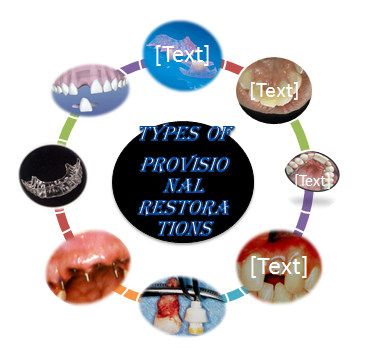
PROVISIONALIZATION PRIOR TO IMPLANT LOADING
|
Type of Support |
Prosthesis Type |
|
Removable Fixed tooth supported Fixed implant supported |
Partial acrylic dentures Essix appliance Archwire supported pontic Resin bonded pontic Resin bonded, cast metal framework bridge Transitional implants Implant supported |
Advantages And Disadvantages Of Aesthetic Provisionalization
ADVANTAGES
Patient management with a provisional prosthesis has following advantages:
1. Elimination of discomfort.
2. Protection of osteotomy site.
3. Psychological comfort to the patient.
4. Properly planned may lead to good soft tissue profile.
5. Maintains the position of adjacent teeth
DISADVANTAGES
1.Additional cost is involved.
2. If not planned properly may interfere with osseo-integration leading to failure.
REMOVABLE PARTIAL DENTURES
- Most widely used as it is inexpensive and easy to fabricate.
- Indicated in case of long edentulous spans and where multiple surgical re-entries are planned.
- Limits function and phonetics due to instability.

ESSIX APPLIANCE
- A removable, temporary restoration.
- A vaccumform shell of the arch is fabricated from a stone model, prior to the extraction of a tooth.
- The crown of the extracted tooth may be bonded to the retainer, or more commonly, tooth colored resin fills the space previously occupied by the crown of the extracted tooth.
- Protects the underlying soft tissue.
- Improper use may cause occlusal wear under vaccumform material.


Bonded Provisional Restorations

GLASS FIBRE REINFORCED COMPOSITE RESIN
- Indicated in young age patients.
- Relatively short time for insertion.
- More esthetic.
- Minimal tooth preparation.
- Good flexure strength.

ADHESIVE BONDING RESIN

Ribbon 4 mm wide wetted with adhesive bonding resin

Ribbon covered with flowable composite

Ribbon 4 mm wide ribbon extended midway buccally on proximal surfaces
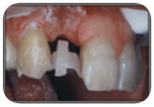
Ribbon 3 mm wide wrapped on 4-mm piece to reinforce core build-up
ARCHWIRE SUPPORTED PONTIC
(Using an existing appliance)

In case of an existing appliance, it can be made use to support provisionals, which can be directly bonded over the archwire appliance
ADHESIVE BRIDGES
- A more esthetic and acceptable option
- Totally tooth supported.
- Cannot be used in long edentulous spans
- Mainly indicated for anterior single tooth cases
- Not suitable in case of multiple re-entries to the surgical site.
- Does not exert any pressure on the implant area.

MODIFYING AN EXISTING PROSTHESIS
- Indicated when the patient seeks implant therapy to replace an existing prosthesis because it does not function properly.
- In case of existing bridges, an impression should be made with the failed bridge in place.
- It is then removed, modified and temporarily cemented back.
- In case of dentures, they can be relined and used as interims.

TRANSITIONAL IMPLANTS
- A new concept in provisionalization.
- Introduced in 1993 as a treatment alternative.
- Involves the placement of miniature implants to restore fixed or removable temporary prosthesis.
- Offer a more stable, non-mobile, esthetic interim prosthesis
- Specially indicated in totally edentulous patients.

PREREQUISITES FOR USING TRANSITIONAL IMPLANTS
- Bone height of at least 7mm to allow for initial stability.
- An interocclusal space of at least 6mm to 9mm.
- Transitional implants should be placed at a distance of 1mm-2mm from the site of the permanent implants to avoid interrupting osseointegration.
- In case of single tooth replacements, transitionals should be placed lingually or palatally. .
- Placement of the transitional implant in bone of inadequate volume may result in potential fracture or premature loss of the implant fixture.
- Contraindicated in excessively resorbed ridges or compromised bone heights.
CONCLUSION
- Provisionalization thus means restoring esthetics, phonetics, and functional requirements from the provisional restoration while simultaneously preserving or enhancing the condition of the dental and gingival tissues until the reconstruction of the final prosthesis is completed.
- Therefore the primary goal of establishing a final restorative result should be no more successful than fabricating a functional esthetic provisional prosthesis that precedes it.
REFERENCES
- Smidt A. Esthetic provisional replacement of a single anterior tooth during the implant healing phase: a clinical report. J Prosthet Dent 2002;87: 598-602.
- Poggio CE, Slavato A. Bonded provisional restorations for esthetic soft tissue support in single-implant treatment. J Prosthet Dent 2002;87:688-91.
- Jonathan C. Meiers, Use of a prefabricated fiber-reinforced composite resin framework to provide a provisional fixed partial denture over an integrating implant:A clinical report (J Prosthet Dent 2006;95:14-8.)
- Color atlas of dental implant surgery
Disclaimer from Guident
The views and opinions expressed in articles published in Guident are solely those of the authors and do not necessarily reflect the views of the editors, the editorial board or the publisher, Ivory India. Guident does not endorse any product, technique or treatment described. Clinical content is intended for qualified dental and medical professionals and is not a substitute for individual clinical judgement. Guident, its editors and the publisher accept no liability for any consequence arising from the use of information published in the journal.
How to cite this article
Dr. Hasan Sarfaraz, Dr. Rathika Rai, Dr. Varun Singla. Provisionalisation in Aesthetic Implantology : An Insight. Guident. 2014 Jul;7(8). Available from: https://ivoryindia.in/articles/implantology/provisionalisation-in-aesthetic-implantology-an-insight.html