Down Syndrome- Diagnosis and Guidelines of Dental and Orthodontic Management
Department of Orthodontics and Dentofacial Orthopedics, Rishi Raj Dental College and Hospital, Bhopal, India, Department of Oral Pathology, L.N. Medical College and Research Centre, Bhopal, India, Umrao Hospitals and Impressions Dental and Maxillofacial Center, India
Abstract
Down syndrome named after John Langdon Down, the first physician to identify the syndrome, is a chromosomal disorder caused by an error in cell division resulting in the presence of an additional third chromosome 21 or trisomy 21. Significant alterations of the cranio-orofacial region have been observed in subjects with Down’s syndrome. Down syndrome is the commonest autosomal chromosomal anomaly with an incidence of 1 in 600 to 1000 live births in all races and economic groups. In this condition extra genetic material causes delays in the way a child develops, both mentally and physically. The physical features and medical problems associated with Down syndrome can vary widely from child to child. This article presents a comprehensive summary of Down’s syndrome.
Key words: Down syndrome, Autosomal, Trisomy 21, Orthodontics, Dental
INTRODUCTION
Accurate diagnosis of a specific syndromes among the 0.7% of babies born with multiple malformations is a necessary pre requisite of providing a prognosis and plant of management for the affected infant, as well as genetic counseling for the parents. Providing oral care to people with Down syndrome requires adaptation of the skills we use every day. In fact, most people with mild or moderate Down syndrome can be successfully treated in the general practice setting. Down syndrome, a common genetic disorder, ranges in severity and is usually associated with medical and physical problems. For example, people with this developmental disability may have cardiac disorders, infectious diseases, hypotonia, and hearing loss. Additionally, most people with this disorder have mild or moderate intellectual disability, while small percentages are severely affected. Developmental delays, such as in speech and language, are common1,10.
Epidemiology
Down syndrome occurs in all areas of the world and among all racial groups. The prevalence
is 1 in 650-800 live births. As such, Down syndrome is the most common chromosomal abnormality1,2.
ETIOLOGY
Approximately 95% of Down syndrome cases are due to Trisomy 21. A trisomy is the
presence of three, instead of the normal two chromosomes3.
Types
There are at least 3 forms of down syndrome 1-3 .
- There is typical trisomy 21 with 47 chromosomes (95% of cases)
- Translocation type : There appear to be only 46 chromosomes although extra chromosomal material of 21st translocated to another chromosome of “G” and “D” group (3% of cases)
- Chromosomal mosaicism (about 2% of cases)
The risk of having an affected child of the typical trisomy 21 type is one is 2000 live births in women under 30 years of age but rises dramatically to one is 50 live births is women over 45 years of age.
To approach toward the evaluation of an individual with multiple defects, following are the steps-
- Gather information i.e. family history, onset and vigor of fetal activity, gestational timing, indications, of uterine constraint, mode of delivery, size of birth, problem in postnatal growth and development.
- Interpret the gathered information and strive to answer following questions
- Which anomaly represents the earliest defect in morphogenesis?
- Can all the anomalies in the patient be explained on the basis of a single problem that leads to cascade of subsequent defects?
- Does the patient has multiple structural defects that cannot be explained on the basis of a single initiating defect but rather appear to be the consequence of multiple defects in one or more tissues? These are referred to as malformation syndromes.
- Attempt to arrive at a specific over all diagnosis.
Abnormalities 4-7
General:
- Hypotonia with tendency to keep mouth open and protrude the tongue
- Hyperflexibility of joints, relatively small stature with awkward gait
- Increased weight in adolescence
- Children have increased risk of acute leukemia
Central nervous system: Mental deficiency
Craniofacial
- Brachycephaly with relatively flat occiput and tendency towards midline parietal hair whorl
- Mild microcephaly
- Thin cranium with late closure of fontanelle
- Hypoplasia to aplasia of frontal sinuses, short hard palate
- Small nose with low nasal bridge and tendency to have inner epicanthal folds
Eyes
- Speckling of iris (Brushfield spots) with peripheral hypoplasia of iris
- Fine lens opacities seen by slit lamp examination
- Refractive errors, mostly myopia (70%), nystagmus (35%) strabismus (45%)
- Blocked tear duct & acquired cataracts in adults (30-60%)
Ears: Small or absent ears lobes, hearing loss (66%), fluid accumulation in middle ear (60-80%)
Neck: Appears short
Hands:
- Relatively short metacarpals and phalanges, 5th finger – hypoplasia of mid phalanx (60%) with clinodactyly (50%)
- Simian crease (50%)
- Ulnar loop dermal ridge pattern on all digits
Feet:
- Wide gap between first and second toe
- Planter crease between first and second toe
Hair:
Fine, soft and often sparse. Straight pubic hair at adolescence.Genitalia: Relatively small penis and decreased testicular volume, primary gonadal deficiency is common.
Dentition:
- Hypoplasia of teeth
- More periodontal diseases
- Delayed eruption
- Developmental defects of enamel
- Hypodontia
- Supernumerary teeth
- Atypical patterns of eruption
- Ectopic eruption
- Abnormal dental morphology
- Orthodontic problems
- Bruxism
Oral manifestation:
- Macroglossia with protrusion of tongue
- Fissured tongue or pebbly tongue due to enlargement of papillae
- High arched palate
IMPORTANT ORTHODONTIC FINDINGS:
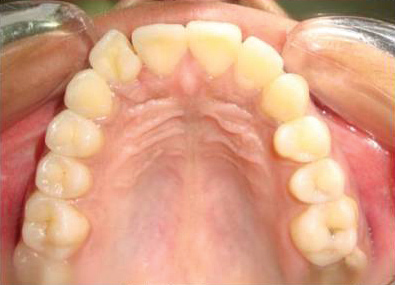
The primary skeletal anomaly affecting the orofacial structures in Down syndrome is hypoplasia of the mid-facial region, with the bridge of the nose, bones of the mid-face and maxilla being relatively small in size. Many children with Down syndrome children exhibit a narrow palate, probably due to the sides of the palate being abnormally thick. This narrowness may sometimes give the impression of a high palatal vault; however the height is generally not significantly greater than normal. Cleft lip and/or palate are reported in 3%-5% of Down syndrome patients.
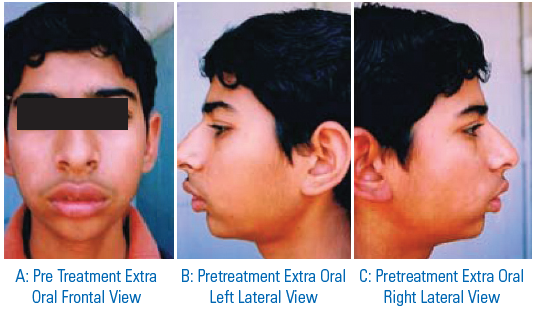
Hypoplasia of the mid-facial region is common in Down syndrome children. In many instances this causes a relative prognathic Class III occlusal relationship which may contribute to an open bite. Other common orthodontic features of Down syndrome include irregular alignment of the teeth, posterior crossbite, anterior open bite, crowding of teeth, and widely spaced teeth. Down syndrome patients tend to have teeth with small conical roots. This is an important factor when considering orthodontic tooth movement and also contributes to early tooth loss in periodontal disease8,9.
DENTAL MANAGEMENT OF PATIENTS WITH DOWN SYNDROME 9-11
General management
Cooperation
Down syndrome children vary widely in the degree of intellectual impairment. Most have IQ's in the mild to moderate range and are able to be treated in a normal setting. Patients with Down syndrome are characteristically gentle, tolerant and eager to please (some may exhibit anxiety and stubbornness). As such, age- and intellect-appropriate conventional behaviour management techniques may be employed with success when treating Down syndrome patients.
Communication
The primary caregiver should always be encouraged to be present for any consultation or treatment to facilitate consent, cooperation and communication.
General anaesthetic
General anaesthesia is frequently employed to facilitate treatment of paediatric dental down syndrome patients. It is essential to note that the physical and medical associations of Down syndrome may have important implications for general anaesthesia. Peri-operative morbidities result mainly from problems with the respiratory system (Down syndrome children tend to have chronic respiratory conditions) and spinal cord damage from atlanto-axial subluxation. Comprehensive examination and consultation with the anaesthetist is essential prior to general anaesthesia.
Prevention
As with all medically compromised children, prevention is the key to any treatment approach. This incorporates extensive and regular oral hygiene motivation, topical fluoride, fissure sealants and cleaning. Children with Down syndrome often exhibit delayed motor function and reduced muscle tone. This manifests as delayed coordination and reduced strength. Oral hygiene should be performed by the primary caregiver until the patient acquires adequate skill. Those patients who exhibit significant intellectual impairment represent a greater challenge to maintaining oral hygiene.
Restorative
All restorative treatment is indicated. Attention to the presence of erosion and developmental defects of dentine are essential. In such cases, full coronal coverage may be preferred.
Periodontal disease
Prevention is the key to management of periodontal disease. This includes optimal oral hygiene, routine review, routine prophylaxis and use of medicaments such as chlorhexidine as indicated. Notwithstanding this, the immune anomalies seen in Down syndrome children may circumvent even the best preventive regimen. In such cases, early, aggressive periodontal treatment is indicated.
Orthodontic
Orthodontic management of malocclusion in children with Down syndrome is considered problematic. This is due to the fact that compliance is perceived to be low due to an inability to understand the need to wear appliances and the inability to adequately maintain oral hygiene. This leads to a high risk of treatment failure, caries and periodontal disease. In some cases, microdontia and hypodontia may alleviate crowding. In other cases, selective extractions following orthodontic workup may be beneficial.
Technologic advances in orthodontics have made it possible for orthodontists to create a treatment environment that welcomes children with special needs and treatment requirements. The following technologic improvements help all orthodontic patients, but some are specifically useful for patients with down syndrome:
1. Impressions using quick-set materials with fun flavors—these may reduce the tendency for activation of the more sensitive gag reflex frequently experienced.
2. Easy bonding of brackets rather than more complex and uncomfortable banding procedures
3. Self-etching primer, to reduce the taste of conventional etchants and glass ionomer cements that can be used in the oral environment in which it is difficult to maintain a dry field for several minutes at a time.
4. High-memory wires, allowing a longer activation interval between appointments.
5. Self-ligating brackets, which allow a more patient-friendly activation appointment.
6. Advances in orthognathic surgical techniques that are less invasive and more predictable.
7. Current reliability of implant replacement of congenitally absent teeth, which greatly aids the overall prognosis for patients.
8. Reversible implant anchorage devices to minimize compliance requirements needed for successful tooth movement.
Pulp therapy
Avoid pulp therapy in the primary dentition of children with down syndrome, who have a congenital cardiac defect.
Medical considerations
Dental management must include adequate investigation of and precautions for any concomitant medical conditions.
CONCLUSION
Making a difference in the oral health of a person with Down syndrome may go slowly at first, but determination can bring positive results—and invaluable rewards. By adopting the strategies discussed in this article, we can have a significant impact not only on patients’ oral health, but on their quality of life as well.
REFERENCES
- Pilcher ES. Dental care for the patient with Down syndrome. Downs Syndr Res Pract. 1998; 5:111–116.
- Desai SS. Down Syndrome. A review of the literature. Oral Surg Oral Med Oral Pathol Oral Radiol Endod.1997; 84:279–285.
- Cohen I. Health care guidelines for individuals with Down syndrome. Down Syndr Q. June 1996; 1:2
- Regezi S. Oral pathology. Clinical pathologic correlations, 1st ed. Philadelphia: Saunders, 1989: 450-51.
- Muller RFO, Young IDO, Emery’s elements of medical genetics. 11th ed. Churchill Livingstone; 2001.pp-52.
- Vogel F, Motulsky AGO. Human genetics, problems and approaches. 2nd ed. Springer-Verlag; 1996 pp-59.
- Smith WB. Recognizable pattern of human malformations, 4th edition. Jones LK, ed. Philadelphia: Saunders; 1988: 10-12.
- Sassouni V, Forrest E. Dentofacial pathology related to malocclusions. Orthodontics in Dental Practice. St. Louis: Mosby, 1971: 169-97.
- Wilson MD. Special considerations for patients with Down's syndrome. ODA Journal 1994 (winter); 184 (3): 24-25.
- Russell BG, Kjær I. Tooth agenesis in Down syndrome. Am J Med Genetics 1995; 13; 55(4): 466-71.
- Sterling ES. Oral and dental considerations in Down syndrome. Down syndrome Advances in Medical Care. In Lott I, McCoy E, editors. New York: Wiley-Liss; 1992: 135-45.
Disclaimer from Guident
The views and opinions expressed in articles published in Guident are solely those of the authors and do not necessarily reflect the views of the editors, the editorial board or the publisher, Ivory India. Guident does not endorse any product, technique or treatment described. Clinical content is intended for qualified dental and medical professionals and is not a substitute for individual clinical judgement. Guident, its editors and the publisher accept no liability for any consequence arising from the use of information published in the journal.
How to cite this article
Dr. Amit Prakash, Dr. Babita Raghuwanshi, Dr. Abdul Hameed. Down Syndrome- Diagnosis and Guidelines of Dental and Orthodontic Management. Guident. 2013 Mar;6(5). Available from: https://ivoryindia.in/articles/orthodontics/down-syndrome-diagnosis-and-guidelines-of-dental-and-orthodontic-management.html