Modified Impression Techniques for Flabby Ridge: Series of Case Reports
Department of Endodontics, Department of Prosthodotics, Department of Prosthodotics, K.D Dental College & Hospital, Mathura UP, India
Abstract
Management of edentulous ridges with localized hyperplastic tissue is challenging. Mobile fibrous tissue offers inadequate support for the complete denture and result in reduced stability and retention. This condition is normally caused by localized loading when the complete maxillary denture is opposed by natural anterior teeth and an absence of posterior natural or artificial teeth. The presence of displaceable denture-bearing tissues often presents a difficulty when making complete dentures. Unless managed appropriately, such 'flabby ridges' adversely affect the support, retention and stability of complete dentures. Many impression techniques have been proposed to help overcome this difficulty. The purpose of this clinical report is to describe the various impression techniques for the treatment of the completely edentulous patients with localized hyperplastic alveolar ridge.
INTRODUCTION
A so-called 'fibrous' or 'flabby' ridge is a superficial area of mobile soft tissue affecting the maxillary or mandibular alveolar ridges. It can develop when hyperplastic soft tissue replaces the alveolar bone and is a common finding, particularly in the upper anterior region of long term denture wearers. Masticatory forces can displace this mobile denture-bearing tissue, leading to altered denture positioning and loss of peripheral seal. Forces exerted during the act of impression making can result in distortion of the mobile tissue.
Watson discussed this phenomenon in 1970, and described an impression technique for maxillary fibrous ridges. Further discussion was reported by Kelly in 1972, when he described changes caused by a mandibular removable partial denture opposing a maxillary complete denture. He suggested the term “Combination Syndrome” to describe the clinical features, including loss of bone from the anterior maxilla with concurrent fibrous tissue hyperplasia; overgrowth of the maxillary tuberosities; extrusion of lower anteriors and papillary hyperplasia of hard palate.
Liddlelow described a technique whereby two separate impression materials were used in a custom tray (using 'plaster of Paris' over the flabby tissues, and zinc oxide and eugenol) over the 'normal' tissues). Osborne described a technique whereby two separate impression trays and materials are used to separately record the 'flabby' and normal 'tissues, and then related intra-orally.
Watson described the 'window' impression technique where a custom tray is made with a window or opening over the (usually anterior) flabby tissues. A muco-compressive impression is first made of the normal tissues using the custom tray with zinc-oxide and eugenol. A low viscosity mix of 'plaster of Paris' is then painted onto the flabby tissues, through the window.
Considering impression techniques, it is important to realise that all impressions for complete dentures could be categorised in three ways:
- The mucostatic technique (non-displacive),
- The mucocompressive technique (displacive),
- The selective pressure impression technique - where some denture bearing tissues are displaced, and others are not.
A multitude of impression techniques have been suggested to circumvent the difficulty of making a denture to rest on a flabby ridge. The purpose of this article is to describe various impression technique for making impressions of denture bearing areas containing flabby ridges.
CASE REPORT-1
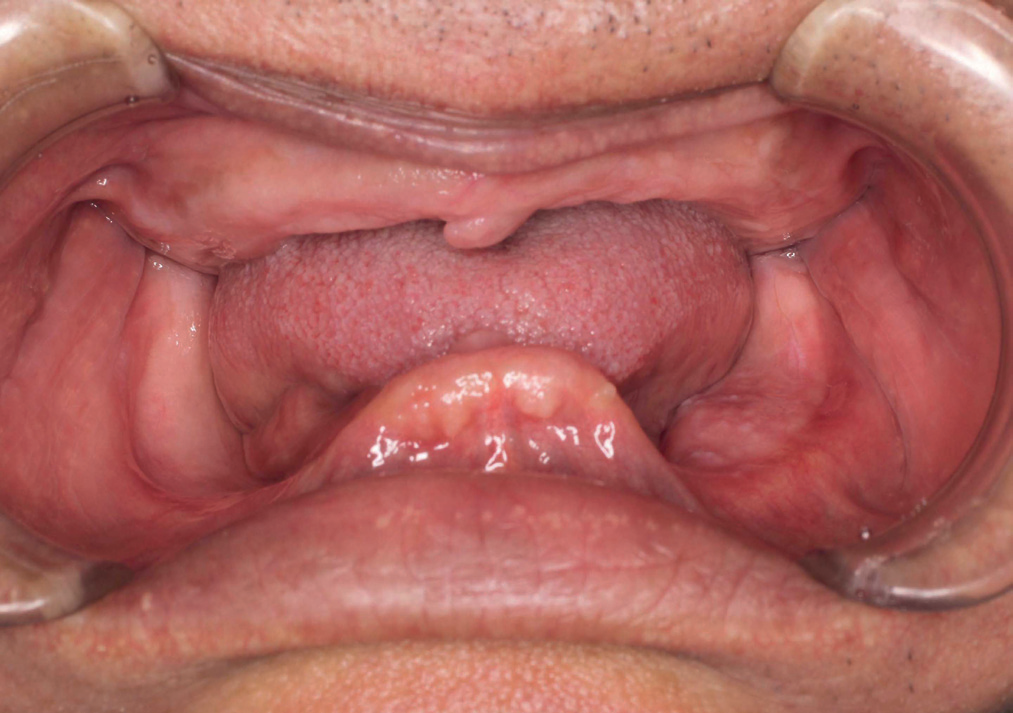
A 60 yrs old male patient reported to the department of prosthodontics, K.D. Dental College & Hospital, to replace his teeth. History revealed that he had complete denture for the past ten years which was loose. On clinical examination, the patient was completely edentulous with an extensive area of flabby ridge on the maxillary and mandibular anterior region. Following discussion with the patient regarding the available treatment options, it was decided to fabricate the new set of complete denture.
PROCEDURE
- A primary impression of the maxillary denture bearing area was made with an irreversible hydrocolloid material (Alginate), to ensure minimal distortion of the displaceable (‘flabby’) tissues. The impression was poured in dental stone. The displaceable areas were identified on the cast.
- Three uniform thicknesses of dental wax were placed as a ‘spacer’ over the displaceable areas identified on the cast and one thickness over the remaining non-displaceable areas.
- The custom tray was fabricated in the usual manner. On the day of secondary impression, the flabby ridge area was marked in patient’s mouth and these marks were transferred to the custom tray, the tray was then perforated over the areas representing the flabby tissue.
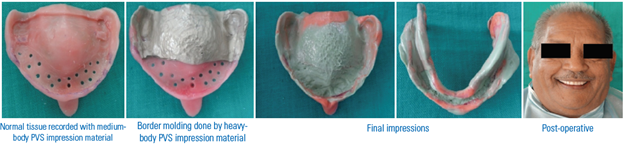
- After application of a suitable adhesive, medium bodied addition polyvinyl-siloxane impression material was applied to the area of the custom tray associated with the ‘normal’ tissues.
- Once the material was set, tray was removed from the mouth.
- Using a scalpel, any material that had flowed into the area of the tray associated with ‘flabby’ tissues was removed.
- Border molding was done with the heavy-body PVS impression material.
- Flabby tissue area was then recorded with the light- body PVS impression material.
- Denture fabrication was done in the conventional manner and regular follow-up was maintained.

CASE REPORT-2
Clinical examination revealed the completely edentulous upper and lower ridge with an extensive area of flabby ridge on the maxillary anterior region.
Procedure
- Preliminary impression was made in a stock tray with irreversible hydrocolloid impression material.
- Spacer of 1mm thickness was adapted over the cast and custom tray was fabricated in the conventional manner.
- The border molding was done with softened greenstick compound.
- A window was created in the custom tray in the flabby ridge area.
- Secondary impression was made with zinc oxide eugenol impression paste and light-body PVS impression material was injected over the window corresponding to the flabby ridge area.
- Once the material was set, impression was removed from the patient’s mouth.

Completely edentulous maxilla with flabby ridge


Post-operative
CASE REPORT-3
Clinical examination revealed the completely edentulous upper and lower ridge with an extensive area of flabby tissue over the mandibular anterior region.
Procedure
- Till the secondary impression, steps are same as described in case report-2.
- A window was created in the custom tray corresponding to the flabby ridge and secondary impression was made with ZOE paste.
- After that alginate was mixed and loaded in the stock tray. Now this stock tray was placed over the custom tray in the patient’s mouth.
- After the material was set, stock tray was removed along with the custom tray.
- Impression was poured and the denture fabrication was followed in the conventional manner.

Edentulous lower ridge with flabby tissue

Secondary impression made with ZOE paste

CONCLUSION
Modified impression techniques are required in a flabby ridge to record the tissues in an undistorted position. The various techniques described as well as the different impression materials used helped in providing an accurately fitted as well as satisfactorily functioning dentures for the patient with a flabby ridge.
REFERENCES
- Management of flabby ridge: using contemporary materials to solve an old problem C. D. Lynch & P. f. Allen. BDJ 2005; 20 (5), 258-261
- Minimally displacive impression technique: A clinical report Rucha Kashyap, Zubeda Begum, Hilal Mohammed. IJCDS NOVEMBER 2011;2:1-3.
- Management of flabby ridge in complete denture construction Finbarr Allen. Dental update 2005;32:524-38.
- Modified impression technique for a flabby maxilla-A clinical report Muthukumar B et al. Volume 3, Issue 1, January - March 2012.
- Management of flabby ridge in complete denture construction
- Finbarr Allen. Dental update 2005;32:524-38.
- Modified impression technique for a flabby maxilla-A clinical report
- Muthukumar B et al. Volume 3, Issue 1, January - March 2012.
Disclaimer from Guident
The views and opinions expressed in articles published in Guident are solely those of the authors and do not necessarily reflect the views of the editors, the editorial board or the publisher, Ivory India. Guident does not endorse any product, technique or treatment described. Clinical content is intended for qualified dental and medical professionals and is not a substitute for individual clinical judgement. Guident, its editors and the publisher accept no liability for any consequence arising from the use of information published in the journal.
How to cite this article
Dr. Satyendra Agarwal, Dr. Anupama Agarwal, Dr. Manjari. Modified Impression Techniques for Flabby Ridge: Series of Case Reports. Guident. 2013 Dec;7(1). Available from: https://ivoryindia.in/articles/prosthodontics/modified-impression-techniques-for-flabby-ridge-series-of-case-reports.html