Prosthodontic Rehabilitation of a Flabby Maxillary Ridge Using Hobkirk’s Technique: A Clinical Case Report
Department of Prosthodontics and Crown & Bridge, K.D. Dental College & Hospital, Mathura, UP, India
ABSTRACT
Edentulism significantly impacts oral health and quality of life, particularly in older adults. A common complication is the presence of flabby ridges which is soft, mobile tissues in the edentulous ridge, most frequently seen in the anterior maxilla of long-term denture wearers. These ridges pose challenges during impression making, as applied forces can distort the tissues, leading to poor denture fit, instability, and loss of retention and support. Management options include surgical intervention, special impression techniques, balanced occlusal load distribution, and implant therapy. This case report presents the prosthodontic rehabilitation of a patient with a flabby ridge using a modified impression technique designed to minimize tissue distortion and improve denture stability.
Keyword:- flabby ridge, denture stability, anterior maxilla, modified impression technique
INTRODUCTION
Edentulism adversely affects mastication, nutrition, and overall quality of life. One common challenge in managing edentulous patients is the presence of flabby ridges, a mobile soft tissues that is often found in the anterior maxilla, especially in long-term denture wearers. These ridges may develop due to unplanned extractions, opposing natural teeth, or as part of combination syndrome. The prevalence is approximately 24% in the maxilla and 5% in the mandible.
Flabby tissues can distort during impression making and rebound after removal, leading to poor denture fit, loss of retention, and instability. Although surgical removal is an option, it eliminates cushioning and may reduce comfort. Therefore, conservative prosthodontic approaches are preferred, focusing on accurate impression techniques that avoid compressing the displaceable tissue.
Several methods have been described, including mucostatic techniques, window tray designs, and the use of dual materials or trays, as seen in techniques by Liddlelow, Osborne, and Watson. Recent advancements in materials, such as polyvinyl siloxane, have enhanced precision in capturing soft tissue detail.
This case report describes the prosthodontic rehabilitation of a patient with a flabby maxillary ridge using Hobkirk’s impression technique, which combines mucostatic and mucocompressive principles to achieve an accurate impression of both firm and mobile tissues.
CASE REPORT
A 72-year-old male patient reported to the Department of Prosthodontics at K.D. Dental College, Mathura, with the chief complaint of missing teeth in both the upper and lower arches for the past 10–12 years. The patient, a long-term denture wearer, expressed dissatisfaction with his existing dentures, citing looseness and reduced functionality, and requested a replacement.
On clinical examination, the patient presented with complete edentulism and a prominent area of flabby tissue located in the anterior maxillary denture-bearing region (Fig. 1). This displaceable tissue posed a challenge for achieving adequate retention and stability of the future prosthesis. The patient was thoroughly informed about all possible treatment modalities, including surgical excision of the flabby ridge followed by ridge augmentation or implant-supported prosthesis. However, the patient declined any form of surgical intervention due to personal preference and concerns regarding the invasiveness of the procedure.
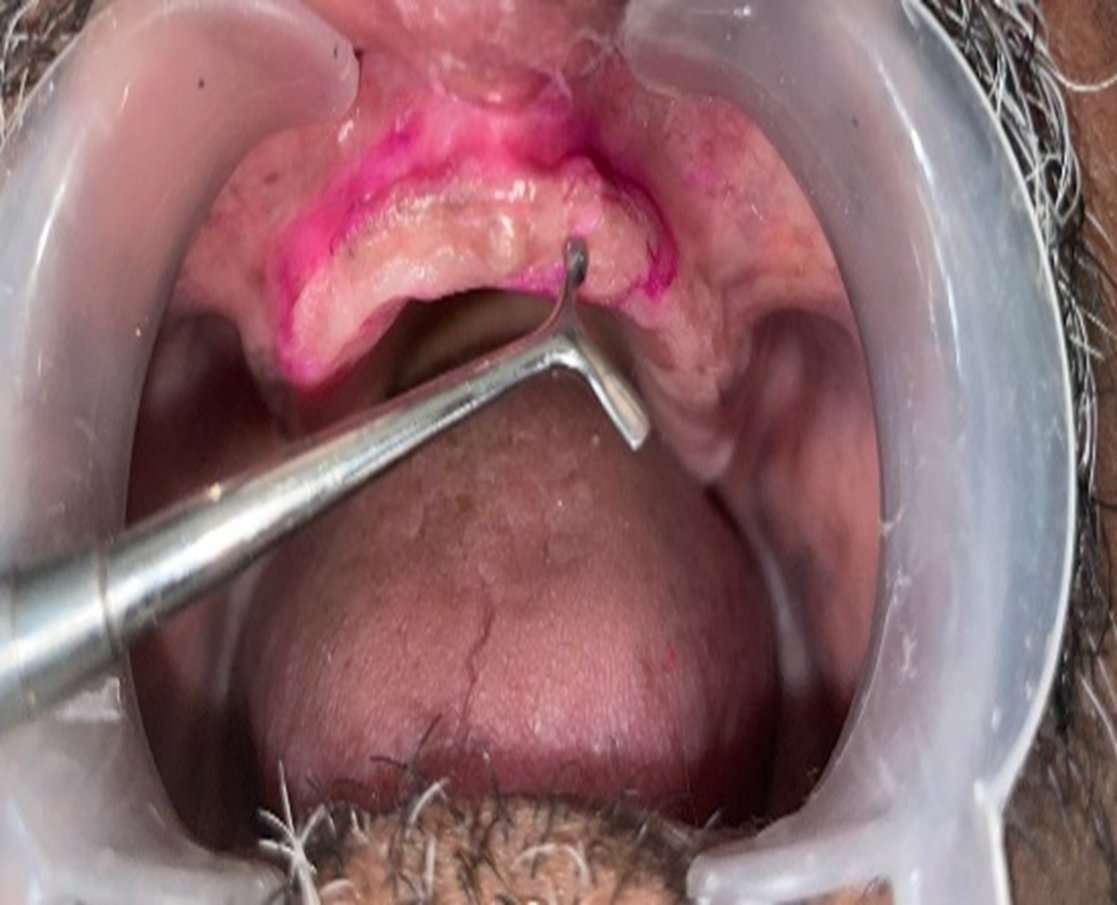
Fig 1
Given the presence of flabby tissue and the patient's refusal of surgical options, a conventional complete denture using a modified impression technique was planned. This approach aimed to accurately record the mobile tissue in a non-displaced state, thereby enhancing the stability, support, and retention of the final prosthesis.
Procedure: A preliminary impression was made using irreversible hydrocolloid. (Fig 2)

Fig 2
A cast was poured and the flabby tissue was marked over the preliminary cast (Fig 3)

Fig 3
A special tray was fabricated using double spacer in the flabby area and single spacer over rest of the areas and the handle was made from impression compound (Fig 4a-c)

Fig 4a

Fig 4b

Fig 4c
Tray extensions were checked and border moulding was done in conventional manner using green stick compound (Fig 5). Spacer wax was removed and impression was made using medium body elastomeric impression material (Avue Gum Mono - Medium Body A-Silicone Impression Material) (Fig 6)

Fig 5

Fig 6
Impression was then removed from the mouth and the impression material was removed in the region of flabby tissue using a scalpel (Fig 7).

Fig 7
Multiple relief holes were made and tray was loaded with light body elastomeric impression material (zhermack hydrorise light body) in this region only to record flabby tissue (Fig 8)

Fig 8
Master cast was poured using dental stone (Fig 9)

Fig 9
All remaining clinical and laboratory steps for denture fabrication were performed using conventional techniques. A try-in was conducted to evaluate fit, esthetics, and occlusion. The final dentures were delivered, and post-insertion instructions were provided. (Fig 10)

Fig 10
Follow-up visits were scheduled at 24 hours, one week, one month, and six months. The patient reported good comfort and function. The final prosthesis showed satisfactory retention and stability, with accurate recording of the flabby tissue. (Fig 11)

Fig 11
DISCUSSION
Managing flabby ridges is a common challenge in prosthodontics. Surgical and implant options exist but can be costly and complex, making modified conventional techniques preferable
Since 1964, various impression methods have been introduced, such as Liddlelow’s use of two materials and Osborne’s separate recording of flabby and normal tissues. Techniques like Watson’s window and Shum & Pow’s single-step elastomeric impression are also popular.
Traditional impressions may distort flabby tissue, causing denture instability. Using windows or reliefs reduces pressure and tissue displacement. Light-body PVS has replaced Plaster of Paris for better consistency . The open tray design helps ensure accurate tissue capture, making the modified window technique effective despite some limitations
CONCLUSION
Managing patients with flabby ridges presents a significant challenge. Dentures made using conventional muco-compressive impression methods often result in poor retention and instability because the flabby tissue is captured in a compressed or distorted condition. On the other hand, muco-static techniques may lead to movement of the denture base relative to the supporting tissues, as they do not fully utilize the available tissue support.
Selective pressure or minimally displacive impression methods are preferred, as they address these issues more effectively. When combined with modified impression techniques, these approaches can provide patients with dentures that have improved retention and stability, without requiring additional clinical appointments compared to standard denture fabrication.
REFERENCES
- Showkat R, Sharma A, Kumar S, Kaura SM. Management of flabby ridge using Hobkirk’s technique: a case report. European Journal of Dental and Oral Health. 2020 Aug 1;1(4).
- Lalwani R, Khubchandani SR, Bhoyar A, Dubey SA. Prosthodontic Rehabilitation of the Flabby Edentulous Maxilla Using Hobkirk’s Technique: A Case Report. Cureus. 2024 May 29;16(5).
- Singh RK, Patil N, Datta A, Pattedar A, Billesh NK. Impression techniques for management of flabby ridges in complete denture patients: a review of literature. Int J Appl Dent Sci. 2022;8(1):31-6.
- Labban N. Management of the flabby ridge using a modified window technique and polyvinylsiloxane impression material. The Saudi Dental Journal. 2018 Jan 1;30(1):89-93.
- Crawford RW, Walmsley AD. A review of prosthodontic management of fibrous ridges. British dental journal. 2005 Dec;199(11):715-9.
- Rathee M, Jain P, Dixit P, Singh P, Mittal S, Tomar SS. Prosthetic Rehabilitation of Edentulous Flabby Ridge using Modified Hobkirk Window Impression Technique: A Case Report. Annals of Dentistry University of Malaya. 2024 Sep 23;31:36-9.
- Chitlange PM, Kambala SR, Pathak V, Doshi K, Dhamande MM, Chitlange P, Doshi Jr K. Optimizing Denture Success: A Strategy for Prosthodontic Rehabilitation in a Patient With Compromised Alveolar Ridges. Cureus. 2024 Jul 20;16(7).
- Bute SA, Bansod A, Beri A. Striving for excellence: fabrication of complete denture in a patient with flabby ridges using specialized impression technique. Cureus. 2024 Jun 23;16(6).
- Zilpilwar N, Nimonkar S, Dubey SA, Belkhode V, Zilpilwar Jr N. Addressing flabby ridges in complete denture patients: a case report. Cureus. 2024 Jul 7;16(7).
- Namita Z, Sharayu N, Dubey SA, Vikram B. Addressing Flabby Ridges in Complete Denture Patients: A Case Report. Cureus. 2024;16(7).
Disclaimer from Guident
The views and opinions expressed in articles published in Guident are solely those of the authors and do not necessarily reflect the views of the editors, the editorial board or the publisher, Ivory India. Guident does not endorse any product, technique or treatment described. Clinical content is intended for qualified dental and medical professionals and is not a substitute for individual clinical judgement. Guident, its editors and the publisher accept no liability for any consequence arising from the use of information published in the journal.
How to cite this article
Dr. Razousinuo Khezhie, Dr. Puja Sarkar, Dr. Abhinav Agarwal. Prosthodontic Rehabilitation of a Flabby Maxillary Ridge Using Hobkirk’s Technique: A Clinical Case Report. Guident. 2026 Mar;19(4). Available from: https://ivoryindia.in/articles/prosthodontics/prosthodontic-rehabilitation-of-a-flabby-maxillary-ridge-using-hobkirk-s-technique-a-clinical-case-report.html